Sales & Proposals
Executive Summary Sample for Business Proposal: How to Write One That Actually Gets Read
Learn how to write an executive summary for a business proposal with real examples, templates, formatting tips, proposal mistakes to avoid, and Decktopus workflows for turning summaries into presentation-ready slides.


Decktopus Content Team
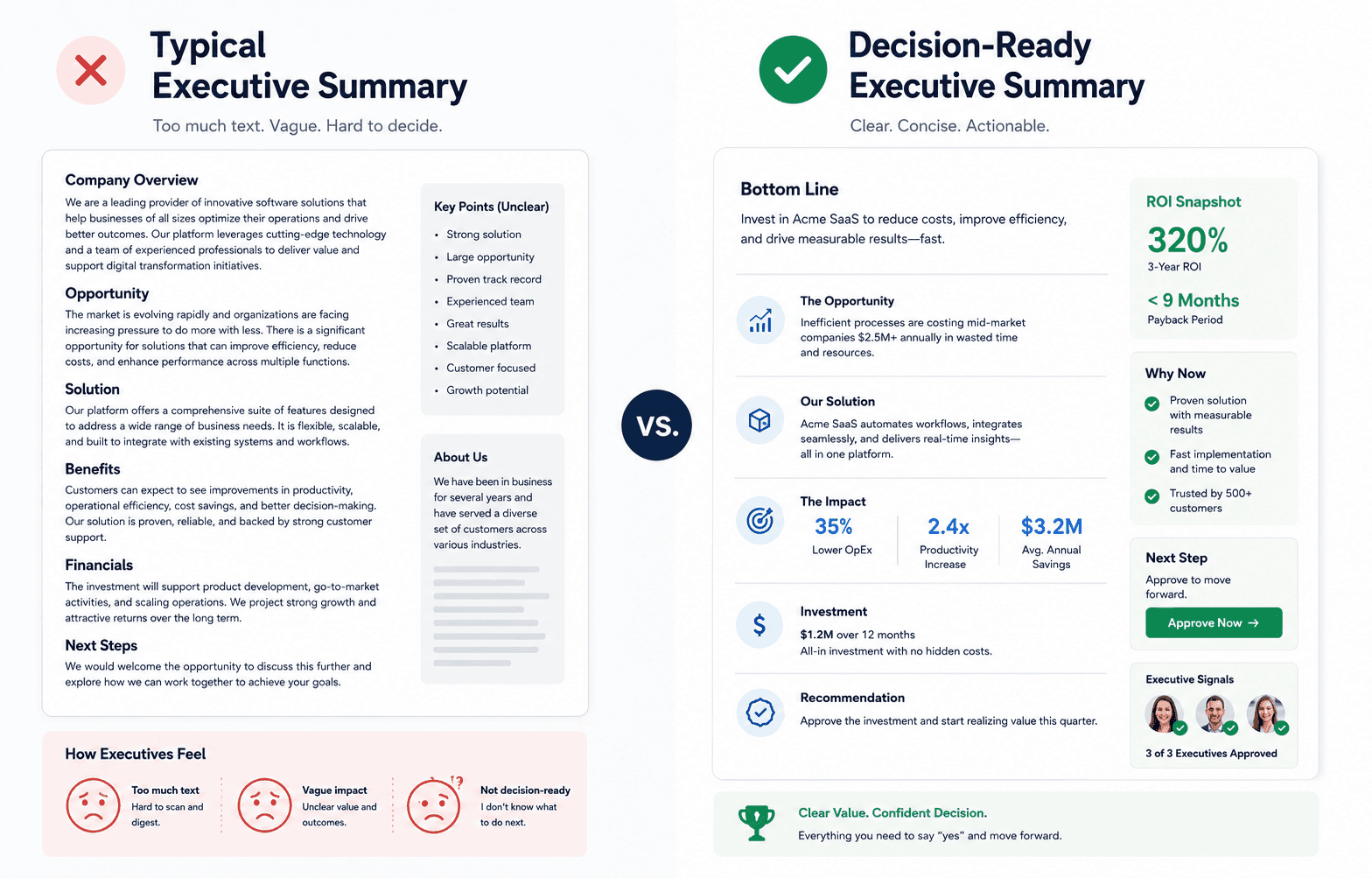
Most executive summaries lose the reader in the first three sentences.
Not because the writer is bad. Because they treated the executive summary like a warm-up to the real proposal.
It’s not a warm-up. It’s the only part most decision-makers will actually read.
If your executive summary doesn’t make the case in 60 seconds, the rest of your 30-page proposal will sit in a folder titled “Review Later.” It will never get reviewed later. You’ve already lost.
This guide shows you what a real executive summary looks like, with sample structures you can adapt this week, and the named mistakes that quietly kill even strong proposals.
You’ll get:
Why most executive summaries fail before they reach the budget
A sample executive summary you can adapt for your own proposal
Real examples for sales proposals, RFPs, partnership pitches, and grants
5 named mistakes that make decision-makers stop reading
How to format the summary so it actually gets skimmed favorably
What Is an Executive Summary in a Business Proposal?
An executive summary is the one-page version of your entire proposal.
It tells the reader, in the time it takes to drink half a coffee, what you’re proposing, why it matters, what it costs, and what you’re asking them to do next.
It’s not an introduction. It’s not a preamble. It’s not a polite throat-clearing before the real content. It’s the proposal, compressed into the shortest version that still makes the case.
If your executive summary works, the rest of the proposal becomes supporting evidence. If it doesn’t, nothing that follows can save it.
For more on the foundational principles, our guide on the executive summary covers the core building blocks in detail.
Why the Executive Summary Is the Most Important Page
Decision-makers don’t read proposals end-to-end.
They scan. They flip to the budget. They skim the executive summary. They check the team page. Then they decide whether to read further.
This is true for almost every proposal context: corporate procurement, RFP responses, grant applications, partnership pitches, internal budget proposals.
The executive summary is the only part of your proposal you can count on being read carefully. Treat it accordingly.
If the rest of your proposal is the meal, the executive summary is the menu. People decide whether to order based on the menu. They don’t order something because the kitchen looks nice.
If you’ve never written one before, our walkthrough on how to write an executive summary covers the step-by-step approach.
What Decision-Makers Actually Look For
Before showing you the sample, here’s what most executive summaries miss.
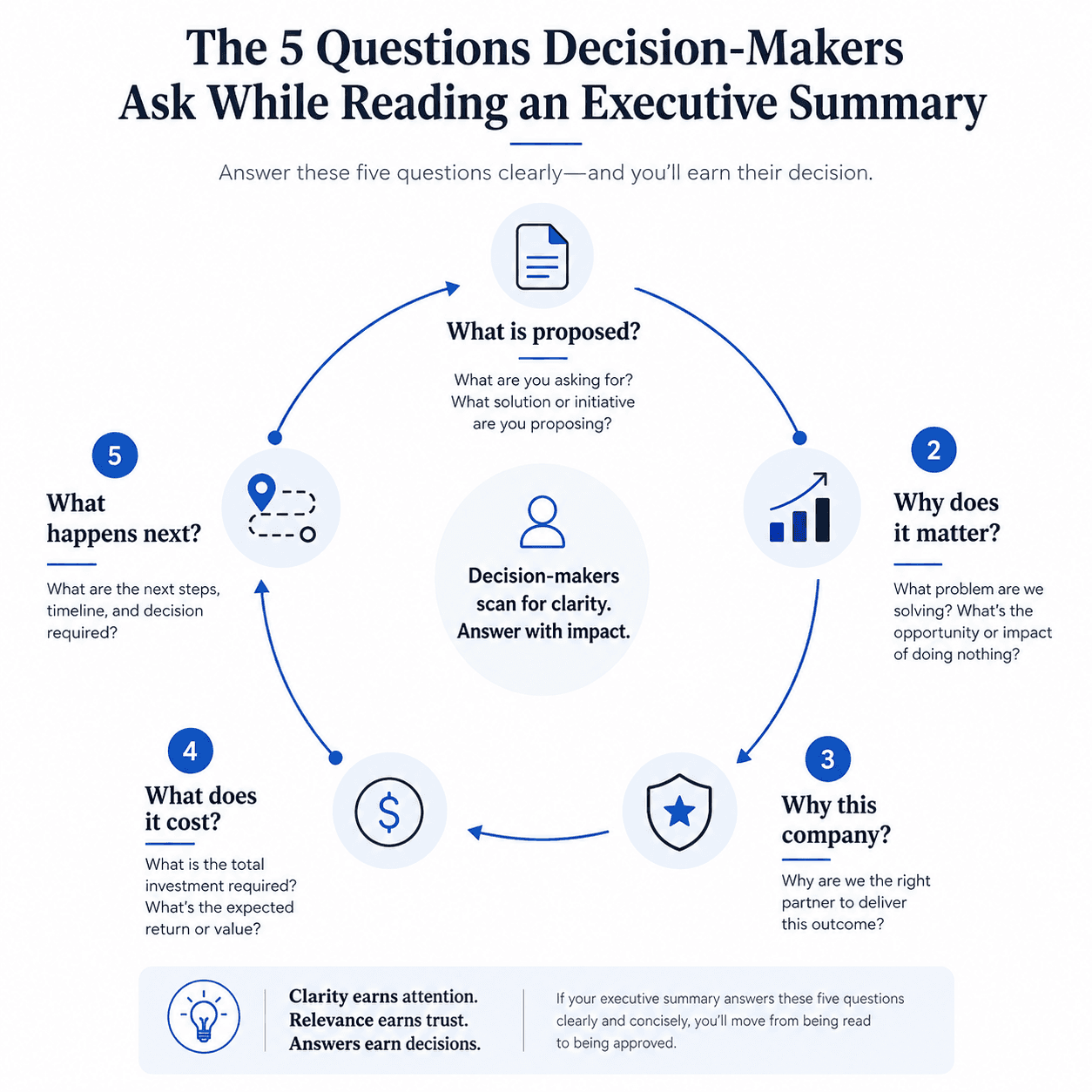
Decision-makers reading a business proposal want answers to five questions, in this order:
What is being proposed?
Why does it matter to me?
Why this company, not another one?
What does it cost?
What do I need to do next?
If your executive summary doesn’t answer all five in under 400 words, it’s not finished yet. Once you’ve answered all five questions in writing, the next step is turning that summary into a slide you can present in the actual decision meeting, which is where Decktopus takes your written summary and generates a clean, on-brand executive summary slide with your headline, proof points, and ask each on its own visual.
Most executive summaries answer questions 1 and 2 thoroughly. Then they get vague on 3, 4, and 5. That’s where the proposal loses.
The 3 Layers of a Strong Executive Summary
Most executive summary advice tells you to keep it short. That’s necessary but not sufficient.
A strong executive summary has three layers, each doing different work:
[[EMBED:PGRpdiBzdHlsZT0ib3ZlcmZsb3cteDphdXRvO21hcmdpbjoyMHB4IDAiPjx0YWJsZSBzdHlsZT0id2lkdGg6MTAwJTtib3JkZXItY29sbGFwc2U6Y29sbGFwc2U7Zm9udC1zaXplOjE1cHg7bWFyZ2luOjhweCAwIj48dGggc3R5bGU9ImJvcmRlcjoxcHggc29saWQgI2UzZTZlYTtwYWRkaW5nOjEwcHggMTRweDt0ZXh0LWFsaWduOmxlZnQ7YmFja2dyb3VuZDojZjRmNmY4O2ZvbnQtd2VpZ2h0OjYwMCI+PHRyPjx0aCBzdHlsZT0iYm9yZGVyOjFweCBzb2xpZCAjZTNlNmVhO3BhZGRpbmc6MTBweCAxNHB4O3RleHQtYWxpZ246bGVmdDtiYWNrZ3JvdW5kOiNmNGY2Zjg7Zm9udC13ZWlnaHQ6NjAwIj5MYXllcjwvdGg+PHRoIHN0eWxlPSJib3JkZXI6MXB4IHNvbGlkICNlM2U2ZWE7cGFkZGluZzoxMHB4IDE0cHg7dGV4dC1hbGlnbjpsZWZ0O2JhY2tncm91bmQ6I2Y0ZjZmODtmb250LXdlaWdodDo2MDAiPkpvYjwvdGg+PHRoIHN0eWxlPSJib3JkZXI6MXB4IHNvbGlkICNlM2U2ZWE7cGFkZGluZzoxMHB4IDE0cHg7dGV4dC1hbGlnbjpsZWZ0O2JhY2tncm91bmQ6I2Y0ZjZmODtmb250LXdlaWdodDo2MDAiPldoYXQgR29lcyBIZXJlPC90aD48L3RyPjwvdGhlYWQ+PHRib2R5Pjx0cj48dGQgc3R5bGU9ImJvcmRlcjoxcHggc29saWQgI2UzZTZlYTtwYWRkaW5nOjEwcHggMTRweDt0ZXh0LWFsaWduOmxlZnQ7dmVydGljYWwtYWxpZ246dG9wIj5UaGUgSG9vazwvdGQ+PHRkIHN0eWxlPSJib3JkZXI6MXB4IHNvbGlkICNlM2U2ZWE7cGFkZGluZzoxMHB4IDE0cHg7dGV4dC1hbGlnbjpsZWZ0O3ZlcnRpY2FsLWFsaWduOnRvcCI+TWFrZSB0aGUgcmVhZGVyIGtlZXAgcmVhZGluZzwvdGQ+PHRkIHN0eWxlPSJib3JkZXI6MXB4IHNvbGlkICNlM2U2ZWE7cGFkZGluZzoxMHB4IDE0cHg7dGV4dC1hbGlnbjpsZWZ0O3ZlcnRpY2FsLWFsaWduOnRvcCI+VGhlIHByb2JsZW0sIGZyYW1lZCBpbiB0aGUgcmVhZGVyJ3MgbGFuZ3VhZ2U8L3RkPjwvdHI+PHRyPjx0ZCBzdHlsZT0iYm9yZGVyOjFweCBzb2xpZCAjZTNlNmVhO3BhZGRpbmc6MTBweCAxNHB4O3RleHQtYWxpZ246bGVmdDt2ZXJ0aWNhbC1hbGlnbjp0b3AiPlRoZSBBcmd1bWVudDwvdGQ+PHRkIHN0eWxlPSJib3JkZXI6MXB4IHNvbGlkICNlM2U2ZWE7cGFkZGluZzoxMHB4IDE0cHg7dGV4dC1hbGlnbjpsZWZ0O3ZlcnRpY2FsLWFsaWduOnRvcCI+QnVpbGQgYmVsaWVmPC90ZD48dGQgc3R5bGU9ImJvcmRlcjoxcHggc29saWQgI2UzZTZlYTtwYWRkaW5nOjEwcHggMTRweDt0ZXh0LWFsaWduOmxlZnQ7dmVydGljYWwtYWxpZ246dG9wIj5Zb3VyIGFwcHJvYWNoLCB3aHkgaXQncyB0aGUgcmlnaHQgb25lLCBwcm9vZjwvdGQ+PC90cj48dHI+PHRkIHN0eWxlPSJib3JkZXI6MXB4IHNvbGlkICNlM2U2ZWE7cGFkZGluZzoxMHB4IDE0cHg7dGV4dC1hbGlnbjpsZWZ0O3ZlcnRpY2FsLWFsaWduOnRvcCI+VGhlIEFzazwvdGQ+PHRkIHN0eWxlPSJib3JkZXI6MXB4IHNvbGlkICNlM2U2ZWE7cGFkZGluZzoxMHB4IDE0cHg7dGV4dC1hbGlnbjpsZWZ0O3ZlcnRpY2FsLWFsaWduOnRvcCI+RHJpdmUgYWN0aW9uPC90ZD48dGQgc3R5bGU9ImJvcmRlcjoxcHggc29saWQgI2UzZTZlYTtwYWRkaW5nOjEwcHggMTRweDt0ZXh0LWFsaWduOmxlZnQ7dmVydGljYWwtYWxpZ246dG9wIj5XaGF0IHlvdSB3YW50LCB3aGF0IGl0IGNvc3RzLCB3aGF0IGhhcHBlbnMgbmV4dDwvdGQ+PC90cj48L3Rib2R5PjwvdGFibGU+PC9kaXY+]]
Most executive summaries are 80% argument and almost no hook or ask. The hook makes the decision-maker care. The ask makes them act. Without both, the argument is wasted.
For inspiration on punchy openings, see our guide on elevator pitch examples. The same compression principles apply.
Sample Executive Summary Structure
Here’s a structure that works across almost every business proposal type. Adapt it to your situation.
[Opening sentence: the problem, in the client’s words]
“ACME Manufacturing currently spends 14 hours per week on manual quote generation across three sales offices, slowing customer response times and creating inconsistent pricing.”
[Second sentence: the cost of the problem]
“This delay costs an estimated $340,000 annually in lost deals due to slow turnaround, plus an additional $80,000 in administrative overhead.”
[Third sentence: your proposed solution]
“We propose implementing [Solution Name], an automated quote generation platform tailored to ACME’s product catalog and pricing rules, projected to reduce quote turnaround from 6 hours to under 15 minutes.”
[Fourth sentence: why your team is the right choice]
“Our team has deployed similar systems for 14 manufacturing companies in the past three years, with an average ROI achieved within 7 months.”
[Fifth sentence: the cost and timeline]
“Total implementation cost is $185,000 over a 4-month deployment, with ongoing support at $24,000 annually.”
[Sixth sentence: the ask]
“We’re requesting a 30-minute call this week to walk through a detailed implementation plan and align on next steps.”
That’s six sentences. About 180 words. Every question answered. No filler.
Most executive summaries take 600 to 1,200 words to say less than this structure says in 180. Six sentences on a page is the document version, but the presentation version needs visual hierarchy, brand colors, and skimmable callouts, which is why proposal teams use Decktopus to instantly turn the written summary into a polished slide that matches the rest of their pitch deck.
For more reference structures, see our collection of executive summary examples.
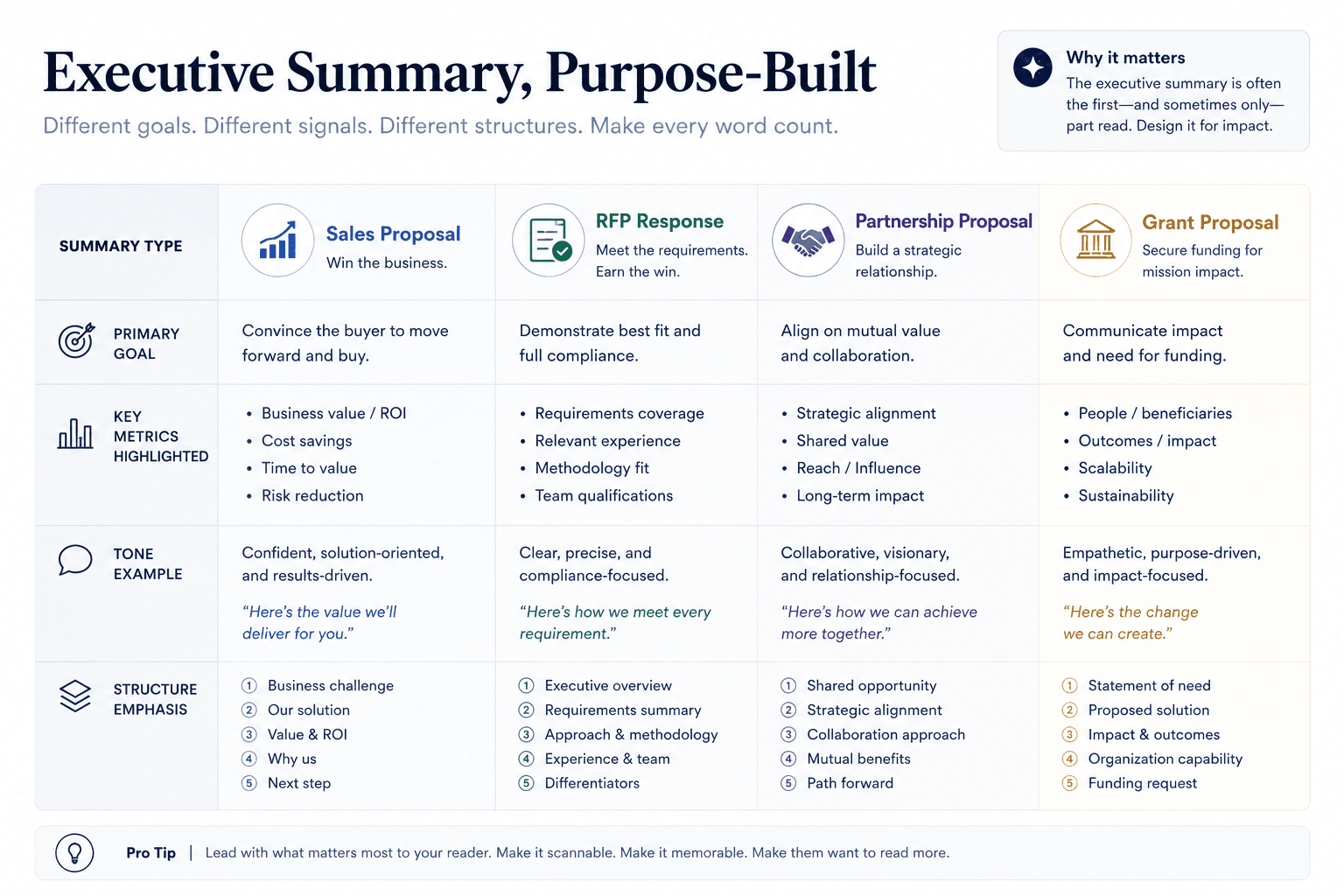
4 Executive Summary Examples by Proposal Type
The structure above works as a baseline. Different proposal types need slight variations.
1. Executive Summary for a Sales Proposal
Goal: Close a deal with a prospect.
Sample:
“TechFlow’s current customer onboarding takes an average of 19 days, well above the industry benchmark of 7 days, creating churn risk among first-time users. This delay correlates with a 34% drop-off in 90-day retention.
We propose deploying our onboarding automation platform, which has reduced onboarding time by 68% on average across our 40+ B2B SaaS clients. Implementation typically takes 6 weeks.
Our team includes specialists in B2B SaaS onboarding from companies like Asana, Notion, and Intercom. We’ve helped clients recover an average of $1.2M in annual revenue previously lost to onboarding-driven churn.
Total investment for the first year is $96,000, including platform, implementation, and ongoing optimization. Expected ROI based on TechFlow’s current churn metrics is $480K within 12 months.
We’d like to schedule a working session with your customer success team next week to map the integration plan.”
Why it works: Specific numbers from the start. Cost of doing nothing is implied in the churn data. Cost of the solution is paired with expected ROI. Ask is concrete.
For more on framing sales narratives, our guide on how to prepare a sales proposal step-by-step breaks down the structure behind decisions like these.
2. Executive Summary for an RFP Response
Goal: Win a competitive procurement process.
Sample:
“The State of [X]’s current case management system serves 12 agencies across 240 field offices, but its 2018-era architecture is limiting integration capabilities, slowing claim processing by an estimated 22%, and creating compliance risk under new federal data-sharing requirements.
We propose a phased modernization built on a cloud-native architecture, integrated with the State’s existing identity management and finance systems. Our approach delivers measurable improvements within 90 days while minimizing service disruption.
Our team has delivered 11 similar state-level modernization projects in the past 6 years, including three with comparable scale and complexity. We bring deep expertise in compliance with 42 CFR Part 2 and state data residency requirements.
Total project cost is $4.8M over 18 months, with optional ongoing managed services at $720K annually. This is approximately 15% below the budget ceiling stated in the RFP.
Our proposed implementation team is available to begin within 30 days of contract execution.”
Why it works: Speaks the RFP’s language. Addresses compliance early. Pricing comes in under the ceiling, signaling value. The ask is implicit: pick us.
3. Executive Summary for a Partnership Proposal
Goal: Get a strategic partnership signed.
Sample:
“Both [Company A] and [Company B] serve mid-market SaaS companies in North America, but with non-overlapping product offerings. [Company A] reaches CTOs through infrastructure tooling. [Company B] reaches VPs of Sales through revenue analytics.
A co-marketing partnership would create immediate access to roughly 8,400 mutual prospects neither company is currently reaching efficiently.
We propose a structured co-marketing program including two joint webinars per quarter, a shared content series, and integrated workflows between our products. Both teams have already mapped technical integration points and confirmed feasibility within 60 days.
Combined pipeline impact based on conservative projections: $2.1M in net new annual recurring revenue across both companies in the first 12 months.
We’d like to schedule a strategic alignment call between executive teams within the next two weeks to refine scope and finalize agreement terms.”
Why it works: Frames mutual benefit immediately. Specific numbers. No fluffy “synergy” language. Clear ask.
For more on framing partnership decks specifically, see our business proposal guide.
4. Executive Summary for a Grant Proposal
Goal: Win nonprofit funding.
Sample:
“First-generation college students in [County] enroll in four-year universities at a rate of 18%, compared to 64% for their peers. The single largest predictor of this gap is lack of structured college application support during junior and senior year of high school.
[Organization Name] proposes expanding its proven mentorship and application support program from 4 high schools to 12 over the next 24 months, reaching an additional 1,200 first-generation students annually.
Our existing program has placed 87% of participants into four-year colleges over the past five years, with an average cost of $2,083 per matriculation, well below the regional average of $5,400.
Total funding request is $640,000 over two years to support program staffing, school partnerships, and outcome tracking.
We would welcome a site visit to one of our existing partner schools to demonstrate the program in action before final funding decisions.”
Why it works: Concrete outcome data. Cost-per-outcome metric is unusual and credible. Clear scope of expansion. Practical next step that lets the funder build conviction.
Every one of these executive summary examples is more persuasive when delivered as a presentation slide in the actual meeting, and Decktopus generates that slide automatically from your written summary, applies your brand from your website URL, and exports as PDF or PPT so it slots straight into your proposal deck.
5 Named Mistakes That Kill Executive Summaries
1. The Throat-Clearing Opening
Starting with “We are pleased to submit this proposal…” or “Thank you for the opportunity…” is wasted real estate. Every word in the first sentence should earn its place. Pleasantries don’t.
The first sentence should make the reader say “this person understands my problem.” That’s it.
2. The Capability Dump
Listing your services, awards, and credentials before you’ve established that you understand the buyer’s situation. Nobody cares how qualified you are until they believe you’ve diagnosed the right problem.
Lead with their problem. Earn the right to talk about yourself.
3. The Vague Outcome Promise
Phrases like “drive results,” “deliver value,” and “transform your business” are decoration. They sound good. They mean nothing. Decision-makers see right through them.
Replace vague outcomes with specific numbers. “Drive results” becomes “reduce processing time from 6 hours to under 15 minutes.”
4. The Buried Ask
The executive summary ends with “We look forward to your consideration.” That’s not an ask. That’s a wish.
The ask should be specific: a meeting, a signature, a decision by a date, a phone call. If you don’t tell the reader what to do next, they won’t do anything.
5. The Symmetry Lie
Writing the executive summary in three perfectly balanced paragraphs of equal length because it looks tidy. Real executive summaries are often asymmetrical. The opening might be three sentences. The ask might be one. Match the length to the work each section is doing.
How to Format an Executive Summary for Skimming
Decision-makers don’t read top to bottom. They scan in F-patterns and Z-patterns.
That means formatting matters as much as content.
The best executive summaries use:
A bolded headline that summarizes the whole proposal in one sentence
Short paragraphs (3 sentences max)
A clear sub-structure (the problem, the approach, the team, the cost, the ask)
One or two callout numbers or stats that catch the eye
A clearly visible CTA at the end
Avoid:
Dense blocks of text
Long unbroken paragraphs
Vague language that doesn’t reward skimming
Formatting an executive summary for F-pattern and Z-pattern scanning takes hours when you’re doing it in PowerPoint, which is why proposal writers use Decktopus to generate a skimmable summary slide automatically, complete with bold headlines, callout numbers, and a visible CTA, all on-brand from the first generation.
If a decision-maker reads only the first sentence of each paragraph, do they get the full picture? They should.
How to Visualize Executive Summary Data
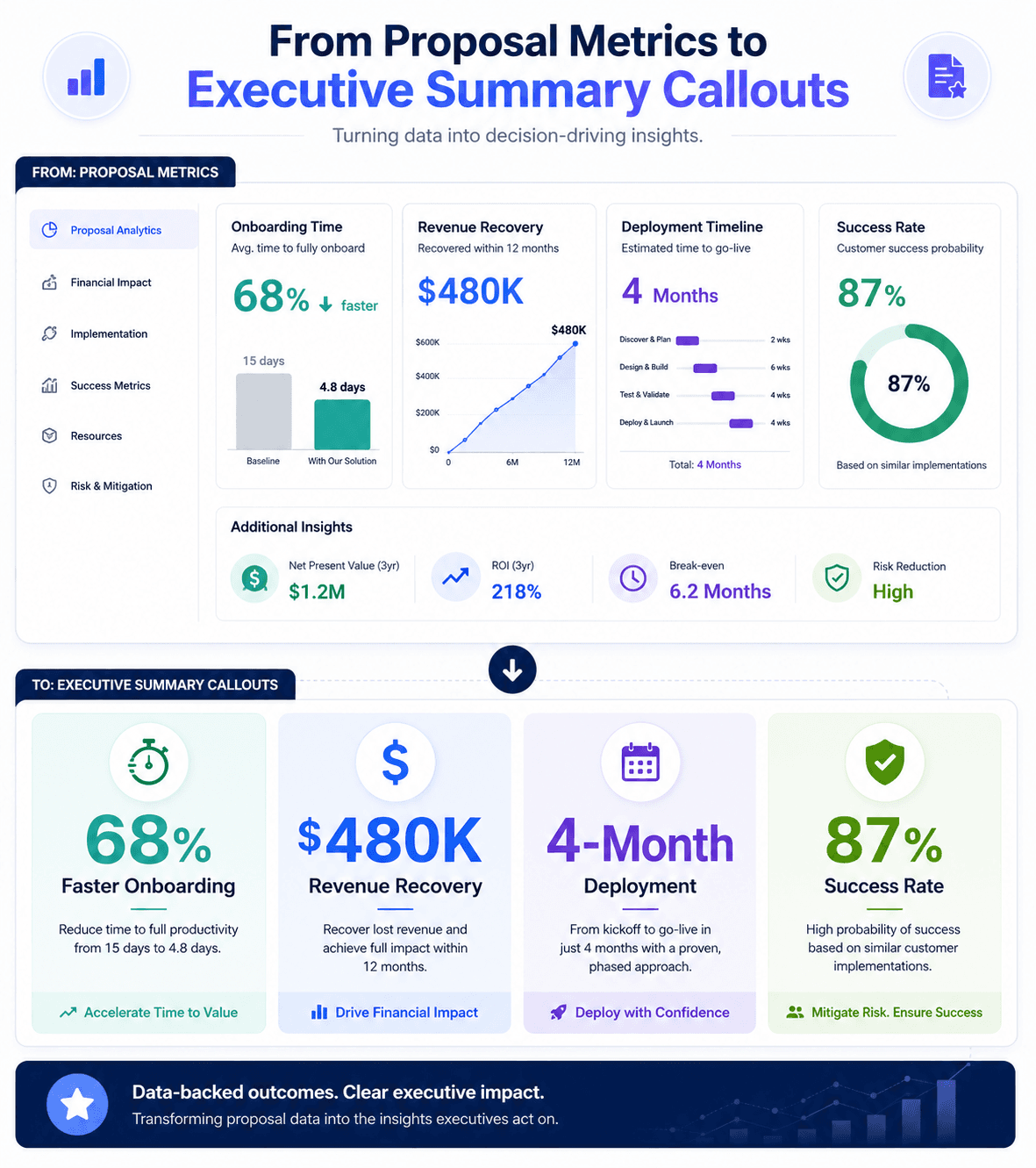
Numbers belong in the executive summary, but they shouldn’t be buried in prose.
The most effective executive summaries pull out one or two key metrics as visual callouts:
“87% of participants enrolled in four-year colleges”
“$2.1M projected annual revenue impact”
“Implementation in 4 months vs industry average of 11”
These are skimmable. They’re the kind of data point a busy decision-maker will remember even if they forget the rest.
For data-heavy summaries, charts can replace several sentences of text. Tools that generate clean bar charts or pie charts make patterns visible at a glance.
Turning Your Executive Summary Into a Presentation
In many cases, your executive summary needs to live in two formats: the document version and the slide version.
The slide version is often what gets presented in the actual decision meeting. It deserves the same level of attention as the written version.
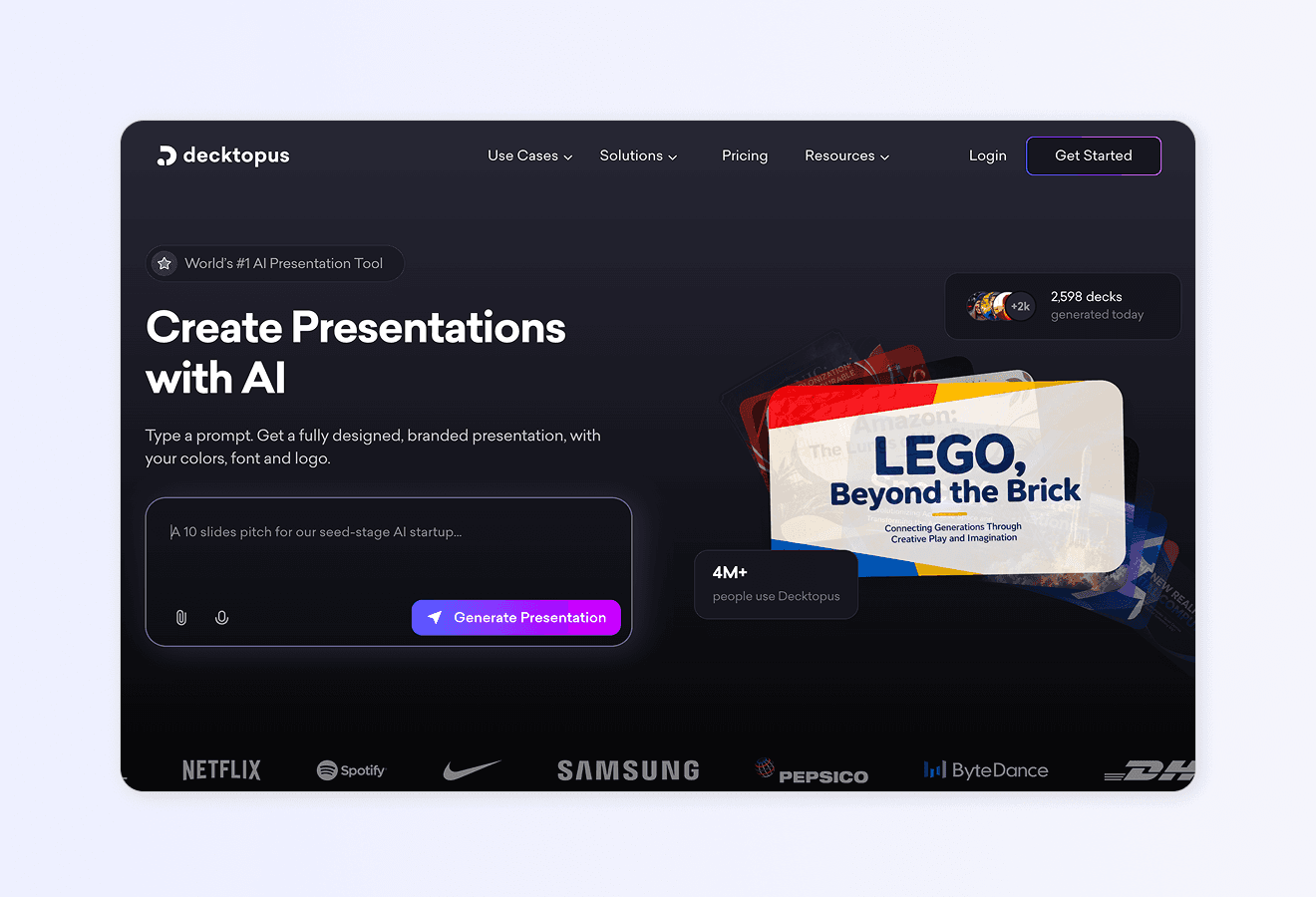
Decktopus generates the slide version for you.
Here’s how it works:
Describe your topic. Type your proposal context and the executive summary content. Or upload the written proposal as a supporting file.
Choose your style. Paste your homepage URL to apply your brand automatically. Decktopus pulls your logo, colors, and fonts so the executive summary slide looks like the rest of your sales materials.
Review the outline. Decktopus generates a slide structure for the summary, with the headline, problem, approach, proof, and ask each on their own slide.
Refine in the editor. Use the prompt bar to fine-tune any slide. Try instructions like “make this headline more concise,” “add a bar chart showing the cost savings,” or “tighten the team slide.” Brand Compliance keeps every slide on-brand.
Export or share. Download as PDF or PPT to attach to the proposal, share via link, or present directly in the decision meeting.
For more on AI-powered presentation workflows, see our guide on the best AI presentation tools.
Frequently Asked Questions
How long should an executive summary be?
For most business proposals, 250 to 400 words is the sweet spot. RFP responses sometimes require longer summaries (up to 1 to 2 pages). The rule: as short as possible while still answering the five questions decision-makers care about.
Should the executive summary repeat content from the rest of the proposal?
Yes and no. It should cover the same ground at a high level, but it should never feel like a copy-paste. The summary is a condensed argument. The rest of the proposal is supporting detail.
Where does the executive summary go in the proposal?
Always first. Right after the cover page. Decision-makers expect it there. Don’t make them search for it.
Should I write the executive summary before or after the rest of the proposal?
Most experienced proposal writers draft the summary last, when the full argument is clear. But they sketch a rough outline of the summary first, to make sure the proposal builds toward a clear ask.
Can AI help write executive summaries?
Yes. AI tools are useful for drafting versions, tightening language, and pulling out key numbers from longer documents. The strategic decisions (what to lead with, what to cut, what the ask should be) still require human judgment. For more on AI-assisted writing, see our breakdown of the best executive summary generators.
What’s the difference between an executive summary and an introduction?
An introduction sets up the proposal. An executive summary replaces the proposal for readers who won’t read further. They serve completely different purposes. Most proposals don’t need an introduction at all if the executive summary is well-written.
How do I know if my executive summary is working?
Hand it to someone who hasn’t read the rest of the proposal. Ask them to summarize what you’re proposing, what it costs, and what you’re asking them to do. If they can’t answer all three in 30 seconds, the summary needs more work.
What’s the best way to structure a marketing-focused proposal?
The structure principles are the same, but the framing changes. For sector-specific guidance, see our guide on how to write a marketing proposal.
Final Thoughts
The executive summary is not the easy part of the proposal.
It’s the hardest part.
You’re compressing weeks of work, a complex argument, specific numbers, and a clear ask into a single page that has to win attention from someone who is busy, skeptical, and looking for a reason to say no.
Most writers treat it as the last thing they write, and they rush it. That’s why most executive summaries fail.
The good ones are written like every word matters. Because in the executive summary, every word does.
If your next executive summary doesn’t answer the five questions in under 400 words, doesn’t lead with the reader’s problem, and doesn’t end with a specific ask, it’s not finished. Keep cutting.
Related posts

Struggling to Find New Clients? 5 Proven Tips to Turn Prospecting Into Growth
Struggling to find new clients? Discover 5 proven tips, from proposals to paid ads, to build a steady pipeline of new business.
Sales & Proposals

Cracking the Code: Mastering B2B Sales Strategies & Techniques
Discover the essential guide to mastering B2B sales strategies and techniques, uncovering the secrets behind successful business-to-business selling. Explore the B2B sales process, optimize your team's performance, and elevate your approach to selling products for businesses.
Sales & Proposals
Mastering Proposals: Exploring the Best Business Proposal Tools and Software Solutions
Discover the best business proposal tools, including PandaDoc and Proposable, to streamline your proposal process and win more clients.
Sales & Proposals