Marketing
How to Write a Marketing Proposal: A Step-by-Step Guide
Learn the 8-section marketing proposal framework, real-world examples, verified best practices, and how to build a client-winning proposal deck fast.

İlayda Tunaboylu
What Is a Marketing Proposal?
A marketing proposal is a structured document that recommends a specific marketing strategy, campaign, or engagement to a client (or internal stakeholder) who has the authority to approve it. It defines the client's marketing problem, proposes a tailored solution, establishes expected value, and asks for a specific decision. Unlike a marketing plan (which describes ongoing operational activity), a marketing proposal is a persuasive sales document built around a single, dated decision. The main benefit is that a well-written proposal converts a discovery conversation into a signed engagement by making the recommended path obvious, credible, and easy to approve.
According to industry research from Proposify and others, proposals sent within 24 hours of a discovery conversation close at significantly higher rates than proposals sent days later. Customized executive summaries increase close rates by up to 50%. Proposals that include tiered pricing options close 35.8% more often than single-price alternatives, and proposals under five pages close 31% more often than longer ones. In short: speed, customization, tiered pricing, and brevity all directly affect whether your marketing proposal wins the client or ends up in the "maybe later" folder.
For related content, see our guides on the business proposal, business proposal vs. business plan, and the marketing plan template.
Marketing Proposal vs. Business Proposal vs. Marketing Plan
These three documents are often confused. They serve different purposes and rarely substitute for each other.
Document | Purpose | When to Use | Length |
|---|---|---|---|
Marketing Proposal | Recommend a specific marketing service, campaign, or engagement | Winning new client work or approval for a specific campaign | 3-10 pages typical |
Business Proposal | Recommend any business service or product to a prospective client | Sales-driven engagement across any category | 4-15 pages typical |
Marketing Plan | Describe ongoing marketing operations and yearly strategy | Internal planning, annual reviews, or leadership alignment | 15-40 pages typical |
Business Plan | Describe entire business model, market, and operations | Fundraising, internal strategy, business review | 25-50 pages typical |
The critical distinction: a marketing proposal drives a single decision (hire us for this campaign, approve this budget, sign this engagement). A marketing plan describes what you're already doing.
For more on distinguishing document types, see business proposal vs. business plan and the marketing plan template.
Why Marketing Proposals Matter More Than Ever
Speed decides more deals than talent. Proposals sent within 24 hours of a discovery conversation close at meaningfully higher rates. In a market where clients evaluate 3 to 5 agencies for every engagement, the fastest, most customized proposal usually wins.
Customization is the biggest lever. Generic template proposals with the client name changed rarely convert. Customized executive summaries alone lift close rates up to 50%. Clients recognize template work instantly and respond accordingly.
Tiered pricing outperforms single-price offers. Giving the client three clearly differentiated options (essential, recommended, premium) closes 35.8% more often than presenting one flat number. Options give clients a sense of control while anchoring the recommended tier.
Brevity wins. Proposals under five pages close 31% more often than longer ones. That doesn't mean skimping on substance. It means cutting anything that doesn't directly help the client say yes.
Client expectations have risen. Post-2022, marketing procurement has tightened dramatically. Clients scrutinize scope, pricing, and ROI more carefully than they did five years ago. Marketing proposals that don't clearly justify the investment get filtered out early.
The 8-Section Marketing Proposal Framework
Every winning marketing proposal follows a version of this 8-section framework. It's built on the Universal Proposal Structure adapted specifically for marketing engagements.
Section | Purpose | Length Guide |
|---|---|---|
1. Cover Page | First impression with client name and engagement title | 1 page |
2. Executive Summary | Standalone persuasive summary of the entire proposal | 1-2 pages |
3. Client Situation and Marketing Challenge | Problem statement rooted in the client's context | 1 page |
4. Proposed Marketing Strategy | Your recommended approach, tied to outcomes | 1-2 pages |
5. Scope of Work and Deliverables | Specific tactical work with clear boundaries | 1-2 pages |
6. Timeline and Milestones | Realistic schedule with owner assignments | 1 page |
7. Investment and Options | Transparent pricing with tiered options | 1 page |
8. Social Proof and Next Steps | Case studies, testimonials, and dated call to action | 1-2 pages |
Deep Dive Into Each Section
1. Cover Page
Your first impression. Include the client's name (prominently), the engagement title (make it specific to their project), your agency or company name, date, and primary point of contact.
Best practice: the title should name the client's specific challenge or campaign, not just say "Marketing Proposal." A titled cover like "Q4 Demand Generation Program for [Client Name]" signals custom work, not a template.
2. Executive Summary
The most important section of the proposal. Read first, often read exclusively, and must stand on its own as a complete persuasive argument.
Include:
The client's core marketing challenge or goal
Your proposed marketing approach at a high level
Key outcomes the client will realize
One line on why your team is the right choice
The specific next step (with a date)
Write the executive summary last. Only after the full proposal is drafted can you accurately distill the most important points.
Opening line matters. Most marketing proposals open with a company introduction. High-performing ones open with a hook tied to the client's situation:
Problem-first: "Most SaaS companies at your revenue stage lose 40% of trial signups before day 7. Here's why, and what a different approach delivers."
Unexpected insight: "The data shows the real constraint on your growth isn't traffic, it's activation. This proposal addresses both."
Transformation: "In 6 months, [comparable client] moved from $2M ARR to $5M ARR through a repositioning of their inbound funnel. Here's the approach that made that possible."
For more on writing executive summaries, see our guides on how to write an executive summary, executive summary examples, and the best executive summary generators.
3. Client Situation and Marketing Challenge
Lead with the problem, not your credentials. Establish that you understand the client's specific situation before proposing anything.
Use the client's own language from the RFP, discovery call, or brief. Define the current state, the desired state, and the gap between them. Quantify impact where possible: lost revenue, missed pipeline, competitor gains, or channel underperformance.
Weak problem statement: "Your company faces challenges with digital marketing."
Strong problem statement: "Your paid acquisition costs have risen 42% year-over-year while conversion rates dropped 18%, translating to a $1.2M pipeline gap by Q4. Your current agency has scaled channels but not attribution, which means you're spending more on the least productive channels without knowing it."
For more on marketing problem framing, see our guides on effective marketing strategies and market analysis.
4. Proposed Marketing Strategy
Lead with outcomes, not activities. State what the client will have or be able to do as a result of the engagement, then explain the methodology that will produce it.
Cover:
The strategic approach (repositioning, channel expansion, funnel optimization, content pillars, etc.)
Why this approach fits this specific problem
The key phases or workstreams
Expected outcomes and success metrics
One paragraph on differentiation (why this approach vs. alternatives)
Avoid the "feature dump" where you list every capability without connecting it to the client's specific situation. For related frameworks, see the 4 Ps of Marketing, go-to-market strategy, and ai marketing strategy.
5. Scope of Work and Deliverables
Define what's included, and critically, what's not.
Include:
Specific, concrete deliverables ("2 x 1,500-word blog posts per month" not "content support")
An explicit "Out of Scope" section
Assumptions about client inputs (approvals, brand assets, review timelines)
Number of revisions and change-request process
Acceptance criteria for each deliverable
Vague scope creates scope creep. Explicit scope protects both sides.
6. Timeline and Milestones
Present the timeline as logic, not decoration. Show:
What happens, in what order
Why the sequence matters
Who owns each stage
Which stages depend on client inputs
When results begin to appear
Avoid suspiciously fast timelines (they signal you don't understand the work). Note client dependencies explicitly at each phase.
7. Investment and Options
Pricing after value, always. Never lead with cost.
Use tiered pricing. Proposals with multiple options close 35.8% more often than single-price alternatives. Present three tiers (essential, recommended, premium) that differ in scope and deliverables, not in quality.
Contextualize the investment. Present pricing with a one-line justification tied to expected outcomes ("Investment of $18,000 per month, representing a projected 4x ROI within 6 months based on comparable engagements").
Always identify the recommended option. Options without a recommendation create decision paralysis. Make your pick obvious.
8. Social Proof and Next Steps
Close with proof and a clear ask.
Social proof options (ranked by persuasive strength):
Quantified outcomes from past clients (most credible)
Named case studies and testimonials
Third-party research or industry data
Awards, media coverage, or recognition
Follower count, community size, general awards (least persuasive)
End with a dated call to action. "We look forward to your feedback" is not a call to action. "Please sign and return by October 15 to secure the Q4 kickoff date" is.
For related close guidance, see how to end a presentation with impact.
Common Types of Marketing Proposals
Different engagements need different proposal formats. Match the format to the engagement type.
Proposal Type | Best For | Key Focus |
|---|---|---|
Retainer proposal | Ongoing monthly marketing services | Scope by month, deliverables, escalation process |
Project proposal | One-time campaigns or launches | Timeline, phases, specific deliverables |
Strategic consulting proposal | Advisory work without execution | Diagnostic phase, deliverable format, engagement duration |
Content marketing proposal | Blog, video, podcast, or thought leadership work | Content calendar, distribution, performance metrics |
Social media proposal | Ongoing social management or campaigns | Platform strategy, posting cadence, engagement KPIs |
SEO proposal | Organic search growth work | Technical audit, content plan, ranking targets |
Paid media proposal | Paid acquisition management | Budget allocation, channel mix, CAC/ROAS targets |
Brand or rebrand proposal | Positioning, identity, or naming work | Discovery phases, deliverables, rollout approach |
Marketing automation proposal | Martech implementation and workflow design | Systems, integrations, adoption plan |
For more on specific marketing formats, see our guides on the marketing campaign, content marketing examples for lead generation, and b2b marketing strategy examples.
6 Marketing Proposal Examples
Real proposal formats worth studying and adapting to your own engagements.
1. Creative marketing case study proposal. A branding or creative agency pitching a specific brand refresh or campaign concept. Heavy on visuals, portfolio work, and creative philosophy.
2. Social media marketing proposal. Ongoing social management for a B2B or B2C brand. Emphasizes platform mix, posting cadence, content pillars, and engagement targets.
3. Content marketing proposal. Blog, thought leadership, video, or podcast production. Includes editorial calendar, content pillars, distribution plan, and lead generation targets.
4. Social media marketing strategy proposal. A one-time strategic engagement to define social positioning, tone, and channel mix (as opposed to ongoing execution).
5. Small business marketing package proposal. A bundled service offering for small business clients. Standardized scope with limited customization to reduce the sales cycle.
6. Marketing project proposal. A single-project brief like a product launch, PR campaign, or event marketing engagement. Time-bounded with clear deliverables.
For related examples, see our guides on the sales pitch, marketing pitch, and perfect pitch and how to collaborate on a sales pitch.
How to Format and Present Your Marketing Proposal
Formatting matters as much as content. A brilliant proposal that's hard to read loses to a mediocre one that's easy to review.
Structure and Navigation
Use consistent heading hierarchy so readers can scan quickly
Break long sections with subheadings
Use tables and bulleted lists where they help comprehension
Add a table of contents for proposals over 5 pages
Include a compliance matrix for formal RFP responses (map every requirement to a section)
Visual Design
Keep design clean and on-brand
White space is your friend (dense proposals create reading fatigue)
Every chart, table, or diagram should answer a specific question
Consistent font family, color palette, and layout across every page
Length
Standard proposals: 4-8 pages
Complex engagements: 10-15 pages
RFP responses: whatever the RFP requires
If a proposal must be long, make sure the executive summary lets decision-makers evaluate without reading the full document.
Delivery Format
PDF is the standard delivery format for most proposals
Presentation deck (PPT or PDF) works well when the proposal will be walked through in a meeting
Live link with auto-update (like Decktopus AI enables) lets you update the proposal after sending without re-emailing new versions
For more on presentation formatting, see our guide on presentation design and how to do a presentation.
Tips for Creating a High-Impact Proposal
1. Send within 24 to 48 hours of the discovery call. Speed compounds. Every day of delay lowers close rate.
2. Customize the executive summary at minimum. Even if the rest of the proposal reuses standard sections, the executive summary must be tailored to this specific client.
3. Use tiered pricing. Three options (essential, recommended, premium) close 35.8% more often than single-price alternatives.
4. Anticipate objections proactively. Address likely concerns (timeline, price, team fit) inside the proposal rather than waiting for them to come up in follow-up.
5. Include a risk mitigation approach. For larger engagements, add a "Risks and Mitigations" section showing how you protect the client from likely challenges.
6. Reference specific details from the discovery call. Mention things the client said, use their exact terminology, and reflect their priorities back at them. This alone signals custom work.
7. Make the call to action explicit and dated. Not "let us know if you have questions." Instead: "Please sign the attached agreement by October 15 to secure the Q4 kickoff."
8. Use social proof strategically. Include case studies analogous to the client's specific situation. Named clients with quantified outcomes beat logo grids.
9. Optimize for scannability. Assume the decision-maker will scan first, read later. Use headings, bullets, and callouts that survive a 3-minute skim.
10. Rehearse the walkthrough if you'll present live. For high-stakes proposals, practice the walkthrough at least three times before the meeting. Tools like Decktopus AI's Loop AI Delivery Coach give real-time feedback on pacing and clarity.
Common Mistakes to Avoid
Leading with company history instead of the client's situation. Puts you first, client second. Signals a template.
Generic language. "We are a leading provider of comprehensive marketing solutions" tells the client nothing. Specificity signals credibility.
Feature dumping without connecting to outcomes. Listing capabilities without showing how they help this specific client wastes the reader's attention.
Vague scope. "Marketing support" or "content services" creates future disputes. Specific deliverables prevent them.
Hiding pricing. "Pricing available upon request" signals distrust. Transparent pricing signals confidence.
Single-price offers. Missing the 35.8% close-rate lift from tiered options.
No clear call to action. Ending with "let us know if you have questions" is passive and unmemorable. End with a dated ask.
Sending too late. Proposals sent 3+ days after discovery close at meaningfully lower rates.
Ignoring RFP evaluation criteria. For formal procurement, missing stated criteria is often a disqualification event.
Manufactured urgency. Fake deadlines erode trust. Only use urgency when it's legitimate.
No revision cycle mentioned. Ambiguity around revisions and change requests creates scope creep.
Sending without independent review. Have someone unfamiliar with the draft read it. If they can't answer "what's the ask?" clearly, the proposal isn't ready.
How to Build Your Marketing Proposal Deck with Decktopus AI
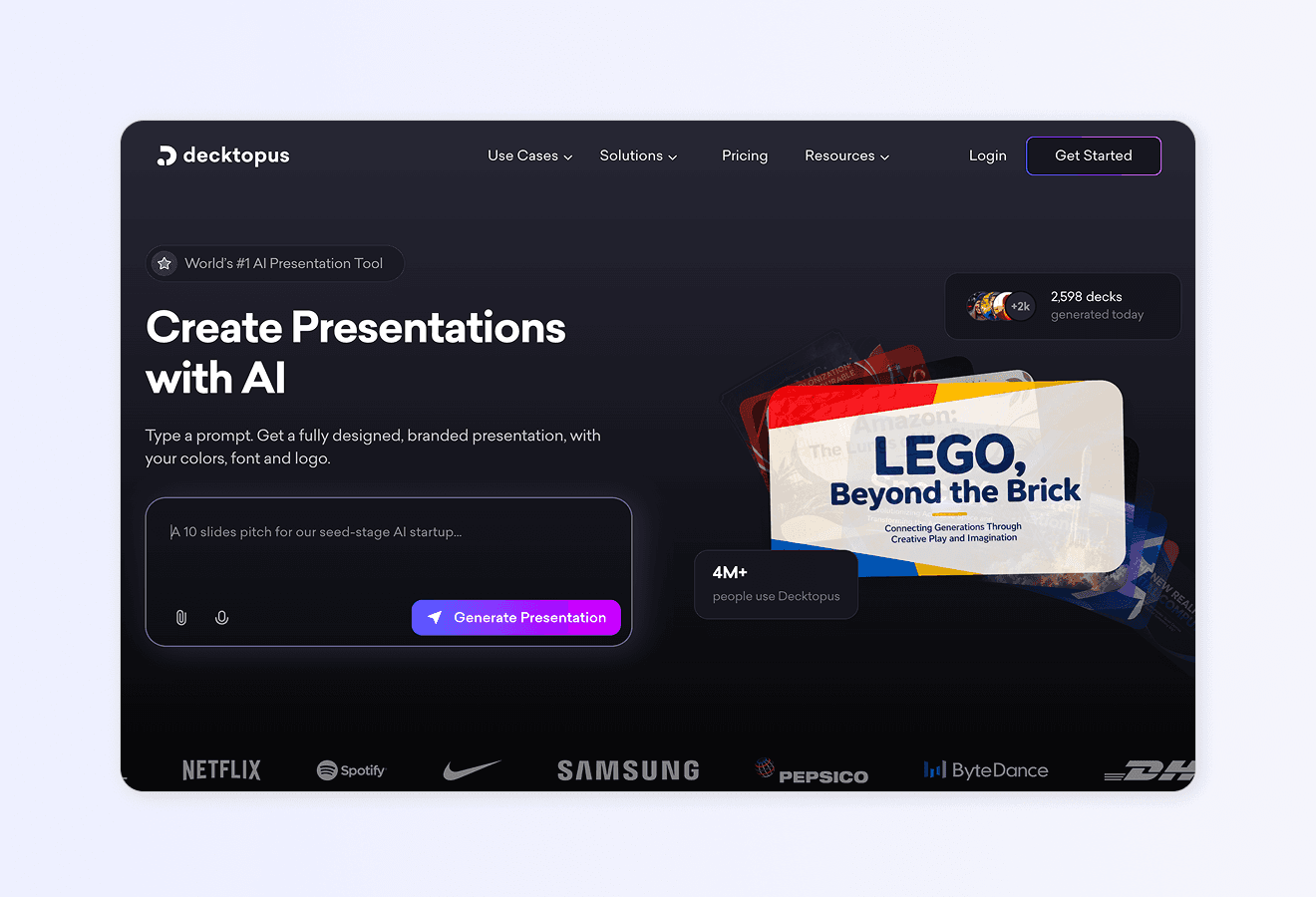
A well-designed proposal deck often outperforms a Word document or PDF, especially when you plan to walk through the proposal in a live meeting. Decktopus AI generates a full marketing proposal deck from a short description in minutes, giving you a polished, on-brand starting point you can customize per client.
Why Decktopus AI Is Built for Marketing Proposals
For agencies, freelancers, marketing consultants, and in-house teams that produce marketing proposals on a recurring basis, Decktopus AI is the fastest path from discovery conversation to client-ready deck. Every feature below is a confirmed part of the Decktopus AI platform.
AI-first proposal generation from a prompt. Type "Marketing proposal for a mid-market B2B SaaS client focused on Q4 demand generation and inbound content." Decktopus AI generates a full slide-by-slide deck with content, layout, and design in minutes. What used to take an account manager an entire afternoon (or a full day for a polished pitch) now takes 15 minutes end-to-end.
AI Outline Generation as a separate reviewable step. Before Decktopus AI produces the full deck, it generates an editable outline. Adjust section titles, add or remove sections (like a risk mitigation section for enterprise clients), and reorder before committing to full slide generation. Ideal for marketing proposals where you want to align the structure with a client's RFP requirements before generating.
Automatic brand import from your website URL. For agencies, this is transformative. Paste your agency URL and Decktopus AI extracts your logo, colors, and typography and applies them across every slide. For white-label engagements, paste the client's URL instead and every slide is automatically branded to them. No manual Brand Kit setup per client.
Beautify for reusing prior proposal decks. If you have last quarter's proposal template or a strong deck from a similar engagement, upload it to Beautify. Two options:
Use as a Resource: extracts the key content from the previous deck and builds a fresh proposal around them (requires a prompt describing the new engagement)
Redesign: keeps text and structure intact, applies fresh visual design
Ideal for iterating from a proven proposal template while personalizing each version to the client.
Edit with AI for prompt-based refinement. Once your deck is generated, refining it doesn't require menu-hunting. Click Edit with AI and type in plain language:
"Add a tiered pricing table with three options (essential, recommended, premium)"
"Add a case study slide featuring [comparable client] with quantified outcomes"
"Make the timeline more visual with clear milestone gates"
"Add a Risks and Mitigations section for slide 12"
"Rewrite the executive summary to open with a hook about churn"
Every edit tracked in unlimited version history. Any past version can be restored, so aggressive edits are risk-free.
Edit Text for manual polish. For fine-grained text edits without AI prompts, click Edit Text to directly edit each text field on a slide in a right-side panel. Perfect for final pass before sending to a client.
AI Image Generation and Stock Image Library. Add custom AI-generated images by describing what you want, or search Unsplash and Freepik directly through the Edit with AI panel. Ideal for marketing proposals that need on-brand visuals, section dividers, or campaign concept imagery.
PDF import for reusing client research and briefs. Upload the client's RFP, brief, or discovery notes as a PDF and Decktopus AI can incorporate the content into the generated proposal. Ideal for turning a dense RFP into a structured proposal response.
Loop AI Delivery Coach for high-stakes proposals. For marketing consultants and agency leads who present proposals live to clients, Loop AI Delivery Coach lets you rehearse the walkthrough and get real-time feedback on pacing, filler words, and clarity. No other major presentation tool offers this. Especially valuable for competitive pitches where three or four agencies are being evaluated in back-to-back meetings.
Live-link sharing with auto-update. Share your proposal via a live link with the client. Any updates you make afterward (refined pricing, updated timeline, adjusted scope after their feedback) automatically appear at the same URL. The client always sees the latest version. No re-sending updated PDFs. This is one of the most useful features for proposals where clients ask for tweaks before signing.
Embed on your website or portal. Generate iframe code to embed the proposal deck directly on your agency website, client portal, or a shared workspace.
Custom Domain (Business plan). Connect a subdomain like proposals.youragency.com so your shared decks and proposals appear on your branded URL. Business plan only.
Team Collaboration for agencies (Business plan). Invite team members to specific proposals for shared access. Not real-time co-editing, but shared deck-access lets account managers, strategists, and directors work on the same proposal set. Business plan only.
Folders for client organization. Organize proposals by client in dashboard folders. Ideal for agencies managing many active proposals simultaneously.
AI Carousel Maker for social distribution. Turn key proposal insights or case studies into native LinkedIn or Instagram carousels for thought leadership content that supports your business development.
Multi-format export. Download proposals as PDF, PPT, or PNG (with Standard or Compressed quality). Send in the format your client prefers.
Version History for iteration. Every change to every slide is tracked. Restore any past version. Useful when clients say "can you send the version with the original pricing too?"
Presentation Mode. Present directly from Decktopus AI's full-screen mode during pitch meetings, live or on Zoom.
Decktopus AI vs. Traditional Proposal Tools
Feature | Decktopus AI | Traditional Tools (Word, Google Docs, PowerPoint) |
|---|---|---|
AI-generated proposal deck from a prompt | Yes | No or limited |
PDF import (turn RFPs into proposals) | Yes | Limited |
Automatic brand import from URL | Yes | No (manual setup per client) |
Beautify (refresh prior proposals) | Yes | No |
Edit with AI (prompt-based refinement) | Yes | Partial or none |
Loop AI Delivery Coach for rehearsal | Yes | No |
Live-link auto-update | Yes | No |
Embed on external site | Yes | Limited |
Custom Domain (branded URL) | Yes (Business plan) | Not available |
Team Collaboration for agencies | Yes (Business plan) | Yes |
Folders for multi-client management | Yes | Yes |
Multi-format export (PDF, PPT, PNG) | Yes | Yes |
Presentation Mode for live pitches | Yes | Yes |
Version History (unlimited) | Yes | Limited |
Who This Section Is For
Decktopus AI is used by marketing professionals across roles:
Marketing agency founders and account managers producing client proposals weekly or monthly
Freelance marketing consultants turning discovery calls into proposals within 24 hours
Marketing strategists delivering advisory proposals for retainer or project work
In-house marketing managers presenting proposals to leadership for budget approval
Business development leads building competitive pitches for new client wins
For deeper use case guidance, see Decktopus AI for Marketers, Decktopus AI for Agencies, and Decktopus AI for Sales.
Step-by-Step: Build Your Marketing Proposal With Decktopus AI
1. Describe your topic or upload the client brief. Type "Marketing proposal for [client name] focused on [engagement type]." Or upload the client's RFP, discovery call notes, or brief via the paperclip icon.
2. Choose your style. Import your agency brand from your website URL, use a previously saved style, or let AI generate a style from scratch. For white-label engagements, import the client's brand instead.
3. Review the AI-generated outline. Adjust sections (executive summary, client situation, proposed strategy, scope, timeline, investment, social proof, next steps). Add engagement-specific sections like Risks and Mitigations or Team.
4. Generate the full proposal deck. Decktopus AI produces the complete slide-by-slide proposal with content, layout, and design.
5. Refine with Edit with AI or Edit Text. Use Edit with AI for structural changes ("add a tiered pricing table," "add a case study slide"). Use Edit Text for wording polish.
6. Add visuals. Use AI Image Generation or the Unsplash and Freepik stock libraries for on-brand imagery.
7. Rehearse with Loop AI Delivery Coach. Practice your walkthrough for the client meeting.
8. Export or share. Download as PDF for email delivery. Share via live link for auto-update. Embed on your client portal. Present directly from Presentation Mode during the pitch call.
For broader guidance, see the best AI presentation tools, our best business proposal tools roundup, and our guide on how to prepare a sales proposal step by step.
Ready to build a marketing proposal that wins clients? Get started with Decktopus AI.
Frequently Asked Questions
What is a marketing proposal?
A marketing proposal is a structured document that recommends a specific marketing strategy, campaign, or engagement to a client or internal stakeholder. It defines the marketing challenge, proposes a tailored solution, establishes expected value, and asks for a specific decision.
What is the difference between a marketing proposal and a marketing plan?
A marketing proposal recommends a specific engagement or campaign that requires client approval. A marketing plan describes ongoing marketing operations, typically over a year, for internal use. Proposals drive decisions. Plans describe activity.
How long should a marketing proposal be?
Standard proposals run 4 to 8 pages. Complex engagements or enterprise clients may require 10 to 15 pages. Formal RFPs follow whatever length the RFP requires. Proposals under 5 pages close 31% more often than longer ones, so brevity matters.
What should a marketing proposal include?
Cover page, executive summary, client situation, proposed strategy, scope of work, timeline, investment (with tiered options), social proof, and a dated call to action. See the 8-section framework above for details.
How quickly should I send a marketing proposal after a discovery call?
Within 24 to 48 hours. Speed compounds. Proposals sent within 24 hours close at meaningfully higher rates than those sent days later.
Should I use tiered pricing in a marketing proposal?
Yes. Proposals with three tiered options (essential, recommended, premium) close 35.8% more often than single-price proposals. Always identify which tier you recommend.
How do I customize a marketing proposal without starting from scratch?
Keep a base template, but always customize at least the executive summary, the client situation, and the case studies to this specific client. Customized executive summaries alone lift close rates by up to 50%. Tools like Decktopus AI's Beautify feature can also redesign an existing proposal template for a new client in minutes.
What is the difference between features and benefits in a marketing proposal?
A feature is a capability of your service (like "content calendar management"). A benefit is the positive effect it creates for the client (like "consistent, on-brand publishing without your team's involvement"). Great proposals lead with benefits, then explain the features that deliver them.
How do I write a strong executive summary?
Write it last. Include the client's core challenge, your proposed approach, expected outcomes, one line on why your team is the right choice, and the specific next step. Keep it to 1 or 2 pages. Open with a hook tied to the client's situation, not with your company introduction.
What are common marketing proposal mistakes?
Leading with company history instead of the client's situation, generic language that could apply to any client, vague scope, hidden pricing, single-price offers instead of tiered options, missing or unclear call to action, and sending too late after the discovery call.
How do I present my marketing proposal to a client?
For high-stakes proposals, walk through the deck live in a meeting or video call. Send the written proposal after the walkthrough as a reference document. Use a tool like Decktopus AI with Loop AI Delivery Coach to rehearse the walkthrough before the meeting.
What is social proof and how do I use it in a marketing proposal?
Social proof is evidence that others have trusted and benefited from your work. Types include customer testimonials, case studies, media coverage, awards, user ratings, follower counts, social media engagement, and industry recognition. Lead with named, quantified case studies analogous to the client's specific situation for the highest impact.
Can I use AI to generate marketing proposals?
Yes. Decktopus AI generates full marketing proposal decks from a short description in minutes, with automatic brand import, Edit with AI for prompt-based refinement, Beautify for redesigning prior proposals, and Loop AI Delivery Coach for rehearsal. It's designed specifically for the fast, high-volume proposal workflows agencies and consultants need.
What is the best format for delivering a marketing proposal?
Depends on the client. PDF is the standard for email delivery. Presentation decks (PPT or PDF) work well for live pitch meetings. Live-link sharing (like Decktopus AI enables) lets you update the proposal after sending without re-emailing new versions, which is valuable when clients request revisions.
What tool should I use to build a marketing proposal deck fast?
Decktopus AI generates a full marketing proposal deck from a short description in minutes with automatic brand import from your website URL, Beautify for refreshing older proposals, and Loop AI Delivery Coach for rehearsal. For more, see our roundup of the best business proposal tools and the best business proposal tools for founders.
Conclusion
Marketing proposals are one of the most consequential documents an agency, consultant, or in-house marketer produces. They convert a good discovery conversation into a signed engagement, or lose it. The difference usually isn't the quality of the underlying marketing thinking. It's how well the proposal itself communicates that thinking.
The 8-section framework in this guide (cover page, executive summary, client situation, proposed strategy, scope, timeline, investment with tiered options, social proof plus next steps) gives you a repeatable structure that scales across engagements. The verified best practices (send within 24 hours, customize the executive summary, use tiered pricing, end with a dated call to action) directly move close rates.
Turning that framework into a polished, on-brand deck is where most agencies lose hours per week. Decktopus AI is built specifically for this workflow: AI-generated proposal decks in minutes, automatic brand import from your website URL, Beautify for refreshing prior proposals, Edit with AI for iteration, Loop AI Delivery Coach for rehearsal, and live-link sharing for delivery. It's the fastest way to move from discovery to signed engagement.
For more resources, see our guides on the business proposal, everything you should know about proposal writing, and the best AI presentation tools.
Related posts

How AI Voice Agents Help Sales Teams Prepare and Deliver Better Presentations
Learn how AI voice agents help sales teams turn call insights into focused slides, stronger delivery, and more confident customer presentations at every stage.
Marketing

Instagram Carousel Size & Dimensions Guide (2026)
Instagram carousel size in 2026: exact dimensions for square, portrait, and landscape, plus file limits and safe zones, verified across sources.
Marketing

LinkedIn Carousel Size, Dimensions & Format Guide 2026
LinkedIn carousel size in 2026: exact dimensions, file limits, aspect ratios, and formatting rules so your slides never get cropped.
Marketing