Sales & Proposals
How to Prepare A Sales Proposal: Step by Step Guide
Learn the 7-step sales proposal framework, verified best practices from top sales research, real-world examples, and how to build a client-winning sales proposal deck fast.

İlayda Tunaboylu
What Is a Sales Proposal?
A sales proposal is a formal document that a salesperson, agency, or business creates to pitch a specific product or service to a prospective customer or client. It defines the prospect's challenge, proposes a tailored solution, presents pricing and terms, and asks for a specific decision. Unlike a general sales pitch (which is verbal and conversational) or a business plan (which describes ongoing operations), a sales proposal is a written, persuasive document built around one dated decision: purchase our product or service. The main benefit is that a well-crafted sales proposal turns a good sales conversation into a signed deal by making the purchase decision clear, credible, and easy to approve.
According to sales research from Proposify and independent industry data, proposals sent within 24 hours of a discovery call close at significantly higher rates than those sent days later. Customized executive summaries alone lift close rates by up to 50%. Proposals with tiered pricing options close 35.8% more often than single-price alternatives, and proposals under five pages close 31% more often than longer ones. Roughly 72% of Fortune 500 procurement departments use a formal 5-point scoring scale to evaluate proposals, which means a document that isn't structured for scan-and-score review starts at a disadvantage before it's even read.
For related content, see our guides on the sales pitch, sales process, and perfect pitch and how to collaborate on a sales pitch.
What Can You Use a Sales Proposal For?
Demonstrate your understanding of the customer's needs. A strong proposal shows you've listened carefully to what the prospect is trying to solve.
Position your unique solution. Explain how your product or service specifically addresses the challenge better than alternatives.
Drive a specific action. Give prospects everything they need to make a purchase decision, including budget, deliverables, timeline, and next steps.
Create a reference document. Both parties can return to the proposal throughout the engagement for alignment and clarity.
Protect against scope disputes. A written proposal creates a shared understanding that prevents misalignment later.
Sales Proposal vs. Business Proposal vs. Marketing Proposal
These three formats are often confused. They serve different purposes.
Document | Purpose | When to Use | Typical Length |
|---|---|---|---|
Sales Proposal | Sell a specific product or service to a prospect | After discovery, before signing a purchase agreement | 4 to 10 pages / slides |
Business Proposal | Sell any product, service, or partnership to a client | Broader sales-driven engagements across categories | 4 to 15 pages / slides |
Marketing Proposal | Sell a specific marketing service or campaign | Agency or consultant pitching marketing engagement | 4 to 10 pages / slides |
Business Plan | Describe your entire business, model, and operations | Fundraising, internal strategy, business review | 25 to 50 pages |
The critical distinction: a sales proposal drives one specific purchase decision. A business proposal is broader (partnerships, services, or products). A marketing proposal is a subset focused on marketing services specifically. A business plan describes what you already do.
For more on distinguishing document types, see our guides on business proposal vs. business plan and how to write a marketing proposal.
Why Sales Proposals Fail
Sales professionals often invest more time in the pitch and less time in the proposal that follows it. That's a mistake. Industry research shows most sales proposals fail for the same five reasons:
1. They're generic. Templates with just the client name changed rarely convert. Customized executive summaries alone lift close rates by up to 50%.
2. They're too long. Proposals under 5 pages close 31% more often. Dense proposals lose the reader before the pricing section.
3. They're sent too late. Every day after the discovery call lowers close rate. Proposals sent within 24 hours dramatically outperform.
4. They have vague pricing. Single-price proposals underperform tiered pricing (which closes 35.8% more often). "Contact us for pricing" signals distrust.
5. They lack a clear next step. Ending with "let us know if you have questions" is passive. Ending with a dated agreement signal drives action.
The good news: all five of these failures are fixable with the framework below.
The 7-Step Sales Proposal Framework
Every winning sales proposal follows a version of this 7-step framework. It's built on the Universal Proposal Structure adapted specifically for sales engagements.
Step | Purpose |
|---|---|
1. Analyze your prospect | Understand needs, budget, decision-makers, timeline |
2. Define your unique selling proposition | Establish what makes you different |
3. Use copywriting best practices | Write for clarity and scannability |
4. Keep it simple | Cut complexity that doesn't help the reader decide |
5. Build on a proven structure | Use a repeatable framework, not a blank canvas |
6. Add specific evidence | Case studies, quantified outcomes, named clients |
7. Close with a dated call to action | Make the next step easy and specific |
Deep Dive Into Each Step
1. Analyze Your Prospect
Before writing anything, understand exactly who you're proposing to and what they need. Key questions to answer:
What problem are they trying to solve? Use their exact words from the discovery call.
What outcome are they measuring? Revenue, cost savings, time saved, risk reduction?
What's their budget range? And is it flexible?
Who are the decision-makers? Often it's not just one person.
What's their timeline? Urgent, planned, or exploratory?
What have they tried before? Understanding past failures helps you differentiate.
What are they evaluating you against? Competitors, in-house solutions, doing nothing.
The more you know before writing, the more relevant the proposal will feel. For deeper prospect research guidance, see our guides on sales prospecting and sales strategy.
2. Define Your Unique Selling Proposition
Clearly convey what separates you from your competition. Every strong sales proposal answers:
What specific advantage do you offer that competitors can't match?
What credibility do you have in the form of clients, results, or expertise?
What unique feature or process makes your solution different?
Avoid vague differentiators like "we care more" or "we're more experienced." Concrete differentiators like "we're the only provider certified in [specific standard]" or "our clients see [specific outcome] in [specific timeframe]" carry weight.
3. Use Copywriting Best Practices
Digital-first sales writing has evolved. Modern proposals follow these principles:
Short paragraphs and clear headings. Assume the reader will scan first.
Bullet points and numbered lists for information that's genuinely list-like.
Active voice ("We will deliver..." not "Delivery will be provided...").
Storytelling flow that leads the reader through problem, solution, evidence, and next step in order.
High-quality visuals that reinforce key points, not decorate them.
No filler words ("As you may know," "It is important to note that").
For related guidance, see our guide on the complete guide of repurposing content.
4. Keep It Simple
Complexity feels professional. It isn't. There's a well-documented cognitive bias where readers equate density with credibility, but the data goes the other way. Proposals under 5 pages close 31% more often than longer ones.
Simplicity rules:
Lead with a one-page executive summary
Cut anything that doesn't help the reader decide
Use tables, not paragraphs, for comparison data
One key idea per slide or page section
Move deep detail to appendices
For more on this principle, see our guide on presentation 101 and how to make a simple presentation.
5. Build on a Proven Structure
Starting from a blank canvas wastes time. Every winning sales proposal shares a similar structure. Use the What to Include section below as your baseline and customize per client.
6. Add Specific Evidence
Every claim in the proposal needs specific evidence. Types of evidence (ranked by persuasive strength):
Quantified outcomes from previous clients (most credible)
Named case studies and testimonials
Third-party research or industry data
Methodology explanation with clear logic
Team credentials alone (least persuasive)
A named client with a specific result outperforms a logo grid every time.
7. Close With a Dated Call to Action
Every sales proposal must end with a specific, dated next step.
Weak call to action: "Let us know if you have questions."
Strong call to action: "Please sign the attached agreement by October 15 to secure the Q4 kickoff date."
A good call to action defines:
The requested decision and who owns it
The timing and any deadline
The immediate next activity (signature, meeting, kickoff)
What happens after approval
For more on strong closes, see how to end a presentation with impact.
What to Include in a Sales Proposal
Every strong sales proposal covers these nine elements.
Element | Purpose |
|---|---|
Cover Page | Client name, engagement title, date, contact |
Executive Summary | Standalone persuasive summary (customized per client) |
Client Situation | The prospect's specific challenge in their own language |
Revenue Loss or Business Impact | Quantified cost of the current problem |
Why Other Solutions Fall Short | Gap analysis positioning your approach |
Your Unique Solution | Recommended approach tied to outcomes |
Product or Service Details | Concrete deliverables and specifications |
Statistics and Case Studies | Named clients with quantified outcomes |
Pricing and Next Steps | Tiered options with a recommended tier and dated CTA |
For related structure guidance, see our guides on detailed proposal outlining and proposal outline.
Common Types of Sales Proposals
Different sales situations need different proposal formats. Match the format to the sale.
Sales Type | Best For | Key Focus |
|---|---|---|
Product sales proposal | Selling a physical or software product | Product specs, pricing tiers, delivery, warranty |
Service sales proposal | Selling a service or engagement | Scope, deliverables, timeline, team |
SaaS sales proposal | Selling subscription software | Feature tiers, onboarding, ROI, contract length |
Enterprise sales proposal | Large B2B deals with multiple stakeholders | Compliance, integration, security, references |
Retainer sales proposal | Ongoing monthly services | Monthly scope, escalation, review cadence |
RFP response | Formal procurement processes | Compliance matrix, evaluation criteria, technical detail |
Consulting sales proposal | Advisory or diagnostic engagements | Methodology, deliverables, discovery phase |
Freelance sales proposal | Individual contractor engagements | Scope, price, timeline, communication cadence |
For more on B2B sales specifically, see our guides on b2b sales, b2b marketing, and b2b marketing strategy examples.
Common Mistakes to Avoid
Leading with your company history. Puts you first, client second. Signals a template.
Generic language. "We are a leading provider of comprehensive solutions" tells the prospect nothing.
Vague pricing. "Pricing available upon request" or a single number without context signals distrust.
Single-price offers instead of tiered options. Missing the 35.8% close-rate lift from tiered pricing.
Long proposals. Anything over 10 pages loses attention. Under 5 pages closes 31% more often.
Feature dumping. Listing every capability without connecting to the prospect's specific situation.
No clear next step. Ending with "let us know" is passive and unmemorable.
Sending too late. Proposals sent 3+ days after the discovery call close at meaningfully lower rates.
Ignoring stakeholders. Most B2B decisions involve 6 to 10 stakeholders. Proposals tailored only to your primary contact miss the rest.
Manufactured urgency. Fake deadlines erode trust. Only use urgency when legitimate.
Weak evidence. Vague claims without named case studies or quantified outcomes.
Poor formatting. Dense paragraphs, no headings, no visuals. Kills scannability.
For more mistakes to avoid, see our guide on pitch deck mistakes.
Tips for a Winning Sales Proposal
1. Send within 24 to 48 hours of the discovery call. Speed compounds. Every day of delay lowers close rate.
2. Customize the executive summary and client situation for every prospect. Even if the rest reuses standard sections, these two must be tailored.
3. Use tiered pricing. Three options (essential, recommended, premium) close 35.8% more often.
4. Reference specific details from the discovery call. Use the prospect's exact terminology.
5. Include named case studies analogous to the prospect's situation. Generic logos don't persuade. Specific outcomes do.
6. Anticipate objections proactively. Address likely concerns (price, timeline, team fit) inside the proposal.
7. Make the call to action explicit and dated. Not "let us know if you have questions." Instead: dated agreement or specific next step.
8. Optimize for scannability. Assume the decision-maker will scan first. Use headings, bullets, and callouts that survive a 3-minute skim.
9. Rehearse the walkthrough for high-stakes pitches. Practice at least three times. Tools like Decktopus AI's Loop AI Delivery Coach provide real-time feedback.
10. Follow up strategically. Reference something specific from the proposal or discovery call, not just "any updates?"
For related guidance, see our guides on salesman tips and how to get 20 more sales meetings with video emails.
How to Build Your Sales Proposal Deck with Decktopus AI
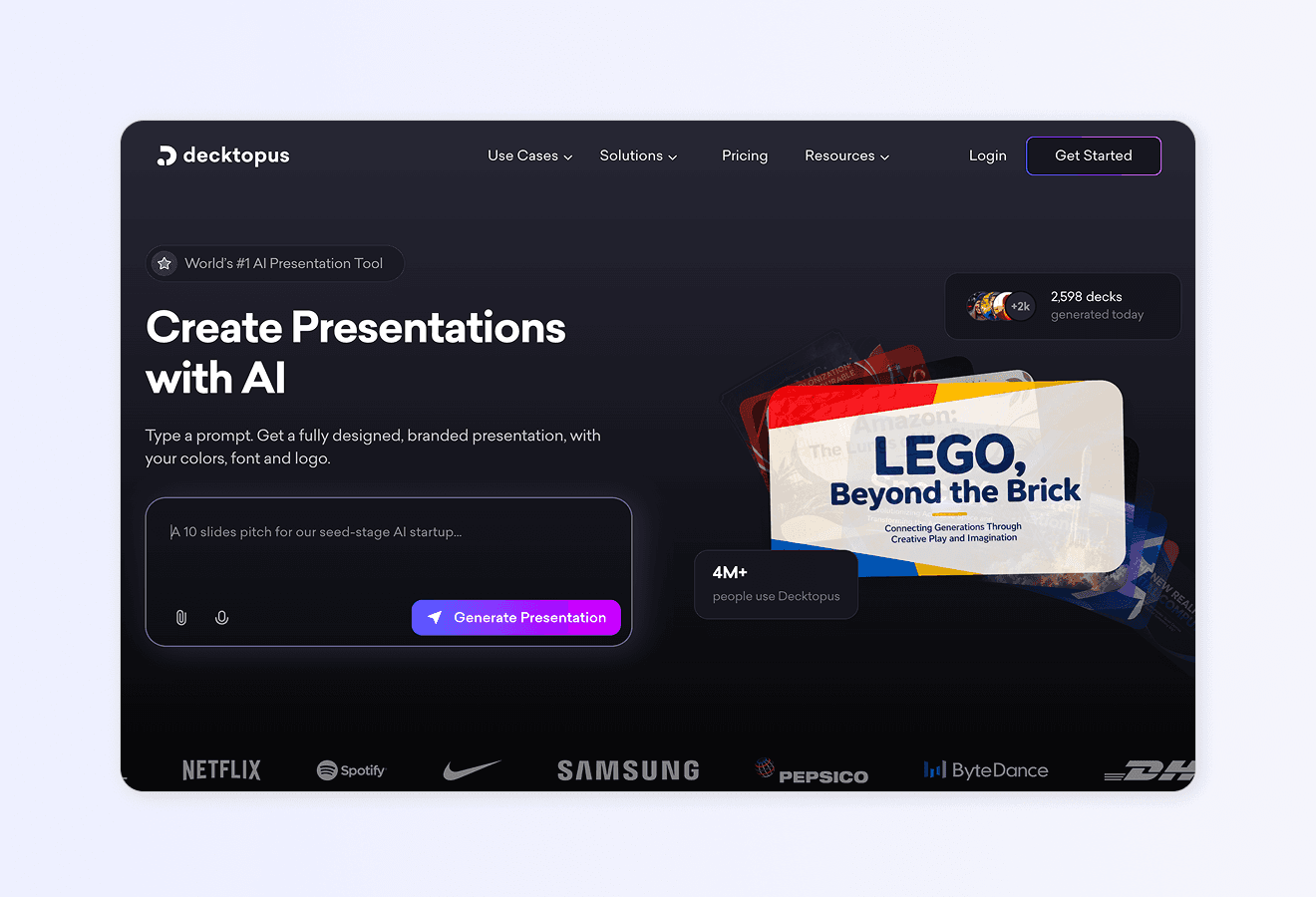
For sales teams, account executives, freelancers, and consultants who produce sales proposals on a recurring basis, Decktopus AI is the fastest path from discovery conversation to client-ready proposal deck. Every feature below is a confirmed part of the Decktopus AI platform. This section walks through how each feature applies specifically to sales proposal workflows.
Why Decktopus AI Is Built for Sales Proposals
Sales teams live and die by proposal turnaround, brand consistency, and pitch quality. Decktopus AI is designed to address all three.
AI-first proposal generation from a prompt. Type "Sales proposal for an enterprise B2B SaaS client focused on annual subscription with premium onboarding." Decktopus AI generates a full slide-by-slide proposal deck with content, layout, and design in minutes. What used to take an account executive an entire afternoon (or a full day for a polished pitch) now takes 15 minutes. This directly addresses the industry data showing proposals sent within 24 hours of discovery close at meaningfully higher rates.
AI Outline Generation as a separate reviewable step. Before Decktopus AI produces the full deck, it generates an editable outline. Adjust section titles, add or remove sections (like a Risks and Mitigations section for enterprise clients or a compliance matrix for RFP responses), and reorder before committing to full generation. Ideal for sales proposals where you want to align structure with the prospect's specific requirements or RFP evaluation criteria before generating.
Automatic brand import from your website URL. For sales teams and agencies, this is the biggest workflow win. Paste your company URL and Decktopus AI extracts your logo, colors, and typography and applies them across every slide. For white-label engagements or partner-branded proposals, paste the partner's URL instead. No manual Brand Kit setup per deal.
Beautify for reusing prior winning proposals. If you have a strong proposal template from a previous deal, upload it to Beautify. Two options:
Use as a Resource: extracts the key content from the previous proposal and builds a fresh version around them (requires a prompt describing the new engagement)
Redesign: keeps text and structure intact, applies fresh visual design
Ideal for iterating from a winning proposal template while personalizing to each new prospect.
Edit with AI for prompt-based refinement. Once your deck is generated, refining it doesn't require menu-hunting. Click Edit with AI and type in plain language:
"Add a tiered pricing table with three options"
"Add a case study slide featuring a comparable client with quantified outcomes"
"Add a Risks and Mitigations section for slide 8"
"Rewrite the executive summary to open with the prospect's specific challenge"
"Make the timeline more visual with clear milestone gates"
Every edit tracked in unlimited version history. Any past version can be restored.
Edit Text for manual polish. For fine-grained text edits without AI prompts, click Edit Text to directly edit each text field on a slide in a right-side panel. Perfect for final polish before sending.
AI Image Generation and Stock Image Library. Add custom AI-generated images by describing what you want, or search Unsplash and Freepik integrations directly through the Edit with AI panel. Ideal for sales proposals that need on-brand visuals, section dividers, or industry-specific imagery.
PDF import for reusing RFPs and briefs. Upload the prospect's RFP, brief, or discovery notes as a PDF and Decktopus AI can incorporate the content into the generated proposal. Ideal for turning a dense RFP into a structured, scoreable sales proposal response.
Loop AI Delivery Coach for high-stakes pitches. For account executives and sales leaders who walk prospects through proposals live, Loop AI Delivery Coach lets you rehearse the walkthrough and get real-time feedback on pacing, filler words, and clarity. No other major proposal tool offers this. Especially valuable for competitive deals where multiple vendors are being evaluated in back-to-back meetings.
Live-link sharing with auto-update. Share your proposal via a live link. Any updates you make afterward (refined pricing after prospect feedback, updated timeline, adjusted scope) automatically appear at the same URL. The prospect always sees the latest version. No re-sending updated PDFs. This is one of the most practical features for real-world sales workflows.
Embed on your website or client portal. Generate iframe code to embed the proposal deck directly on your company website, client portal, or shared workspace.
Custom Domain (Business plan). Connect a subdomain like proposals.yourcompany.com so your shared proposals appear on your branded URL. Business plan only.
Team Collaboration (Business plan). Invite team members (account managers, sales engineers, sales directors) to specific proposals for shared access. Not real-time co-editing, but shared deck-access lets team members work on the same proposal set. Business plan only.
Folders for account organization. Organize proposals by account or opportunity in dashboard folders. Ideal for sales teams managing many active opportunities simultaneously.
AI Carousel Maker for social selling. Turn key sales insights or client win stories into native LinkedIn or Instagram carousels for thought leadership content that supports business development.
Multi-format export. Download proposals as PDF, PPT, or PNG in Standard or Compressed quality. Send in the format your prospect prefers.
Version History for iteration. Every change to every slide is tracked. Restore any past version. Useful when prospects say "can you send the version with the original pricing too?"
Presentation Mode. Present directly from Decktopus AI's full-screen mode during pitch meetings, live or on Zoom.
Mobile Experience. Full workflow available on mobile devices. Update proposals on the go between meetings.
Decktopus AI vs. Traditional Sales Proposal Tools
Feature | Decktopus AI | Traditional Tools (Word, Docs, PowerPoint) |
|---|---|---|
AI-generated proposal deck from a prompt | Yes | No or limited |
PDF import (RFP into proposal) | Yes | Limited |
Automatic brand import from URL | Yes | No (manual per client) |
Beautify (refresh prior proposals) | Yes | No |
Edit with AI (prompt-based) | Yes | Partial or none |
Loop AI Delivery Coach for rehearsal | Yes | No |
Live-link auto-update | Yes | No |
Embed on external site | Yes | Limited |
Custom Domain (branded URL) | Yes (Business plan) | Not available |
Team Collaboration | Yes (Business plan) | Yes |
Folders for multi-account management | Yes | Yes |
Multi-format export (PDF, PPT, PNG) | Yes | Yes |
Presentation Mode for live pitches | Yes | Yes |
Version History (unlimited) | Yes | Limited |
Mobile Experience | Yes | Yes |
Who This Section Is For
Account executives and enterprise sales reps producing proposals for high-value deals
SDRs and BDRs delivering proposals as part of outbound and inbound cycles
Sales managers and directors building repeatable proposal workflows across a team
Agency owners and freelance consultants turning discovery calls into proposals within 24 hours
Founders and startup teams pitching customers, partners, and investors
Professional services firms (legal, accounting, IT) delivering formal service proposals
For deeper use case guidance, see Decktopus AI for Sales, Decktopus AI for Account Executives, Decktopus AI for Business Development Reps, Decktopus AI for Agencies, and Decktopus AI for Founders.
Step-by-Step: Build Your Sales Proposal With Decktopus AI
1. Describe your topic or upload the client brief. Type "Sales proposal for [prospect name] focused on [product or service]." Or upload the prospect's RFP, discovery call notes, or brief via the paperclip icon.
2. Choose your style. Import your company brand from your website URL, use a previously saved style, or let AI generate a style from scratch. For white-label or partner-branded proposals, import the partner's brand instead.
3. Review the AI-generated outline. Adjust sections (executive summary, client situation, proposed solution, scope, timeline, investment, social proof, next steps).
4. Generate the full proposal deck. Decktopus AI produces the complete slide-by-slide proposal with content, layout, and design.
5. Refine with Edit with AI or Edit Text. Use Edit with AI for structural changes ("add tiered pricing," "add a case study"). Use Edit Text for wording polish.
6. Add visuals. Use AI Image Generation or the Unsplash and Freepik stock libraries for on-brand imagery.
7. Rehearse with Loop AI Delivery Coach. Practice your walkthrough for the prospect meeting.
8. Export or share. Download as PDF for email delivery. Share via live link for auto-update. Embed on your client portal. Present directly from Presentation Mode during the pitch call.
For broader guidance, see the best AI presentation tools, the best business proposal tools, and our guide on how to do a presentation.
Ready to build a sales proposal that closes deals? Get started with Decktopus AI.
Frequently Asked Questions
What is a sales proposal?
A sales proposal is a formal document that a salesperson, agency, or business creates to pitch a specific product or service to a prospective customer. It defines the prospect's challenge, proposes a tailored solution, presents pricing and terms, and asks for a specific decision.
What is the difference between a sales proposal and a sales pitch?
A sales pitch is verbal and conversational, typically delivered early in the sales process. A sales proposal is a formal written document delivered after discovery, usually as the final step before purchase decision.
How long should a sales proposal be?
Standard sales proposals run 4 to 8 pages or slides. Complex enterprise deals may require 10 to 15. Formal RFP responses follow whatever length the RFP requires. Proposals under 5 pages close 31% more often than longer ones.
What should a sales proposal include?
Cover page, executive summary, client situation, revenue loss or business impact, why other solutions fall short, your unique solution, product or service details, statistics and case studies, and pricing with next steps. See the What to Include section above.
How quickly should I send a sales proposal after a discovery call?
Within 24 to 48 hours. Speed compounds. Proposals sent within 24 hours close at meaningfully higher rates than those sent days later.
Should I use tiered pricing in a sales proposal?
Yes. Proposals with three tiered options (essential, recommended, premium) close 35.8% more often than single-price proposals. Always identify which tier you recommend and why.
How do I customize a sales proposal without starting from scratch?
Keep a base template, but always customize the executive summary, client situation, and case studies for each prospect. Customized executive summaries alone lift close rates by up to 50%. Tools like Decktopus AI's Beautify feature can also redesign an existing proposal template for a new prospect in minutes.
How do I write a strong client situation section?
Use the prospect's own language from the discovery call or brief. Define the current state, the desired state, and the gap between them. Quantify impact where possible (revenue lost, hours wasted, opportunities missed). Avoid generic pain point statements.
What is the best way to present pricing in a sales proposal?
Present pricing after value, never before. Use tiered options (essential, recommended, premium) that differ in scope. Contextualize each price with a one-line justification tied to expected outcomes. Always identify the recommended option.
How do I handle objections in a sales proposal?
Anticipate the top 5 to 10 objections your prospects raise. Address them proactively inside the proposal (in a Risks and Mitigations section or by weaving them into the solution section). Objections raised in the proposal get addressed once. Objections that come up later slow the deal.
Can I use AI to generate sales proposals?
Yes. Decktopus AI generates full sales proposal decks from a short description in minutes with automatic brand import, Edit with AI for prompt-based refinement, Beautify for redesigning prior proposals, and Loop AI Delivery Coach for rehearsal. Designed specifically for the fast, high-volume proposal workflows sales teams need.
What is the best format for delivering a sales proposal?
PDF is standard for email delivery. Presentation decks work well for live walkthrough meetings. Live-link sharing (like Decktopus AI enables) lets you update the proposal after sending without re-emailing new versions, which is valuable when prospects request revisions.
How do I follow up on a sales proposal?
Follow up within 3 to 5 days if you haven't heard back. Reference something specific from the proposal or discovery call. Ask a specific question (not "any updates?"). Analytics-based follow-up (when the prospect actually opened the proposal) outperforms fixed-schedule follow-up.
What tool should I use to build a sales proposal deck fast?
Decktopus AI generates a full sales proposal deck from a short description in minutes with automatic brand import from your website URL, Beautify for refreshing older proposals, and Loop AI Delivery Coach for rehearsal. For more, see our roundup of the best business proposal tools and the best business proposal tools for founders.
What is the difference between a sales proposal and a marketing proposal?
A sales proposal sells a specific product or service to a prospect. A marketing proposal specifically pitches marketing services (like content, paid media, or brand strategy engagements). Both follow similar structures, but marketing proposals typically go deeper on channel strategy, KPIs, and campaign detail.
Conclusion
Sales proposals are where deals get won or lost. Get it right and you convert good discovery calls into signed contracts consistently. Get it wrong and you lose deals to competitors whose proposals were faster, more customized, and easier to say yes to.
The 7-step framework in this guide (analyze your prospect, define your USP, use copywriting best practices, keep it simple, build on a proven structure, add specific evidence, close with a dated call to action) gives you a repeatable process that scales across deals. The verified best practices (send within 24 hours, customize the executive summary, use tiered pricing, end with a dated call to action) directly move close rates in industry research.
Turning that framework into a polished, on-brand deck is where most sales teams lose hours per week. Decktopus AI is built specifically for this workflow: AI-generated proposal decks in minutes, automatic brand import from your website URL, Beautify for refreshing prior proposals, Edit with AI for iteration, Loop AI Delivery Coach for rehearsal, and live-link sharing for delivery. It's the fastest way to move from discovery to signed contract.
For more resources, see our guides on the sales pitch, sales process, and the best business proposal tools.
Related posts

Struggling to Find New Clients? 5 Proven Tips to Turn Prospecting Into Growth
Struggling to find new clients? Discover 5 proven tips, from proposals to paid ads, to build a steady pipeline of new business.
Sales & Proposals

Cracking the Code: Mastering B2B Sales Strategies & Techniques
Discover the essential guide to mastering B2B sales strategies and techniques, uncovering the secrets behind successful business-to-business selling. Explore the B2B sales process, optimize your team's performance, and elevate your approach to selling products for businesses.
Sales & Proposals

Mastering Proposals: Exploring the Best Business Proposal Tools and Software Solutions
Discover the best business proposal tools, including PandaDoc and Proposable, to streamline your proposal process and win more clients.
Sales & Proposals