Business & Strategy
Sample Business Plan for Nonprofit Organization: What Funders Actually Read
A real sample business plan structure for nonprofit organizations, with examples from charity: water and Khan Academy, plus the 5 mistakes that kill funding.


Decktopus Content Team
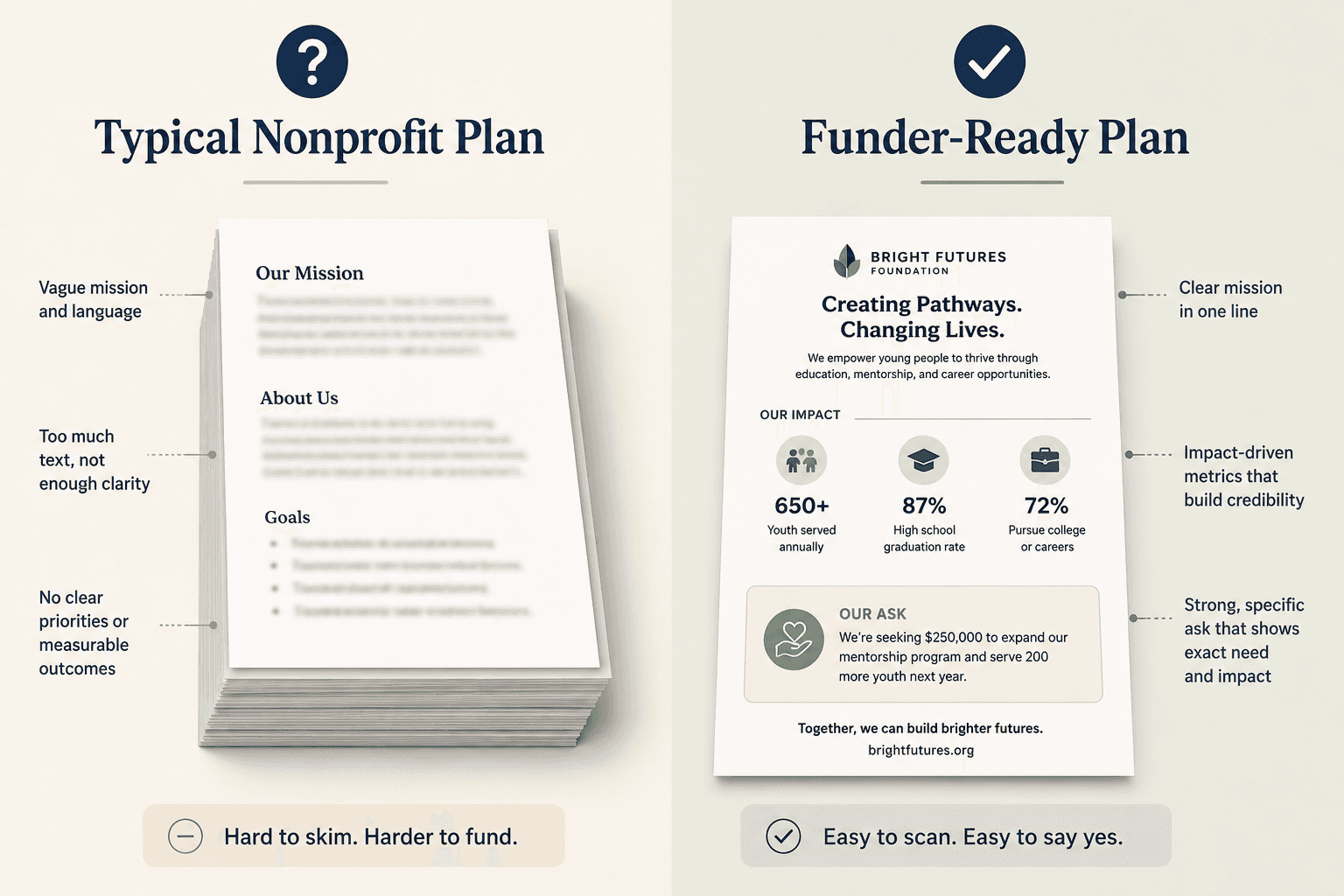
Most nonprofit business plans are written for the founder’s clarity.
The ones that get funded are written for the funder’s questions.
That’s the difference between a 30-page document gathering dust on a board member’s desk and a 12-slide plan that opens doors to grants, partnerships, and donors. The structure looks similar. The mindset is completely different.
Most nonprofit business plan resources online are just for-profit frameworks with the word “revenue” replaced by “donations.” They miss what makes a nonprofit plan actually work: a clear answer to why your organization should exist, why now, and how it will create durable impact without burning out the founder or chasing every grant that comes along.
In this guide, you’ll get:
A real sample structure used by funded nonprofits
Why most nonprofit plans fail to get read
Named mistakes that kill funding conversations early
Examples from charity: water, Khan Academy, and KIPP
How to present your plan to boards, donors, and grantmakers
What Makes a Nonprofit Business Plan Different
A for-profit business plan answers one core question: “How will this business make money?”
A nonprofit business plan answers a harder one: “How will this organization create durable impact without depending on the founder’s energy or a single funder’s generosity?”
That changes everything.
Revenue becomes funding strategy. Customers become beneficiaries and donors (two completely different audiences). Profit becomes program outcomes. Defensibility becomes mission integrity over time.
If you’re unsure whether you actually need a business plan or a business proposal, our guide on the difference between a business proposal and a business plan clarifies when each is appropriate.
If you write your nonprofit plan like a startup pitch with the word “social” added, funders will see through it in five minutes.
The 3 Audiences of a Nonprofit Business Plan
Most nonprofit founders treat the business plan as a single document for a single reader. That’s the first mistake.
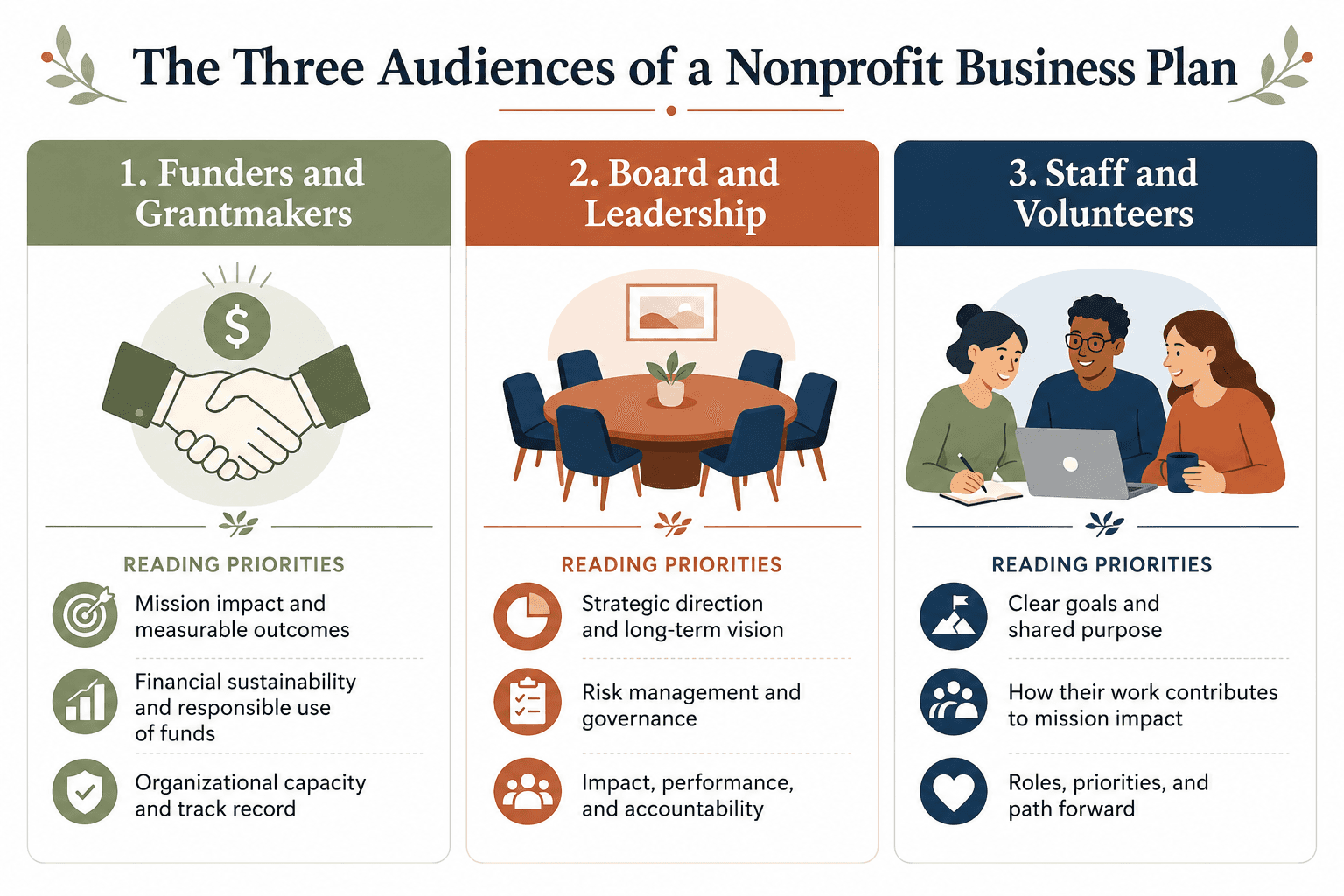
A real nonprofit business plan serves three distinct audiences. Each one reads it differently.
Audience 1: Funders and Grantmakers
They’re asking:
Is this mission urgent and clearly defined?
Can this team actually execute?
Will my money produce measurable impact?
Is there a plan beyond one or two grant cycles?
Funders skim. They look for clarity, specificity, and traction.
Audience 2: Your Board and Leadership Team
They’re asking:
Do we know what we’re saying yes to?
What are we explicitly choosing not to do?
How do we measure progress?
What does the next 18 months look like operationally?
Boards read for accountability and decision-making frameworks.
Audience 3: Staff and Volunteers
They’re asking:
What is our actual day-to-day priority?
Whose problems are we solving?
How does my work connect to the bigger goal?
Staff read for direction and motivation.
A great nonprofit business plan speaks to all three in one document. Most plans speak only to the founder.
Sample Business Plan Structure for a Nonprofit Organization
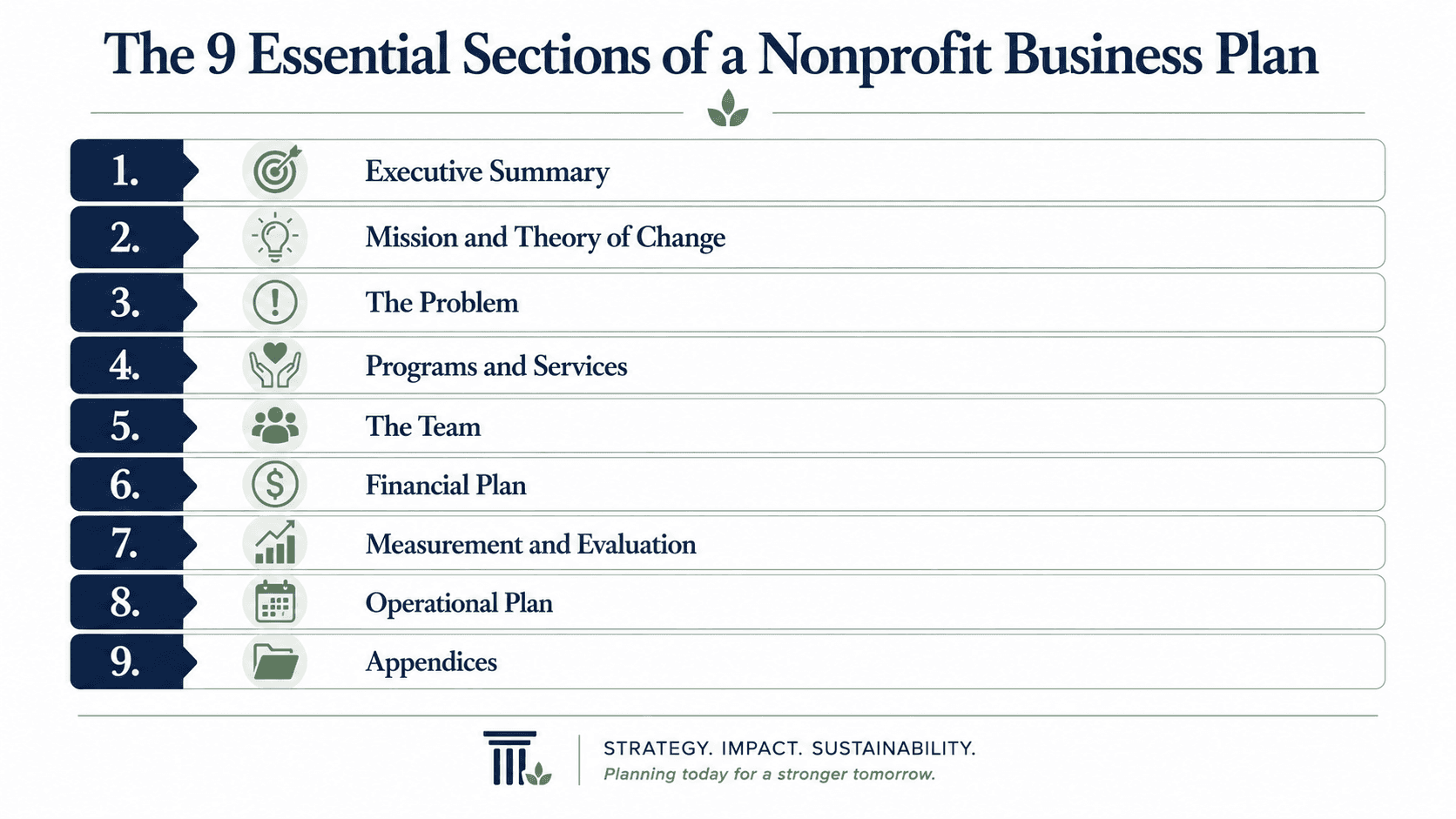
Here’s the structure that consistently works for nonprofits getting funded, scaled, or partnered with.
1. Executive Summary (1 page)
The hardest page to write. The first page funders read.
Cover:
The problem you exist to solve
Who you serve and why
Your proposed approach
Current traction (programs, partnerships, outcomes)
What you’re asking for (funding, partnership, board members)
Keep it under 400 words. If a funder can’t grasp your mission and ask in 90 seconds, you’ve already lost them. A polished executive summary slide is often the first thing a foundation officer sees, which is why nonprofit leaders use Decktopus to generate a branded, ready-to-share version in minutes.
For more on writing this critical page, see our guide on how to write an executive summary, which walks through what funders look for in the opening.
2. Mission, Vision, and Theory of Change
This is where most nonprofit plans get lazy.
A mission statement is not “to improve lives in our community.” That tells me nothing.
Weak: “To help children in need.”
Strong: “To increase college matriculation rates for first-generation students in [specific city] by providing structured mentorship, application support, and financial aid navigation from junior year through their first college semester.”
The strong version tells me who, where, what, and how. The weak version is generic enough to apply to any of 10,000 nonprofits.
A theory of change explains the chain: “If we do X, then Y will happen, because Z.” This is what funders want to see, and what most nonprofits skip entirely.
3. The Problem and Why It Matters Now
Funders fund urgency.
Show:
The size of the problem (use real data, not vague claims)
Who is most affected
Why current solutions are insufficient
Why timing matters
“Childhood literacy is important” is not a problem statement. “Forty-three percent of third graders in our county read below grade level, and the existing district intervention budget was cut by 22% last year” is a problem statement.
A thorough market analysis approach (the same one for-profits use) helps frame the problem with data instead of feelings.
4. Your Programs and Services
Describe what you actually do.
For each program, cover:
Who participates
What happens
What outcomes you measure
Cost per participant or beneficiary served
Current capacity vs demand
This is where you need to resist what I’d call Theater of Activities. Listing every event, workshop, and initiative without showing impact. Funders don’t want a calendar. They want results.
5. The Team
Bios matter, but credentials are not enough.
Show:
Why this team is uniquely qualified to run this organization
What experience or lived perspective makes you credible
Who is full-time vs part-time vs board
What expertise you currently lack
For deeper guidance on team and credibility framing, our about me presentation guide covers how to introduce yourself in ways that build trust quickly.
6. Financial Plan and Funding Strategy
Here’s where most nonprofit plans implode.
A real financial plan includes:
Annual budget broken down by program, operations, and fundraising
Current revenue mix (grants, individual donors, earned revenue, events)
Sustainability plan: how you’ll be funded in three years if your largest current funder disappears
Cost per outcome (not just total spend)
The cost-per-outcome metric matters most. “We spent $500,000 last year” tells me nothing. “We placed 240 first-generation students into four-year colleges at an average cost of $2,083 per matriculation” tells me everything. Once your numbers are ready, Decktopus turns your financials into clean visual slides automatically, so board members and grantmakers see your cost-per-outcome story at a glance instead of buried in a spreadsheet.
If your funding is heavily dependent on a single source today, our guide on bootstrapping a startup covers principles that apply directly to lean nonprofits planning for sustainability.
7. Measurement and Evaluation
How you’ll know it’s working.
Funders distinguish between:
Outputs: What you produced (workshops held, meals served, students enrolled)
Outcomes: What changed because of what you produced (literacy improvement, employment rates, college matriculation)
Impact: Long-term, durable change in the community
Outcome data lands harder when it’s visualized, which is why nonprofit teams use Decktopus to turn their measurement spreadsheets into slide-ready charts that show cost-per-outcome, year-over-year impact, and beneficiary growth in formats funders can actually skim in 30 seconds.
Most nonprofit plans report outputs. The funded ones report outcomes and impact.
For visualizing outcome data, tools that generate clean bar charts or pie charts help donors and board members understand impact at a glance.
8. Operational Plan and Milestones
The 18-month roadmap.
Show:
Quarterly milestones
Hiring plan
Program expansion or refinement
Specific fundraising targets and timing
Risks and how you’ll respond to them
This is also where you should explicitly call out what you are choosing not to do. Saying “we will not expand to a third city in 2026” is more credible than promising you’ll do everything.
9. Appendices
Supporting documents:
501(c)(3) status confirmation
Board roster and bios
Three-year financial statements
Letters of support
Detailed program data
Real Examples of Nonprofit Plans That Worked
charity: water and the 100% Model
charity: water’s early business plan separated operating costs from program costs entirely.
100% of public donations went to water projects. A separate group of private donors funded operations.
That positioning decision was the entire business model. It solved a perception problem nonprofits had been losing on for decades: donors hated funding overhead. So they built a plan that eliminated overhead from the donor’s view.
The lesson: a nonprofit business plan can win on positioning, not just programs.
Khan Academy’s Original Plan
Khan Academy didn’t start as a nonprofit education giant. It started as Salman Khan recording YouTube tutorials for his cousins.
The early plan focused on one thing: free, world-class education delivered through video.
It deliberately rejected the temptation to expand into curriculum sales, certifications, or paid teacher training. That focus is what made the plan fundable.
The lesson: a nonprofit plan that says no to revenue diversification is often more credible than one that promises five income streams.
KIPP and Replicable Models
KIPP’s early business plan wasn’t about the schools themselves. It was about a replicable operational model that could be deployed across cities.
Funders weren’t being asked to fund a school. They were being asked to fund a model that would produce hundreds of schools.
The lesson: think about whether you’re funding a project or a system. The latter raises more money.
5 Named Mistakes That Kill Nonprofit Business Plans
1. Mission Statement Inflation
Vague, broad statements that mean nothing. “Empowering communities through hope and opportunity.” Empower whom? Through what? Where?
Specificity is the difference between a plan that gets funded and one that gets filed away.
2. Mission Drift Through Funding
Taking grants that pull you outside your core focus because the money is available.
It feels like growth. It usually creates fragility. One year of mission drift can break your theory of change.
3. Founder-Voice Plan
The plan reads like the founder’s internal monologue. Lots of passion, no structure. Funders need to find answers to their questions in 60 seconds. If they have to read your origin story to find your budget, you’ve lost them.
4. Theater of Activities
Listing every workshop, event, and initiative without showing what changed because of them.
Activities are not outcomes. Funders learned this distinction a decade ago. Many nonprofits still haven’t. While organizing photos and records of these daily events through digital asset management for nonprofits is highly useful for your marketing and social media efforts, your business plan itself must remain strictly focused on the measurable results those activities produced.
5. The Forever Grant Trap
Building your three-year plan around one major grant you hope will renew.
It’s the nonprofit equivalent of a startup with one customer. Funders see this and back away.
How to Present a Nonprofit Business Plan
A 40-page Word document is not a business plan presentation. It’s a reference document.
When you actually present your plan to a foundation, a board, or a partner, you need a tight visual deck.
The most effective nonprofit plan presentations include:
A single-slide problem statement
A clear mission and theory of change
Program outcomes with real numbers
Financial summary with cost per outcome
A specific, actionable ask
You’re not trying to explain everything. You’re trying to make the funder lean forward. The fastest way to turn a 30-page plan into a 12-slide funder-ready deck is to describe your nonprofit in Decktopus, apply your brand with one click, and let AI handle the design while you focus on the story.
For more on framing pitches in a way that earns commitment, see our guide on how to sell an idea effectively. The same principles apply to nonprofit funding asks.
If you’re writing a partnership proposal alongside your business plan, our business proposal guide walks through how to structure the ask for maximum clarity.
Turning Your Nonprofit Plan Into a Presentation
You’ve done the strategic work. Now make it readable in 15 minutes.
This is where Decktopus saves nonprofit leaders hours of design time.
Here’s how it works:
Describe your topic. Type something like “Business plan presentation for [your organization name], a nonprofit serving [population] through [programs].” Or upload your draft plan as a supporting file.
Choose your style. Paste your organization’s website URL to apply your brand automatically. Decktopus pulls your logo, colors, and fonts so every slide stays on-brand. No design review needed.
Review the outline. Decktopus generates a slide structure covering mission, problem, programs, team, financials, and the ask. Adjust the order before the full deck is built.
Refine in the editor. Use the prompt bar with instructions like “show our cost-per-outcome as a chart” or “make the theory of change more visual.” Brand Compliance auto-checks every slide.
Export or share. Download as PDF or PPT for your grant submission, share via link with board members, or present directly to funders.
If you’re comparing AI presentation tools for your nonprofit, our guide to the best AI presentation tools covers what to look for in speed, design, and brand consistency.
Frequently Asked Questions
What is the difference between a nonprofit business plan and a strategic plan?
A business plan is operational and forward-facing. It covers programs, finances, team, and milestones for the next 18 to 36 months. A strategic plan is broader and longer-range, often spanning three to five years. Most nonprofits need both, but a business plan is what funders ask for first.
How long should a nonprofit business plan be?
The written document is typically 15 to 25 pages, including appendices. The presentation version is 10 to 15 slides. Anything longer suggests you haven’t prioritized what matters.
Do I need a business plan to apply for grants?
Most grantmakers don’t require a formal business plan, but they ask the same questions one answers: who you serve, what you do, how you measure outcomes, and what funding you need. Having a real plan makes grant applications dramatically faster.
How often should a nonprofit business plan be updated?
At minimum, annually. Major program changes, leadership transitions, or new funding strategies should trigger a refresh. The plan is a living document, not a one-time artifact.
Should we share our business plan publicly?
Many funders prefer to see it. Some nonprofits publish a public-facing version on their website to build trust with donors and partners. Keep sensitive financial details and strategic decisions internal.
Can AI help write a nonprofit business plan?
Yes. AI is useful for drafting sections, summarizing research, and generating presentation slides. But the strategic decisions (your mission focus, your theory of change, what you choose not to do) still require human judgment.
What’s the most common reason nonprofit plans get rejected by funders?
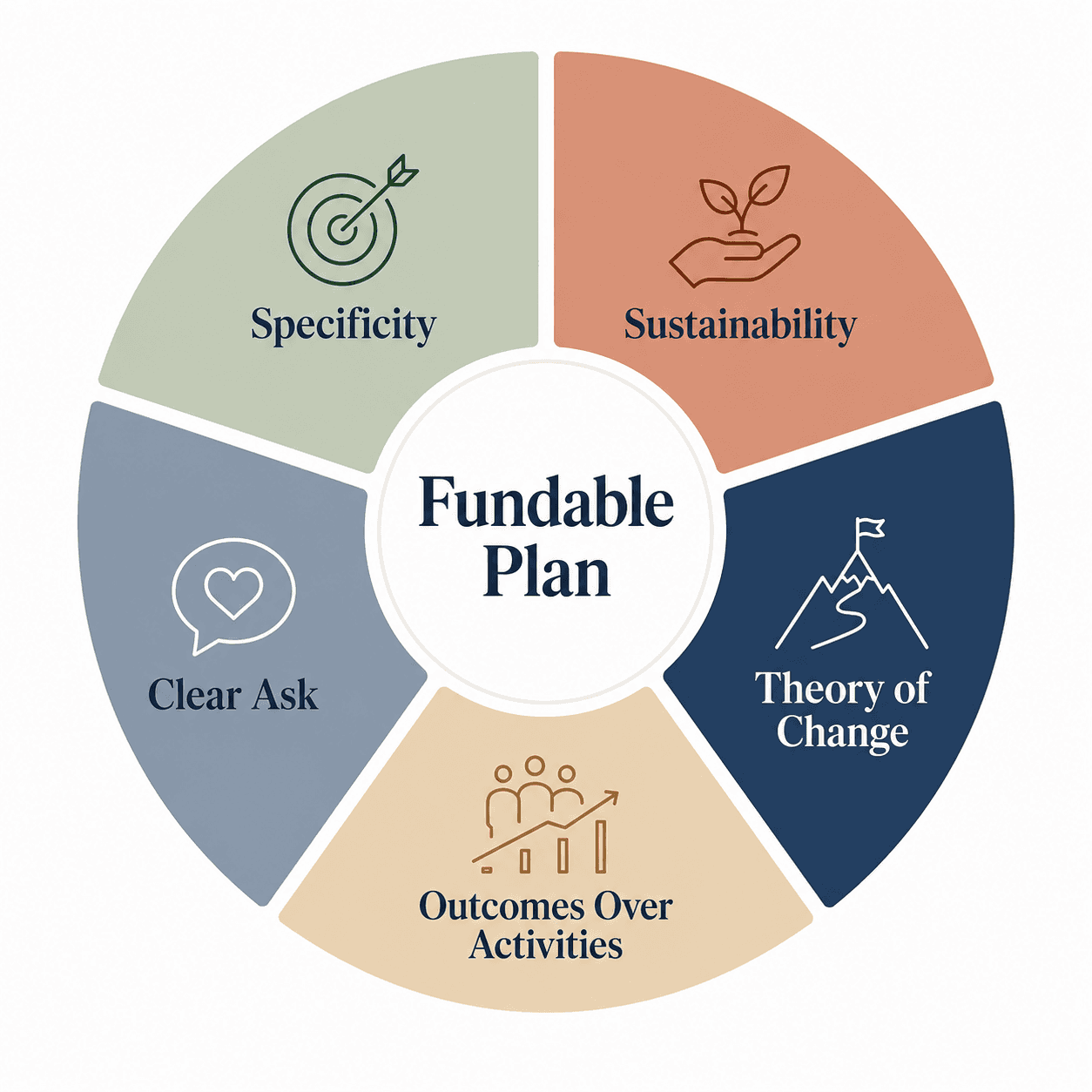
Vagueness. Funders reject plans that don’t specify who is served, what changes, or how impact is measured. Specificity is the single most important quality of a fundable nonprofit business plan.
Final Thoughts
The best nonprofit business plans are not the longest, the most polished, or the most ambitious.
They’re the clearest.
They answer the questions funders are actually asking. They distinguish outcomes from activities. They say what the organization will not do. And they leave the reader confident that the founder knows exactly where the money is going and what change it will produce.
Mission alone doesn’t get funded. Mission with specificity, sustainability, and a clear theory of change does.
Write your plan for the funder’s questions, not your own clarity. The funded organizations have always done it this way.
Related posts

How to Improve Communication Skills at Work (2026 Practical Guide)
The 5 workplace communication skills that matter most, the CLEAR framework, and the AI practice method that turns weak communicators into strong ones.
Business & Strategy

Job Interview Sample Questions: How to Practice Your Answers (2026)
The 20 most common interview questions, the STAR framework for answers, and the AI practice method that turns rehearsed responses into confident ones.
Business & Strategy

How to Negotiate a Raise: The Script, Practice Method & Tips That Actually Work
A step-by-step script for negotiating a raise, common mistakes to avoid, and the AI practice method that turns a nervous ask into a confident one.
Business & Strategy