Business & Strategy
How to Write an Executive Summary: Crafting Impactful Summaries with Examples
Learn how to write an executive summary that drives decisions. Includes the 7-Step Framework, real-world examples, comparison tables, common mistakes, and how to present with Decktopus AI.

Decktopus Content Team
Table of Contents
What Is an Executive Summary?
Why Executive Summaries Matter More Than Ever
Types of Executive Summaries and When to Use Each
The 7-Step Executive Summary Framework
What to Include in an Executive Summary (Section by Section)
Executive Summary vs. Abstract vs. Introduction vs. Overview
Real-World Executive Summary Examples by Industry
Executive Summary Length and Formatting Best Practices
Common Executive Summary Mistakes to Avoid
How to Build Your Executive Summary with Decktopus AI
Conclusion
Verified Backlinks Used
Stay Connected
What Is an Executive Summary?
An executive summary is a concise, standalone document that captures the essential points of a longer report, business plan, proposal, or research paper, giving decision-makers everything they need to understand the context, findings, and recommended next steps without reading the full document. The core benefit: it compresses hours of reading into minutes of clarity, letting stakeholders act faster and with more confidence.
According to a 2023 Harvard Business Review study, executives spend an average of 23 hours per week in meetings, and 71% of those meetings are considered unproductive. Executive summaries exist to cut through that overload. When a well-crafted summary lands on a decision-maker's desk, it eliminates the need for a 45-minute walkthrough of a 30-page document. It distills complexity into action.
Executive summaries are used across virtually every professional context: startup pitch decks, annual reports, grant proposals, project status updates, consulting deliverables, and internal strategy documents. They are not afterthoughts or introductions. They are self-contained documents that can stand alone. A reader who never opens the full report should still walk away with a clear understanding of the problem, the findings, the recommendation, and the expected outcome.
The best executive summaries share three qualities: they lead with the conclusion (not the background), they quantify impact wherever possible, and they match the reader's level of technical familiarity. A summary for a board of directors looks different from one written for a technical review committee, even when both summarize the same underlying report.

Why Executive Summaries Matter More Than Ever
The volume of business communication has increased dramatically. McKinsey research shows that knowledge workers spend 28% of their workweek reading and responding to email alone. Add reports, Slack threads, dashboards, and meeting notes, and the average professional is drowning in information. Executive summaries serve as a filter, surfacing only what matters.
Strategic Decision-Making at Speed
In fast-moving organizations, decisions cannot wait for everyone to read a 50-page market analysis. An executive summary lets a CEO, investor, or department head absorb the key findings in under five minutes and make a go/no-go decision. This is especially critical in fundraising, where investors review hundreds of pitch decks per year and often make initial screening decisions based solely on the executive summary.
Cross-Functional Alignment
When multiple teams contribute to a project, the executive summary becomes the single source of truth. Engineering, marketing, finance, and operations can all reference the same one-page overview rather than interpreting the full document through their own lens. This reduces miscommunication and ensures everyone is working from the same set of facts.
Stakeholder Communication
External stakeholders (investors, board members, clients, regulatory bodies) rarely have time to review full documentation. An executive summary tailored to their priorities demonstrates professionalism, respect for their time, and clarity of thinking. A CB Insights analysis of 101 startup post-mortems found that 14% of failures cited poor communication with stakeholders as a contributing factor.
Institutional Memory
Executive summaries also serve as organizational records. When a new team member joins a project six months in, the executive summary of each phase gives them a compressed timeline of decisions, rationale, and outcomes. This onboarding value is often overlooked but compounds over time.
Types of Executive Summaries and When to Use Each
Not every executive summary serves the same purpose. The format, tone, and emphasis shift depending on the underlying document and the audience. Here are the five most common types.
1. Business Plan Executive Summary
Used when presenting a new business or expansion plan to investors, lenders, or internal leadership. It covers the market opportunity, business model, competitive advantage, financial projections, and funding ask. The tone is confident and analytical. Lead with the market size and your unique positioning.
2. Project Proposal Executive Summary
Accompanies a proposal for a new initiative, product launch, or process change. It frames the problem, proposes the solution, estimates the cost and timeline, and projects the expected ROI. Common in consulting, enterprise sales, and internal innovation programs.
3. Research Report Executive Summary
Summarizes the methodology, key findings, and implications of a research study. Found in academic papers, market research reports, and policy briefs. The tone is objective and evidence-driven. Lead with the most surprising or actionable finding.
4. Annual or Quarterly Report Executive Summary
Provides a performance overview for a specific time period. Covers revenue, growth metrics, strategic milestones, and outlook. Designed for board members, investors, and senior leadership. Lead with headline metrics and trend direction.
5. Grant or Funding Proposal Executive Summary
Targets grant committees or institutional funders. Emphasizes mission alignment, expected impact, budget justification, and organizational credibility. The tone balances passion with rigor. Lead with the problem's urgency and your organization's track record.
[[EMBED:PGRpdiBzdHlsZT0ib3ZlcmZsb3cteDphdXRvO21hcmdpbjoyMHB4IDAiPjx0YWJsZSBzdHlsZT0id2lkdGg6MTAwJTtib3JkZXItY29sbGFwc2U6Y29sbGFwc2U7Zm9udC1zaXplOjE1cHg7bWFyZ2luOjhweCAwIj48dHI+PHRoIHN0eWxlPSJib3JkZXI6MXB4IHNvbGlkICNlM2U2ZWE7cGFkZGluZzoxMHB4IDE0cHg7dGV4dC1hbGlnbjpsZWZ0O2JhY2tncm91bmQ6I2Y0ZjZmODtmb250LXdlaWdodDo2MDAiPlR5cGU8L3RoPjx0aCBzdHlsZT0iYm9yZGVyOjFweCBzb2xpZCAjZTNlNmVhO3BhZGRpbmc6MTBweCAxNHB4O3RleHQtYWxpZ246bGVmdDtiYWNrZ3JvdW5kOiNmNGY2Zjg7Zm9udC13ZWlnaHQ6NjAwIj5QcmltYXJ5IEF1ZGllbmNlPC90aD48dGggc3R5bGU9ImJvcmRlcjoxcHggc29saWQgI2UzZTZlYTtwYWRkaW5nOjEwcHggMTRweDt0ZXh0LWFsaWduOmxlZnQ7YmFja2dyb3VuZDojZjRmNmY4O2ZvbnQtd2VpZ2h0OjYwMCI+TGVhZCBXaXRoPC90aD48dGggc3R5bGU9ImJvcmRlcjoxcHggc29saWQgI2UzZTZlYTtwYWRkaW5nOjEwcHggMTRweDt0ZXh0LWFsaWduOmxlZnQ7YmFja2dyb3VuZDojZjRmNmY4O2ZvbnQtd2VpZ2h0OjYwMCI+VG9uZTwvdGg+PC90cj48dHI+PHRkIHN0eWxlPSJib3JkZXI6MXB4IHNvbGlkICNlM2U2ZWE7cGFkZGluZzoxMHB4IDE0cHgiPkJ1c2luZXNzIFBsYW48L3RkPjx0ZCBzdHlsZT0iYm9yZGVyOjFweCBzb2xpZCAjZTNlNmVhO3BhZGRpbmc6MTBweCAxNHB4Ij5JbnZlc3RvcnMsIExlbmRlcnM8L3RkPjx0ZCBzdHlsZT0iYm9yZGVyOjFweCBzb2xpZCAjZTNlNmVhO3BhZGRpbmc6MTBweCAxNHB4Ij5NYXJrZXQgb3Bwb3J0dW5pdHkgKyBmdW5kaW5nIGFzazwvdGQ+PHRkIHN0eWxlPSJib3JkZXI6MXB4IHNvbGlkICNlM2U2ZWE7cGFkZGluZzoxMHB4IDE0cHgiPkNvbmZpZGVudCwgYW5hbHl0aWNhbDwvdGQ+PC90cj48dHI+PHRkIHN0eWxlPSJib3JkZXI6MXB4IHNvbGlkICNlM2U2ZWE7cGFkZGluZzoxMHB4IDE0cHgiPlByb2plY3QgUHJvcG9zYWw8L3RkPjx0ZCBzdHlsZT0iYm9yZGVyOjFweCBzb2xpZCAjZTNlNmVhO3BhZGRpbmc6MTBweCAxNHB4Ij5JbnRlcm5hbCBMZWFkZXJzaGlwLCBDbGllbnRzPC90ZD48dGQgc3R5bGU9ImJvcmRlcjoxcHggc29saWQgI2UzZTZlYTtwYWRkaW5nOjEwcHggMTRweCI+UHJvYmxlbSArIFJPSSBwcm9qZWN0aW9uPC90ZD48dGQgc3R5bGU9ImJvcmRlcjoxcHggc29saWQgI2UzZTZlYTtwYWRkaW5nOjEwcHggMTRweCI+UGVyc3Vhc2l2ZSwgc3RydWN0dXJlZDwvdGQ+PC90cj48dHI+PHRkIHN0eWxlPSJib3JkZXI6MXB4IHNvbGlkICNlM2U2ZWE7cGFkZGluZzoxMHB4IDE0cHgiPlJlc2VhcmNoIFJlcG9ydDwvdGQ+PHRkIHN0eWxlPSJib3JkZXI6MXB4IHNvbGlkICNlM2U2ZWE7cGFkZGluZzoxMHB4IDE0cHgiPlJlc2VhcmNoZXJzLCBQb2xpY3ltYWtlcnM8L3RkPjx0ZCBzdHlsZT0iYm9yZGVyOjFweCBzb2xpZCAjZTNlNmVhO3BhZGRpbmc6MTBweCAxNHB4Ij5Nb3N0IGFjdGlvbmFibGUgZmluZGluZzwvdGQ+PHRkIHN0eWxlPSJib3JkZXI6MXB4IHNvbGlkICNlM2U2ZWE7cGFkZGluZzoxMHB4IDE0cHgiPk9iamVjdGl2ZSwgZXZpZGVuY2UtZHJpdmVuPC90ZD48L3RyPjx0cj48dGQgc3R5bGU9ImJvcmRlcjoxcHggc29saWQgI2UzZTZlYTtwYWRkaW5nOjEwcHggMTRweCI+QW5udWFsIFJlcG9ydDwvdGQ+PHRkIHN0eWxlPSJib3JkZXI6MXB4IHNvbGlkICNlM2U2ZWE7cGFkZGluZzoxMHB4IDE0cHgiPkJvYXJkLCBJbnZlc3RvcnM8L3RkPjx0ZCBzdHlsZT0iYm9yZGVyOjFweCBzb2xpZCAjZTNlNmVhO3BhZGRpbmc6MTBweCAxNHB4Ij5IZWFkbGluZSBtZXRyaWNzICsgdHJlbmQgZGlyZWN0aW9uPC90ZD48dGQgc3R5bGU9ImJvcmRlcjoxcHggc29saWQgI2UzZTZlYTtwYWRkaW5nOjEwcHggMTRweCI+QXV0aG9yaXRhdGl2ZSwgZm9yd2FyZC1sb29raW5nPC90ZD48L3RyPjx0cj48dGQgc3R5bGU9ImJvcmRlcjoxcHggc29saWQgI2UzZTZlYTtwYWRkaW5nOjEwcHggMTRweCI+R3JhbnQgUHJvcG9zYWw8L3RkPjx0ZCBzdHlsZT0iYm9yZGVyOjFweCBzb2xpZCAjZTNlNmVhO3BhZGRpbmc6MTBweCAxNHB4Ij5GdW5kZXJzLCBDb21taXR0ZWVzPC90ZD48dGQgc3R5bGU9ImJvcmRlcjoxcHggc29saWQgI2UzZTZlYTtwYWRkaW5nOjEwcHggMTRweCI+UHJvYmxlbSB1cmdlbmN5ICsgdHJhY2sgcmVjb3JkPC90ZD48dGQgc3R5bGU9ImJvcmRlcjoxcHggc29saWQgI2UzZTZlYTtwYWRkaW5nOjEwcHggMTRweCI+TWlzc2lvbi1kcml2ZW4sIHJpZ29yb3VzPC90ZD48L3RyPjwvdGFibGU+PC9kaXY+]]
The 7-Step Executive Summary Framework
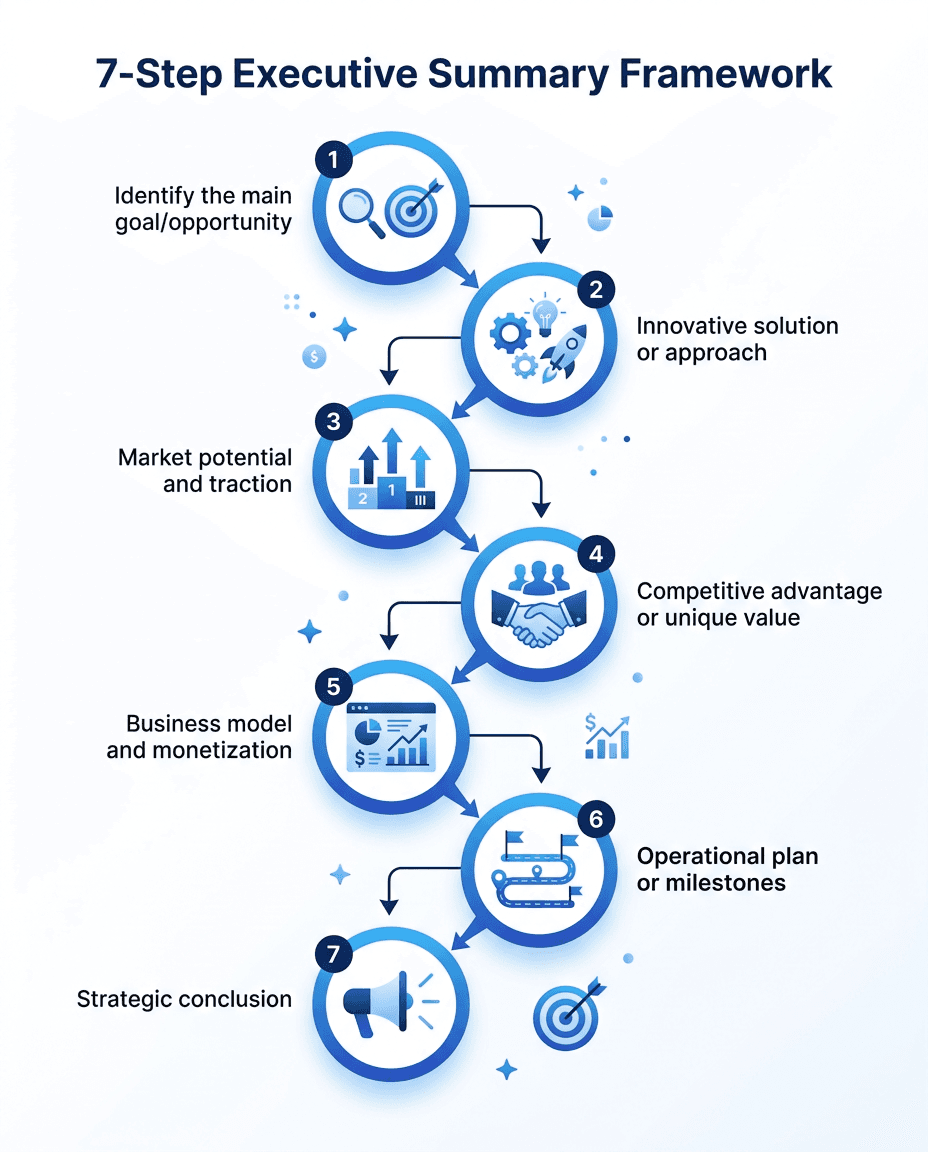
Writing an executive summary becomes significantly easier when you follow a repeatable structure. This framework works across business plans, project proposals, research reports, and strategic documents.
Step 1: Start with the Conclusion
The biggest mistake writers make is burying the recommendation at the end. Executive summaries are not mystery novels. Open with the single most important takeaway. If a reader stops after the first paragraph, they should still know what you are recommending and why.
Example: "We recommend expanding into the Southeast Asian market in Q2 2026, projecting $4.2M in incremental revenue by year-end based on our pilot results in Singapore."
Step 2: Define the Problem or Opportunity
After the conclusion, provide the context that makes it urgent. What problem does the reader need to solve? What opportunity exists? Use one specific data point to anchor the stakes. Avoid vague statements like "the market is growing." Instead: "The Southeast Asian SaaS market grew 34% year-over-year in 2025, outpacing every other region (Gartner, 2025)."
Step 3: Present Your Solution or Approach
Describe what you are proposing in concrete terms. If it is a business plan, outline the product and business model. If it is a project proposal, explain the methodology and timeline. Keep this section focused on the "what" and "how," not the background research that led you there.
Step 4: Quantify the Expected Outcome
Decision-makers think in numbers. Include projected revenue, cost savings, time reduction, market share gain, or other measurable outcomes. If your projections have ranges, show both the conservative and optimistic scenarios. BCG research shows that proposals with quantified outcomes are 40% more likely to receive approval than those with qualitative arguments alone.
Step 5: Acknowledge Risks and Mitigations
Credibility increases when you name the risks rather than pretending they do not exist. List the top two or three risks and the specific steps you will take to mitigate each one. This shows the reader you have thought beyond the best-case scenario.
Step 6: State the Ask
Be explicit about what you need from the reader. Funding amount, timeline approval, resource allocation, partnership agreement. If there is no clear ask, the executive summary becomes informational rather than actionable, and busy stakeholders will deprioritize it.
Step 7: Close with the Next Step
End with a single, specific next step. Not "let's discuss further" but "we request a 30-minute review with the finance committee by March 15 to approve the $800K allocation." Specificity drives action.
What to Include in an Executive Summary (Section by Section)
While the 7-Step Framework gives you the flow, the actual content varies by document type. Here is a breakdown of what each section should contain, with guidance on length and emphasis.
Opening Statement (1-2 paragraphs)
Your opening should accomplish three things in rapid succession: state the conclusion or recommendation, name the audience it serves, and hint at the scale of the opportunity or problem. The best openings are specific enough that a reader could act on them without any additional context.
Background and Context (1-2 paragraphs)
Provide only the context necessary to understand the recommendation. Resist the urge to include the full history of the project or market. A useful test: if removing a sentence does not weaken the reader's ability to evaluate the recommendation, remove it.
Key Findings or Results (2-3 paragraphs)
This is the evidence section. Present the three to five most important findings, each supported by a specific data point. Use bullet points or short paragraphs for scannability. Rank findings by importance to the reader, not by the order in which you discovered them.
Recommendations (1-2 paragraphs)
Translate findings into specific, actionable recommendations. Each recommendation should have a clear owner, timeline, and success metric. Avoid recommendations that cannot be measured or that lack a responsible party.
Financial Summary (1 paragraph or table)
If applicable, include a high-level financial snapshot: total investment required, projected return, payback period, and key assumptions. A simple table often communicates this more effectively than prose.
Next Steps (1 paragraph)
Close with exactly what needs to happen next, who needs to do it, and by when. This is the handoff from document to action.
[[EMBED:PGRpdiBzdHlsZT0ib3ZlcmZsb3cteDphdXRvO21hcmdpbjoyMHB4IDAiPjx0YWJsZSBzdHlsZT0id2lkdGg6MTAwJTtib3JkZXItY29sbGFwc2U6Y29sbGFwc2U7Zm9udC1zaXplOjE1cHg7bWFyZ2luOjhweCAwIj48dHI+PHRoIHN0eWxlPSJib3JkZXI6MXB4IHNvbGlkICNlM2U2ZWE7cGFkZGluZzoxMHB4IDE0cHg7dGV4dC1hbGlnbjpsZWZ0O2JhY2tncm91bmQ6I2Y0ZjZmODtmb250LXdlaWdodDo2MDAiPkVsZW1lbnQ8L3RoPjx0aCBzdHlsZT0iYm9yZGVyOjFweCBzb2xpZCAjZTNlNmVhO3BhZGRpbmc6MTBweCAxNHB4O3RleHQtYWxpZ246bGVmdDtiYWNrZ3JvdW5kOiNmNGY2Zjg7Zm9udC13ZWlnaHQ6NjAwIj5XZWFrIEV4YW1wbGU8L3RoPjx0aCBzdHlsZT0iYm9yZGVyOjFweCBzb2xpZCAjZTNlNmVhO3BhZGRpbmc6MTBweCAxNHB4O3RleHQtYWxpZ246bGVmdDtiYWNrZ3JvdW5kOiNmNGY2Zjg7Zm9udC13ZWlnaHQ6NjAwIj5TdHJvbmcgRXhhbXBsZTwvdGg+PC90cj48dHI+PHRkIHN0eWxlPSJib3JkZXI6MXB4IHNvbGlkICNlM2U2ZWE7cGFkZGluZzoxMHB4IDE0cHgiPk9wZW5pbmc8L3RkPjx0ZCBzdHlsZT0iYm9yZGVyOjFweCBzb2xpZCAjZTNlNmVhO3BhZGRpbmc6MTBweCAxNHB4Ij4iVGhpcyByZXBvcnQgZXhhbWluZXMgbWFya2V0IHRyZW5kcy4iPC90ZD48dGQgc3R5bGU9ImJvcmRlcjoxcHggc29saWQgI2UzZTZlYTtwYWRkaW5nOjEwcHggMTRweCI+IldlIHJlY29tbWVuZCBhICQxLjJNIGludmVzdG1lbnQgaW4gQVBBQyBleHBhbnNpb24sIHByb2plY3RpbmcgMzB4IFJPSSBieSBRNCDigJQgaGVyZSdzIHdoeS4iPC90ZD48L3RyPjx0cj48dGQgc3R5bGU9ImJvcmRlcjoxcHggc29saWQgI2UzZTZlYTtwYWRkaW5nOjEwcHggMTRweCI+RGF0YSBQb2ludDwvdGQ+PHRkIHN0eWxlPSJib3JkZXI6MXB4IHNvbGlkICNlM2U2ZWE7cGFkZGluZzoxMHB4IDE0cHgiPiJSZXZlbnVlIGluY3JlYXNlZC4iPC90ZD48dGQgc3R5bGU9ImJvcmRlcjoxcHggc29saWQgI2UzZTZlYTtwYWRkaW5nOjEwcHggMTRweCI+IlJldmVudWUgZ3JldyAyMyUgWW9ZIHRvICQ4LjRNLCBvdXRwYWNpbmcgdGhlIGluZHVzdHJ5IGF2ZXJhZ2Ugb2YgMTIlLiI8L3RkPjwvdHI+PHRyPjx0ZCBzdHlsZT0iYm9yZGVyOjFweCBzb2xpZCAjZTNlNmVhO3BhZGRpbmc6MTBweCAxNHB4Ij5SZWNvbW1lbmRhdGlvbjwvdGQ+PHRkIHN0eWxlPSJib3JkZXI6MXB4IHNvbGlkICNlM2U2ZWE7cGFkZGluZzoxMHB4IDE0cHgiPiJXZSBzaG91bGQgY29uc2lkZXIgZXhwYW5kaW5nLiI8L3RkPjx0ZCBzdHlsZT0iYm9yZGVyOjFweCBzb2xpZCAjZTNlNmVhO3BhZGRpbmc6MTBweCAxNHB4Ij4iSGlyZSAzIHJlZ2lvbmFsIEFFcyBieSBNYXJjaCAxNSBhbmQgbGF1bmNoIHRoZSBTaW5nYXBvcmUgb2ZmaWNlIGJ5IEFwcmlsIDEuIjwvdGQ+PC90cj48dHI+PHRkIHN0eWxlPSJib3JkZXI6MXB4IHNvbGlkICNlM2U2ZWE7cGFkZGluZzoxMHB4IDE0cHgiPlJpc2s8L3RkPjx0ZCBzdHlsZT0iYm9yZGVyOjFweCBzb2xpZCAjZTNlNmVhO3BhZGRpbmc6MTBweCAxNHB4Ij4iVGhlcmUgYXJlIHNvbWUgcmlza3MuIjwvdGQ+PHRkIHN0eWxlPSJib3JkZXI6MXB4IHNvbGlkICNlM2U2ZWE7cGFkZGluZzoxMHB4IDE0cHgiPiJDdXJyZW5jeSBmbHVjdHVhdGlvbiByaXNrOiBtaXRpZ2F0ZWQgYnkgNi1tb250aCBmb3J3YXJkIGNvbnRyYWN0cyB3aXRoIEhTQkMuIjwvdGQ+PC90cj48dHI+PHRkIHN0eWxlPSJib3JkZXI6MXB4IHNvbGlkICNlM2U2ZWE7cGFkZGluZzoxMHB4IDE0cHgiPkNsb3Npbmc8L3RkPjx0ZCBzdHlsZT0iYm9yZGVyOjFweCBzb2xpZCAjZTNlNmVhO3BhZGRpbmc6MTBweCAxNHB4Ij4iTGV0J3MgZGlzY3VzcyBmdXJ0aGVyLiI8L3RkPjx0ZCBzdHlsZT0iYm9yZGVyOjFweCBzb2xpZCAjZTNlNmVhO3BhZGRpbmc6MTBweCAxNHB4Ij4iUmVxdWVzdGluZyBib2FyZCBhcHByb3ZhbCBvZiAkODAwSyBieSBNYXJjaCAxNSB0byBtZWV0IGhpcmluZyB0aW1lbGluZS4iPC90ZD48L3RyPjwvdGFibGU+PC9kaXY+]]
Executive Summary vs. Abstract vs. Introduction vs. Overview
One of the most common sources of confusion is the difference between an executive summary and other opening sections. They serve different purposes, target different readers, and follow different conventions.
An abstract is a brief (150-300 word) description of a research paper's methodology and findings, written for an academic audience. It helps researchers decide whether to read the full paper. It does not include recommendations or calls to action.
An introduction is the first section of a document that sets up the topic, provides background, and outlines what the document will cover. It is part of the document, not a standalone summary. Readers are expected to continue reading after the introduction.
An overview is a high-level description of a topic, product, or organization. It is informational rather than persuasive and does not typically include recommendations or financial data.
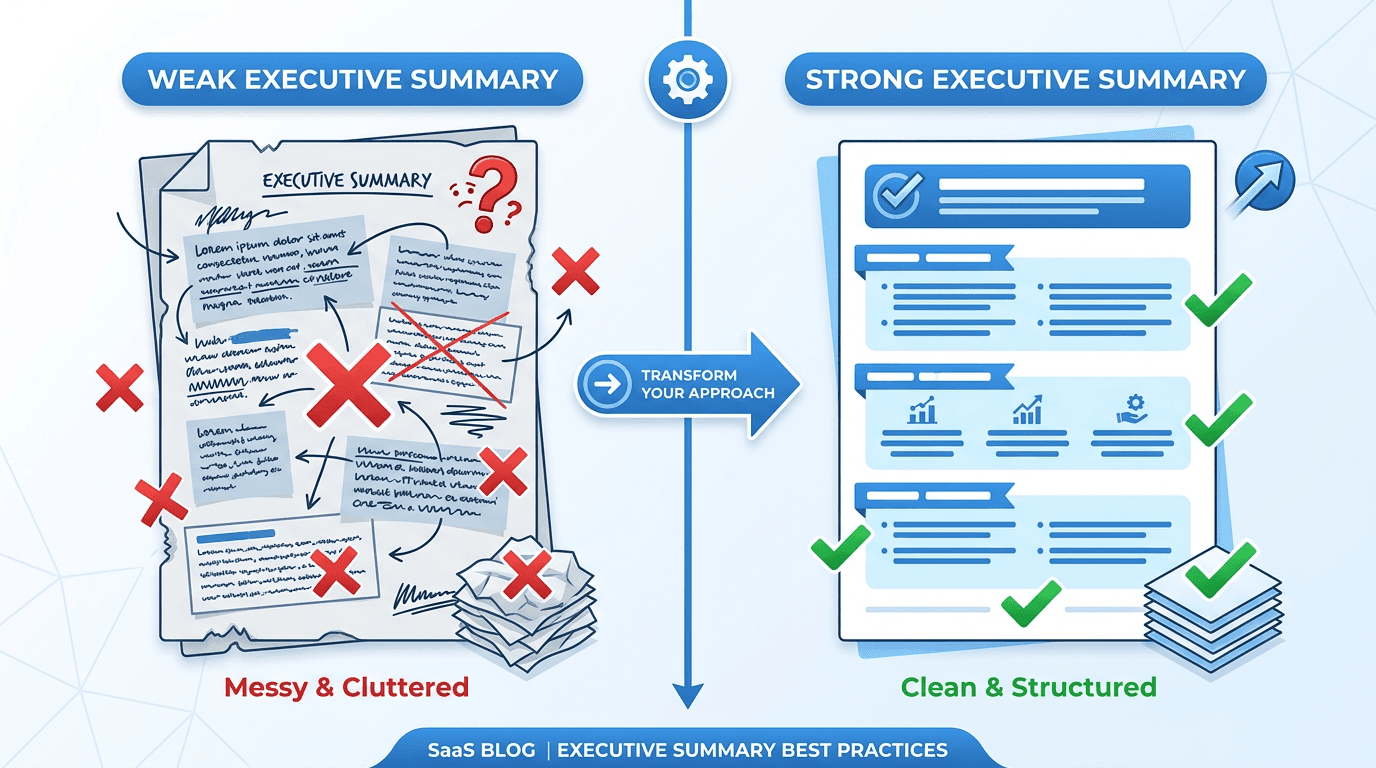
An executive summary stands alone. A reader who never opens the full document should still understand the problem, the evidence, the recommendation, and the next step. It is designed for action, not orientation.
Real-World Executive Summary Examples by Industry
Startup Pitch Deck: Series A SaaS Company
A Series A SaaS company raising $5M would open its executive summary with the funding ask, followed by current traction metrics (ARR, growth rate, retention), the market opportunity (TAM/SAM/SOM), the competitive advantage (proprietary technology, network effects, or distribution moats), and how the funds will be deployed (hiring plan, product roadmap, GTM expansion). According to LinkedIn Global Talent Trends, 87% of candidates say a clear company mission and growth trajectory influence their decision to join a startup. The executive summary often doubles as a recruiting tool.
Consulting Engagement: Digital Transformation Proposal
A consulting firm proposing a digital transformation initiative would lead with the projected cost savings or revenue uplift, followed by the current-state assessment, the proposed solution architecture, the implementation timeline (typically phased), risk factors, and the engagement fee structure. The key is framing the fee as an investment with measurable returns, not a cost.
Nonprofit Grant Application: Education Initiative
A nonprofit applying for a $500K education grant would open with the problem's urgency (e.g., "42% of students in rural districts lack access to STEM instruction"), followed by the proposed program design, evidence of effectiveness from prior pilots, budget allocation, sustainability plan, and evaluation metrics. Grant committees look for specificity, measurement, and organizational credibility.
Internal Strategy Document: Market Expansion
An internal strategy document recommending market expansion would lead with the projected revenue impact, supported by market sizing data, competitive landscape analysis, required investment, expected timeline to profitability, and the top three risks with mitigations. Internal documents can be more direct and less polished than external-facing summaries because the audience shares organizational context.
Executive Summary Length and Formatting Best Practices
The ideal length of an executive summary depends on the underlying document, but the general rule is 5-10% of the total document length. A 20-page report warrants a 1-2 page summary. A 100-page business plan might justify a 5-page executive summary. Microsoft research on document readability found that comprehension drops significantly after 2,000 words of continuous prose, reinforcing the case for brevity and visual breaks in executive summaries.
Formatting Guidelines
Use headers and subheaders to create visual hierarchy and enable scanning
Include one comparison table or data visualization if it strengthens the argument
Use bullet points for lists of findings, recommendations, or metrics
Bold key numbers and conclusions for readers who scan rather than read linearly
Leave white space. Dense paragraphs signal complexity, not thoroughness
Place the most important information in the first and last paragraphs (primacy and recency effects)
Page Layout Recommendations
One-page executive summaries: single column, 11-12pt font, generous margins
Multi-page summaries: consider a two-column layout for data-heavy sections
Always include page numbers if the summary exceeds one page
Include a header with the document title and date on every page
Common Executive Summary Mistakes to Avoid
Even experienced professionals make predictable errors when writing executive summaries. Here are the most damaging ones, along with how to avoid each.
1. Burying the Lead
Starting with background instead of the recommendation forces readers to hunt for the point. Executives scan, they do not read sequentially. If the recommendation is on page two, most readers will never reach it.
2. Including Everything
An executive summary that tries to cover every section of the full document becomes a compressed version of it rather than a strategic summary. Be ruthless about what to exclude. If a detail does not directly support the recommendation, cut it.
3. Using Vague Language
"Significant growth opportunity" means nothing without a number. "We should consider expanding" is not a recommendation. Every claim should be anchored by a specific data point, and every recommendation should include a timeline and owner.
4. Writing It First
The executive summary should be the last thing you write, even though it appears first in the document. You need the full analysis completed before you can accurately summarize the findings and recommendations. Writing it first almost guarantees it will be revised multiple times.
5. Ignoring the Audience
A technical executive summary written for a non-technical board will fail. A high-level summary written for engineers will feel thin. Always tailor vocabulary, depth, and emphasis to the specific reader. When in doubt, write for the least technical person in the room.
6. Missing the Call to Action
An executive summary without a clear next step is a status update, not a decision document. Every summary should end with a specific ask: approve this budget, greenlight this project, schedule this meeting.
7. Introducing New Information
The executive summary should never contain findings, data, or conclusions that are not in the full document. If a reader reads the summary and then the full report, nothing should be contradictory or surprising. Consistency between the summary and the source document is non-negotiable.
How to Build Your Executive Summary with Decktopus AI
Writing the executive summary is one challenge. Presenting it in a format that looks professional, reinforces your credibility, and works across every stakeholder meeting is another. This is where Decktopus AI comes in.

Why Decktopus AI Is Built for Executive Summaries
Decktopus AI is an AI-powered platform used by over 4 million professionals worldwide that generates complete, presentation-ready decks from a simple text prompt. For executive summaries, this means you can go from a rough draft to a polished, on-brand presentation in minutes rather than hours.
Here is what makes it particularly effective for executive summary presentations:
AI Presentation Generation: Describe your executive summary topic, and Decktopus generates a complete deck with structure, content, layout, and design. The two-step process (outline review, then full generation) lets you shape the structure before committing.
Brand Import via URL: Paste your company's website URL, and Decktopus automatically pulls your brand colors, typography, and logos. Every executive summary presentation stays on-brand without manual design work.
Edit with AI: Need to adjust a slide? Use natural language instructions like "make this section more data-focused" or "add a comparison table." Preview changes before applying, with full undo available.
AI Image Generation: Generate custom visuals, charts, and diagrams directly from descriptions. No stock photo hunting or Photoshop required.
Loop AI Delivery Coach: Practice your executive summary presentation with real-time feedback on pacing, filler words, and delivery confidence before the actual stakeholder meeting.
Export Flexibility: Export to PDF, PPT, or PNG (Standard or Compressed quality, Pro and Business plans) for different distribution needs. Share via live link that auto-updates when you make changes, or embed directly into internal portals.
Version History: Every edit is tracked with unlimited version history. Restore any previous version of any slide, and see who made changes and when.
[[EMBED:PGRpdiBzdHlsZT0ib3ZlcmZsb3cteDphdXRvO21hcmdpbjoyMHB4IDAiPjx0YWJsZSBzdHlsZT0id2lkdGg6MTAwJTtib3JkZXItY29sbGFwc2U6Y29sbGFwc2U7Zm9udC1zaXplOjE1cHg7bWFyZ2luOjhweCAwIj48dHI+PHRoIHN0eWxlPSJib3JkZXI6MXB4IHNvbGlkICNlM2U2ZWE7cGFkZGluZzoxMHB4IDE0cHg7dGV4dC1hbGlnbjpsZWZ0O2JhY2tncm91bmQ6I2Y0ZjZmODtmb250LXdlaWdodDo2MDAiPkNhcGFiaWxpdHk8L3RoPjx0aCBzdHlsZT0iYm9yZGVyOjFweCBzb2xpZCAjZTNlNmVhO3BhZGRpbmc6MTBweCAxNHB4O3RleHQtYWxpZ246bGVmdDtiYWNrZ3JvdW5kOiNmNGY2Zjg7Zm9udC13ZWlnaHQ6NjAwIj5UcmFkaXRpb25hbCBUb29scyAoUG93ZXJQb2ludCwgR29vZ2xlIFNsaWRlcyk8L3RoPjx0aCBzdHlsZT0iYm9yZGVyOjFweCBzb2xpZCAjZTNlNmVhO3BhZGRpbmc6MTBweCAxNHB4O3RleHQtYWxpZ246bGVmdDtiYWNrZ3JvdW5kOiNmNGY2Zjg7Zm9udC13ZWlnaHQ6NjAwIj5EZWNrdG9wdXMgQUk8L3RoPjwvdHI+PHRyPjx0ZCBzdHlsZT0iYm9yZGVyOjFweCBzb2xpZCAjZTNlNmVhO3BhZGRpbmc6MTBweCAxNHB4Ij5UaW1lIHRvIGZpcnN0IGRyYWZ0PC90ZD48dGQgc3R5bGU9ImJvcmRlcjoxcHggc29saWQgI2UzZTZlYTtwYWRkaW5nOjEwcHggMTRweCI+Mi00IGhvdXJzPC90ZD48dGQgc3R5bGU9ImJvcmRlcjoxcHggc29saWQgI2UzZTZlYTtwYWRkaW5nOjEwcHggMTRweCI+VW5kZXIgNSBtaW51dGVzPC90ZD48L3RyPjx0cj48dGQgc3R5bGU9ImJvcmRlcjoxcHggc29saWQgI2UzZTZlYTtwYWRkaW5nOjEwcHggMTRweCI+QnJhbmQgY29uc2lzdGVuY3k8L3RkPjx0ZCBzdHlsZT0iYm9yZGVyOjFweCBzb2xpZCAjZTNlNmVhO3BhZGRpbmc6MTBweCAxNHB4Ij5NYW51YWwgdGVtcGxhdGUgZW5mb3JjZW1lbnQ8L3RkPjx0ZCBzdHlsZT0iYm9yZGVyOjFweCBzb2xpZCAjZTNlNmVhO3BhZGRpbmc6MTBweCAxNHB4Ij5BdXRvbWF0aWMgdmlhIEJyYW5kIEltcG9ydDwvdGQ+PC90cj48dHI+PHRkIHN0eWxlPSJib3JkZXI6MXB4IHNvbGlkICNlM2U2ZWE7cGFkZGluZzoxMHB4IDE0cHgiPkRlc2lnbiBza2lsbHMgcmVxdWlyZWQ8L3RkPjx0ZCBzdHlsZT0iYm9yZGVyOjFweCBzb2xpZCAjZTNlNmVhO3BhZGRpbmc6MTBweCAxNHB4Ij5IaWdoPC90ZD48dGQgc3R5bGU9ImJvcmRlcjoxcHggc29saWQgI2UzZTZlYTtwYWRkaW5nOjEwcHggMTRweCI+Tm9uZSAoQUktZ2VuZXJhdGVkIGxheW91dHMpPC90ZD48L3RyPjx0cj48dGQgc3R5bGU9ImJvcmRlcjoxcHggc29saWQgI2UzZTZlYTtwYWRkaW5nOjEwcHggMTRweCI+UHJlc2VudGF0aW9uIGNvYWNoaW5nPC90ZD48dGQgc3R5bGU9ImJvcmRlcjoxcHggc29saWQgI2UzZTZlYTtwYWRkaW5nOjEwcHggMTRweCI+Tm90IGF2YWlsYWJsZTwvdGQ+PHRkIHN0eWxlPSJib3JkZXI6MXB4IHNvbGlkICNlM2U2ZWE7cGFkZGluZzoxMHB4IDE0cHgiPkxvb3AgQUkgRGVsaXZlcnkgQ29hY2g8L3RkPjwvdHI+PHRyPjx0ZCBzdHlsZT0iYm9yZGVyOjFweCBzb2xpZCAjZTNlNmVhO3BhZGRpbmc6MTBweCAxNHB4Ij5MaXZlIHNoYXJpbmcgKyBhdXRvLXVwZGF0ZTwvdGQ+PHRkIHN0eWxlPSJib3JkZXI6MXB4IHNvbGlkICNlM2U2ZWE7cGFkZGluZzoxMHB4IDE0cHgiPk1hbnVhbCByZS1leHBvcnQgYW5kIHJlLXNlbmQ8L3RkPjx0ZCBzdHlsZT0iYm9yZGVyOjFweCBzb2xpZCAjZTNlNmVhO3BhZGRpbmc6MTBweCAxNHB4Ij5MaXZlIGxpbmsgd2l0aCBhdXRvLXVwZGF0ZTwvdGQ+PC90cj48dHI+PHRkIHN0eWxlPSJib3JkZXI6MXB4IHNvbGlkICNlM2U2ZWE7cGFkZGluZzoxMHB4IDE0cHgiPlZlcnNpb24gaGlzdG9yeTwvdGQ+PHRkIHN0eWxlPSJib3JkZXI6MXB4IHNvbGlkICNlM2U2ZWE7cGFkZGluZzoxMHB4IDE0cHgiPkxpbWl0ZWQgb3IgbWFudWFsIHNhdmVzPC90ZD48dGQgc3R5bGU9ImJvcmRlcjoxcHggc29saWQgI2UzZTZlYTtwYWRkaW5nOjEwcHggMTRweCI+VW5saW1pdGVkLCBwZXItc2xpZGUsIHdpdGggcmVzdG9yZTwvdGQ+PC90cj48dHI+PHRkIHN0eWxlPSJib3JkZXI6MXB4IHNvbGlkICNlM2U2ZWE7cGFkZGluZzoxMHB4IDE0cHgiPk1vYmlsZSBjcmVhdGlvbjwvdGQ+PHRkIHN0eWxlPSJib3JkZXI6MXB4IHNvbGlkICNlM2U2ZWE7cGFkZGluZzoxMHB4IDE0cHgiPlZpZXcgb25seSAobW9zdCB0b29scyk8L3RkPjx0ZCBzdHlsZT0iYm9yZGVyOjFweCBzb2xpZCAjZTNlNmVhO3BhZGRpbmc6MTBweCAxNHB4Ij5GdWxsIHdvcmtmbG93OiBjcmVhdGUsIGVkaXQsIHByZXNlbnQsIGV4cG9ydDwvdGQ+PC90cj48L3RhYmxlPjwvZGl2Pg==]]
Who This Section Is For
If you fall into any of these roles, Decktopus AI eliminates the design bottleneck from your executive summary workflow:
Founders preparing investor updates and board presentations
Sales leaders creating executive briefings for enterprise prospects
Account executives summarizing proposals for C-suite buyers
Business development reps building partnership summaries
Customer success managers presenting quarterly business reviews
Marketers condensing campaign results for leadership
Agencies delivering client-ready summary presentations
Step-by-Step: Creating an Executive Summary Presentation with Decktopus AI
1. Describe your topic. Open Decktopus and type a short description of your executive summary, such as "Q3 2026 executive summary for Series B board meeting covering revenue growth, product milestones, and next quarter priorities." You can also upload source files (PDF, PPT, or notes) via the paperclip icon. If you have an existing deck that needs a visual refresh, use Beautify: "Use as a Resource" extracts key points and rebuilds with a new prompt, while "Redesign" keeps your text and structure but applies a completely new visual design.
2. Choose your style. Import your brand directly from your company's website URL, apply a previously saved brand style, or let AI generate a fresh style from scratch.
3. Review the AI-generated outline. Decktopus generates an outline with suggested sections, slide titles, and flow. Edit titles, reorder sections, add or remove slides before full generation. This review step ensures the deck matches your executive summary structure before any design work begins.
4. Generate the full presentation. One click produces a complete deck with content, layout, and design across every slide.
5. Refine with Edit with AI or Edit Text. Use "Edit with AI" for natural language adjustments: "make the financial section more visual" or "add a risk mitigation slide after the projections." Preview every change before applying it, and undo if needed. Use "Edit Text" for precise manual edits through the right-side panel. Every change is tracked in unlimited version history.
6. Add images. Generate custom visuals from a text description using AI Image Generation, upload from your device, or choose from the Unsplash and Freepik stock library.
7. Rehearse with Loop AI Delivery Coach. Practice delivering your executive summary with real-time AI feedback on pacing, clarity, and filler words. This is especially valuable for high-stakes presentations to investors, boards, or executive committees.
8. Export or share. Download as PDF, PPT, or PNG (Standard or Compressed). Share via a live link that automatically updates when you edit the deck. Embed directly into a company wiki or internal portal using the iframe embed option. Present in full-screen Presentation Mode without needing any external software. Business plan users can set up a Custom Domain for branded sharing URLs.
Frequently Asked Questions
What is an executive summary?
An executive summary is a concise, standalone document that captures the essential points of a longer report, proposal, or business plan. It gives decision-makers everything they need to understand the problem, findings, recommendation, and next steps without reading the full document.
How long should an executive summary be?
The general guideline is 5-10% of the total document length. A 20-page report warrants a 1-2 page summary. A 100-page business plan might justify up to 5 pages. The goal is to be as short as possible while still conveying every critical point.
What should be included in an executive summary?
At minimum: the main recommendation or conclusion, the problem or opportunity being addressed, key findings supported by data, a financial snapshot if applicable, risks and mitigations, and a clear next step or call to action.
What is the difference between an executive summary and an abstract?
An abstract is a 150-300 word description of an academic paper's methodology and findings. An executive summary is a standalone document designed for business decision-makers, includes recommendations and calls to action, and can be multiple pages long.
Should I write the executive summary first or last?
Always last. You need the full analysis, findings, and recommendations finalized before you can accurately summarize them. Writing the summary first almost guarantees multiple rewrites as the underlying document evolves.
What are the 5 key parts of an executive summary?
The five essential components are: (1) the conclusion or recommendation, (2) the problem or opportunity statement, (3) key findings with supporting data, (4) proposed solution or approach with expected outcomes, and (5) a specific call to action with timeline.
How do you write an executive summary for a business plan?
Lead with what makes the business compelling: the market opportunity, your unique positioning, and the funding ask. Follow with traction metrics (revenue, users, growth rate), the business model, competitive advantages, and how the funds will be deployed. Keep the tone confident and analytical.
Can an executive summary be used as a standalone document?
Yes. A well-written executive summary should be completely self-contained. A reader who never opens the full report should still understand the problem, the evidence, the recommendation, and what action is needed.
What common mistakes should I avoid in an executive summary?
The most damaging mistakes are: burying the recommendation after pages of background, using vague language without data, trying to include every detail from the full document, writing it before the full document is complete, and omitting a clear call to action.
How do I tailor an executive summary for different audiences?
Adjust three things: vocabulary (technical vs. accessible), emphasis (financial metrics for investors, operational details for managers, impact metrics for nonprofit funders), and depth (board members want headlines, project leads want specifics). When in doubt, write for the least technical person in the room.
What is the best format for an executive summary?
Use clear headers for visual hierarchy, bold key metrics for scanners, bullet points for lists of findings or recommendations, and at least one comparison table or data visualization. Keep paragraphs short (3-4 sentences maximum) and leave white space between sections.
How do I present an executive summary in a meeting?
Convert the written summary into a presentation with one key point per slide. Lead with the recommendation, walk through the evidence, address risks proactively, and close with the specific ask. Rehearse to stay within the allotted time. Tools like Decktopus AI's presentation maker can generate a presentation-ready version from your written summary in minutes.
Should an executive summary include financial data?
Yes, whenever the underlying document involves financial decisions. Include total investment, projected returns, payback period, and key assumptions. A small table is often more effective than narrative text for financial data.
How is an executive summary different from an introduction?
An introduction sets up the document and assumes the reader will continue reading. An executive summary stands alone and assumes the reader may never open the full document. The introduction orients; the executive summary decides.
Can AI help write an executive summary?
AI tools can accelerate the drafting process significantly, especially for structuring content and generating initial drafts. Decktopus AI goes further by turning your executive summary into a complete, on-brand presentation with AI-generated content, design, and delivery coaching. The key is always reviewing AI-generated content for accuracy, especially data points and financial figures, before sharing with stakeholders.
Conclusion
An executive summary is not a formality. It is often the only page a decision-maker reads before saying yes or no. The difference between a summary that drives action and one that gets filed away comes down to structure, specificity, and audience awareness.
Start with the conclusion, not the background. Quantify every claim. Name the risks. State the ask explicitly. And close with a specific next step that makes it easy for the reader to act.
The 7-Step Executive Summary Framework covered in this guide gives you a repeatable structure that works across business plans, project proposals, research reports, and strategic documents. Whether you are raising a Series A, pitching a consulting engagement, or presenting quarterly results to your board, the principles are the same: lead with what matters, prove it with data, and make the next step obvious.
For professionals who need to present their executive summaries (not just write them), Decktopus AI turns a written summary into a polished, on-brand presentation in minutes, complete with AI-generated content, design, and delivery coaching through Loop AI. Over 4 million professionals already use it to eliminate the gap between writing and presenting.
Verified Backlinks Used
https://www.decktopus.com/
https://www.decktopus.com/presentation-maker-online
https://www.decktopus.com/use-case/decktopus-for-founders
https://www.decktopus.com/use-case/decktopus-for-sales
https://www.decktopus.com/use-case/decktopus-for-account-executives
https://www.decktopus.com/use-case/decktopus-for-business-development-reps
https://www.decktopus.com/use-case/decktopus-for-customer-success
https://www.decktopus.com/use-case/decktopus-for-marketer
https://www.decktopus.com/use-case/decktopus-for-agencies
https://www.decktopus.com/executive-summary-templates
Stay Connected
Follow Decktopus for the latest updates, tips, and resources:
Related posts

How to Improve Communication Skills at Work (2026 Practical Guide)
The 5 workplace communication skills that matter most, the CLEAR framework, and the AI practice method that turns weak communicators into strong ones.
Business & Strategy

Job Interview Sample Questions: How to Practice Your Answers (2026)
The 20 most common interview questions, the STAR framework for answers, and the AI practice method that turns rehearsed responses into confident ones.
Business & Strategy

How to Negotiate a Raise: The Script, Practice Method & Tips That Actually Work
A step-by-step script for negotiating a raise, common mistakes to avoid, and the AI practice method that turns a nervous ask into a confident one.
Business & Strategy