Sales & Proposals
Business Proposal vs Business Plan: The Real Difference (and Which One You Actually Need First)
Business proposal vs business plan: the real difference, when to use each, and the named mistakes that confuse the two. Plus a fast test to know which you need.

Decktopus Content Team
Most people search “business proposal vs business plan“ because they’re staring at a blank page and don’t know which one they need.
The answer matters more than people realize.
Building a 30-page business plan when you needed a 6-page business proposal will cost you a month. Sending a business proposal to investors when they expected a business plan will cost you the round. These two documents look similar from the outside, but they serve completely different audiences, answer completely different questions, and get used at completely different moments in a company’s life.
This guide breaks down the real difference, when to use each one, and the named mistakes that cost founders deals and funding every week.
You’ll get:
A side-by-side comparison that resolves the confusion in 30 seconds
The Direction Test that tells you instantly which document you need
Real examples of when each one wins (and when each one fails)
Named mistakes that turn the wrong document into a deal-killer
How to write either one in minutes instead of weeks
The Short Answer: Business Proposal vs Business Plan
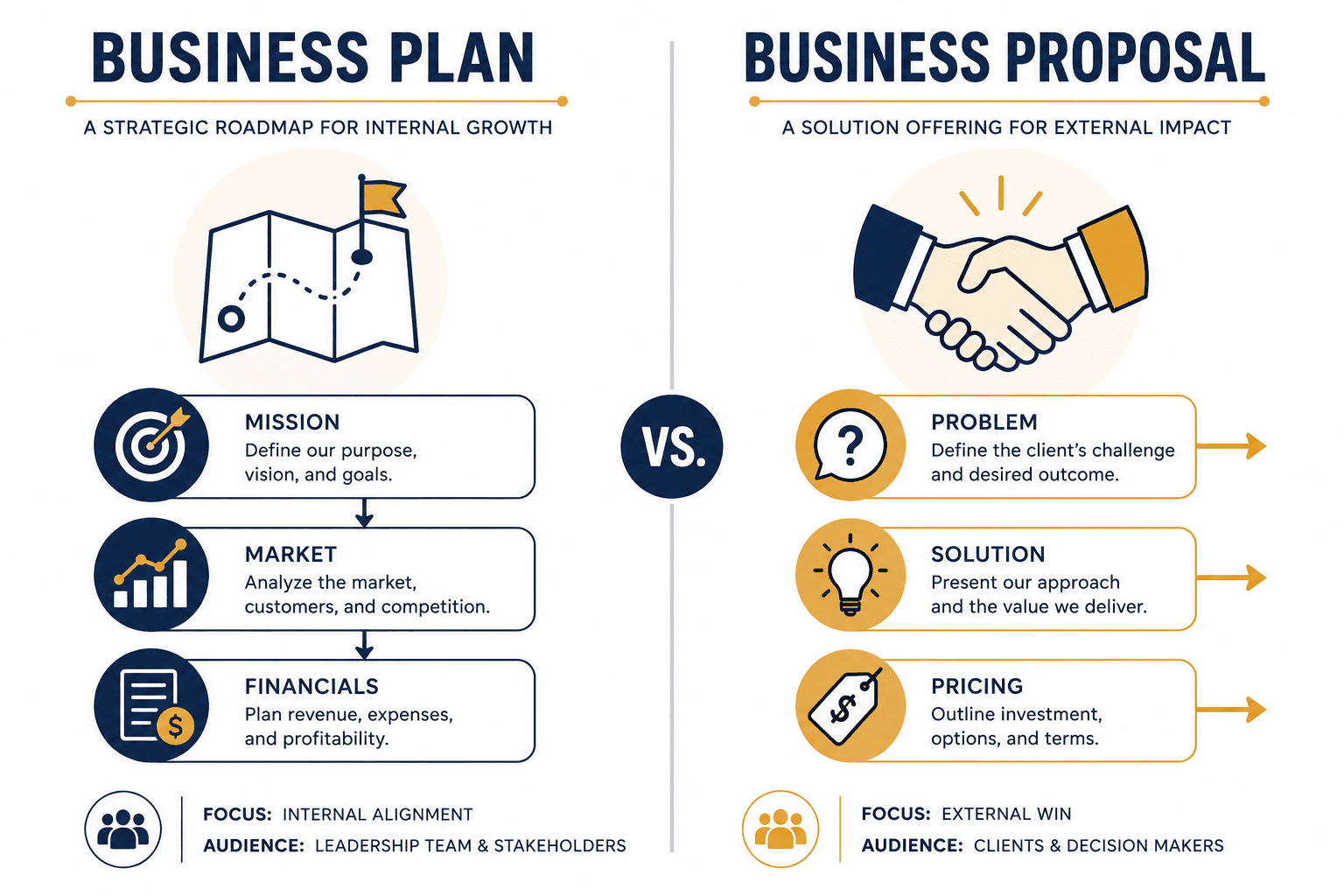
A business plan answers the question: How will our company grow?
A business proposal answers the question: How can we help this specific client?
That’s the entire difference, compressed.
A business plan is internal-facing and strategic. It exists so your team, board, and investors understand where the company is going over the next 3 to 5 years. It covers your market, your model, your team, your financials, and your roadmap.
A business proposal is external-facing and tactical. It exists to win a specific deal. The right pitch deck generator can help you build one fast. It covers a client’s problem, your solution, your pricing, and your ask. It’s measured in conversions, not in vision.
If the rest of this article tells you anything beyond this, it’s just detail. The fundamental difference is audience. Inward or outward.
The Direction Test: Inward or Outward?
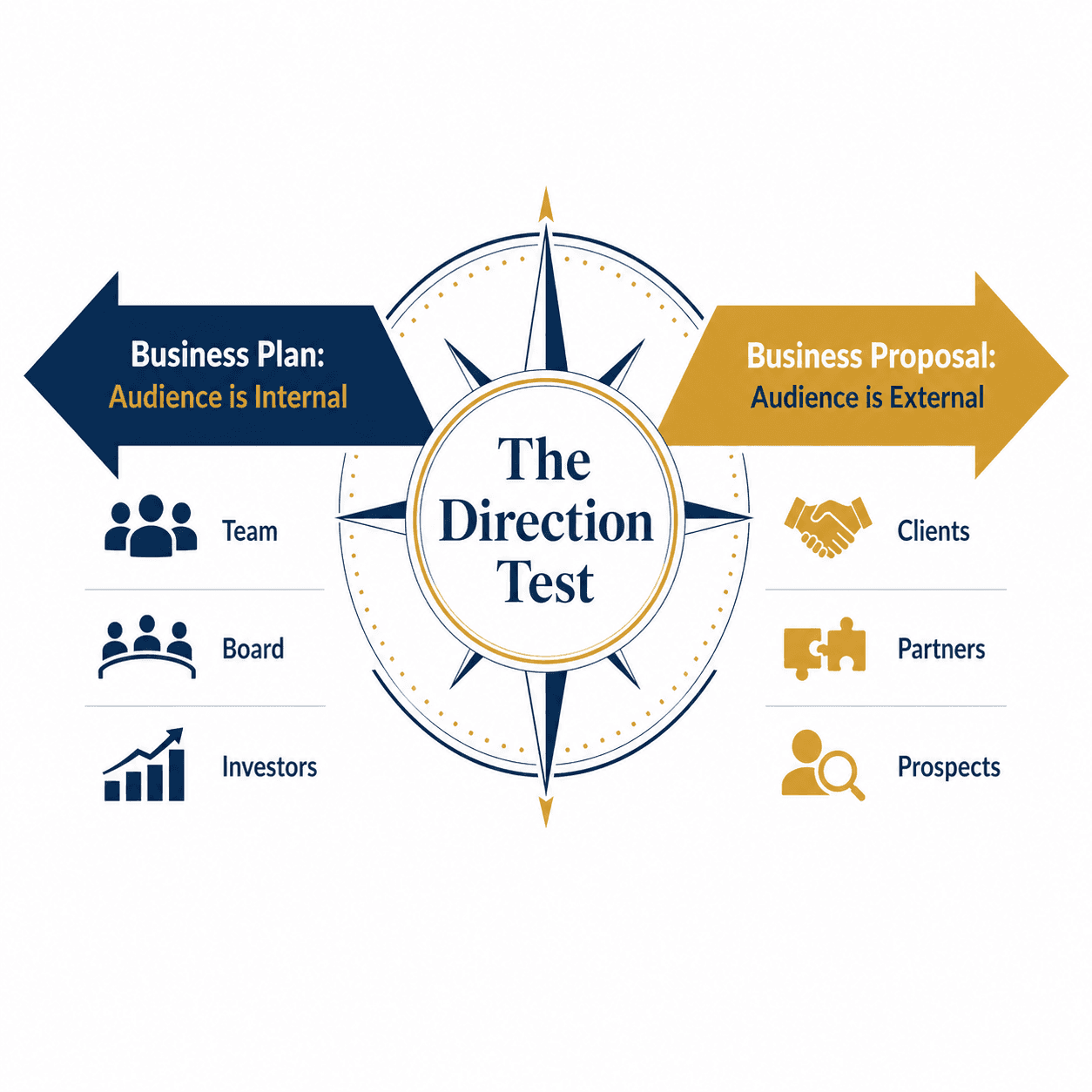
Here’s the fastest way to decide which document you need.
Ask yourself: Who is going to read this, and what do they want to walk away with?
If the reader is internal (you, your team, your board, your investors) and they want to understand the company’s direction: You need a business plan.
If the reader is external (a prospective client, a procurement officer, a partner) and they want to know what you can do for them specifically: You need a business proposal.
Most confusion in this space comes from founders trying to use one document for both audiences. It almost never works. The questions are too different. The level of detail is too different. The persuasion goal is too different.
The Direction Test sorts this out in 10 seconds. Inward = plan. Outward = proposal.
What Is a Business Plan?
A business plan is a strategic document that outlines your company’s mission, target market, business model, competitive landscape, financial projections, and operational roadmap.
It typically covers a 3 to 5 year horizon and includes:
Executive Summary (the one-page version of the whole plan)
Company Overview (who you are, what you do)
Market Analysis (the size of the opportunity)
Competitive Landscape (who else is in the space)
Business Model (how you make money)
Marketing and Sales Strategy (how you reach customers)
Operations Plan (how you actually deliver)
Team and Management (who runs the business)
Financial Projections (revenue, expenses, profit, cash flow)
Funding Request (if applicable)
For more on framing the strategic story, our guide on how to write an executive summary walks through the most important page of any plan.
Who reads a business plan?
You and your leadership team (to stay aligned)
Board members (to evaluate strategy)
Investors and lenders (to assess viability)
Strategic partners (to understand fit)
Who does NOT read a business plan?
Clients. Prospects. Buyers. They don’t care about your five-year vision. They care about whether you can solve their problem this quarter.
If you’re refining your strategic foundation, our breakdown on market analysis covers how to build the section investors scrutinize most.
A well-crafted business plan functions as a planning tool, a decision-making guide, and a roadmap for business growth. It also plays a crucial role when seeking external support, showing potential investors or partners that your business is viable and future-ready.
What Is a Business Proposal?
A business proposal is an external-facing document that pitches a specific solution to a specific client.
It’s a sales document. Not a strategy document.
A business proposal typically includes:
The Client’s Problem (in their own language)
Your Proposed Solution (tailored to their situation)
Why You (case studies, expertise, differentiation)
Scope of Work (what’s included)
Timeline (when it will happen)
Pricing (transparent and structured)
Terms and Conditions (what they’re agreeing to)
The Ask (what you want them to do next)
Business proposals come in two flavors:
Solicited: The client requested it, often through an RFP (Request for Proposal). The format and content are often dictated by the buyer.
Unsolicited: You initiated it. You see an opportunity, you build the case for working together.
For a deeper look at writing one that actually closes, see our business proposal guide and our breakdown on how to prepare a sales proposal step-by-step.

The Real Differences (Side-by-Side)
[[EMBED:PGRpdiBzdHlsZT0ib3ZlcmZsb3cteDphdXRvO21hcmdpbjoyMHB4IDAiPjx0YWJsZSBzdHlsZT0id2lkdGg6MTAwJTtib3JkZXItY29sbGFwc2U6Y29sbGFwc2U7Zm9udC1zaXplOjE1cHg7bWFyZ2luOjhweCAwIj48dGggc3R5bGU9ImJvcmRlcjoxcHggc29saWQgI2UzZTZlYTtwYWRkaW5nOjEwcHggMTRweDt0ZXh0LWFsaWduOmxlZnQ7YmFja2dyb3VuZDojZjRmNmY4O2ZvbnQtd2VpZ2h0OjYwMCI+PHRyPjx0aCBzdHlsZT0iYm9yZGVyOjFweCBzb2xpZCAjZTNlNmVhO3BhZGRpbmc6MTBweCAxNHB4O3RleHQtYWxpZ246bGVmdDtiYWNrZ3JvdW5kOiNmNGY2Zjg7Zm9udC13ZWlnaHQ6NjAwIj5FbGVtZW50PC90aD48dGggc3R5bGU9ImJvcmRlcjoxcHggc29saWQgI2UzZTZlYTtwYWRkaW5nOjEwcHggMTRweDt0ZXh0LWFsaWduOmxlZnQ7YmFja2dyb3VuZDojZjRmNmY4O2ZvbnQtd2VpZ2h0OjYwMCI+QnVzaW5lc3MgUGxhbjwvdGg+PHRoIHN0eWxlPSJib3JkZXI6MXB4IHNvbGlkICNlM2U2ZWE7cGFkZGluZzoxMHB4IDE0cHg7dGV4dC1hbGlnbjpsZWZ0O2JhY2tncm91bmQ6I2Y0ZjZmODtmb250LXdlaWdodDo2MDAiPkJ1c2luZXNzIFByb3Bvc2FsPC90aD48L3RyPjwvdGhlYWQ+PHRib2R5Pjx0cj48dGQgc3R5bGU9ImJvcmRlcjoxcHggc29saWQgI2UzZTZlYTtwYWRkaW5nOjEwcHggMTRweDt0ZXh0LWFsaWduOmxlZnQ7dmVydGljYWwtYWxpZ246dG9wIj5BdWRpZW5jZTwvdGQ+PHRkIHN0eWxlPSJib3JkZXI6MXB4IHNvbGlkICNlM2U2ZWE7cGFkZGluZzoxMHB4IDE0cHg7dGV4dC1hbGlnbjpsZWZ0O3ZlcnRpY2FsLWFsaWduOnRvcCI+SW50ZXJuYWw6IHRlYW0sIGJvYXJkLCBpbnZlc3RvcnM8L3RkPjx0ZCBzdHlsZT0iYm9yZGVyOjFweCBzb2xpZCAjZTNlNmVhO3BhZGRpbmc6MTBweCAxNHB4O3RleHQtYWxpZ246bGVmdDt2ZXJ0aWNhbC1hbGlnbjp0b3AiPkV4dGVybmFsOiBwcm9zcGVjdGl2ZSBjbGllbnRzPC90ZD48L3RyPjx0cj48dGQgc3R5bGU9ImJvcmRlcjoxcHggc29saWQgI2UzZTZlYTtwYWRkaW5nOjEwcHggMTRweDt0ZXh0LWFsaWduOmxlZnQ7dmVydGljYWwtYWxpZ246dG9wIj5QdXJwb3NlPC90ZD48dGQgc3R5bGU9ImJvcmRlcjoxcHggc29saWQgI2UzZTZlYTtwYWRkaW5nOjEwcHggMTRweDt0ZXh0LWFsaWduOmxlZnQ7dmVydGljYWwtYWxpZ246dG9wIj5TdHJhdGVneSBhbmQgZGlyZWN0aW9uPC90ZD48dGQgc3R5bGU9ImJvcmRlcjoxcHggc29saWQgI2UzZTZlYTtwYWRkaW5nOjEwcHggMTRweDt0ZXh0LWFsaWduOmxlZnQ7dmVydGljYWwtYWxpZ246dG9wIj5DbG9zZSBhIHNwZWNpZmljIGRlYWw8L3RkPjwvdHI+PHRyPjx0ZCBzdHlsZT0iYm9yZGVyOjFweCBzb2xpZCAjZTNlNmVhO3BhZGRpbmc6MTBweCAxNHB4O3RleHQtYWxpZ246bGVmdDt2ZXJ0aWNhbC1hbGlnbjp0b3AiPlRpbWUgSG9yaXpvbjwvdGQ+PHRkIHN0eWxlPSJib3JkZXI6MXB4IHNvbGlkICNlM2U2ZWE7cGFkZGluZzoxMHB4IDE0cHg7dGV4dC1hbGlnbjpsZWZ0O3ZlcnRpY2FsLWFsaWduOnRvcCI+MyB0byA1IHllYXJzPC90ZD48dGQgc3R5bGU9ImJvcmRlcjoxcHggc29saWQgI2UzZTZlYTtwYWRkaW5nOjEwcHggMTRweDt0ZXh0LWFsaWduOmxlZnQ7dmVydGljYWwtYWxpZ246dG9wIj5PbmUgcHJvamVjdCBvciBlbmdhZ2VtZW50PC90ZD48L3RyPjx0cj48dGQgc3R5bGU9ImJvcmRlcjoxcHggc29saWQgI2UzZTZlYTtwYWRkaW5nOjEwcHggMTRweDt0ZXh0LWFsaWduOmxlZnQ7dmVydGljYWwtYWxpZ246dG9wIj5MZW5ndGg8L3RkPjx0ZCBzdHlsZT0iYm9yZGVyOjFweCBzb2xpZCAjZTNlNmVhO3BhZGRpbmc6MTBweCAxNHB4O3RleHQtYWxpZ246bGVmdDt2ZXJ0aWNhbC1hbGlnbjp0b3AiPjE1IHRvIDQwIHBhZ2VzPC90ZD48dGQgc3R5bGU9ImJvcmRlcjoxcHggc29saWQgI2UzZTZlYTtwYWRkaW5nOjEwcHggMTRweDt0ZXh0LWFsaWduOmxlZnQ7dmVydGljYWwtYWxpZ246dG9wIj41IHRvIDIwIHBhZ2VzPC90ZD48L3RyPjx0cj48dGQgc3R5bGU9ImJvcmRlcjoxcHggc29saWQgI2UzZTZlYTtwYWRkaW5nOjEwcHggMTRweDt0ZXh0LWFsaWduOmxlZnQ7dmVydGljYWwtYWxpZ246dG9wIj5Ub25lPC90ZD48dGQgc3R5bGU9ImJvcmRlcjoxcHggc29saWQgI2UzZTZlYTtwYWRkaW5nOjEwcHggMTRweDt0ZXh0LWFsaWduOmxlZnQ7dmVydGljYWwtYWxpZ246dG9wIj5BbmFseXRpY2FsLCBjb21wcmVoZW5zaXZlPC90ZD48dGQgc3R5bGU9ImJvcmRlcjoxcHggc29saWQgI2UzZTZlYTtwYWRkaW5nOjEwcHggMTRweDt0ZXh0LWFsaWduOmxlZnQ7dmVydGljYWwtYWxpZ246dG9wIj5QZXJzdWFzaXZlLCBmb2N1c2VkPC90ZD48L3RyPjx0cj48dGQgc3R5bGU9ImJvcmRlcjoxcHggc29saWQgI2UzZTZlYTtwYWRkaW5nOjEwcHggMTRweDt0ZXh0LWFsaWduOmxlZnQ7dmVydGljYWwtYWxpZ246dG9wIj5LZXkgU2VjdGlvbnM8L3RkPjx0ZCBzdHlsZT0iYm9yZGVyOjFweCBzb2xpZCAjZTNlNmVhO3BhZGRpbmc6MTBweCAxNHB4O3RleHQtYWxpZ246bGVmdDt2ZXJ0aWNhbC1hbGlnbjp0b3AiPk1hcmtldCwgbW9kZWwsIHRlYW0sIGZpbmFuY2lhbHM8L3RkPjx0ZCBzdHlsZT0iYm9yZGVyOjFweCBzb2xpZCAjZTNlNmVhO3BhZGRpbmc6MTBweCAxNHB4O3RleHQtYWxpZ246bGVmdDt2ZXJ0aWNhbC1hbGlnbjp0b3AiPlByb2JsZW0sIHNvbHV0aW9uLCBwcmljaW5nLCBhc2s8L3RkPjwvdHI+PHRyPjx0ZCBzdHlsZT0iYm9yZGVyOjFweCBzb2xpZCAjZTNlNmVhO3BhZGRpbmc6MTBweCAxNHB4O3RleHQtYWxpZ246bGVmdDt2ZXJ0aWNhbC1hbGlnbjp0b3AiPlN1Y2Nlc3MgTWV0cmljPC90ZD48dGQgc3R5bGU9ImJvcmRlcjoxcHggc29saWQgI2UzZTZlYTtwYWRkaW5nOjEwcHggMTRweDt0ZXh0LWFsaWduOmxlZnQ7dmVydGljYWwtYWxpZ246dG9wIj5GdW5kaW5nIHNlY3VyZWQsIHN0cmF0ZWd5IGFsaWduZWQ8L3RkPjx0ZCBzdHlsZT0iYm9yZGVyOjFweCBzb2xpZCAjZTNlNmVhO3BhZGRpbmc6MTBweCAxNHB4O3RleHQtYWxpZ246bGVmdDt2ZXJ0aWNhbC1hbGlnbjp0b3AiPkRlYWwgY2xvc2VkLCBjb250cmFjdCBzaWduZWQ8L3RkPjwvdHI+PHRyPjx0ZCBzdHlsZT0iYm9yZGVyOjFweCBzb2xpZCAjZTNlNmVhO3BhZGRpbmc6MTBweCAxNHB4O3RleHQtYWxpZ246bGVmdDt2ZXJ0aWNhbC1hbGlnbjp0b3AiPlVwZGF0ZSBGcmVxdWVuY3k8L3RkPjx0ZCBzdHlsZT0iYm9yZGVyOjFweCBzb2xpZCAjZTNlNmVhO3BhZGRpbmc6MTBweCAxNHB4O3RleHQtYWxpZ246bGVmdDt2ZXJ0aWNhbC1hbGlnbjp0b3AiPkFubnVhbGx5IG9yIGFmdGVyIG1ham9yIHNoaWZ0czwvdGQ+PHRkIHN0eWxlPSJib3JkZXI6MXB4IHNvbGlkICNlM2U2ZWE7cGFkZGluZzoxMHB4IDE0cHg7dGV4dC1hbGlnbjpsZWZ0O3ZlcnRpY2FsLWFsaWduOnRvcCI+RXZlcnkgbmV3IGNsaWVudCBvciBSRlA8L3RkPjwvdHI+PHRyPjx0ZCBzdHlsZT0iYm9yZGVyOjFweCBzb2xpZCAjZTNlNmVhO3BhZGRpbmc6MTBweCAxNHB4O3RleHQtYWxpZ246bGVmdDt2ZXJ0aWNhbC1hbGlnbjp0b3AiPkZpcnN0IFJlYWRlciBSZWFjdGlvbjwvdGQ+PHRkIHN0eWxlPSJib3JkZXI6MXB4IHNvbGlkICNlM2U2ZWE7cGFkZGluZzoxMHB4IDE0cHg7dGV4dC1hbGlnbjpsZWZ0O3ZlcnRpY2FsLWFsaWduOnRvcCI+IklzIHRoaXMgdmlhYmxlPyI8L3RkPjx0ZCBzdHlsZT0iYm9yZGVyOjFweCBzb2xpZCAjZTNlNmVhO3BhZGRpbmc6MTBweCAxNHB4O3RleHQtYWxpZ246bGVmdDt2ZXJ0aWNhbC1hbGlnbjp0b3AiPiJJcyB0aGlzIHRoZSByaWdodCBmaXQgZm9yIHVzPyI8L3RkPjwvdHI+PHRyPjx0ZCBzdHlsZT0iYm9yZGVyOjFweCBzb2xpZCAjZTNlNmVhO3BhZGRpbmc6MTBweCAxNHB4O3RleHQtYWxpZ246bGVmdDt2ZXJ0aWNhbC1hbGlnbjp0b3AiPldyb25nIFVzZTwvdGQ+PHRkIHN0eWxlPSJib3JkZXI6MXB4IHNvbGlkICNlM2U2ZWE7cGFkZGluZzoxMHB4IDE0cHg7dGV4dC1hbGlnbjpsZWZ0O3ZlcnRpY2FsLWFsaWduOnRvcCI+U2VuZGluZyBpdCB0byBhIHByb3NwZWN0PC90ZD48dGQgc3R5bGU9ImJvcmRlcjoxcHggc29saWQgI2UzZTZlYTtwYWRkaW5nOjEwcHggMTRweDt0ZXh0LWFsaWduOmxlZnQ7dmVydGljYWwtYWxpZ246dG9wIj5TZW5kaW5nIGl0IHRvIGFuIGludmVzdG9yPC90ZD48L3RyPjwvdGJvZHk+PC90YWJsZT48L2Rpdj4=]]
This table alone resolves 80% of the confusion around business proposal vs business plan.
When to Use Each One
Use a business plan when:
You’re starting a company and need to clarify your strategic foundation
You’re raising a round and investors require it
You’re applying for a bank loan or SBA financing
You’re aligning a leadership team on direction
You’re entering a new market and need to think through the move
You’re acquiring another company and need to model the combined entity
Use a business proposal when:
A prospective client asks for one
An RFP requires a formal response
You’re pitching a specific service or product to a buyer
You’re entering a new account and want to outline the engagement
You’re closing a partnership deal that needs structured terms
You’re proposing a new project to an existing client
The wrong document at the wrong moment kills deals. A startup founder who answers an investor question with “Let me send over a business proposal” looks like they don’t understand what investors actually fund.
How They Connect to Each Other
Here’s the part most articles miss.
A business plan informs your business proposals.
Your plan defines who you serve, what you do, what makes you different, and how you price. Every business proposal you send should reflect those decisions.
If your plan says you serve mid-market SaaS companies, your proposals should look like they were built for mid-market SaaS companies, not enterprise procurement teams.
If your plan says your pricing strategy is value-based and premium, your proposals should never undercut that with discount language.
A weak plan creates inconsistent proposals. Strong proposals are downstream of a clear plan.
This is why founders who skip the business plan often struggle with proposals. They don’t know what they’re selling, who they’re selling to, or what makes them different. So every proposal feels different, performs differently, and never compounds into a repeatable system.
For more on how planning translates into pitch material, see our breakdown of pitch deck examples and our guide on how to sell an idea effectively.
5 Named Mistakes That Confuse the Two
1. The Eternal Plan
The founder keeps refining the business plan for months but never sends a single proposal. The plan gets perfect. The pipeline stays empty. Plans don’t pay rent. Proposals do.
2. The Premature Proposal
The team sends polished proposals to clients before they’ve figured out who they actually serve or what they’re selling. Every proposal looks slightly different because the strategy underneath keeps changing.
3. The Frankenstein Document
The founder builds one document that tries to be both. It’s too strategic for a prospect, too pitchy for an investor, and ends up being read by neither. Two documents. Two audiences. Two purposes. Don’t combine them.
4. The Copy-Paste Pitch
The team sends the exact same business proposal to every prospect, swapping the company name in the header. Prospects can tell. Generic proposals signal generic service. Tailor every proposal to the client’s specific problem.
5. The Mission Drift Plan
The business plan promises so many things it has no real focus. The proposal that follows reflects that confusion. Strong plans say what they will not do. Strong proposals inherit that clarity.
How to Write a Business Plan
Keep the structure tight. Most weak business plans are weak because they’re too long, too vague, or both.
A strong business plan follows this order:
Executive Summary (1 page, the entire plan compressed)
The Problem and Market Opportunity (with real data)
Your Solution and Business Model (how you create and capture value)
Competitive Landscape (where you fit and why you win)
Go-to-Market Strategy (how you reach customers)
Team and Operations (who runs this and how)
Financial Projections (3-year P&L, cash flow, key assumptions)
Funding Ask (if applicable, what you need and what it unlocks)
The executive summary is the most important page. If a reader gets through page one and isn’t convinced, they won’t read pages two through forty. For more on writing this critical page, see our executive summary guide.
For founders just getting started, our breakdown on bootstrapping a startup covers the practical mindset that should shape your early plan.
How to Write a Business Proposal
Business proposals are shorter, sharper, and built around the client’s specific situation.
A strong business proposal follows this order:
Cover and Title (clear name of the engagement)
Executive Summary (the proposal compressed into one page)
The Client’s Problem (in their own language, with their data)
Your Proposed Solution (tailored, specific)
Why You (case studies, results, relevant experience)
Scope of Work (what’s included, what’s not)
Timeline (clear milestones)
Pricing and Terms (transparent, ideally with options)
Call to Action (specific next step)
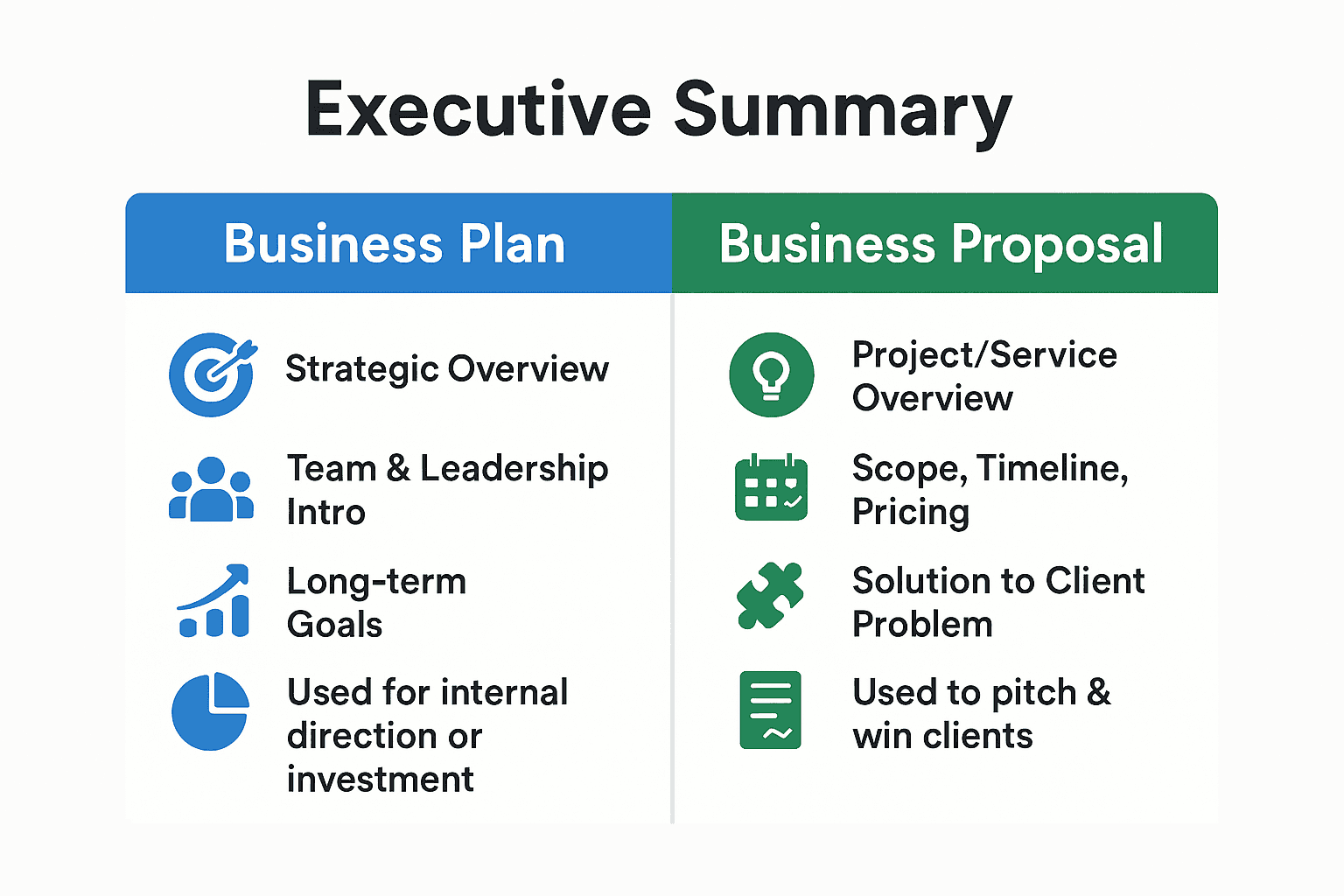
The executive summary in a business proposal is different from the one in a business plan. In a plan, it summarizes strategy. In a proposal, it summarizes the deal. Same name, different job.
For tactical structure breakdowns, see our guide on the proposal outline and our breakdown on how to write a marketing proposal. And if you’re comparing tools, our roundup of the best business proposal tools covers what to look for.
Turning Either Document Into a Presentation with Decktopus
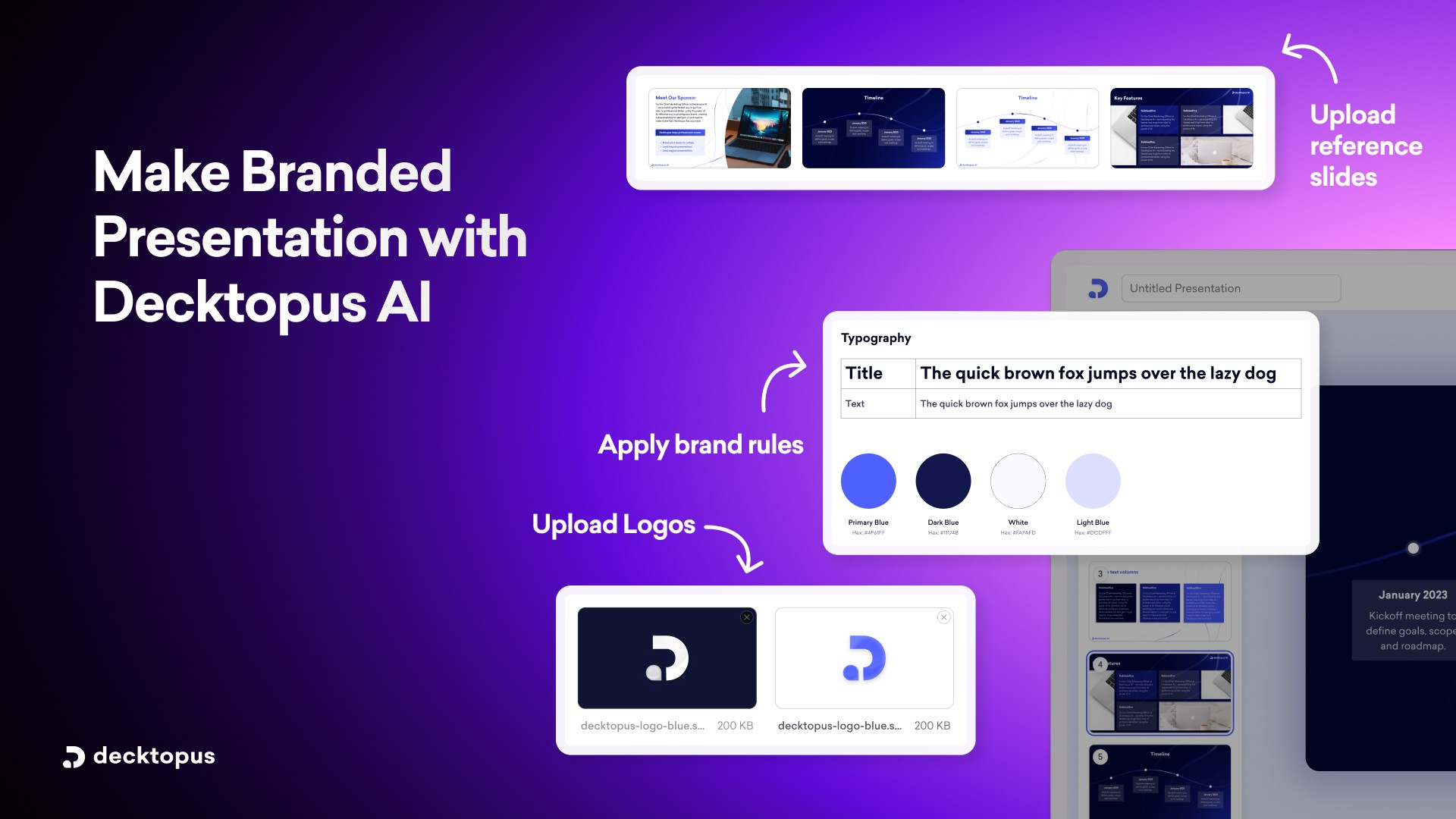
Most business plans and proposals don’t live as documents. They live as presentations.
The plan gets pitched to investors in a meeting. The proposal gets walked through with a prospect on a call. The actual decision moment is almost always the slide version.
This is where Decktopus saves founders and sales teams hours of design time.
Here’s how it works:
Describe your topic. Type something like “Business plan presentation for my SaaS startup” or “Sales proposal for a B2B prospect in manufacturing.” Or upload your written document as a supporting file.
Choose your style. Paste your homepage URL to apply your brand automatically. Decktopus pulls your logo, colors, and fonts so every slide stays on-brand. No design review needed.
Review the outline. Decktopus generates a slide structure tailored to your input. Adjust the order or focus before the full deck is built.
Refine in the editor. Use the prompt bar to fine-tune any slide. Try instructions like “make this executive summary tighter,” “show our pricing as a comparison table,” or “add a chart for our market opportunity.” Brand Compliance keeps every slide on-brand.
Export or share. Download as PDF or PPT, share via link, or present directly from the editor.
Whether you’re pitching a 5-year strategy to investors or a 3-month engagement to a prospect, Decktopus generates the slide deck while you focus on the content that only you know.
For more on choosing the right AI presentation tool, see our guide on the best AI presentation tools.
Frequently Asked Questions
Is a business plan the same as a business proposal?
No. A business plan is an internal strategy document covering long-term company direction. A business proposal is an external sales document pitching a specific solution to a specific client. They serve different audiences and answer different questions.
Which comes first, a business plan or a business proposal?
Typically the business plan. The plan defines who you serve, what you sell, and how you operate. Every business proposal you send should reflect those decisions. Founders who write proposals before they’ve clarified their strategy end up with inconsistent pitches that don’t compound.
Can a business proposal replace a business plan?
No. They’re different documents for different audiences. A business proposal can win a single deal, but it doesn’t tell investors how your company will grow. A business plan can attract funding, but it doesn’t close clients.
Do all businesses need both a business plan and a business proposal?
Most do, eventually. Service-based businesses use proposals constantly because every client engagement requires one. All companies need a business plan at some point, whether for fundraising, strategic alignment, or major decisions like expansion or pivoting.
How long should a business plan be?
Usually 15 to 25 pages, plus appendices for detailed financials. Longer plans signal a lack of prioritization. Most investors won’t read past page 10 unless the first 10 earn it.
How long should a business proposal be?
Typically 5 to 15 pages, depending on complexity. RFP responses can run longer because the buyer dictates the format. The shorter you can make it while still answering every question, the better.
What’s the difference between a business proposal and a pitch deck?
A pitch deck is a presentation format, usually 10 to 20 slides, designed for a live meeting with investors. A business proposal is a document or presentation pitching a specific service or solution to a client. Both can be slides, but they target different audiences. For more on pitch decks specifically, see our breakdown of common pitch deck mistakes.
Can AI write a business plan or proposal for me?
AI is useful for drafting structure, summarizing research, and generating presentation slides. But the strategic decisions (what your company does, who you serve, what to charge) still require human judgment. AI accelerates production. It doesn’t replace strategy.
Final Thoughts
The confusion around business proposal vs business plan costs founders deals every day.
The plan is for the inside. It tells your team and your investors where you’re going. The proposal is for the outside. It tells your client what you can do for them.
Get the audience right, and the rest of the document writes itself.
Get the audience wrong, and no amount of polish will save it.
If you’re staring at a blank page wondering which document you need, run the Direction Test. Inward or outward? Strategy or sales? Long-term or specific deal?
The answer almost always tells you exactly which document to build.
Related posts

Struggling to Find New Clients? 5 Proven Tips to Turn Prospecting Into Growth
Struggling to find new clients? Discover 5 proven tips, from proposals to paid ads, to build a steady pipeline of new business.
Sales & Proposals

Cracking the Code: Mastering B2B Sales Strategies & Techniques
Discover the essential guide to mastering B2B sales strategies and techniques, uncovering the secrets behind successful business-to-business selling. Explore the B2B sales process, optimize your team's performance, and elevate your approach to selling products for businesses.
Sales & Proposals
Mastering Proposals: Exploring the Best Business Proposal Tools and Software Solutions
Discover the best business proposal tools, including PandaDoc and Proposable, to streamline your proposal process and win more clients.
Sales & Proposals