Marketing
SEO Report Examples: What Actually Drives Decisions (and What Wastes Everyone's Time)
Real SEO report examples and structures that actually drive decisions. Includes monthly, audit, competitor, and executive reports, with named mistakes to avoid.


Decktopus Content Team
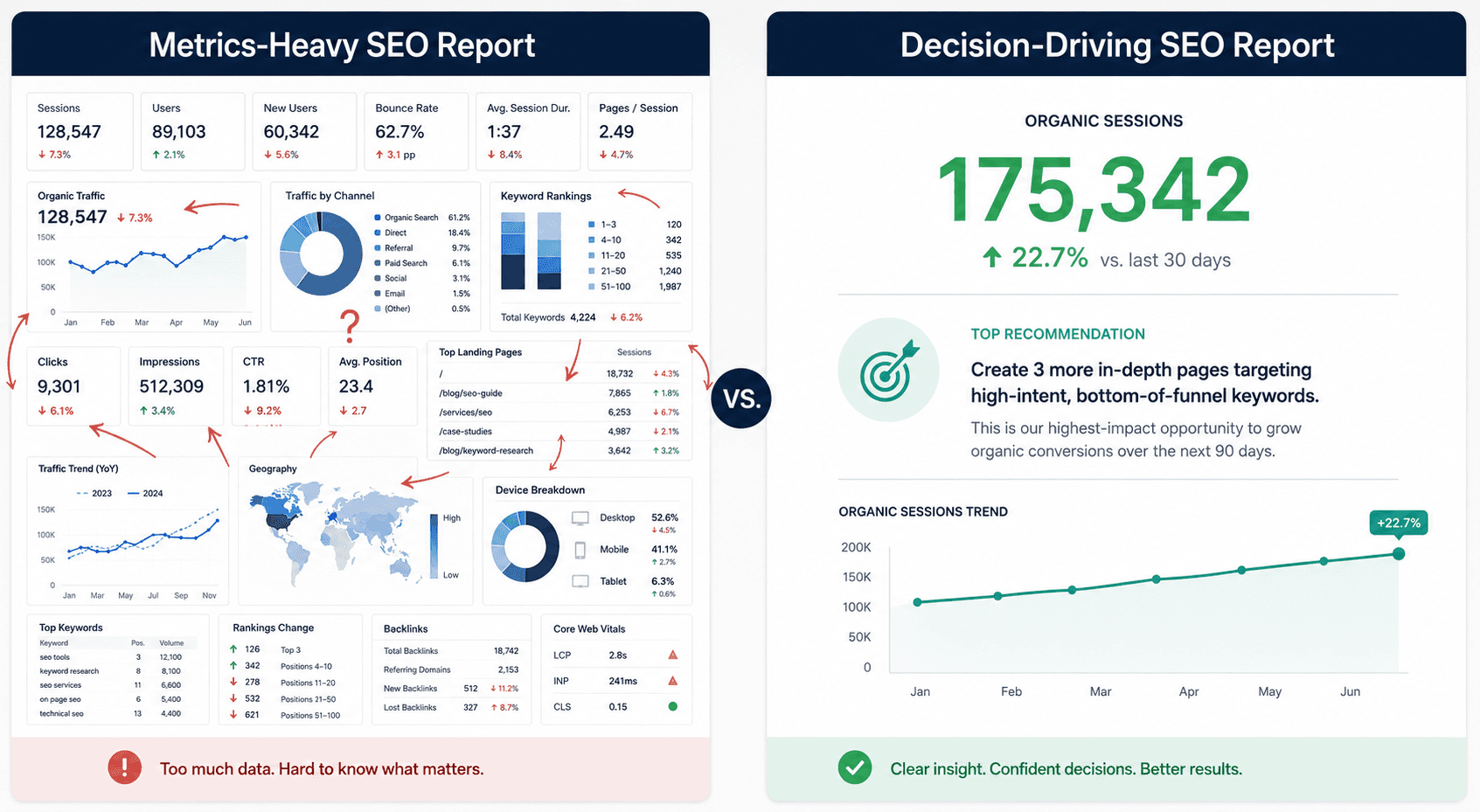
Most SEO reports get skimmed for 12 seconds and filed away.
The ones that get acted on share a single trait: they answer the question the reader was already asking.
That sounds obvious. It almost never happens.
Agencies send clients a 40-page report full of impressions, rankings, and crawl errors. Marketing teams send executives a dashboard with 60 metrics. SEO specialists send founders a screenshot of Google Search Console. Nobody knows what to do next. Nothing changes. The report becomes performance theater.
This guide shows you what a useful SEO report actually looks like. With real examples, named mistakes, and a structure you can apply this week.
You’ll get:
The 4 audiences SEO reports serve (and why most reports speak to none of them)
6 real SEO report examples for different goals
Named mistakes that make reports unreadable
A practical structure that drives decisions
How to present the report so it actually gets read
What Is an SEO Report?
An SEO report is a document or dashboard that summarizes how a website is performing in organic search and what actions should be taken next.
The keyword in that sentence is “next.”
Most SEO reports describe the past. The valuable ones change the future.
A real SEO report covers:
What’s working
What’s broken
What’s changing in the market
What we should do about it
If your report stops at the first two, it’s a status update. If it gets to the last two, it’s strategy.
If you’re new to the broader discipline, our guide on SEO and online marketing covers the fundamentals before you start measuring.
Why Most SEO Reports Get Ignored
The problem is not lack of data.
The problem is lack of judgment.
Modern SEO tools (Ahrefs, Semrush, Search Console, GA4) generate more data than any human can read. So agencies and in-house teams default to dumping the data into a deck and calling it a report.
Executives don’t care about your crawl budget. CEOs don’t read keyword position movements. Founders don’t want to see 200 backlinks listed line by line.
What they want is the answer to a simple question: “Are we winning, and what should we do this month to win more?”
If your SEO report doesn’t make that answer obvious in the first slide, it will be ignored.
For more on translating raw data into actions, our guide on turning analysis into decision-ready insights walks through the exact framework.
The 4 Audiences of an SEO Report
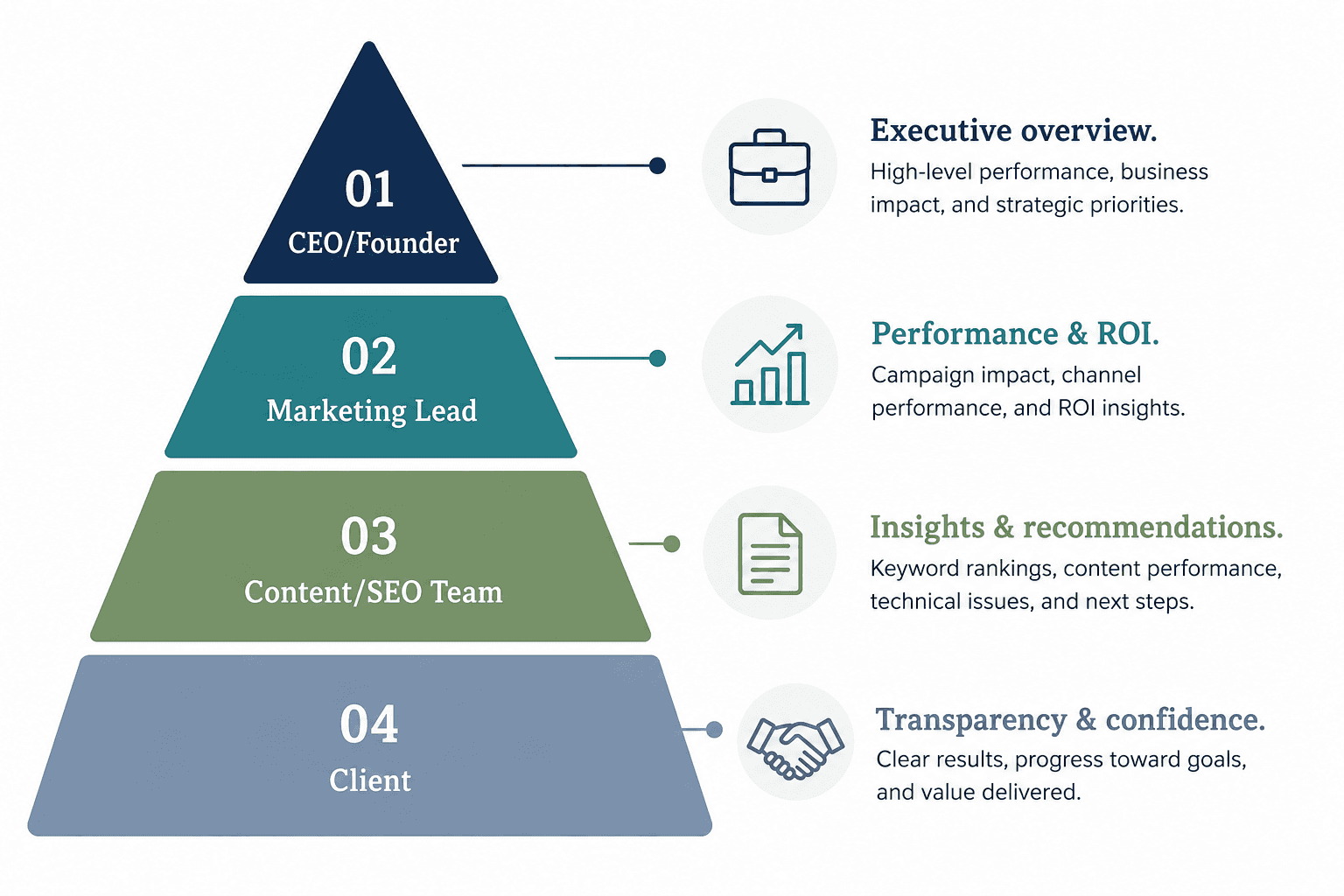
This is the most common mistake. SEO reports are written for one audience and sent to four.
Each audience reads differently.
Audience 1: The CEO or Founder
Reading for:
Is SEO making us money?
Are we beating competitors?
What should we invest in next quarter?
They want a one-page summary. Numbers tied to revenue. A clear recommendation.
Audience 2: The Marketing Lead
Reading for:
Is our content strategy working?
Where are the gaps?
How do we allocate budget between SEO, paid, and other channels?
They want trends, channel comparisons, and a clear ROI picture.
Audience 3: The Content or SEO Team
Reading for:
Which pages are winning and why?
What technical issues need fixing?
What keywords should we target next?
They want detail. Page-level performance, ranking shifts, technical health.
Audience 4: The Client (for Agencies)
Reading for:
Am I getting what I’m paying for?
Is this agency actually doing work that matters?
What is the long-term plan?
They want transparency. Activity logs, results, and a path forward.
A good SEO report layers these. Executive summary first. Strategic insights second. Tactical detail third. Activity log last. Each audience can stop reading at their level.
The 3 Types of SEO Reports (And When to Use Each)
Not every report has the same job. Most teams use the wrong type at the wrong time.
[[EMBED:PGRpdiBzdHlsZT0ib3ZlcmZsb3cteDphdXRvO21hcmdpbjoyMHB4IDAiPjx0YWJsZSBzdHlsZT0id2lkdGg6MTAwJTtib3JkZXItY29sbGFwc2U6Y29sbGFwc2U7Zm9udC1zaXplOjE1cHg7bWFyZ2luOjhweCAwIj48dGggc3R5bGU9ImJvcmRlcjoxcHggc29saWQgI2UzZTZlYTtwYWRkaW5nOjEwcHggMTRweDt0ZXh0LWFsaWduOmxlZnQ7YmFja2dyb3VuZDojZjRmNmY4O2ZvbnQtd2VpZ2h0OjYwMCI+PHRyPjx0aCBzdHlsZT0iYm9yZGVyOjFweCBzb2xpZCAjZTNlNmVhO3BhZGRpbmc6MTBweCAxNHB4O3RleHQtYWxpZ246bGVmdDtiYWNrZ3JvdW5kOiNmNGY2Zjg7Zm9udC13ZWlnaHQ6NjAwIj5SZXBvcnQgVHlwZTwvdGg+PHRoIHN0eWxlPSJib3JkZXI6MXB4IHNvbGlkICNlM2U2ZWE7cGFkZGluZzoxMHB4IDE0cHg7dGV4dC1hbGlnbjpsZWZ0O2JhY2tncm91bmQ6I2Y0ZjZmODtmb250LXdlaWdodDo2MDAiPlB1cnBvc2U8L3RoPjx0aCBzdHlsZT0iYm9yZGVyOjFweCBzb2xpZCAjZTNlNmVhO3BhZGRpbmc6MTBweCAxNHB4O3RleHQtYWxpZ246bGVmdDtiYWNrZ3JvdW5kOiNmNGY2Zjg7Zm9udC13ZWlnaHQ6NjAwIj5BdWRpZW5jZTwvdGg+PHRoIHN0eWxlPSJib3JkZXI6MXB4IHNvbGlkICNlM2U2ZWE7cGFkZGluZzoxMHB4IDE0cHg7dGV4dC1hbGlnbjpsZWZ0O2JhY2tncm91bmQ6I2Y0ZjZmODtmb250LXdlaWdodDo2MDAiPkZyZXF1ZW5jeTwvdGg+PC90cj48L3RoZWFkPjx0Ym9keT48dHI+PHRkIHN0eWxlPSJib3JkZXI6MXB4IHNvbGlkICNlM2U2ZWE7cGFkZGluZzoxMHB4IDE0cHg7dGV4dC1hbGlnbjpsZWZ0O3ZlcnRpY2FsLWFsaWduOnRvcCI+UGVyZm9ybWFuY2UgUmVwb3J0PC90ZD48dGQgc3R5bGU9ImJvcmRlcjoxcHggc29saWQgI2UzZTZlYTtwYWRkaW5nOjEwcHggMTRweDt0ZXh0LWFsaWduOmxlZnQ7dmVydGljYWwtYWxpZ246dG9wIj5XaGF0IGhhcHBlbmVkIGxhc3QgcGVyaW9kPC90ZD48dGQgc3R5bGU9ImJvcmRlcjoxcHggc29saWQgI2UzZTZlYTtwYWRkaW5nOjEwcHggMTRweDt0ZXh0LWFsaWduOmxlZnQ7dmVydGljYWwtYWxpZ246dG9wIj5FeGVjdXRpdmVzLCBjbGllbnRzPC90ZD48dGQgc3R5bGU9ImJvcmRlcjoxcHggc29saWQgI2UzZTZlYTtwYWRkaW5nOjEwcHggMTRweDt0ZXh0LWFsaWduOmxlZnQ7dmVydGljYWwtYWxpZ246dG9wIj5Nb250aGx5PC90ZD48L3RyPjx0cj48dGQgc3R5bGU9ImJvcmRlcjoxcHggc29saWQgI2UzZTZlYTtwYWRkaW5nOjEwcHggMTRweDt0ZXh0LWFsaWduOmxlZnQ7dmVydGljYWwtYWxpZ246dG9wIj5TRU8gQXVkaXQ8L3RkPjx0ZCBzdHlsZT0iYm9yZGVyOjFweCBzb2xpZCAjZTNlNmVhO3BhZGRpbmc6MTBweCAxNHB4O3RleHQtYWxpZ246bGVmdDt2ZXJ0aWNhbC1hbGlnbjp0b3AiPldoYXQncyBicm9rZW4gYW5kIHdoYXQgdG8gZml4PC90ZD48dGQgc3R5bGU9ImJvcmRlcjoxcHggc29saWQgI2UzZTZlYTtwYWRkaW5nOjEwcHggMTRweDt0ZXh0LWFsaWduOmxlZnQ7dmVydGljYWwtYWxpZ246dG9wIj5NYXJrZXRpbmcgbGVhZHMsIFNFTyB0ZWFtPC90ZD48dGQgc3R5bGU9ImJvcmRlcjoxcHggc29saWQgI2UzZTZlYTtwYWRkaW5nOjEwcHggMTRweDt0ZXh0LWFsaWduOmxlZnQ7dmVydGljYWwtYWxpZ246dG9wIj5RdWFydGVybHkgb3Igb25lLXRpbWU8L3RkPjwvdHI+PHRyPjx0ZCBzdHlsZT0iYm9yZGVyOjFweCBzb2xpZCAjZTNlNmVhO3BhZGRpbmc6MTBweCAxNHB4O3RleHQtYWxpZ246bGVmdDt2ZXJ0aWNhbC1hbGlnbjp0b3AiPlN0cmF0ZWdpYyBSZXBvcnQ8L3RkPjx0ZCBzdHlsZT0iYm9yZGVyOjFweCBzb2xpZCAjZTNlNmVhO3BhZGRpbmc6MTBweCAxNHB4O3RleHQtYWxpZ246bGVmdDt2ZXJ0aWNhbC1hbGlnbjp0b3AiPldoYXQgd2Ugc2hvdWxkIGRvIG5leHQ8L3RkPjx0ZCBzdHlsZT0iYm9yZGVyOjFweCBzb2xpZCAjZTNlNmVhO3BhZGRpbmc6MTBweCAxNHB4O3RleHQtYWxpZ246bGVmdDt2ZXJ0aWNhbC1hbGlnbjp0b3AiPkNFT3MsIGRlY2lzaW9uLW1ha2VyczwvdGQ+PHRkIHN0eWxlPSJib3JkZXI6MXB4IHNvbGlkICNlM2U2ZWE7cGFkZGluZzoxMHB4IDE0cHg7dGV4dC1hbGlnbjpsZWZ0O3ZlcnRpY2FsLWFsaWduOnRvcCI+UXVhcnRlcmx5PC90ZD48L3RyPjwvdGJvZHk+PC90YWJsZT48L2Rpdj4=]]
If you send a performance report when the client needs a strategic report, you’ll lose them. If you send a strategic report when an executive just wants the monthly numbers, you’ll waste their time.
Match the report to the moment.
6 SEO Report Examples by Goal
1. The Monthly Performance Report
The most common report, and the most commonly misused.
Goal: Show progress against goals, surface anomalies, and recommend one or two next steps.
Should include:
Organic traffic vs previous period and previous year
Top 10 landing pages by traffic and conversions
Keyword ranking movements (top wins and losses)
Revenue or lead volume from organic search
One recommendation for next month
Should NOT include:
Every keyword in the top 100
A 50-row backlinks list
Screenshot of Search Console with no commentary
Generic “we will continue to optimize” filler
Example summary line:
“Organic traffic up 18% MoM, driven by three new ranking gains on commercial-intent keywords. Recommended next step: expand the ‘pricing comparison’ content cluster, which is showing the strongest conversion lift.”
That’s one sentence. It answers what happened, why, and what to do next. The 40 pages of data sit underneath as appendix.
Once your monthly performance numbers are ready, the part that takes hours is turning them into a clean, on-brand client deck, which is why agencies use Decktopus to generate the slide version automatically, with charts, headlines, and brand colors applied without any manual design work.
2. The SEO Audit Report
A point-in-time deep dive. Usually done at the start of an engagement or once a year.
Goal: Identify everything broken, prioritize fixes, and create a 90-day action plan.
Should include:
Technical health score (Core Web Vitals, indexing issues, site speed)
On-page issues (title tags, meta descriptions, content gaps)
Backlink profile health (toxic links, opportunities)
Content performance audit (winners, losers, decaying pages)
Competitive gap analysis
Prioritized action plan (effort vs impact)
The trap: Audits that list 400 issues without prioritization are useless. Funders, executives, and even SEO teams need to know what to fix first.
For a related approach to prioritization in strategy work, our guide to competitor analysis covers how to choose which signals matter.
3. The Competitor SEO Report
When a competitor passes you in rankings, you need a different kind of report.
Goal: Understand why they’re winning and what you can do about it.
Should include:
Side-by-side keyword overlap
Content gap analysis (keywords they rank for, you don’t)
Backlink comparison (who links to them, not you)
Top-performing competitor pages and why they win
Strategic recommendation (compete head-on, differentiate, or ignore)
Example structure:
[[EMBED:PGRpdiBzdHlsZT0ib3ZlcmZsb3cteDphdXRvO21hcmdpbjoyMHB4IDAiPjx0YWJsZSBzdHlsZT0id2lkdGg6MTAwJTtib3JkZXItY29sbGFwc2U6Y29sbGFwc2U7Zm9udC1zaXplOjE1cHg7bWFyZ2luOjhweCAwIj48dGggc3R5bGU9ImJvcmRlcjoxcHggc29saWQgI2UzZTZlYTtwYWRkaW5nOjEwcHggMTRweDt0ZXh0LWFsaWduOmxlZnQ7YmFja2dyb3VuZDojZjRmNmY4O2ZvbnQtd2VpZ2h0OjYwMCI+PHRyPjx0aCBzdHlsZT0iYm9yZGVyOjFweCBzb2xpZCAjZTNlNmVhO3BhZGRpbmc6MTBweCAxNHB4O3RleHQtYWxpZ246bGVmdDtiYWNrZ3JvdW5kOiNmNGY2Zjg7Zm9udC13ZWlnaHQ6NjAwIj5NZXRyaWM8L3RoPjx0aCBzdHlsZT0iYm9yZGVyOjFweCBzb2xpZCAjZTNlNmVhO3BhZGRpbmc6MTBweCAxNHB4O3RleHQtYWxpZ246bGVmdDtiYWNrZ3JvdW5kOiNmNGY2Zjg7Zm9udC13ZWlnaHQ6NjAwIj5Zb3VyIFNpdGU8L3RoPjx0aCBzdHlsZT0iYm9yZGVyOjFweCBzb2xpZCAjZTNlNmVhO3BhZGRpbmc6MTBweCAxNHB4O3RleHQtYWxpZ246bGVmdDtiYWNrZ3JvdW5kOiNmNGY2Zjg7Zm9udC13ZWlnaHQ6NjAwIj5Db21wZXRpdG9yIEE8L3RoPjx0aCBzdHlsZT0iYm9yZGVyOjFweCBzb2xpZCAjZTNlNmVhO3BhZGRpbmc6MTBweCAxNHB4O3RleHQtYWxpZ246bGVmdDtiYWNrZ3JvdW5kOiNmNGY2Zjg7Zm9udC13ZWlnaHQ6NjAwIj5HYXA8L3RoPjwvdHI+PC90aGVhZD48dGJvZHk+PHRyPjx0ZCBzdHlsZT0iYm9yZGVyOjFweCBzb2xpZCAjZTNlNmVhO3BhZGRpbmc6MTBweCAxNHB4O3RleHQtYWxpZ246bGVmdDt2ZXJ0aWNhbC1hbGlnbjp0b3AiPk9yZ2FuaWMga2V5d29yZHM8L3RkPjx0ZCBzdHlsZT0iYm9yZGVyOjFweCBzb2xpZCAjZTNlNmVhO3BhZGRpbmc6MTBweCAxNHB4O3RleHQtYWxpZ246bGVmdDt2ZXJ0aWNhbC1hbGlnbjp0b3AiPjQsMjAwPC90ZD48dGQgc3R5bGU9ImJvcmRlcjoxcHggc29saWQgI2UzZTZlYTtwYWRkaW5nOjEwcHggMTRweDt0ZXh0LWFsaWduOmxlZnQ7dmVydGljYWwtYWxpZ246dG9wIj4xMSw4MDA8L3RkPjx0ZCBzdHlsZT0iYm9yZGVyOjFweCBzb2xpZCAjZTNlNmVhO3BhZGRpbmc6MTBweCAxNHB4O3RleHQtYWxpZ246bGVmdDt2ZXJ0aWNhbC1hbGlnbjp0b3AiPi03LDYwMDwvdGQ+PC90cj48dHI+PHRkIHN0eWxlPSJib3JkZXI6MXB4IHNvbGlkICNlM2U2ZWE7cGFkZGluZzoxMHB4IDE0cHg7dGV4dC1hbGlnbjpsZWZ0O3ZlcnRpY2FsLWFsaWduOnRvcCI+VG9wIDMgcmFua2luZ3M8L3RkPjx0ZCBzdHlsZT0iYm9yZGVyOjFweCBzb2xpZCAjZTNlNmVhO3BhZGRpbmc6MTBweCAxNHB4O3RleHQtYWxpZ246bGVmdDt2ZXJ0aWNhbC1hbGlnbjp0b3AiPjE4MDwvdGQ+PHRkIHN0eWxlPSJib3JkZXI6MXB4IHNvbGlkICNlM2U2ZWE7cGFkZGluZzoxMHB4IDE0cHg7dGV4dC1hbGlnbjpsZWZ0O3ZlcnRpY2FsLWFsaWduOnRvcCI+NTQwPC90ZD48dGQgc3R5bGU9ImJvcmRlcjoxcHggc29saWQgI2UzZTZlYTtwYWRkaW5nOjEwcHggMTRweDt0ZXh0LWFsaWduOmxlZnQ7dmVydGljYWwtYWxpZ246dG9wIj4tMzYwPC90ZD48L3RyPjx0cj48dGQgc3R5bGU9ImJvcmRlcjoxcHggc29saWQgI2UzZTZlYTtwYWRkaW5nOjEwcHggMTRweDt0ZXh0LWFsaWduOmxlZnQ7dmVydGljYWwtYWxpZ246dG9wIj5CYWNrbGlua3MgKERSIDUwKyk8L3RkPjx0ZCBzdHlsZT0iYm9yZGVyOjFweCBzb2xpZCAjZTNlNmVhO3BhZGRpbmc6MTBweCAxNHB4O3RleHQtYWxpZ246bGVmdDt2ZXJ0aWNhbC1hbGlnbjp0b3AiPjMyMDwvdGQ+PHRkIHN0eWxlPSJib3JkZXI6MXB4IHNvbGlkICNlM2U2ZWE7cGFkZGluZzoxMHB4IDE0cHg7dGV4dC1hbGlnbjpsZWZ0O3ZlcnRpY2FsLWFsaWduOnRvcCI+MSwxMDA8L3RkPjx0ZCBzdHlsZT0iYm9yZGVyOjFweCBzb2xpZCAjZTNlNmVhO3BhZGRpbmc6MTBweCAxNHB4O3RleHQtYWxpZ246bGVmdDt2ZXJ0aWNhbC1hbGlnbjp0b3AiPi03ODA8L3RkPjwvdHI+PHRyPjx0ZCBzdHlsZT0iYm9yZGVyOjFweCBzb2xpZCAjZTNlNmVhO3BhZGRpbmc6MTBweCAxNHB4O3RleHQtYWxpZ246bGVmdDt2ZXJ0aWNhbC1hbGlnbjp0b3AiPkVzdGltYXRlZCBvcmdhbmljIHRyYWZmaWM8L3RkPjx0ZCBzdHlsZT0iYm9yZGVyOjFweCBzb2xpZCAjZTNlNmVhO3BhZGRpbmc6MTBweCAxNHB4O3RleHQtYWxpZ246bGVmdDt2ZXJ0aWNhbC1hbGlnbjp0b3AiPjI0Sy9tbzwvdGQ+PHRkIHN0eWxlPSJib3JkZXI6MXB4IHNvbGlkICNlM2U2ZWE7cGFkZGluZzoxMHB4IDE0cHg7dGV4dC1hbGlnbjpsZWZ0O3ZlcnRpY2FsLWFsaWduOnRvcCI+OTVLL21vPC90ZD48dGQgc3R5bGU9ImJvcmRlcjoxcHggc29saWQgI2UzZTZlYTtwYWRkaW5nOjEwcHggMTRweDt0ZXh0LWFsaWduOmxlZnQ7dmVydGljYWwtYWxpZ246dG9wIj4tNzFLPC90ZD48L3RyPjwvdGJvZHk+PC90YWJsZT48L2Rpdj4=]]
The gap tells the story. Then the report explains how to close it.
For deeper analysis of how to read competitive signals, see our breakdown of the best competitor analysis tools.
4. The Content SEO Report
For teams that publish content regularly. Tracks what’s working and what’s decaying.
Goal: Make publishing decisions based on real performance data, not gut feel.
Should include:
New content performance (first 30, 60, 90 days)
Decaying content (pages losing rankings or traffic)
Top-converting content
Cannibalization issues (multiple pages competing for the same keyword)
Refresh and consolidation recommendations
Example callout:
“12 blog posts published in Q2. 4 are climbing toward page one. 6 are stalled at positions 30 to 50. 2 are cannibalizing existing pages. Recommended actions: refresh and merge 2 cannibalizing pairs, expand the 4 climbers with related keywords, deprecate the 6 stalled pieces.”
That’s a decision, not a status update.
For more on what makes content work in the first place, our guide on building a content strategy covers the foundations.
5. The Local SEO Report
For businesses where Google Business Profile, local rankings, and “near me” searches drive revenue.
Goal: Track visibility in local pack, review velocity, and citation health.
Should include:
Google Business Profile insights (views, calls, direction requests)
Local pack ranking by primary keyword and location
Review velocity and sentiment trends
Citation consistency across directories
Competitor local visibility
For local businesses, this report is often more important than the standard organic SEO report.
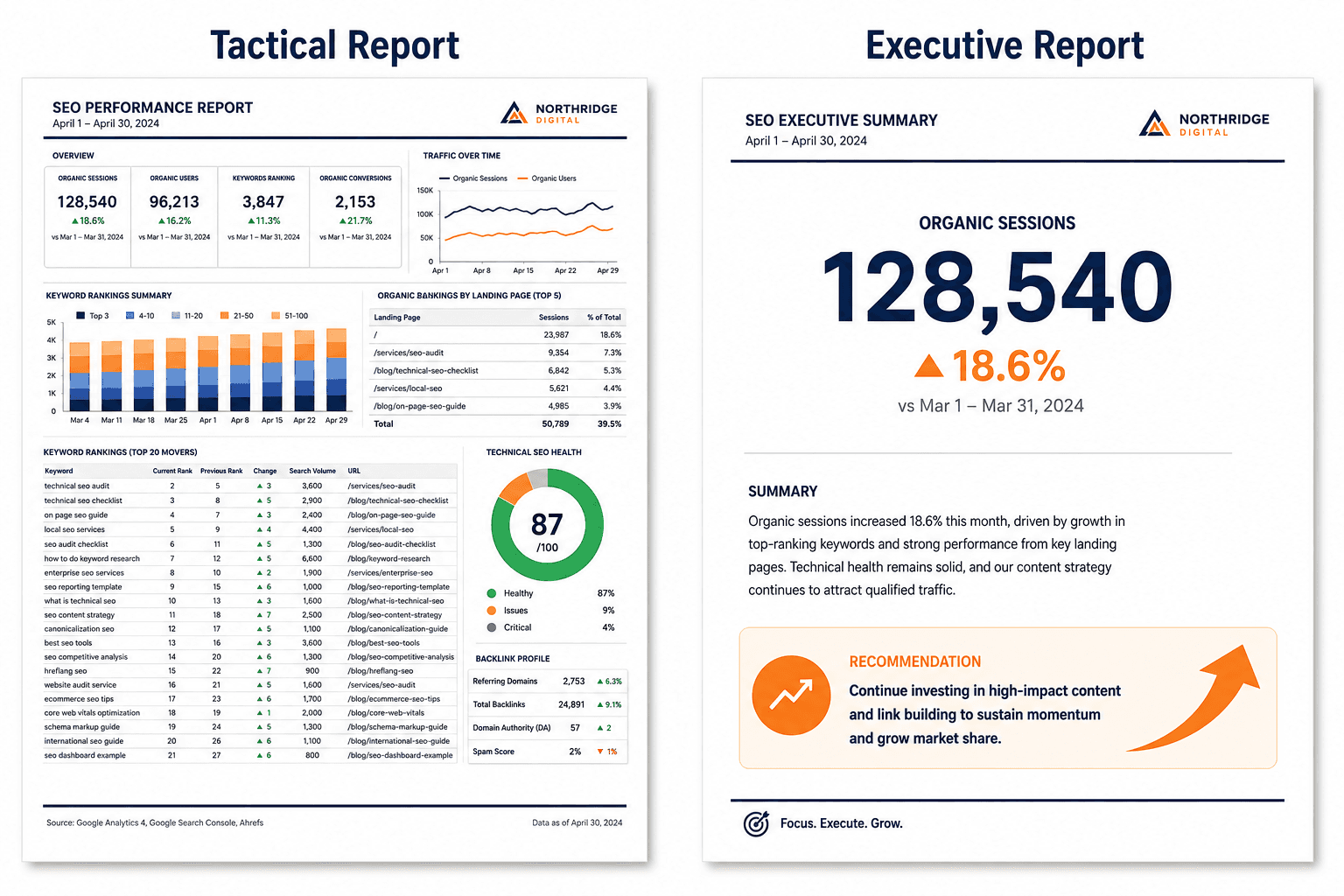
6. The Executive SEO Report
The one most agencies write badly.
Goal: Give the CEO or founder a 5-minute read that ends with a recommendation.
Should include:
A single headline number (revenue, leads, or traffic tied to business goal)
A short narrative: what changed and why
A recommendation: what to do next quarter
A confidence level (we’re winning, we’re holding, we need to act)
Example structure:
Headline: Organic search drove $142K in attributed revenue in Q3, up 24% from Q2.
What changed: Three new commercial pages reached page one, and our category landing pages started outranking [competitor]’s comparable pages.
What to do next: Double down on the category page strategy. Specifically, build 6 more pages targeting mid-funnel keywords.
Confidence: High. The traffic is converting at 4.2%, well above our blended channel average of 2.1%.
That’s the entire executive report. Four sentences and a number. The supporting data lives in appendices.
Executive reports are short for a reason, and the slide version needs to land that headline number in one second, which is where Decktopus helps by turning your written executive summary into a single, scannable slide with one bold metric, one narrative, and one recommendation on display.
5 Named Mistakes That Kill SEO Reports
1. Vanity Metric Stacking
Loading the report with impressions, keyword counts, and average position. None of these tie to revenue. They make the agency look busy. They don’t help the client decide anything.
2. Data Without Decisions
Showing a graph that traffic went up 12%, then moving on. Why did it go up? Is it sustainable? What should we do about it? If your chart isn’t paired with an interpretation, it’s just decoration.
3. The Activity Log Disguised as a Report
“This month we published 4 blog posts, fixed 12 broken links, and updated 6 meta descriptions.” That’s a timesheet. The client doesn’t pay you to be busy. They pay you for results.
4. The Forever Optimization Promise
Reports that end with “we will continue to optimize and monitor performance.” Continue optimizing what, specifically? Monitoring for what threshold? Vague closes signal a vague strategy.
5. Burying the Bad News
Hiding ranking losses or traffic drops in a footnote. Clients see through this every time, and it destroys credibility. Lead with the bad news, explain why it happened, and show what you’re doing about it.
How to Structure Your Own SEO Report
Here’s a structure that works across industries, audiences, and reporting cadences.
Section 1: Executive Summary (1 page or 1 slide)
The single most important page. Should contain:
Headline metric tied to business goal
One paragraph narrative
The recommended action
For more on writing this critical page, see our guide on how to write an executive summary.
Section 2: Performance Overview
Organic traffic trends
Conversion or revenue from organic
Top wins and losses
Section 3: Strategic Insights
What changed in the market
What’s working in our content and SEO strategy
What’s not working
Section 4: Tactical Detail
Page-level performance
Keyword movements
Technical issues found and fixed
Section 5: Action Plan
Priorities for next reporting period
Specific deliverables and owners
Risks and dependencies
Section 6: Appendix
Raw data
Detailed keyword lists
Backlink profile
Anything a power user might want to dig into
If your report follows this structure, every audience can stop reading at the level that serves them.
For more on structuring reports and proposals for different audiences, our business proposal guide covers how to layer information for stakeholders with different attention spans.
How to Present an SEO Report So It Gets Read
A great SEO report is wasted if the presentation is unclear.
The best SEO presentations follow three principles:
1. One insight per slide.
Don’t pack three charts onto a slide hoping someone will connect them. Make the connection for the reader.
2. Charts that make the answer obvious.
If a bar chart shows your traffic vs a competitor, the reader should know who’s winning in one second. If it takes 10 seconds, redesign the chart.
3. Recommendations on every section.
After every chart, every comparison, every section, answer the “so what?” question. Don’t make the reader work for the takeaway.
For visualizing channel mix, share of voice, or content category breakdowns, pie charts often communicate faster than tables.
The fastest way to go from a written SEO report to a presentation-ready client deck is to upload your data and analysis into Decktopus, apply your agency brand with one click from your website URL, and let AI generate a layered deck where executives stop reading at slide 3 and the SEO team digs into the appendix slides.
Turning Your SEO Report Into a Presentation
This is where most SEO teams lose hours.
You’ve done the analysis. You’ve pulled the data. Now you need a clean, branded deck to send to a client or present to leadership.
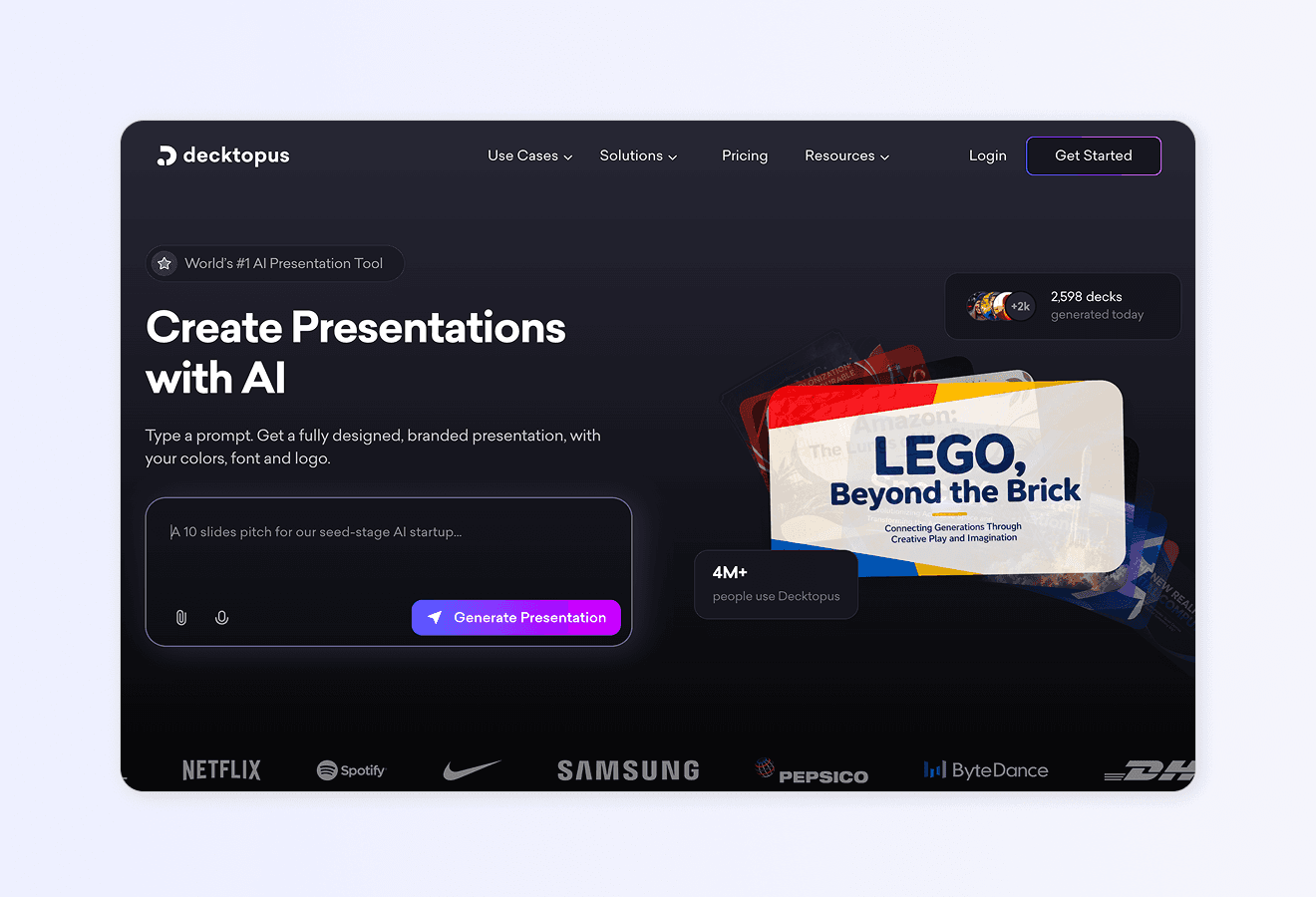
Decktopus generates the full deck for you.
Here’s how it works:
Describe your topic. Type something like “Q3 SEO performance report for [client name], focused on revenue growth and content strategy.” Or upload your data and notes as supporting files.
Choose your style. Paste your agency or company website URL to apply your brand automatically. Logo, colors, and fonts get pulled in without any manual setup.
Review the outline. Decktopus generates a slide structure covering executive summary, performance, insights, and action plan. Adjust before the full deck is built.
Refine in the editor. Use the prompt bar to fine-tune any slide. Try instructions like “show traffic vs competitors as a bar chart” or “make this executive summary tighter.” Brand Compliance keeps every slide on-brand.
Export or share. Download as PDF for client delivery, share via link, or present directly.
This is especially useful for agencies that send dozens of reports a month. Instead of formatting each one manually, you generate the deck and refine with prompts.
For more on AI-powered presentation workflows, see our guide on the best AI presentation tools.
Frequently Asked Questions
How long should an SEO report be?
Depends on the audience. An executive summary is one page or one slide. A monthly performance report is typically 8 to 12 slides. A full SEO audit can run 25 to 40 slides with appendices. Match length to attention span, not the other way around.
What metrics belong in every SEO report?
At minimum: organic traffic vs previous period, top landing pages, conversions or revenue from organic, and a recommendation. Everything else is contextual.
Should I include keyword rankings in my SEO report?
Yes, but selectively. Showing the top 10 wins and top 10 losses is useful. Showing all 4,000 tracked keywords is noise. Rankings also matter less than they used to, since search results are increasingly personalized.
How often should SEO reports be sent?
Monthly for performance reports. Quarterly for strategic reports. SEO audits happen once a year or at the start of a new engagement. Weekly reports are usually overkill and create noise.
What’s the difference between an SEO report and an SEO audit?
A report shows performance over a period. An audit identifies everything that needs fixing at a point in time. Audits are typically one-time or annual. Reports are ongoing.
Can AI help write SEO reports?
Yes. AI tools are useful for summarizing data, drafting narratives, and generating presentation slides. But the strategic interpretation (what to do next, what to prioritize) still requires human judgment.
How do I make my SEO report stand out from a competitor agency’s?
Stop reporting on activity. Start reporting on decisions. The agency that says “here’s what we did” loses to the agency that says “here’s what to do next, and here’s why.” Specificity and prioritization beat thoroughness every time.
Final Thoughts
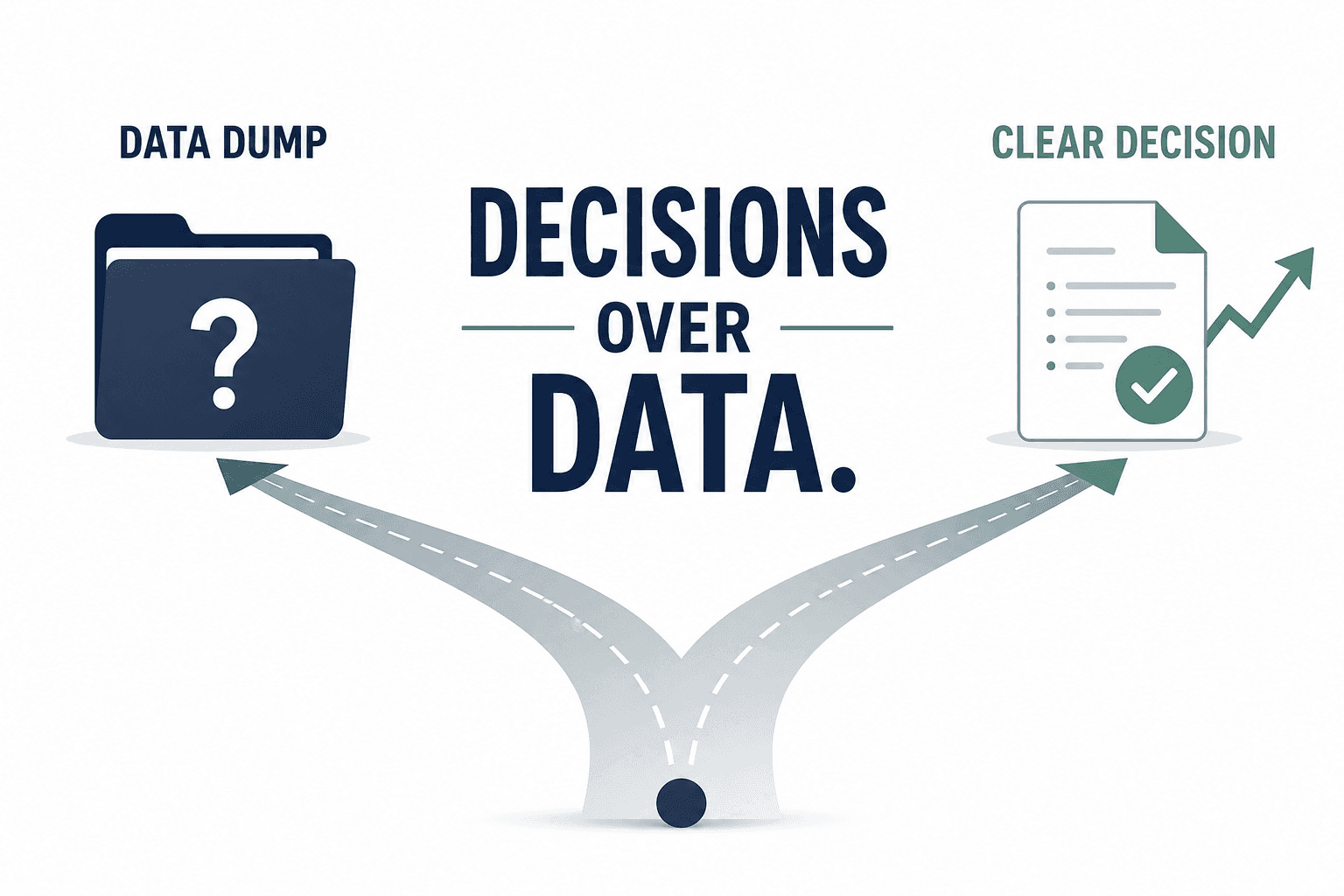
The best SEO reports are not the longest, the most detailed, or the most polished.
They’re the clearest.
They answer the question the reader is already asking. They tie organic search to business outcomes, not vanity metrics. They tell you what to do next, not just what already happened.
Most SEO reports describe the past. The good ones change the future.
If your next report doesn’t change a decision someone makes this month, you’ve written the wrong report.
Related posts

How AI Voice Agents Help Sales Teams Prepare and Deliver Better Presentations
Learn how AI voice agents help sales teams turn call insights into focused slides, stronger delivery, and more confident customer presentations at every stage.
Marketing

Instagram Carousel Size & Dimensions Guide (2026)
Instagram carousel size in 2026: exact dimensions for square, portrait, and landscape, plus file limits and safe zones, verified across sources.
Marketing

LinkedIn Carousel Size, Dimensions & Format Guide 2026
LinkedIn carousel size in 2026: exact dimensions, file limits, aspect ratios, and formatting rules so your slides never get cropped.
Marketing