Marketing
Content Types Every Real Estate Agent Needs
The 5 core content types every real estate agent needs, from visual listings to newsletters, plus 20 social media post ideas that convert.


Decktopus Content Team
Content types every real estate agent needs are the specific formats, visuals, and videos that turn browsers into buyers. Getting the mix right means covering every stage of a home search, not just listing photos.
82% of millennials say buying a home is a top priority, and most start that search online, according to data cited by the National Association of Realtors. Meeting them there with the right content types matters as much as the listing itself.
Table of Contents
Why Content Marketing Matters for Real Estate
The 5 Core Content Types Every Agent Needs
Content Types Compared
Building a Cohesive Brand Story
Optimizing Your Website for Content
20 Social Media Post Ideas for Real Estate Agents
Before and After: A Content Strategy Makeover
Common Mistakes to Avoid
How to Build Your Real Estate Content with Decktopus AI
Frequently Asked Questions
Conclusion
Stay Connected
Why Content Marketing Matters for Real Estate
Buying a home is one of the biggest milestones in a person's life. It carries real emotional weight, not just financial weight.

Real estate professionals who become content creators tap into that sentiment instead of just advertising rates. The real estate industry has increasingly leaned into content marketing in recent years, and agents who skip it are leaving trust and leads on the table.
This shift is not limited to real estate. Even a traditionally offline industry like supply chain services has started using the same kind of marketing content to build trust with prospects.
The 5 Core Content Types Every Agent Needs
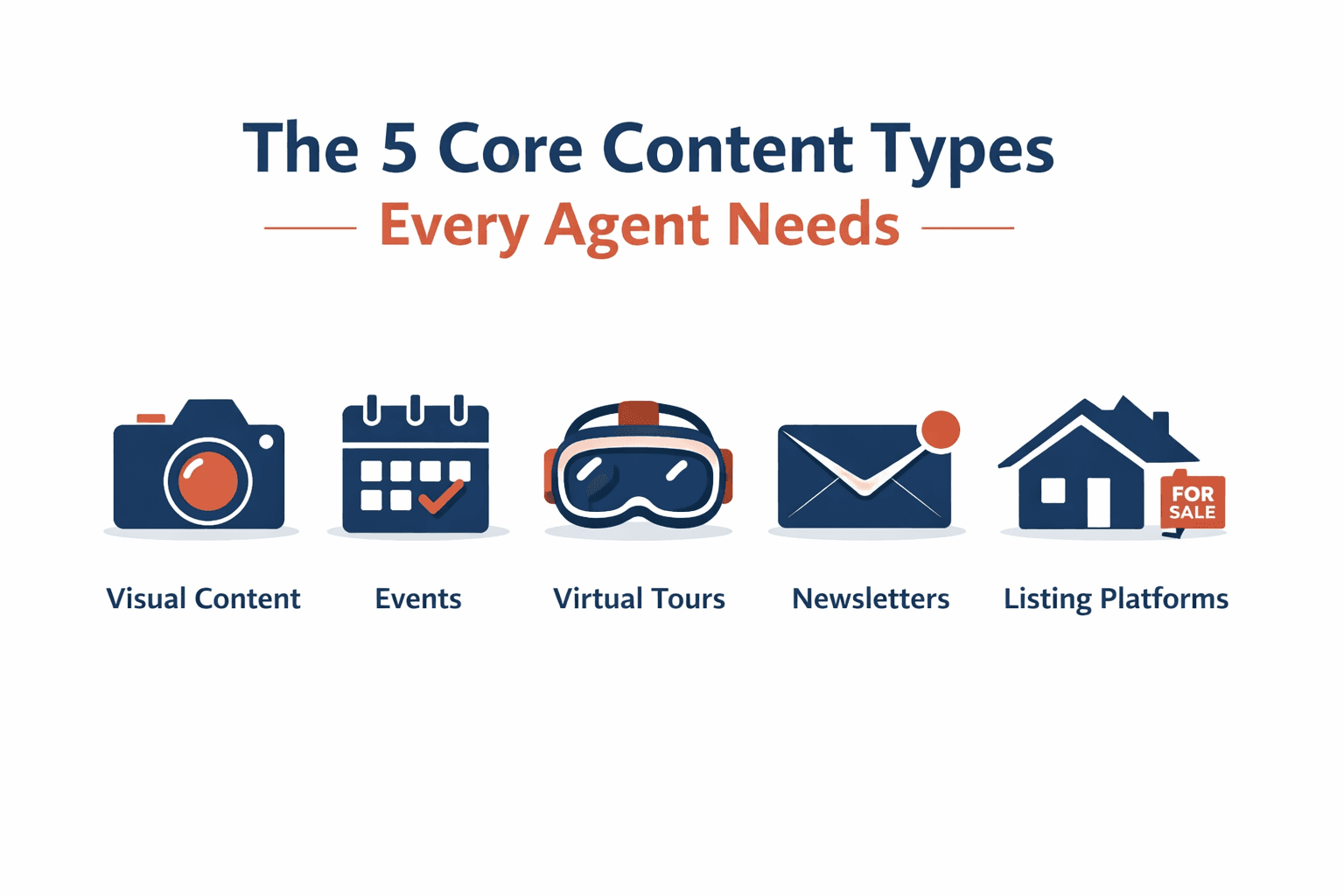
These five formats cover the full range of what today's homebuyers expect to see before they ever pick up the phone.
1. Visual Content
Real estate is won or lost on first impressions, so visual content deserves priority above almost everything else.

Professional, high-resolution photos of staging and open houses can be reused across every channel, from printed collateral to social media.
Infographics are especially useful for answering common questions in a visual format, like pros versus cons of renting versus owning, or condo versus townhouse comparisons.
2. Event-Based Marketing
Buying or selling a home is a deeply human moment, even when most of the process happens online. Pairing digital marketing with in-person events keeps that human element alive.

Strong event formats include open houses, block parties, agent meet-and-greets, real estate seminars, Q&A sessions, and industry conferences.
Partnering with lenders, appraisers, attorneys, and local officials at these events expands your reach well beyond your own client list.
3. AR and VR Virtual Tours
Interactive video is a different experience entirely from static photos. Tools built for augmented and virtual reality let agents offer custom, one-of-a-kind open houses.

This is not limited to luxury listings anymore. Prospective buyers increasingly expect to explore a property remotely before ever scheduling an in-person visit.
A smartphone or a basic VR headset is often all a buyer needs to get the full experience without stepping into the home itself.
4. Newsletter Marketing
Email marketing tends to deliver a stronger ROI than almost any other channel, even in an era of apps and chatbots.

A good rule of thumb from HubSpot is to keep newsletters 90% educational and 10% promotional. About 33% of subscribers open an email based on the subject line alone, so brevity matters.
Strong real estate newsletters mix blog posts, infographics, short videos, new listings, and buyer or seller guides.
5. Listing Platform Presence
Listing platforms like Zillow, Redfin, and Trulia host massive volumes of homes with advanced filtering by price and location.
Keeping listings accurate and up to date across web, mobile browser, and mobile app is essential for staying visible to prospects who are searching around the clock.
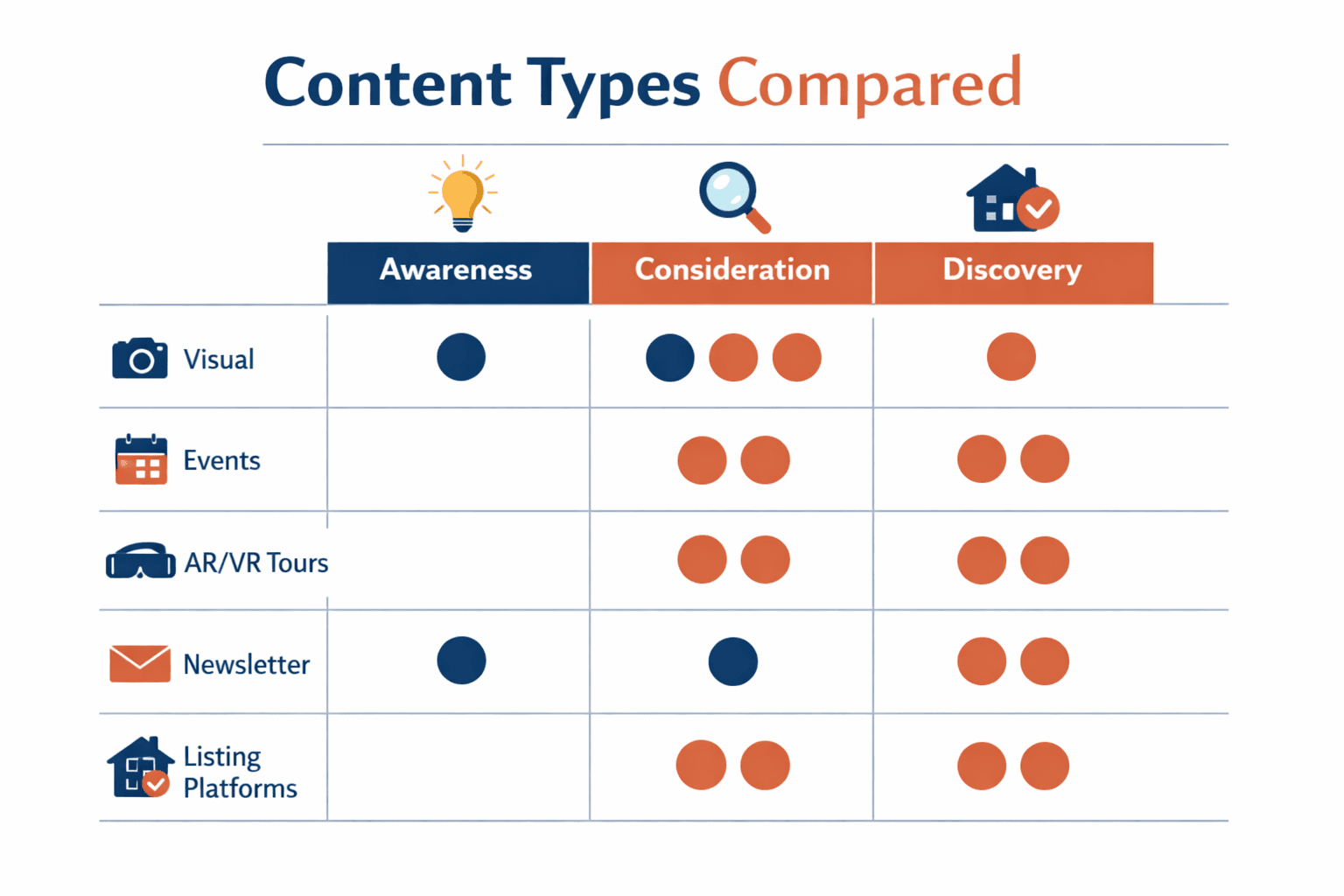
Content Types Compared
Content Type | Best Stage of the Buyer Journey | Primary Channel |
|---|---|---|
Visual Content | Awareness and first impressions | Website, social media |
Event-Based Marketing | Trust-building | In-person, local press |
AR/VR Tours | Consideration | Website, listing platforms |
Newsletter Marketing | Nurture | |
Listing Platforms | Discovery | Zillow, Redfin, Trulia |

Building a Cohesive Brand Story
Consider co-branding with adjacent services like interior designers, photographers, movers, and cleaning companies. It builds brand awareness and generates fresh creative ideas.

Marketing should tell a cohesive story that focuses on emotion rather than jargon. Inspirational blog posts, first-person case studies, and short video features all do this well.

Ask past clients to share how they chose their home and what owning it means to them. That kind of warmth is what makes a story worth watching.
Learn more about how to prepare the ultimate real estate listing presentation.
Optimizing Your Website for Content
Homebuyers expect a fast, smooth website experience. Page load time under two seconds and strong SEO practices are the baseline, not a bonus.

Appointment booking, clear calls to action, photo and video galleries, and functional resource pages all matter for keeping visitors engaged once they land on your site.
Read more in this guide to a real estate listing template for lead generation.
20 Social Media Post Ideas for Real Estate Agents
Check out our related post on why real estate agents are turning into content creators for more background on this shift.
These ideas are built to increase engagement, boost brand awareness, and keep your audience coming back.
New listings. Beds, baths, standout features, and a link to the full listing.
Gifts or contests. Clear rules, fast responses, and a winner photo.
Local news. Share market updates or interesting local stories.
Local businesses and events. Show buyers what the neighborhood actually feels like.
Home tour videos. Walkthroughs or drone footage for buyers who cannot visit in person.
Client testimonials. Real stories build trust faster than any ad copy.
Free resources. A simple buying or selling guide people can download.
Recurring video series. A weekly format, like fixer-upper spotlights, builds a habit.
Behind-the-scenes content. Show the prep work that goes into a showing.
Q&A sessions. Answer the questions buyers ask most often.
Light, personal posts. A vacation photo or a good quote humanizes your brand.
How-to and DIY tips. Practical home advice keeps your audience engaged.
Expert advice. Share what you have learned from your own experience.
Customer events. Recap events and tag attendees when possible.
Closing announcements. Celebrate wins with a few details about the deal.
Seasonal messages. Holiday posts that feel personal, not generic.
Light humor. A well-placed, on-brand meme can boost reach.
Market data. Keep it visual, cite your source, and explain why it matters.
Buying-process breakdowns. Walk buyers through the steps to reduce uncertainty.
Personal posts. Let your personality show through, in moderation.

Before and After: A Content Strategy Makeover
Before | After |
|---|---|
Listing photos only, no context | Photos paired with infographics and virtual tours |
Occasional, inconsistent newsletters | Regular, 90% educational newsletter cadence |
No co-marketing partnerships | Active co-branding with local service providers |
Slow, outdated website | Fast site with clear CTAs and booking tools |
Common Mistakes to Avoid
Relying only on listing photos misses most of the buyer journey. Pair visuals with education and story.
Treating email as promotional-only wastes your best-performing channel. Keep it mostly educational.
Ignoring event-based marketing loses the human, trust-building side of real estate. Combine digital and in-person efforts.
Letting your website lag on speed or SEO costs you visibility before a buyer ever sees a listing.
How to Build Your Real Estate Content with Decktopus AI
Once you know which content types you need, Decktopus AI helps you turn listing details, market data, and buyer guides into polished visuals fast.
Why Decktopus AI Is Built for Real Estate Content
Describe a listing presentation or buyer guide in a sentence, and Decktopus AI generates a reviewable outline first, then a complete, designed presentation once you approve it.
Brand Import pulls your logo, colors, and typography from your website, so every listing presentation and buyer guide looks consistent with your brand.
AI Image Generation and the built-in Unsplash and Freepik library make it easy to add strong visuals without a separate design tool.
Decktopus AI vs. Traditional Tools
Task | Traditional Tools | Decktopus AI |
|---|---|---|
Building a listing presentation | Manual, from a blank template | Generated automatically from your outline |
Matching your brand | Manual formatting each time | One-click Brand Import from your website |
Sharing with clients | Export and email a static file | Live link that updates automatically |
Practicing your pitch | No built-in tool | Loop AI Delivery Coach with real-time feedback |
Who This Is For
This workflow fits real estate marketers and agencies building listing presentations, buyer guides, or market update decks.
Step-by-Step Workflow
Describe your topic, like "a listing presentation for a 3-bedroom home in a growing suburb," or upload your listing notes via the paperclip icon.
Choose your style: import your brand from your company URL, apply a saved style, or let AI generate one from scratch.
Review the AI-generated outline and adjust section order before generating the full deck.
Generate the complete presentation with content, layout, and design finished.
Refine with Edit with AI or Edit Text, with every change tracked in unlimited version history.
Add property photos, generate custom AI visuals, or pull from the built-in Unsplash and Freepik library.
Export to PDF, PPT, or PNG, share a live link that updates automatically, or embed it directly on your website.
Get started with Decktopus AI and turn your real estate content into presentations clients actually remember.
Frequently Asked Questions
What content types matter most for a new real estate agent?
Start with visual content and listing platform presence, then add newsletters and social media once you have a steady flow of listings.
How often should a real estate agent post on social media?
Several times a week works well for most agents, mixing listings, education, and personal content.
Is video content worth the investment for real estate?
Yes, video consistently outperforms static photos for engagement, especially for walkthroughs and neighborhood guides.
What should go in a real estate newsletter?
A mix of new listings, market updates, buyer or seller tips, and links to your latest content, kept mostly educational.
Do agents really need AR or VR tours?
They are increasingly expected for higher-value listings and for buyers who cannot visit in person right away.
How important is website speed for real estate agents?
Very important. A load time under two seconds keeps prospects from bouncing before they see your listings.
What is the biggest content mistake real estate agents make?
Relying only on listing photos instead of building a full content mix across video, email, and social media.
Should real estate agents partner with other local businesses?
Yes, co-branded content with movers, designers, or photographers expands reach and builds local credibility.
How do listing platforms fit into a content strategy?
They are often the first touchpoint for buyers, so accurate, well-photographed listings there are essential.
What makes real estate storytelling effective?
Focusing on emotion and real client experiences instead of technical jargon or generic sales language.
How can agents track which content actually works?
Watch engagement on social posts and open rates on email, then double down on the formats that perform best.
Is event-based marketing still relevant in a digital-first market?
Yes, in-person events build trust that purely digital content cannot replicate on its own.
Conclusion
The agents who win today are the ones treating content like part of the job, not an afterthought. Visual content, events, virtual tours, newsletters, and listing platform presence together cover the full buyer journey.
Start with the content types that fit your current listings and audience, then build outward from there.
Once you have your message, turning it into a polished listing presentation or buyer guide is the easy part, especially with a tool like Decktopus AI built to speed up exactly that step.
Stay Connected
Follow Decktopus AI for more guides on sales, marketing, and presentation strategy:
Related posts

How AI Voice Agents Help Sales Teams Prepare and Deliver Better Presentations
Learn how AI voice agents help sales teams turn call insights into focused slides, stronger delivery, and more confident customer presentations at every stage.
Marketing

Instagram Carousel Size & Dimensions Guide (2026)
Instagram carousel size in 2026: exact dimensions for square, portrait, and landscape, plus file limits and safe zones, verified across sources.
Marketing

LinkedIn Carousel Size, Dimensions & Format Guide 2026
LinkedIn carousel size in 2026: exact dimensions, file limits, aspect ratios, and formatting rules so your slides never get cropped.
Marketing