Presentations
Real Estate Listing Presentation Checklist
Real estate agents, consultants, and realtors are constantly looking for the best real estate listing presentation and new tools to create documents. A major part of their job is to create listings, make an offer, and send their customers those offers as documents.


Decktopus Content Team
If life was only about showing houses, everyone could have done it.
One of the things people don’t know about the real estate industry is that half of the job is creating, handling, and following up on legal and financial documents. Not every potential buyer is ready after seeing a house. Even after a year, people might come back to their realtor for the property and close the deal.
When it comes to conversion, realtors know the struggle, and they know how to be patient. So how does a realtor enhance their sales funnel? With follow-ups and a strong real estate listing presentation. Here’s the real estate listing presentation checklist.
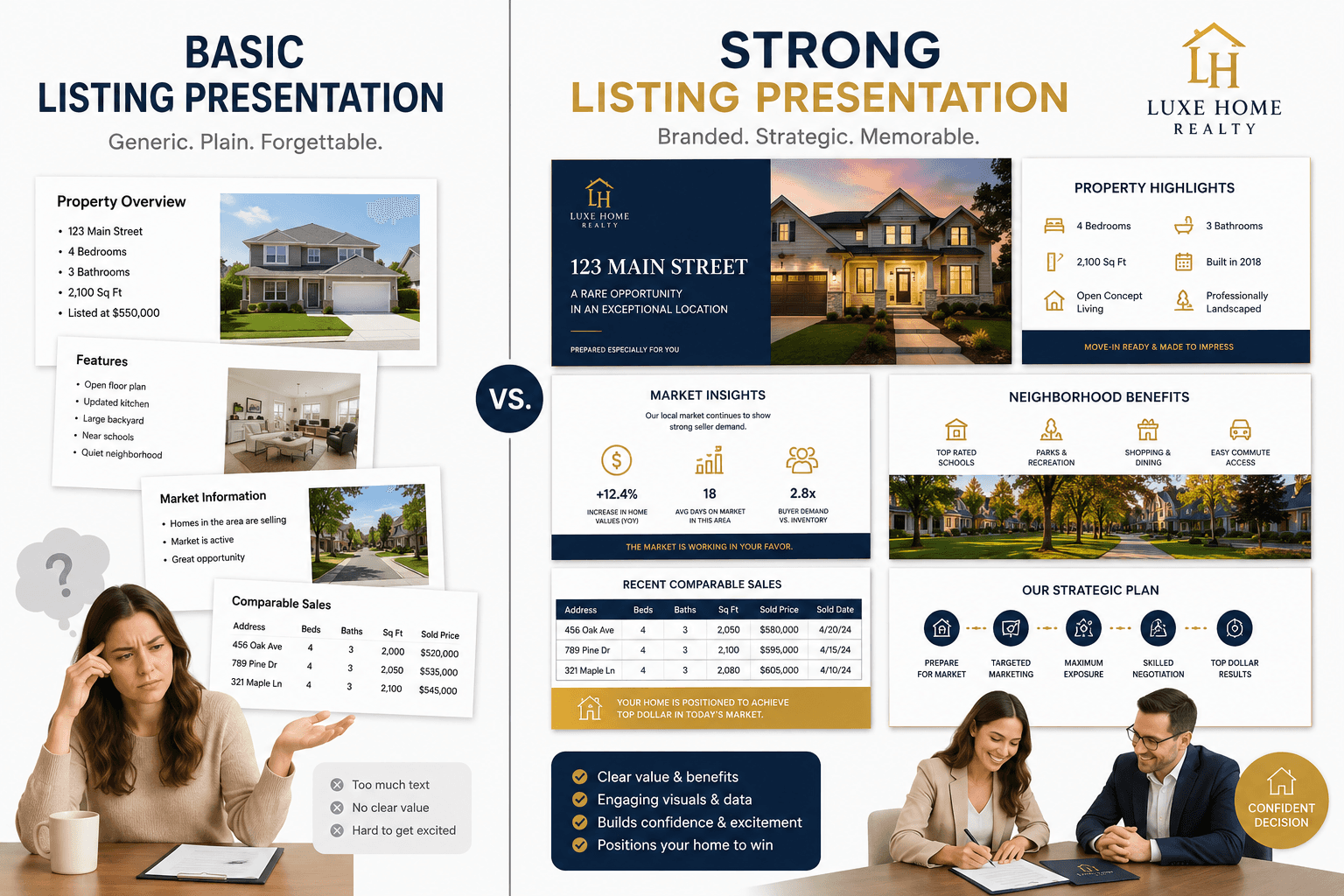
What Does a Real Estate Agent Do and What Does It Have to Do With Documents?
A real estate agent is a professional who works for a real estate agency or broker. They guide prospective buyers in every phase of owning a property. Real estate agents work for both the buyer and seller. They are responsible for many things that are not shown in real estate shows.
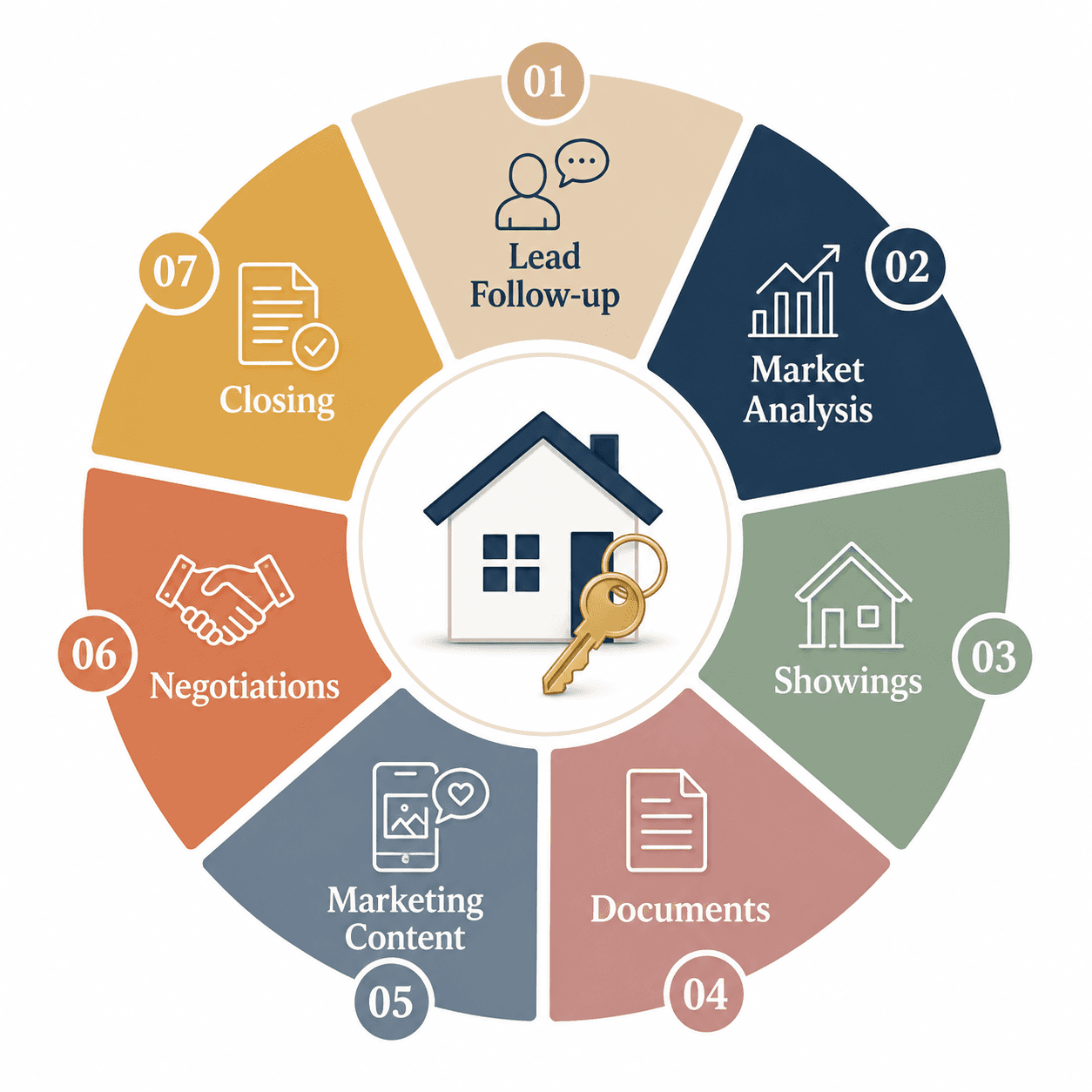
Some of the things they do:
Answer phones and emails
Follow up after seeing or contacting a prospect
Schedule appointments and open houses or private showings
Update listings frequently
Create draft and final documents
Real estate market analysis
Competitive analysis
Search for listings and new properties
Create promotional material
Distribute promotional material
Draft and run advertisements
Build a website and create content that attracts prospects
For more on this last point, see our breakdown of content types every real estate agent needs.
Step-by-Step Instructions for Your Next Listing Presentation
When you’re presenting a listing to potential buyers, there’s nothing worse than getting caught unprepared. You want to be on top of your game with a solid listing marketing plan and everything planned out so the presentation goes smoothly. Here are some steps for preparing an effective listing presentation.
Find a Strong Real Estate Listing Presentation Approach
There are many things real estate agents have to do other than showing houses. They have to build soft skills as well as technical skills like using computers and content creation platforms. In recent years, content creation companies realized how big and loyal a customer segment real estate agents are. Technology companies started creating better tools for real estate agents too.
Start Writing an Outline Script and Sales Flow
You’ve done it. You found the house of your client’s dreams and you’re ready to make an offer. Before you do, take a step back and start writing out a sales flow for the listing. This helps you remember everything that needs to be taken care of so that when push comes to shove, you can present a well-thought-out proposal quickly and efficiently.
It also helps keep your buyer from getting cold feet. Putting in extra legwork now might just land you an excited customer who’s ready to close fast.
Brief Bio and Introduction of Your Career Skills
You’ll want to have a structured bio to use later. The best real estate listing presentations come from the best presenters. Here’s an example:
I’m a realtor who has been in the industry for some time. I have had my fair share of successes and failures, but what makes me different from other agents is that I am an expert negotiator. If you’re looking to buy or sell a home, I will help you through the process with ease.
Here are just a few of my skills:
Certified as a California Real Estate Agent by the state department of consumer affairs
Specializing in negotiating contracts
Assisting sellers and buyers during showings
Experience with all types of transactions, from FHA to luxury homes
For more on framing your personal background well, see our guide on about me presentations.
Introduce the Power of Your Brand
Realtors are often the first point of contact for buyers and sellers. They provide information on homes that are available, negotiate the terms of purchase or sale, and help people make decisions about their family’s future. You are also the person who represents the brand.
Leverage the power of your brokerage. But do you know how to pitch it? The key is in thinking about what makes you unique. Maybe you want to talk about the size and scope of your office. Or maybe you want to highlight your connections with potential clients. Be creative.
Research and Summarize the Local Market Properties
If you’re a realtor and your client asks you what the state of the market is, it’s important to be prepared with as much information as possible. It’s helpful if you can give them actual data from reliable sources, not just your opinion or what another agent told you. The best real estate listing presentations offer as much data as possible in the most easy-to-understand way.
Describe the Sales Process as Easy as Possible
The sales process can be a confusing and difficult thing for clients, but it’s your job to make it as easy as possible.
First, find out what a home is worth in today’s market. This is accomplished by looking at recent sales of comparable homes in your area and accounting for any upgrades or renovations made since the last sale.
Show them the way so they don’t think this is a complicated job. It’s a time-consuming process. That’s why your expertise comes in.
You’ll also need information about how much money they owe on the property, including their mortgage company details if available.
Next, put together an initial list of interested buyers who match most of the criteria from step one, including price range, financing needs, and size requirements.
Finally, explain and hand them a list of paperwork so they don’t get overwhelmed by the amount of work.
For more on how to structure proposals, see our business proposal guide.
Work on Your Pricing Strategy Wisely
Realtors need to set a price point that is competitive and fair. To do this, you need to be knowledgeable about the market and understand your customer base. It’s also helpful to know how much profit you want from each transaction, as well as what other costs are associated with closing a deal.
Tips to get started:
Research the latest market trends and average prices for homes in your area
Prepare a list of comparable properties that have sold or are currently on the market
Consider what price range will offer buyers an incentive to contact you first
Gather Marketing Content
One of the most important aspects of marketing your property is making sure you have all the necessary information for your listing. Great photography and videography can make the best real estate listing presentations. If your realtor agency has a marketing brand in place, you are one of the lucky ones. Ask for photographs, videos, and color palettes that will match the branding.
For more on color choices in presentations, see our guide on color psychology in presentations.
Show Trusted Buyers
The average person will have three homes in their lifetime. The first home is usually a starter home, small and with few luxuries. The second is a family-friendly house with lots of space for everyone to run around in. Then there’s the third, the retirement home.
Your buyers want to buy from a real estate agent they can trust. There’s one thing you need to do first: show them you’re trustworthy too. Almost all real estate listing presentation examples have testimonials. Don’t forget to accumulate them for yourself.
Have a List of Comparable Industry Statistics
The number of homes for sale in your area has a direct impact on how quickly and at what price they sell. If there is very little inventory, buyers will be willing to pay more or move off their list. If there are many listings available, buyers can afford to be picky and wait until they find exactly what they want.
As a realtor, knowing this information will help you when working with clients so you can give them an accurate idea of how long it might take to sell their home and at what price. Visualize this data in bar charts or pie charts so it lands faster.
Additional Tips for Real Estate Listing Professionals
Build an Online Presence to Get More Leads
A common question is “How do you get chosen among the sea of other agents?” There are many ways, but the most important thing is consistency with your online presence. Your brand needs consistency to rank highly on Google. When it comes to purchasing something, people will want the product they can identify with their favorite brand.
Establish a blog. Most people forget about your business, including those who found you on Google search. For most small businesses, blogging is the best way to maintain an active online presence and build long-term relationships with followers and customers.
Track Your Online Appearance
Assess the volume of your online presence. The signal-to-noise ratio tells you how difficult it would be for any sound or message to reach an audience. Establish a baseline for your social media presence because meaningful conversations happen when both speakers know someone else is listening.
Have Personal Statistics In-Hand
Some real estate listing presentation examples include personal statistics that are important for realtors. If you don’t know what to list, here are suggestions:
The number of listings you have right now
Days on market since the last sale
Days on market so far this year
Annual price change vs the average in your city or state
Selling activity
How many homes were sold in a given month last year
How does it compare to the current calendar month
Practice Your Presentation Over and Over
Practice in front of a mirror, videotaping the entire presentation with your phone
Go through your slides and read them aloud. Get used to hearing yourself speak when prepared
Spend time preparing your talk before doing it for an audience
Rehearse potential questions. Have people ask you these questions in different ways so you can navigate various types of responses
Prepare captivating opening lines
For more on opening strong, see our guide on public speaking tips. For closing strong, see our breakdown of how to end a presentation with impact.
Ask Questions to Clients
You can ask questions like “What are your first thoughts on this home?” or “Which rooms will you probably use most?”
The best way to get information about a house is by talking to the people who live in it. Pointed questions about specific features or potential issues with certain neighborhoods could help turn an interview into a lasting relationship.
Identify the Buyer’s Motivation
Understanding how a buyer may be motivated to buy is incredibly important. Motivation can influence an individual’s willingness to do their legwork. It can also affect the ability of the potential seller to negotiate with their client. Some questions to start:
Why are they moving and what is their timeline?
What drew them to this home when they bought it?
Learn About the Local Community
The local community is very important. Many factors to consider, but always do your due diligence first by getting familiar with the area and neighborhood of the property.
Do you feel safe walking around at night?
What safety precautions do you need to take daily?
How will this neighborhood be impacted by future changes in legislation, technological advances, economic shifts, or natural disasters?
These questions help determine if there’s a good potential for return on investment.
Dress for Success Always
As a real estate agent, it’s important to dress sharp to present yourself professionally. For men, make sure the clothes you wear are neat and presentable. This doesn’t mean an expensive suit every day, but make sure your clothes are clean, tailored, and well-fitted. A sharp blazer works in most cases.
For women, nobody wants to take their home-buying experience seriously if you show up wearing sweats or jeans. There’s no hard and fast rule about what type of clothing you should wear, but remember that not every day is Casual Friday. Keep the color palette simple.
Real Estate Listing Presentation Outline
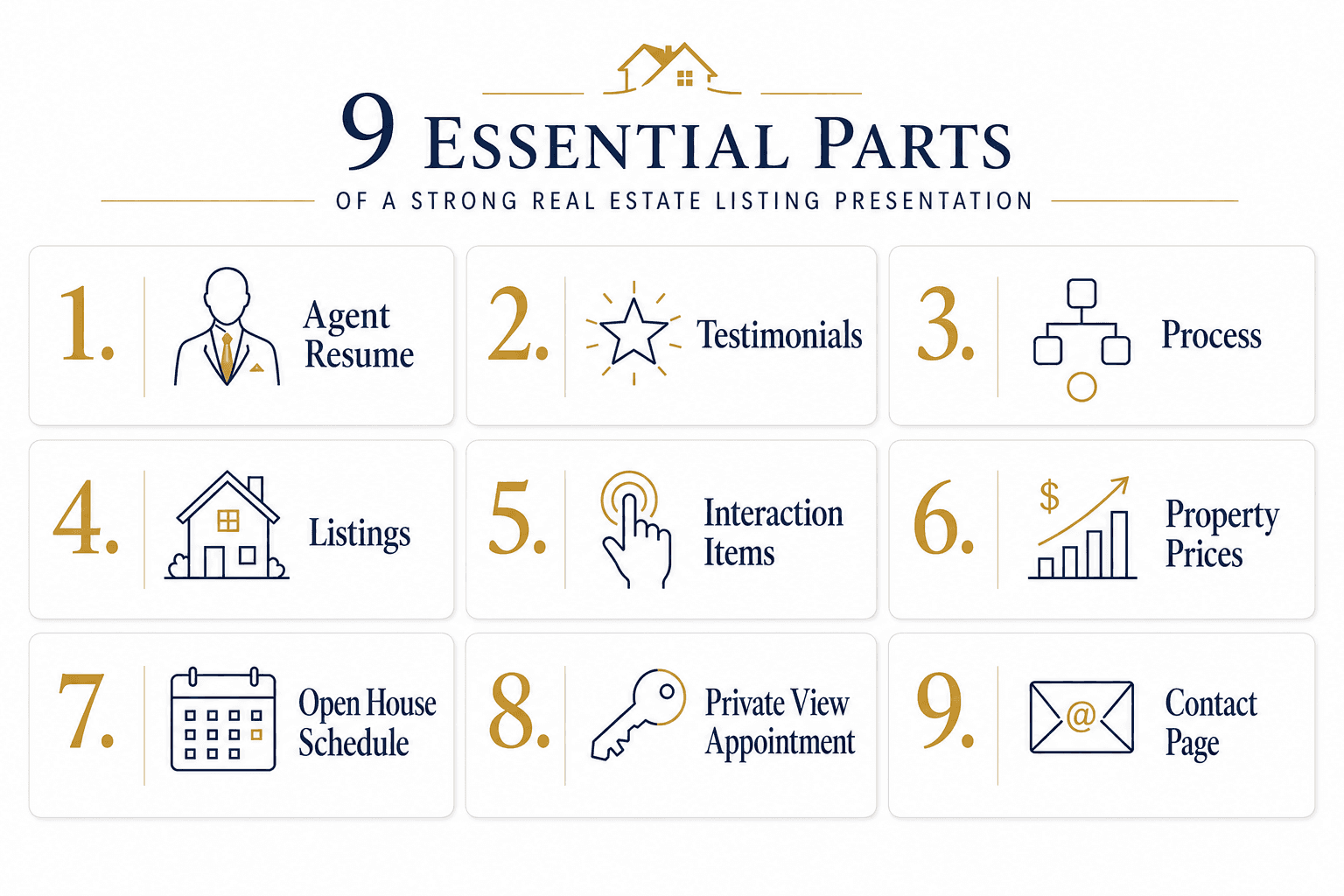
Here’s the structure of a strong real estate listing presentation. Let’s break it into different parts.
#1 The Real Estate Agent Professional Resume
One of the most important promotional items of a real estate agency is its team. How well they trained their agents, how experienced the team is, and how supportive the agents can be. Always start any document with the best representation of the agency, the agent.
The real estate agent is a thought leader working closely with prospective buyers. A professional representation emphasizes experience (especially in years), expertise in various fields, and bonus traits.
Buying, selling, or renting a property requires a lot of money. With that much money in place, people won’t take chances. That’s why every real estate agent should own a set of photo galleries with professional and good-looking outfits, an environment, and a decent look.
#2 Testimonials
While investing, people look for social proof. The most natural thing for a prospect is to look for your past successes. Most of the time, if it’s not an international broker franchise, people find local real estate agents with testimonials.
#3 Process
The navigation slide is one of the most important parts of an introductory document. A major part of society generally doesn’t know a lot about finances and investment beyond taxes. People look for trust and want to feel in control. Give them a clear route about what’s going to happen in every detail and in a simple way.
#4 Listings
Include at least 3 listings with different styles if this is the first interaction with the prospect. It’s always important to find their interest. If they’re not into classical buildings, include a modern house to keep their attention. In listing slides always include:
Location
Price
Condition and size
#5 Interaction Items
Sending prospects plain PDFs without actionable items is old school. As humans, we lost our long attention span and long memory for new things a long time ago. Create an actionable slide where people take action and click on things so they refocus on the content.
#6 Property Prices
People hate risk and love opportunities. Always add infographics that are easy to understand and give signals that investing right now is logical. A simple infographic can show your potential buyers that prices will go up next season and that this is the right time to invest.
#7 Open House Schedule
Some prospects can be shy and hard to communicate with online. They want to see with their own eyes. Generally, the ones who show up to open houses are the ones not easy to communicate with online. They won’t answer their phones or emails, but they will show up. Include an open house schedule in every possible piece of content you have.
#8 Private View Appointment
Appointment taking is a very important part of the process. A private view can mean a lot of things. Generally, highly interested buyers book a private viewing, and these are the interactions where real estate agents shine with their persuasive skills.
#9 Contact Page
The last part should be a slide where all of the contact information of the real estate agent or agency is listed.
How to Use Decktopus for Listing Presentations
Decktopus generates real estate listing presentations from a short description. Here’s how the workflow fits the realtor’s job:
Brand Import and Brand Kit

In any professional business, documents should feel professional. Agencies often start by creating a brand kit with brand colors, brand theme, brand font, and a logo. For these reasons, a lot of agencies work with design teams to keep every content piece consistent.
Decktopus handles this automatically. Paste your agency’s website URL and Decktopus pulls your logo, colors, and fonts. Apply them across every listing presentation, no manual design work. Or upload your Brand Kit once and every deck inherits it from day one.
For more on how AI handles brand consistency, see our guides on can AI generate presentations using my company logo, colors, and tone and presentation design.
Infographics for Data and Visuals
Infographics are a major part of real estate agent jobs. Things can get complex, and it can be hard to explain things in numbers. Describe the data visually with infographics and make them easier to understand. Rather than spending hours on Excel and editing infographics manually, Decktopus generates charts and visuals automatically as part of your deck.
Share Your Listing Presentation as a Link
Decktopus lets you share your listing presentation via link. No more sending PDF attachments by email. The link option also means you can update the deck and the link always shows the latest version.
Why Modern Real Estate Agents Need Better Presentation Tools
Real estate agencies and brokers deal with significant money. They need to create professional-looking and consistent-looking branded documents, not only for social media but also for promotional content, frequent market updates, proposals, special offers, and quarterly summaries.
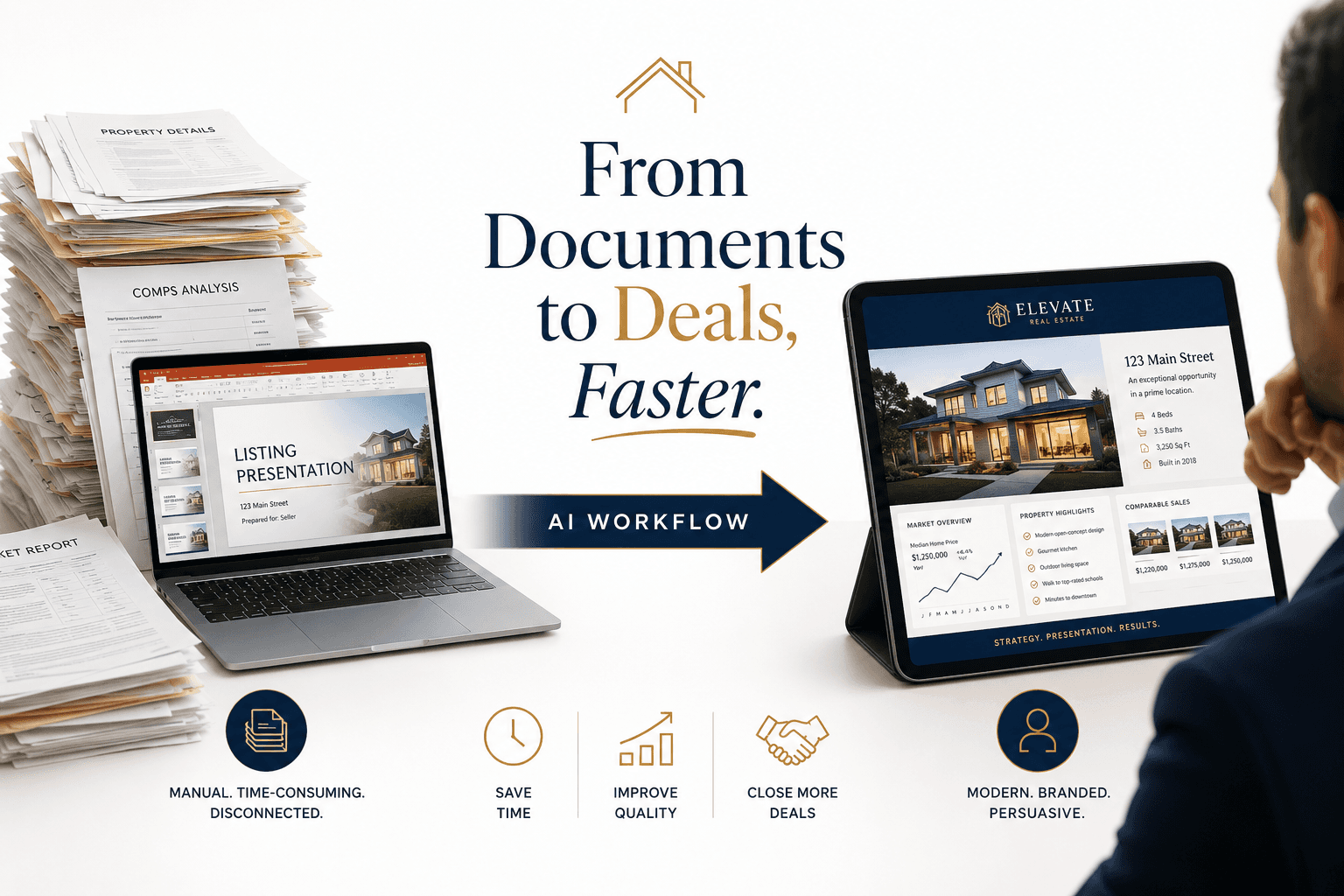
Turning drafts into professional, branded, easily duplicated, and optimizable content has always been a challenge. Traditional tools like PowerPoint and Prezi require manual design work on every deck.
Decktopus generates the deck from your description, applies your brand automatically, and lets you refine specific slides with prompts like “make the listings slide more visual” or “show the price trend as a bar chart.” The strategic work stays with you. The deck design happens automatically.
For more on AI presentation workflows, see our guides on the best AI presentation tools and why real estate agents are turning into content creators.
Ready to build your next listing presentation? Start your deck in Decktopus.
Frequently Asked Questions
What is a real estate listing presentation?
A real estate listing presentation is a structured document or slide deck that real estate agents use to convince a homeowner to list their property with them. It typically includes the agent’s qualifications, a market analysis, a marketing plan, pricing strategy, comparable properties, and the agent’s process for selling the home. The listing presentation is one of the most important sales tools in a realtor’s toolkit because it directly determines whether they win or lose the listing.
What should be included in a real estate listing presentation?
A strong real estate listing presentation includes:
Your professional resume with experience, certifications, and credentials
Testimonials and reviews from past clients
A clear sales process that explains every step
Local market data with comparable properties and recent sales
A pricing strategy with justification
Your marketing plan including photography, videography, listings, and online promotion
Open house and private viewing schedules
A clear contact page with all your details
For deeper guidance on framing your professional background, see our breakdown of about me presentations.
How long should a real estate listing presentation be?
The actual presentation in front of the seller should run 20 to 30 minutes, with extra time built in for questions. The deck itself should be 12 to 18 slides. Anything longer risks losing the seller’s attention. Anything shorter usually means you haven’t fully made your case.
How do I create a real estate listing presentation fast?
The fastest workflow is to describe your listing topic in Decktopus, paste your agency’s website URL to apply your brand automatically, and let AI generate the full deck with your professional resume, market data, marketing plan, and contact details already in place. Refine specific slides with prompts like “make the comps section more visual” or “switch the pricing chart to a bar graph.” A presentation that used to take three hours in PowerPoint takes about 15 minutes.
What makes a good real estate listing presentation?
Three things separate strong listing presentations from weak ones:
Specificity: Generic claims like “we sell homes fast” lose to specific data like “we sold 87% of our listings above asking price in the last 12 months”
Visual hierarchy: Use bar charts and pie charts to communicate data faster than tables
Personal connection: Address the seller’s specific situation, not a template description
For more on what makes presentations stick, see our breakdown of what makes for a good presentation.
How do I stand out from other real estate agents in my listing presentation?
Specificity wins. Most agents present the same generic content with their photo swapped in. To stand out:
Lead with the seller’s situation, not your credentials
Use real local data, not national averages
Show specific past listings comparable to theirs
Personalize your marketing plan to their specific property
End with a clear ask and next step
For deeper guidance on persuasion strategy, see our guide on how to sell an idea effectively.
Can I use AI to create a real estate listing presentation?
Yes. AI presentation tools like Decktopus generate full listing presentations from a short description, apply your agency’s brand automatically from your website URL, and let you refine specific slides with prompts. The strategic decisions (your positioning, your pricing approach, your marketing plan) still require human judgment. AI accelerates the production, not the strategy.
What’s the difference between a listing presentation and a CMA?
A CMA (Comparative Market Analysis) is a specific data document showing recent sales of comparable properties to help establish a price point. A listing presentation is the broader sales document that includes the CMA plus your qualifications, marketing plan, sales process, and ask. The CMA usually lives inside the listing presentation, not separately.
How do I follow up after a listing presentation?
Send a thank-you email within 24 hours that includes:
A recap of the key points you discussed
A link to your listing presentation deck (so they can revisit it)
Any specific data they asked for during the meeting
A clear next step (signing the listing agreement, scheduling another call)
For more on follow-up strategies that close, see our guide on how to end a presentation with impact.
Related posts

Best TED Talks to Improve Your Presentation Skills
Watch ten of the best TED talks for presentation skills and use a practical exercise from each to improve structure, voice, visuals, and confidence.
Presentations

Decktopus AI Best Practices: The Complete Guide, Tips and Tricks (2026)
A complete guide to using Decktopus AI effectively, from writing better prompts and reviewing outlines to rehearsing with Loop and building carousels.
Presentations
What Makes Slides Look Professional in 2026
Learn the 10 slide design principles top presenters follow, common presentation design mistakes to avoid, and how to apply every principle to your slides in minutes with AI
Presentations