Templates & How-to
Job Interview Presentations: Templates, Tips, and Examples
Learn what a job interview presentation is, the 6-step framework hiring managers respond to, how to nail online interviews, and how to build your deck fast.


Decktopus Content Team
What Is a Job Interview Presentation?
A job interview presentation is a short deck (typically 8 to 15 slides) that a candidate delivers as part of a hiring process to demonstrate technical knowledge, communication skills, and how they think through a business problem. Hiring managers use it to evaluate both what you know and how you present yourself under pressure. The main benefit for candidates is that a well-built presentation lets you control the narrative of the interview instead of reacting to questions.
According to LinkedIn’s Global Talent Trends research, 92% of hiring managers say soft skills matter as much as or more than hard skills, and communication consistently ranks as the #1 soft skill they screen for. The interview presentation is the format most companies use to measure that skill in a single sitting.
As the workplace has become more digital and cross-functional, companies increasingly weigh communication and social skills as heavily as technical ability. Technical skills can be trained. Presentation skills are harder to fake in front of a hiring panel.
Interview Presentation Checklist: What Recruiters Are Evaluating
Before building your slides, understand what the panel is actually watching for.
Communication skills: Are you speaking naturally or reading off the slides?
Ability to engage: Can you hold a room’s attention and adjust when energy drops?
Sector knowledge: Can you talk through technical details confidently?
Ability to understand a task: Did you interpret the brief correctly and stay on topic?
Stress management: How do you perform when the panel pushes back or asks hard questions?
Creativity: Can you improvise a smart answer when caught off guard?
Every design choice, timing choice, and word choice in your deck should point back to one or more of these evaluation criteria.
The 6-Step Interview Presentation Framework
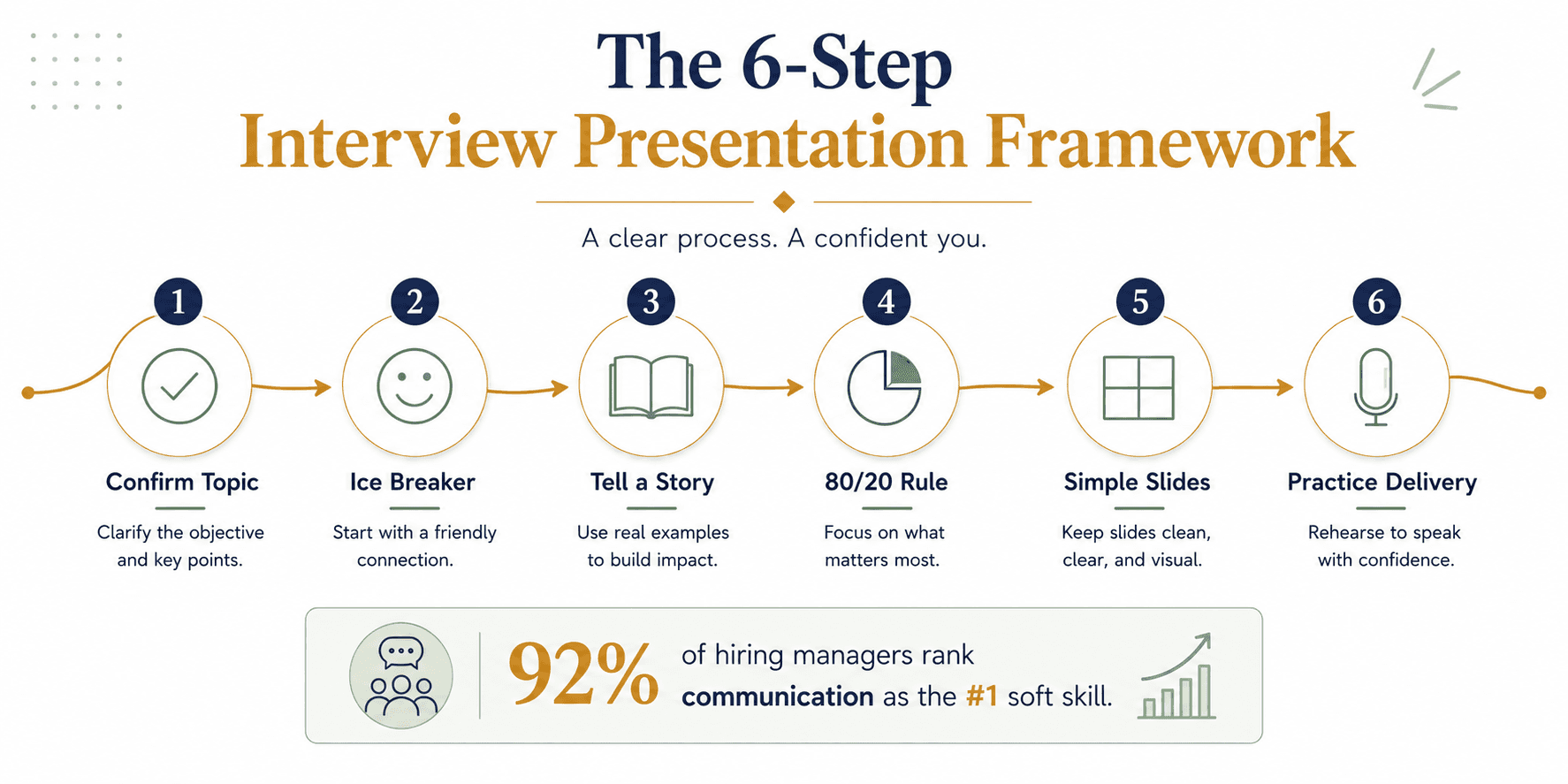
Use this 6-step framework to build a presentation that reliably lands.
[[EMBED:PGRpdiBzdHlsZT0ib3ZlcmZsb3cteDphdXRvO21hcmdpbjoyMHB4IDAiPjx0YWJsZSBzdHlsZT0id2lkdGg6MTAwJTtib3JkZXItY29sbGFwc2U6Y29sbGFwc2U7Zm9udC1zaXplOjE1cHg7bWFyZ2luOjhweCAwIj48dGggc3R5bGU9ImJvcmRlcjoxcHggc29saWQgI2UzZTZlYTtwYWRkaW5nOjEwcHggMTRweDt0ZXh0LWFsaWduOmxlZnQ7YmFja2dyb3VuZDojZjRmNmY4O2ZvbnQtd2VpZ2h0OjYwMCI+PHRyPjx0aCBzdHlsZT0iYm9yZGVyOjFweCBzb2xpZCAjZTNlNmVhO3BhZGRpbmc6MTBweCAxNHB4O3RleHQtYWxpZ246bGVmdDtiYWNrZ3JvdW5kOiNmNGY2Zjg7Zm9udC13ZWlnaHQ6NjAwIj5TdGVwPC90aD48dGggc3R5bGU9ImJvcmRlcjoxcHggc29saWQgI2UzZTZlYTtwYWRkaW5nOjEwcHggMTRweDt0ZXh0LWFsaWduOmxlZnQ7YmFja2dyb3VuZDojZjRmNmY4O2ZvbnQtd2VpZ2h0OjYwMCI+V2hhdCB0byBEbzwvdGg+PC90cj48L3RoZWFkPjx0Ym9keT48dHI+PHRkIHN0eWxlPSJib3JkZXI6MXB4IHNvbGlkICNlM2U2ZWE7cGFkZGluZzoxMHB4IDE0cHg7dGV4dC1hbGlnbjpsZWZ0O3ZlcnRpY2FsLWFsaWduOnRvcCI+MTwvdGQ+PHRkIHN0eWxlPSJib3JkZXI6MXB4IHNvbGlkICNlM2U2ZWE7cGFkZGluZzoxMHB4IDE0cHg7dGV4dC1hbGlnbjpsZWZ0O3ZlcnRpY2FsLWFsaWduOnRvcCI+Q29uZmlybSB5b3VyIHRvcGljIGFuZCBhdWRpZW5jZTwvdGQ+PC90cj48dHI+PHRkIHN0eWxlPSJib3JkZXI6MXB4IHNvbGlkICNlM2U2ZWE7cGFkZGluZzoxMHB4IDE0cHg7dGV4dC1hbGlnbjpsZWZ0O3ZlcnRpY2FsLWFsaWduOnRvcCI+MjwvdGQ+PHRkIHN0eWxlPSJib3JkZXI6MXB4IHNvbGlkICNlM2U2ZWE7cGFkZGluZzoxMHB4IDE0cHg7dGV4dC1hbGlnbjpsZWZ0O3ZlcnRpY2FsLWFsaWduOnRvcCI+T3BlbiB3aXRoIGEgbWVtb3JhYmxlIGljZSBicmVha2VyPC90ZD48L3RyPjx0cj48dGQgc3R5bGU9ImJvcmRlcjoxcHggc29saWQgI2UzZTZlYTtwYWRkaW5nOjEwcHggMTRweDt0ZXh0LWFsaWduOmxlZnQ7dmVydGljYWwtYWxpZ246dG9wIj4zPC90ZD48dGQgc3R5bGU9ImJvcmRlcjoxcHggc29saWQgI2UzZTZlYTtwYWRkaW5nOjEwcHggMTRweDt0ZXh0LWFsaWduOmxlZnQ7dmVydGljYWwtYWxpZ246dG9wIj5UZWxsIGEgY29tcGVsbGluZyBzdG9yeTwvdGQ+PC90cj48dHI+PHRkIHN0eWxlPSJib3JkZXI6MXB4IHNvbGlkICNlM2U2ZWE7cGFkZGluZzoxMHB4IDE0cHg7dGV4dC1hbGlnbjpsZWZ0O3ZlcnRpY2FsLWFsaWduOnRvcCI+NDwvdGQ+PHRkIHN0eWxlPSJib3JkZXI6MXB4IHNvbGlkICNlM2U2ZWE7cGFkZGluZzoxMHB4IDE0cHg7dGV4dC1hbGlnbjpsZWZ0O3ZlcnRpY2FsLWFsaWduOnRvcCI+QXBwbHkgdGhlIDgwLzIwIGVuZ2FnZW1lbnQgcnVsZTwvdGQ+PC90cj48dHI+PHRkIHN0eWxlPSJib3JkZXI6MXB4IHNvbGlkICNlM2U2ZWE7cGFkZGluZzoxMHB4IDE0cHg7dGV4dC1hbGlnbjpsZWZ0O3ZlcnRpY2FsLWFsaWduOnRvcCI+NTwvdGQ+PHRkIHN0eWxlPSJib3JkZXI6MXB4IHNvbGlkICNlM2U2ZWE7cGFkZGluZzoxMHB4IDE0cHg7dGV4dC1hbGlnbjpsZWZ0O3ZlcnRpY2FsLWFsaWduOnRvcCI+RGVzaWduIHNpbXBsZSwgcHJvZmVzc2lvbmFsIHNsaWRlczwvdGQ+PC90cj48dHI+PHRkIHN0eWxlPSJib3JkZXI6MXB4IHNvbGlkICNlM2U2ZWE7cGFkZGluZzoxMHB4IDE0cHg7dGV4dC1hbGlnbjpsZWZ0O3ZlcnRpY2FsLWFsaWduOnRvcCI+NjwvdGQ+PHRkIHN0eWxlPSJib3JkZXI6MXB4IHNvbGlkICNlM2U2ZWE7cGFkZGluZzoxMHB4IDE0cHg7dGV4dC1hbGlnbjpsZWZ0O3ZlcnRpY2FsLWFsaWduOnRvcCI+UHJhY3RpY2UgZGVsaXZlcnkgdW50aWwgaXQncyBhdXRvbWF0aWM8L3RkPjwvdHI+PC90Ym9keT48L3RhYmxlPjwvZGl2Pg==]]
Step 1: Confirm Your Topic and Audience
Before you build a single slide, contact the recruiter and ask two questions: who will be in the room, and what topic they want you to cover. If the audience isn’t specialized in your topic, you’ll need to simplify the technical depth or you’ll lose them in the first three minutes.
Some companies assign a specific topic. Others give freedom. If the choice is yours, pick something with real substance:
A project you led or shipped
A new technology in your niche and why it matters
A process you improved with measurable results
Step 2: Open With a Memorable Ice Breaker
Introduce yourself. This is a cliche for good reason. Cover your name, your background, and one or two career highlights, but keep it under 60 seconds. Add one small personal detail that makes you memorable.
Example: “I studied computer science at Stanford, but the accomplishment I’m most proud of this year is finally potty-training my dog.”
Small moments of humor lower the tension in the room, including yours. Don’t reread your resume. The panel already has it. Your resume covers the facts. Your opening covers the impression.
Step 3: Tell a Compelling Story
The candidate who tells the best story wins. Not fairy tales, real stories. Start with a specific problem or moment that led to what you’re presenting.
Example: “During finals week in college, I couldn’t find an open cafe past midnight or a friend with the ingredients I wanted. So I built a social platform that connects sandwich lovers in the dorm.”
That opening does three things: it introduces the problem, it introduces you as someone who solves problems, and it sets up the rest of the presentation. For more on presentation storytelling, see our guide on how to start a presentation with 10 hooks that instantly grab attention.
Step 4: Apply the 80/20 Engagement Rule
Spend 80% of your time delivering substance and 20% engaging the audience. Ask questions. Insert a light joke. Pause to invite reactions.
Don’t try to be a comedian. The panel isn’t looking for one. They’re looking for someone who can hold attention and adapt to the room. Prepare backup slides with deeper detail so you can pull them up if a panelist asks a specific question. Rehearse with friends and have them ask dummy questions until nothing surprises you.
Step 5: Design Simple, Professional Slides
Minimalism isn’t just aesthetic. It’s a tool that keeps attention on you, not on decorative slides. Rules of thumb:
Consistent layout across every slide. Same font family, same colors, same spacing.
Professional font. Sans-serifs like Inter, Roboto, or Helvetica. Avoid decorative fonts.
Professional color palette. Two or three colors max. Nothing neon.
One key idea per slide. If you have two ideas, split it into two slides.
For more, see our presentation design guide.
Use tools like Decktopus to generate a clean, on-brand deck fast so you can focus your time on rehearsing rather than fiddling with alignment.
Step 6: Practice Delivery Until It’s Automatic
Every element of delivery is scored by the panel. Nail these:
Voice. You don’t need to be loud. You need to be clear. Vary tempo and volume to emphasize key points.
Eyes. Maintain eye contact with the panel. Never turn your back to the audience.
Smile. Signals confidence and approachability.
Body language. Stillness reads as calm. Excessive movement reads as nervous. Hold a pen or clicker to keep your hands busy if you fidget.
Rehearse out loud at least three full times before the interview. Ideally record yourself and watch it back.
In-Person vs. Online Interview Presentations
[[EMBED:PGRpdiBzdHlsZT0ib3ZlcmZsb3cteDphdXRvO21hcmdpbjoyMHB4IDAiPjx0YWJsZSBzdHlsZT0id2lkdGg6MTAwJTtib3JkZXItY29sbGFwc2U6Y29sbGFwc2U7Zm9udC1zaXplOjE1cHg7bWFyZ2luOjhweCAwIj48dGggc3R5bGU9ImJvcmRlcjoxcHggc29saWQgI2UzZTZlYTtwYWRkaW5nOjEwcHggMTRweDt0ZXh0LWFsaWduOmxlZnQ7YmFja2dyb3VuZDojZjRmNmY4O2ZvbnQtd2VpZ2h0OjYwMCI+PHRyPjx0aCBzdHlsZT0iYm9yZGVyOjFweCBzb2xpZCAjZTNlNmVhO3BhZGRpbmc6MTBweCAxNHB4O3RleHQtYWxpZ246bGVmdDtiYWNrZ3JvdW5kOiNmNGY2Zjg7Zm9udC13ZWlnaHQ6NjAwIj5GYWN0b3I8L3RoPjx0aCBzdHlsZT0iYm9yZGVyOjFweCBzb2xpZCAjZTNlNmVhO3BhZGRpbmc6MTBweCAxNHB4O3RleHQtYWxpZ246bGVmdDtiYWNrZ3JvdW5kOiNmNGY2Zjg7Zm9udC13ZWlnaHQ6NjAwIj5Jbi1QZXJzb248L3RoPjx0aCBzdHlsZT0iYm9yZGVyOjFweCBzb2xpZCAjZTNlNmVhO3BhZGRpbmc6MTBweCAxNHB4O3RleHQtYWxpZ246bGVmdDtiYWNrZ3JvdW5kOiNmNGY2Zjg7Zm9udC13ZWlnaHQ6NjAwIj5PbmxpbmU8L3RoPjwvdHI+PC90aGVhZD48dGJvZHk+PHRyPjx0ZCBzdHlsZT0iYm9yZGVyOjFweCBzb2xpZCAjZTNlNmVhO3BhZGRpbmc6MTBweCAxNHB4O3RleHQtYWxpZ246bGVmdDt2ZXJ0aWNhbC1hbGlnbjp0b3AiPlNldHVwIHRpbWU8L3RkPjx0ZCBzdHlsZT0iYm9yZGVyOjFweCBzb2xpZCAjZTNlNmVhO3BhZGRpbmc6MTBweCAxNHB4O3RleHQtYWxpZ246bGVmdDt2ZXJ0aWNhbC1hbGlnbjp0b3AiPkFycml2ZSBlYXJseSB0byB0ZXN0IHRoZSByb29tPC90ZD48dGQgc3R5bGU9ImJvcmRlcjoxcHggc29saWQgI2UzZTZlYTtwYWRkaW5nOjEwcHggMTRweDt0ZXh0LWFsaWduOmxlZnQ7dmVydGljYWwtYWxpZ246dG9wIj5UZXN0IHlvdXIgdGVjaG5vbG9neSBhdCBsZWFzdCAzMCBtaW51dGVzIGJlZm9yZTwvdGQ+PC90cj48dHI+PHRkIHN0eWxlPSJib3JkZXI6MXB4IHNvbGlkICNlM2U2ZWE7cGFkZGluZzoxMHB4IDE0cHg7dGV4dC1hbGlnbjpsZWZ0O3ZlcnRpY2FsLWFsaWduOnRvcCI+Qm9keSBsYW5ndWFnZSB2aXNpYmlsaXR5PC90ZD48dGQgc3R5bGU9ImJvcmRlcjoxcHggc29saWQgI2UzZTZlYTtwYWRkaW5nOjEwcHggMTRweDt0ZXh0LWFsaWduOmxlZnQ7dmVydGljYWwtYWxpZ246dG9wIj5GdWxsIGJvZHk8L3RkPjx0ZCBzdHlsZT0iYm9yZGVyOjFweCBzb2xpZCAjZTNlNmVhO3BhZGRpbmc6MTBweCAxNHB4O3RleHQtYWxpZ246bGVmdDt2ZXJ0aWNhbC1hbGlnbjp0b3AiPkNoZXN0LXVwIG9ubHk8L3RkPjwvdHI+PHRyPjx0ZCBzdHlsZT0iYm9yZGVyOjFweCBzb2xpZCAjZTNlNmVhO3BhZGRpbmc6MTBweCAxNHB4O3RleHQtYWxpZ246bGVmdDt2ZXJ0aWNhbC1hbGlnbjp0b3AiPkV5ZSBjb250YWN0PC90ZD48dGQgc3R5bGU9ImJvcmRlcjoxcHggc29saWQgI2UzZTZlYTtwYWRkaW5nOjEwcHggMTRweDt0ZXh0LWFsaWduOmxlZnQ7dmVydGljYWwtYWxpZ246dG9wIj5EaXJlY3Qgd2l0aCB0aGUgaW50ZXJ2aWV3IHBhbmVsPC90ZD48dGQgc3R5bGU9ImJvcmRlcjoxcHggc29saWQgI2UzZTZlYTtwYWRkaW5nOjEwcHggMTRweDt0ZXh0LWFsaWduOmxlZnQ7dmVydGljYWwtYWxpZ246dG9wIj5Mb29rIGF0IHRoZSB3ZWJjYW0sIG5vdCB0aGUgc2NyZWVuPC90ZD48L3RyPjx0cj48dGQgc3R5bGU9ImJvcmRlcjoxcHggc29saWQgI2UzZTZlYTtwYWRkaW5nOjEwcHggMTRweDt0ZXh0LWFsaWduOmxlZnQ7dmVydGljYWwtYWxpZ246dG9wIj5FbnZpcm9ubWVudCBjb250cm9sPC90ZD48dGQgc3R5bGU9ImJvcmRlcjoxcHggc29saWQgI2UzZTZlYTtwYWRkaW5nOjEwcHggMTRweDt0ZXh0LWFsaWduOmxlZnQ7dmVydGljYWwtYWxpZ246dG9wIj5Sb29tIHByb3ZpZGVkPC90ZD48dGQgc3R5bGU9ImJvcmRlcjoxcHggc29saWQgI2UzZTZlYTtwYWRkaW5nOjEwcHggMTRweDt0ZXh0LWFsaWduOmxlZnQ7dmVydGljYWwtYWxpZ246dG9wIj5Zb3VyIHJlc3BvbnNpYmlsaXR5PC90ZD48L3RyPjx0cj48dGQgc3R5bGU9ImJvcmRlcjoxcHggc29saWQgI2UzZTZlYTtwYWRkaW5nOjEwcHggMTRweDt0ZXh0LWFsaWduOmxlZnQ7dmVydGljYWwtYWxpZ246dG9wIj5CYWNrdXAgcGxhbjwvdGQ+PHRkIHN0eWxlPSJib3JkZXI6MXB4IHNvbGlkICNlM2U2ZWE7cGFkZGluZzoxMHB4IDE0cHg7dGV4dC1hbGlnbjpsZWZ0O3ZlcnRpY2FsLWFsaWduOnRvcCI+UHJpbnRlZCBzbGlkZXM8L3RkPjx0ZCBzdHlsZT0iYm9yZGVyOjFweCBzb2xpZCAjZTNlNmVhO3BhZGRpbmc6MTBweCAxNHB4O3RleHQtYWxpZ246bGVmdDt2ZXJ0aWNhbC1hbGlnbjp0b3AiPkJhY2t1cCBkZXZpY2UgYW5kIHN0YWJsZSBpbnRlcm5ldDwvdGQ+PC90cj48dHI+PHRkIHN0eWxlPSJib3JkZXI6MXB4IHNvbGlkICNlM2U2ZWE7cGFkZGluZzoxMHB4IDE0cHg7dGV4dC1hbGlnbjpsZWZ0O3ZlcnRpY2FsLWFsaWduOnRvcCI+UGF1c2VzIGFuZCB0dXJuLXRha2luZzwvdGQ+PHRkIHN0eWxlPSJib3JkZXI6MXB4IHNvbGlkICNlM2U2ZWE7cGFkZGluZzoxMHB4IDE0cHg7dGV4dC1hbGlnbjpsZWZ0O3ZlcnRpY2FsLWFsaWduOnRvcCI+TmF0dXJhbCBjb252ZXJzYXRpb24gZmxvdzwvdGQ+PHRkIHN0eWxlPSJib3JkZXI6MXB4IHNvbGlkICNlM2U2ZWE7cGFkZGluZzoxMHB4IDE0cHg7dGV4dC1hbGlnbjpsZWZ0O3ZlcnRpY2FsLWFsaWduOnRvcCI+U2xpZ2h0bHkgbG9uZ2VyIHRvIGFjY291bnQgZm9yIGRlbGF5PC90ZD48L3RyPjwvdGJvZHk+PC90YWJsZT48L2Rpdj4=]]
Both formats reward the same fundamentals: clear structure, strong story, calm delivery. Online adds a layer of tech logistics and environment control that in-person doesn’t.
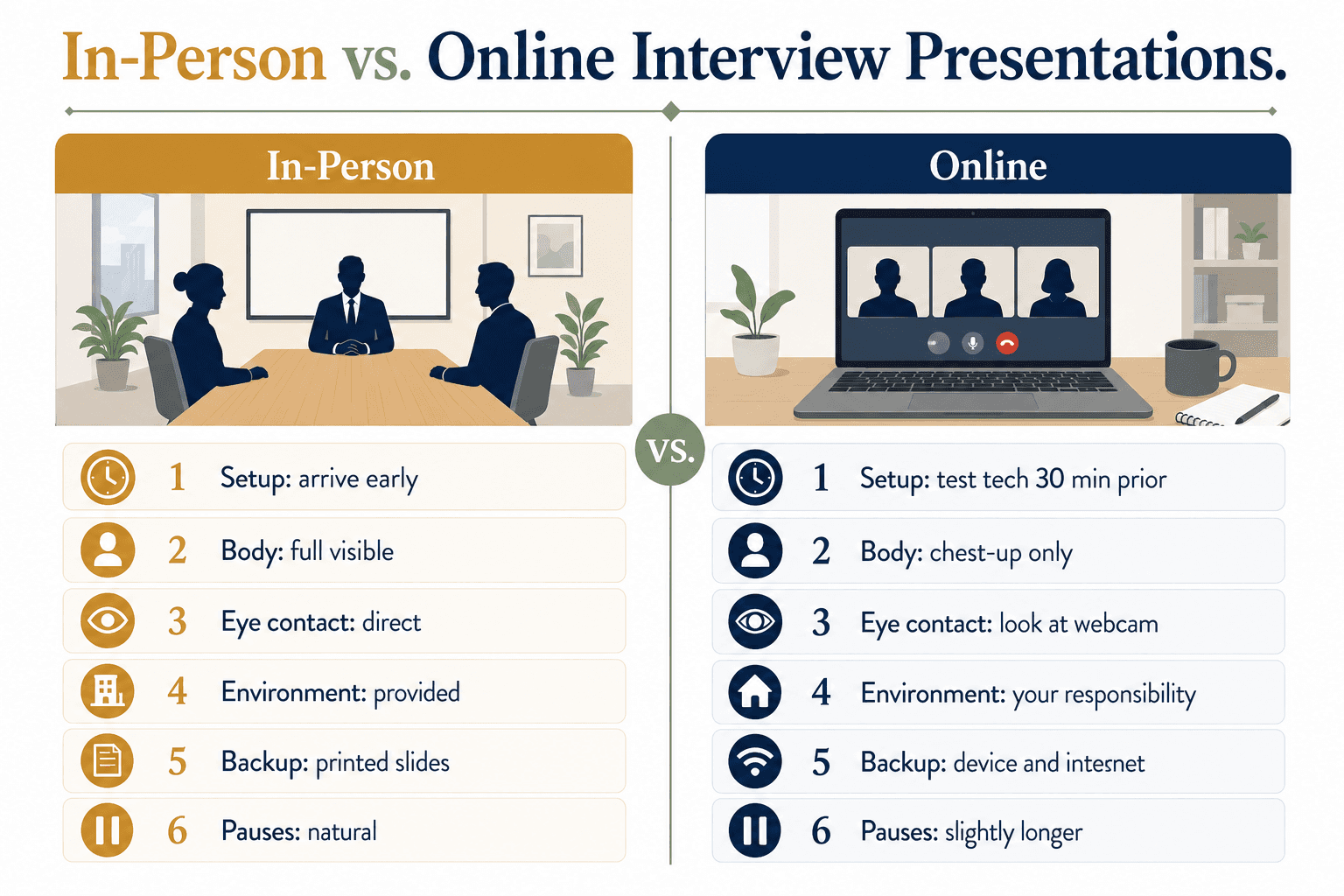
Two-column comparison infographic showing how in-person and online interview presentations differ across 6 factors.
How to Nail an Online Job Interview
Many interview presentations are now conducted remotely over Zoom, Google Meet, or Microsoft Teams. These three tips come from Maris Tepers, CEO of IT recruitment agency MateHR.
1. Test Software and Equipment Before the Interview
Most online interviews start badly because of avoidable tech issues. Get 100% familiar with the app and equipment before you go live. Do a test call with a friend using the exact same video conferencing tool the interview will use.
Pre-interview tech checklist:
Internet connection with a backup plan (smartphone hotspot ready to switch to)
Webcam and microphone tested on the same platform the interview will use
Screen sharing rehearsed step by step
Presentation preview in the actual video app to confirm nothing gets cut off
Device fully charged or plugged in
If you don’t know which video platform will be used, ask the recruiter directly. That’s a normal question.
2. Set Up the Space Around You
For online interviews, the room behind you is part of your first impression. Make it work for you.
Good lighting. Natural light works best, but avoid having a window directly behind you (it silhouettes you).
Neutral, tidy background. A bookshelf, a plant, or a piece of art works better than a blank wall.
No intruders. Ask anyone sharing your space to stay out of frame during the interview.
No background noise. Pick a quiet space. Mute notifications on every device.
3. Pay More Attention to Pauses and Confirmation Sounds
Online has slight audio delay that changes the rhythm of conversation. Adjust for it.
Pause slightly longer after each slide or major point so panelists can jump in.
Use small confirmation words (“right,” “makes sense,” “got it”) to signal engagement.
Ask “any questions on this before I move on?” every few slides.
Look directly into the webcam, not at your own screen or the panelists’ faces on screen. This is what creates the feeling of eye contact for the panel.
How to Build Your Interview Presentation with Decktopus AI
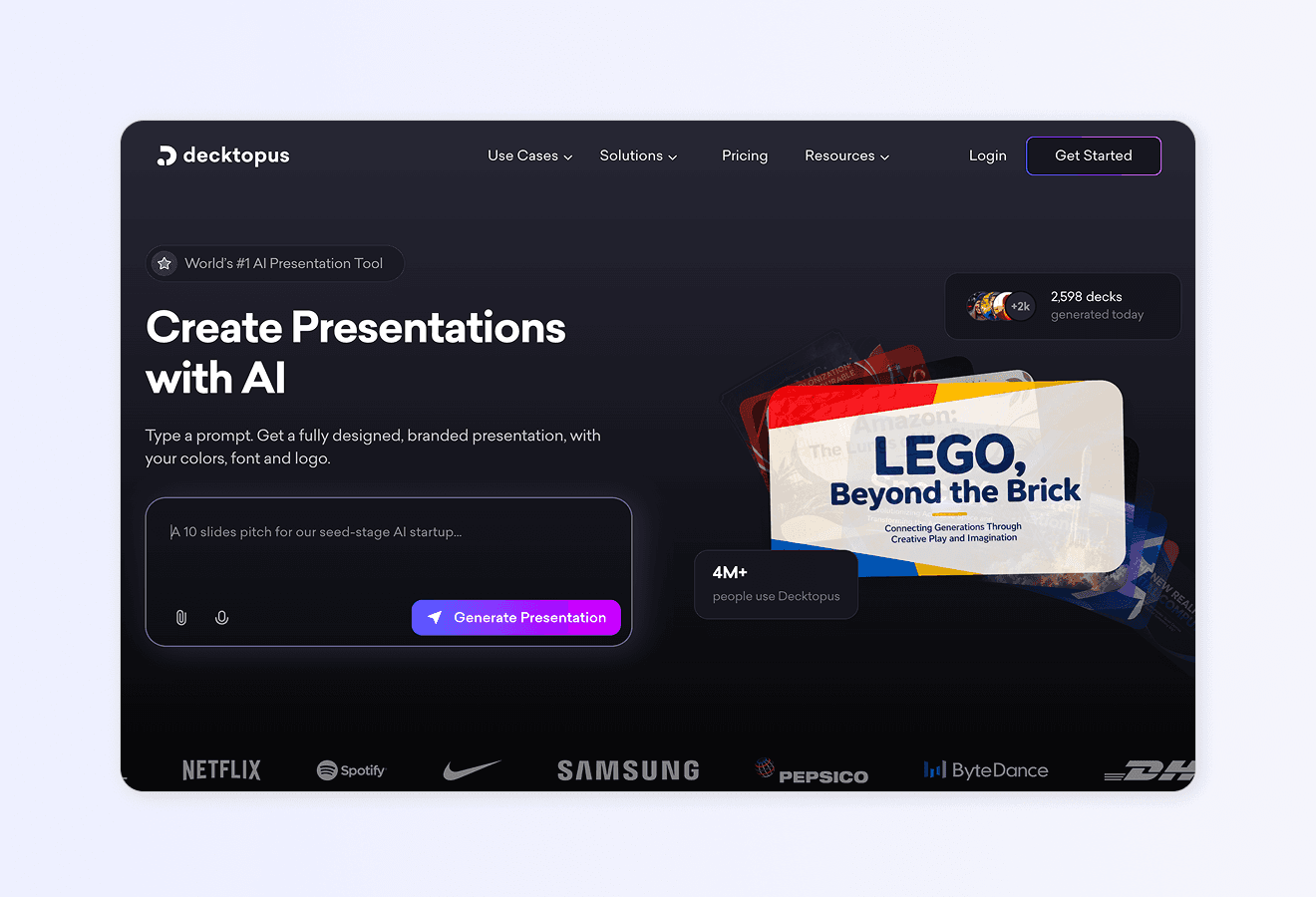
You have the framework. Now build the deck. Decktopus generates a full interview presentation from a short description in minutes.
1. Describe your topic. Type something like “Interview presentation on a customer onboarding process I redesigned that reduced churn 30%.” Or upload your notes, project doc, or past deck as a supporting file. If you already have a rough draft, Decktopus’s Beautify feature can redesign it or use it as a source.
2. Choose your style. Pick a brand, reuse a saved look, or start fresh with AI. Decktopus will ask how you want your presentation to look. You can apply a saved style, import a style from any website URL, or let AI generate a professional style for you.
3. Review the outline. Decktopus generates a slide-by-slide structure covering intro, problem, approach, results, and Q&A. Adjust before the full deck is built.
4. Refine with Edit with AI. Click Edit with AI and type instructions like “add a results slide with three bullet metrics,” “make the intro slide more visual,” or “add a summary slide at the end.” All edits are tracked with unlimited version history.
5. Export or share. Download as PDF, PPT, or PNG. Share via live link before the interview so the panel can preview. Or present directly.
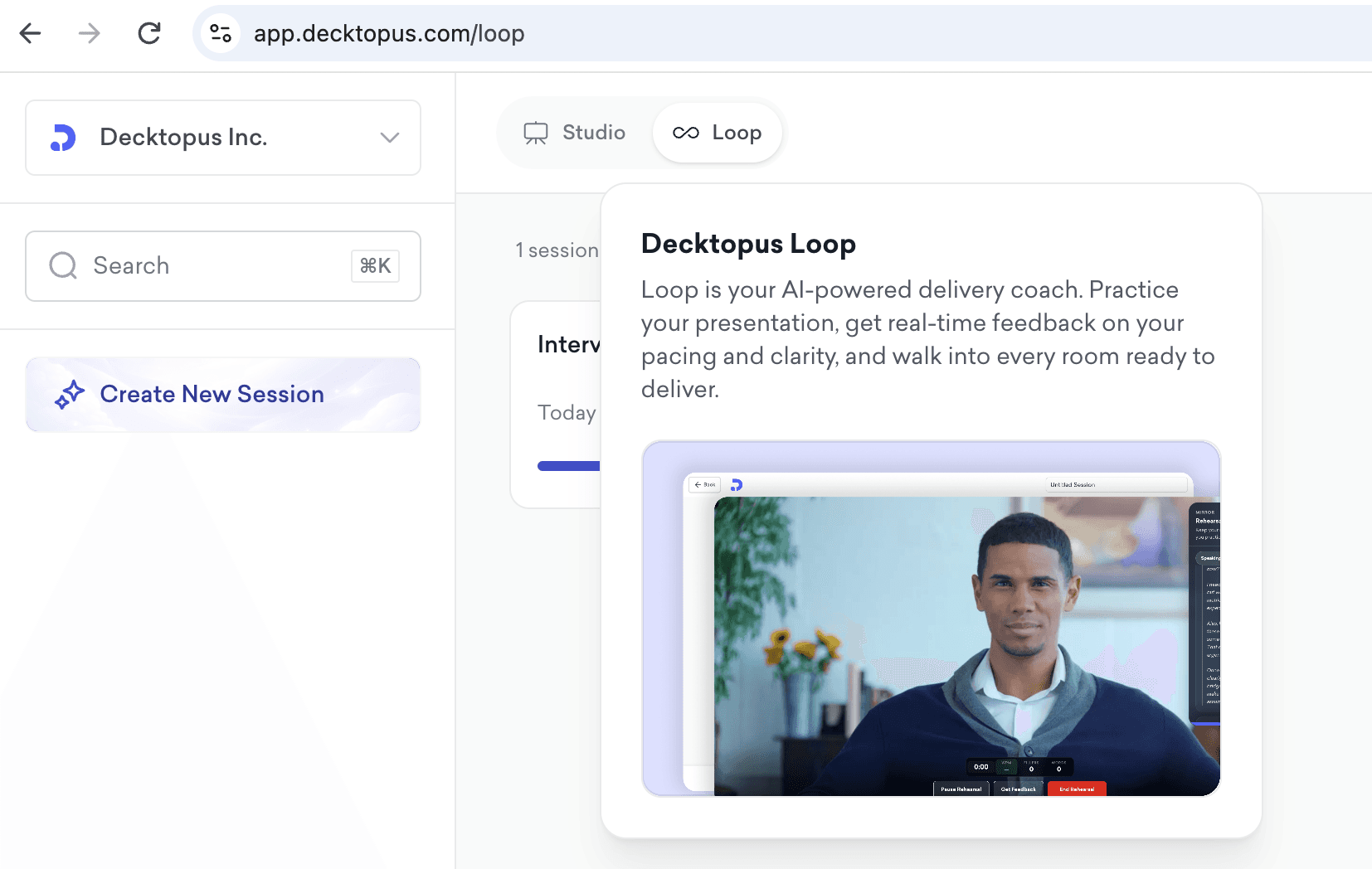
You can also use the Loop AI Delivery Coach during rehearsal to get real-time feedback on pacing, filler words, and clarity.
For broader guidance, see our roundup of the best AI presentation tools and our guide on how to do a presentation.
Ready to build an interview presentation that lands the offer? Get started with Decktopus.
Rehearse Your Interview Presentation with Loop AI Delivery Coach
The panel doesn't just grade your slides - they grade how you handle pressure, hard questions, and small failures live. A candidate with a decent deck and confident delivery beats a candidate with a beautiful deck and a shaky voice every single time.
Loop AI Delivery Coach is Decktopus AI's built-in rehearsal environment. It puts you in front of four AI agents that simulate the actual interview panel before you sit in front of the real one.
The 4 Loop Agents for Interview Prep
Profiler (Emily) - Simulates the hiring panel you'll face. Describe the role, the company, the seniority level of the interviewers, and Emily reacts the way a real panel would. Skeptical questions from a technical lead. Softer, exploratory questions from an HR partner. You rehearse for the exact room, not a generic one.
Architect (Marcus) - Reviews how your interview presentation flows. Flags when your self-intro runs long, when the problem statement doesn't set up your solution clearly enough, or when your results slide doesn't lead into a strong close. Structural feedback tuned for interview timing (10-20 minutes with Q&A).
Red Team - Fires the hard interview questions: "What would you do differently?", "How did you measure that result?", "What's the biggest failure in this project?", "Why should we hire you over someone with more experience?" These are the questions that sink unprepared candidates. Facing them in Loop turns them into routine answers.
Mirror - Records your delivery and plays it back with metrics: pace, filler words, pauses, tone shifts. Interview panels notice every "um" and "like." Mirror shows you exactly where yours cluster so you can cut them before the real interview.
Loop Rehearsal Flow for Interview Presentations
Build your interview deck in Decktopus AI
Open Loop, describe the panel (role, company, seniority)
Deliver the full presentation - Emily reacts, Marcus scores structure
Face Red Team's tough panel questions until answers feel automatic
Review Mirror playback and cut filler words and pace issues
Repeat until the delivery runs clean under pressure
Most candidates run 3-5 Loop sessions before a high-stakes interview. The difference in delivery confidence is the difference between an offer and a rejection email.
Prep your next interview with Loop →
Frequently Asked Questions
How long should a job interview presentation be?
Most interview presentations run 10 to 20 minutes with 5 to 10 minutes of Q&A. Aim for 8 to 15 slides. Always ask the recruiter for the exact time limit and stick to it.
What should I include in an interview presentation?
An intro slide, a clear problem statement, your approach or methodology, results with real numbers, lessons learned, and a Q&A slide. Keep each slide focused on one key idea.
How do I start an interview presentation?
Open with a short self-introduction (under 60 seconds) that includes one memorable personal detail. Then tell a specific story that sets up your topic. Don’t reread your resume.
What are common interview presentation mistakes?
Reading directly from the slides, going over the time limit, overloading slides with text, ignoring the audience’s expertise level, no clear structure, and skipping rehearsal. Rehearsal is the biggest single fix.
How do I handle tough questions during an interview presentation?
Pause before answering. It’s fine to say “great question, let me think for a second.” Answer honestly. If you don’t know something, say so and explain how you’d figure it out. Faking an answer is the worst response.
What should my slides look like for an interview presentation?
Clean, consistent, and professional. Two or three colors max. One idea per slide. Sans-serif font. Use visuals or data to support your points, not decorate the deck.
How is an online interview presentation different from in-person?
The fundamentals are the same, but online adds tech setup, environment control, and rhythm adjustments. Test your equipment, set up a clean background, and pause slightly longer after key points to give the panel room to jump in.
What tool is best for building an interview presentation fast?
Decktopus generates a full interview deck from a short topic description in minutes, with clean design and on-brand styling. Rehearsal features like Loop AI Delivery Coach help you prep before the interview. For more, see our roundup of the best AI presentation tools.
Related posts

How to Build Confidence When Speaking in Public (2026 Guide)
The science behind speaking confidence, the CONFIDENT framework, and the AI practice method that turns nervous presenters into calm, credible speakers.
Templates & How-to

How to Practice Public Speaking Alone (With and Without AI)
The 4 rehearsal methods that actually build public speaking skill, why mirror practice fails, and how AI simulates a real audience for structured feedback.
Templates & How-to

How to Give a TED Talk: Delivery Tips from the Best Speakers (2026)
A structured breakdown of what makes TED talks land, the delivery framework used by top speakers, and the AI practice method that closes the gap.
Templates & How-to