Education
Why Students Hate Giving Presentations
Every single person is different. Some flourish under the spotlight, while for some it is the one thing they dread the most. Perhaps the easiest place to observe this is the classroom


Decktopus Content Team
Ask any high schooler or college student what they dread most about class, and there’s a good chance the answer is “presentations.”
They’re not wrong to dread them. According to a 2024 study from the National Social Anxiety Center, 77% of students report significant anxiety about classroom presentations - with 1 in 5 experiencing symptoms severe enough to affect their grades. Presentation anxiety is now more commonly reported among students than test anxiety.
And yet, presentations aren’t going anywhere. They’re baked into curricula from middle school through graduate programs, and they carry into every professional field afterward. So the question isn’t whether students will keep presenting. It’s why they hate it so much, and what actually works to fix it.
This guide breaks down the real reasons students dread presentations, gives educators and students a framework that works, and shows how modern AI tools have quietly changed the game for anxious presenters.
You’ll get:
The 5 real reasons students hate giving presentations (and why the usual advice fails)
The CONFIDENCE framework for students who freeze under pressure
How teachers can restructure presentations to reduce anxiety without lowering standards
The AI-powered rehearsal method that replaces mirror practice
Answers to the questions students and parents actually ask

The 5 Real Reasons Students Hate Giving Presentations
Most advice treats presentation anxiety as a confidence problem. It isn’t - or at least, it isn’t only that. The real reasons are structural.
1. Fear of Judgment From Peers
For most students, the audience isn’t a room of strangers. It’s the people they’ll see in the cafeteria in an hour. A stumble in front of adults is embarrassing. A stumble in front of classmates is social currency they can’t get back.
2. No Real Rehearsal Method
Students are told to “practice more” without ever being taught how to practice. Reading through slides three times in your head isn’t rehearsal - it’s memorization. Real rehearsal requires simulated audience feedback, and most students never get any until the actual presentation.
3. Grading That Rewards Extroversion
Traditional presentation grading rewards volume, gestures, and eye contact - traits that come naturally to some personalities and are exhausting for others. A quiet, technically brilliant presentation often scores lower than a louder, less substantive one. Students notice this pattern early and disengage.
4. Slide Design Anxiety
Beyond the speaking piece, students are asked to design decks with zero training in visual design. They spend hours picking fonts and fighting formatting, arriving at the presentation exhausted before they even open their mouth.
5. No Recovery Skills
Nobody teaches students what to do when something goes wrong - when a slide misfires, when a laptop crashes, when a joke lands flat. Without recovery skills, one small failure spirals into a full presentation collapse.

The CONFIDENCE Framework for Student Presenters
Every strong student presentation delivery follows a repeatable structure. This framework maps to the 10 things that actually matter - and none of them are “smile more.”
Letter | Component | What It Does |
|---|---|---|
C | Clarity | You know the one thing the audience should walk away knowing |
O | Outline | The structure holds up if a slide fails |
N | Notes | Trigger words on a card, not a full script |
F | Format | Clean slides, one idea each, minimal text |
I | Intro | A specific opening line memorized cold |
D | Delivery | Pace and pauses rehearsed, not improvised |
E | Eye contact | Zone-based scanning, not stared-down individuals |
N | Nerve control | Reappraised as excitement, not anxiety |
C | Close | A specific final line memorized cold |
E | Exit | You know how to end and sit down without floundering |
Skip any of these ten and the presentation feels shaky. Nail all ten and the audience never notices that you were nervous.
What Teachers Can Do to Reduce Presentation Anxiety
Educators often assume that pushing students out of their comfort zone will build resilience. Sometimes it does. More often, it produces students who develop long-term aversions to public speaking.
The fix isn’t to eliminate presentations - it’s to redesign them.
Offer Format Choices
Let students choose between live presentations, recorded video presentations, or interactive walkthroughs. All three build presentation skills. Only one triggers panic attacks.
Grade Structure and Substance, Not Personality
Rebuild rubrics around clarity, evidence, and structure - not “engagement” or “charisma.” This levels the playing field for introverted students without lowering academic standards.
Provide Rehearsal Time
Give students structured rehearsal time with feedback. This is the single change that most reliably reduces anxiety and improves outcomes.
Normalize Recovery
Teach students what to do when things go wrong. A one-hour class session on “what to do when your slides break” removes 80% of catastrophic-failure anxiety.
The Practice Method That Actually Works for Students
The traditional advice - “practice in front of a mirror” - fails because a mirror doesn’t react, doesn’t interrupt, and doesn’t ask hard questions. Students rehearse to a completely forgiving audience, then get blindsided by a real one.
The rehearsal method that actually transfers to real presentations has three properties:
A simulated audience that reacts based on the room the student will actually face
Structural feedback on where the presentation drags or loses the argument
Playback so students can hear their own filler words, pace, and pauses
Historically, only students with access to expensive tutors got these three things. That’s now changed.
How Loop AI Delivery Coach Replaces Mirror Practice
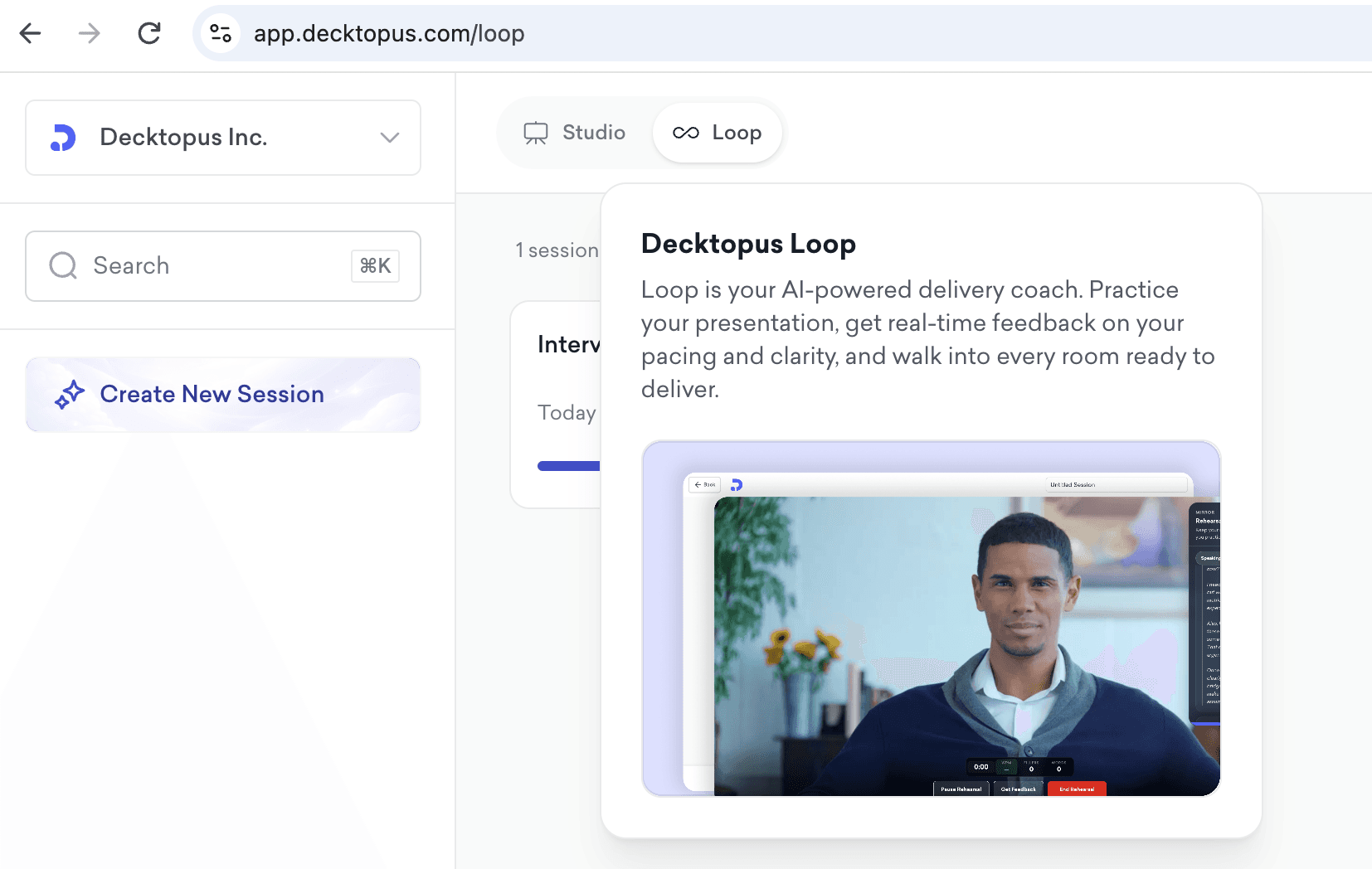
Loop AI Delivery Coach is Decktopus AI’s built-in rehearsal environment. Instead of practicing to a mirror, students practice to four AI agents - each solving a different part of the presentation problem.
The 4 Loop Agents
Profiler (Emily) - Builds a listener persona that matches the student’s actual audience. If the presentation is for a high school class, Emily reacts like a peer-and-teacher panel. If it’s a college seminar, her responses reflect that room. Students finally rehearse to a realistic listener, not to their bedroom wall.
Architect (Marcus) - Analyzes the structure of the presentation. Flags when the opening runs long, when evidence isn’t landing, or when the conclusion is buried. Structural feedback in seconds - the kind of feedback most students only get once, after the grade is already in.
Red Team - Fires the hard questions the teacher or classmates might ask. “What’s your source?”, “How does this apply beyond your example?”, “What’s the counterargument?” Facing these in rehearsal turns Q&A from a nightmare into a routine part of the presentation.
Mirror - Records the student’s run-through and plays it back with metrics: filler count (“um,” “like,” “you know”), pace, pause length. Students hear themselves the way the audience hears them - which is completely different from how they hear themselves in the moment.
Loop Rehearsal Flow for Students
Build or upload the presentation in Decktopus AI
Open Loop, describe the audience (class type, teacher, subject)
Run the presentation - Emily reacts, Marcus scores structure
Face Red Team questions until answers feel automatic
Review Mirror playback and cut filler words
Repeat until the delivery runs clean
Most students see meaningful improvement after 2-3 Loop sessions - measured in fewer fillers, tighter pacing, and calmer delivery under pressure. It’s the closest thing to a private speech coach that a student can access without paying for one.
Pre-Presentation Checklist for Students (10 Minutes Before You Go On)
Water bottle within reach
Slides loaded and working on the classroom setup
First sentence memorized cold
Last sentence memorized cold
Notecards visible, not read from
Two deep breaths before you stand up
Scan the room for one friendly face - anchor eye contact there for the first 10 seconds
Remind yourself: the audience wants you to succeed
How to Build Presentations Students Don’t Dread Making
Some of the anxiety around presentations comes from the deck itself - students spending hours fighting formatting instead of learning content.
Decktopus AI collapses the design step:
Type the topic, get a complete on-brand deck in minutes
One idea per slide by default, so students aren’t tempted to overload
Reviewable AI outline, so students always have a clear structure to speak from, plus Loop AI Delivery Coach for Q&A practice before the real thing
Rehearsal built in with Loop, so practice happens inside the same tool as the deck
Combined with Loop rehearsal, students spend their time on content and delivery - not on picking fonts.
Frequently Asked Questions
Why do so many students hate giving presentations?
The most common reasons are fear of peer judgment, no real rehearsal method, grading rubrics that reward extroversion over substance, and no training in recovery from small failures. Presentation anxiety is often a structural problem, not a personality flaw.
Is it normal for students to be nervous before a presentation?
Yes - about 77% of students report significant presentation anxiety. Some level of nervousness is universal and doesn’t get in the way of a strong presentation. Chronic, disabling anxiety needs specific tools and rehearsal methods to manage.
Should teachers force students to give presentations?
Presentations build a valuable skill, but the fix for anxious students isn’t to remove presentations - it’s to redesign them. Offer format choices (live, recorded, or interactive), grade on structure and substance rather than personality, and provide real rehearsal time.
What’s the best way for students to practice a presentation?
Not the mirror. Rehearsal only transfers to real presentations when it includes a simulated audience, structural feedback, and playback. Loop AI Delivery Coach automates all three inside Decktopus AI.
How can parents help a student prepare for a presentation?
Be an audience during rehearsal, but don’t only give encouragement. Ask real questions. Point out where you got confused. Ask “what’s the one thing you want us to remember?” - if the student can’t answer, the presentation isn’t ready.
What should students do if they freeze during a presentation?
Take one breath. Look at your notecards. Say “let me pick that back up” or “let me rephrase” and keep going. The audience remembers how you recovered, not that you froze.
How long should a student presentation be?
Whatever the teacher assigned - never longer. If unspecified, target 5-10 minutes with 2-3 minutes of Q&A. Practice out loud with a timer. Almost every student’s first draft runs long.
What’s the difference between memorizing and rehearsing?
Memorizing means you know the words. Rehearsing means you know the flow, the pace, the pauses, and what to do when something goes wrong. Memorizing is fragile. Rehearsing is robust.
How can shy students give strong presentations?
Play to your strengths. Quiet delivery with strong structure and evidence beats loud delivery with no substance. Rehearse until the material is automatic - that removes the need to also manage nerves in the moment. Loop rehearsal is especially useful for shy students because it removes the human-judgment factor.
What makes a student presentation look professional?
Clean, consistent slide design. One idea per slide. Two or three colors max. Sans-serif fonts. Real evidence backing every claim. Decktopus AI handles all of this automatically so students focus on content.
Do universities accept AI-generated presentations?
Most universities accept AI-assisted work as long as it’s disclosed and the student did the substantive thinking. Decktopus AI generates the deck around your outline and evidence - the strategic and analytical work is still yours.
What’s the single best thing a student can do to improve at presentations?
Rehearse with feedback. One session with Loop-style feedback teaches more than five practice runs in front of a mirror.
Related Posts
Public Speaking Tips: How to Deliver a Presentation That Actually Lands
How to Start a Presentation: 10 Hooks That Instantly Grab Attention
Stay Connected
Related posts

[UPDATED] 8 Niche Areas for Online Courses for 2026
79% of online students said that they preferred online learning to in-school education. What’s more, the e-learning industry is expected to reach 325 billion dollars of value by 2025. As a result, many people dove into online learning systems. Check out these online course domains!
Education

A Conversation on How Decktopus Can Help Ease Student Life for Engineers
In an extended interview with the Vitruvian organizing team, we were able to identify the growing need for a tool or platform for presentation and document creation that would alleviate the time and stress involved for organizations like these.
Education

A Message to Students and Teachers: Decktopus is here to help!
Studies have shown that teachers are spending at least 3.5 billion dollars on class materials and supporting equipment every year. Does that sound fair? Decktopus didn’t think so!
Education