Templates & How-to
How to Create A Pie Chart in Excel: A Step-By-Step Guide on to Make Excel Pie Chart
Build a pie chart in Excel step by step, then see how Decktopus AI generates presentation-ready charts automatically.


Decktopus Content Team
Table of Contents
What Is a Pie Chart?
Why Pie Charts Are Still One of the Most Used Chart Types
Types of Pie Charts Available in Excel
The 9-Step Framework for Making a Pie Chart in Excel
Excel Pie Charts vs. AI-Generated Charts: Quick Comparison
Common Mistakes to Avoid
How to Present Your Data with Decktopus AI
Frequently Asked Questions
Conclusion
Stay Connected
What Is a Pie Chart?
A pie chart is a circular data visualization where each slice represents a proportional share of a whole. Its main benefit is immediacy: a well-labeled pie chart lets a reader grasp relative proportions at a glance, without reading a single number.
Excel remains one of the most widely used tools for building these visualizations, and Microsoft reports that Excel is used by more than 1 billion people worldwide across data analysis, reporting, and presentation work, which is why knowing how to build a clean pie chart in it is still a genuinely useful skill.
This guide walks through exactly how to build a pie chart in Excel step by step, then shows a faster path for turning that same data into a presentation-ready chart with Decktopus AI.

Why Pie Charts Are Still One of the Most Used Chart Types
Pie charts work best when you have a small number of categories (ideally five or fewer) that together make up 100% of something, like market share, budget allocation, or survey responses. Every pie chart consists of the same core parts: slices representing each category, labels identifying the value or percentage, a legend explaining the color coding, and a title giving the chart context.
Types of Pie Charts Available in Excel
# | Pie Chart Type | Description |
|---|---|---|
1 | 2-D Pie Chart | Standard two-dimensional pie chart |
2 | 3-D Pie Chart | Three-dimensional pie chart |
3 | Pie of Pie Chart | Combines small slices into a secondary pie chart |
4 | Bar of Pie Chart | Combines small slices into a secondary bar chart |
5 | Doughnut Chart | Pie chart with a hole in the center |
The 9-Step Framework for Making a Pie Chart in Excel
Step 1: Open Microsoft Excel
Open Excel and click "Blank workbook" to start a new spreadsheet. If you already have existing data, open that file directly and skip to Step 4.
Step 2: Enter Your Category Labels
In cell A1 and B1, add labels describing the data you are about to enter. The label in B1 will later appear as your chart title. For example, "Class Preference" and "Percentage of Students."
Step 3: Enter Your Data
In column A, enter your categories. In column B, enter the corresponding values. Excel automatically calculates percentages if your values do not already add up to 100. Keep phrases in column A short, since long labels can crowd the finished chart and may not fit on smaller slices.
Step 4: Select the Table
Hold Shift and drag your cursor from A1 to the end of your data table. Make sure you are selecting only your actual data, since blank cells in the selection can distort the resulting chart.
Step 5: Open the Insert Tab
Click "Insert" on the ribbon while your data is still selected.
Step 6: Insert a Pie Chart
Click the pie chart icon in the Charts group of the Insert ribbon.
Step 7: Choose Your Pie Chart Type
Excel shows a dropdown of the pie chart types listed in the table above. Hover over each to preview its format. For most straightforward comparisons, a standard 2-D pie chart is the clearest choice.
Step 8: Review Your Chart
Excel inserts a default pie chart into your document. Review it, and use it as-is or continue customizing.
Step 9: Customize the Chart
Use the "Chart Design" tab to change the overall style and color palette, and the "Format" tab to adjust the position of labels, values, and percentages. Once finished, click anywhere outside the chart to return to your worksheet; you can reopen the design controls anytime by clicking the chart again.
Excel Pie Charts vs. AI-Generated Charts: Quick Comparison
Task | Excel | Decktopus AI |
|---|---|---|
Building the chart | Manual, 9 steps as above | Generated automatically as part of your AI-built deck |
Matching your presentation's design | Manual formatting to match slide theme | Charts inherit your deck's brand and style automatically |
Best for | Standalone spreadsheets and detailed data work | Presentation slides that need to look finished immediately |
Common Mistakes to Avoid
Using a pie chart for too many categories. Once you exceed five or six slices, a pie chart becomes hard to read. Consider a bar chart instead.
Skipping the data labels. A pie chart without percentages or values forces the reader to guess proportions from slice size alone.
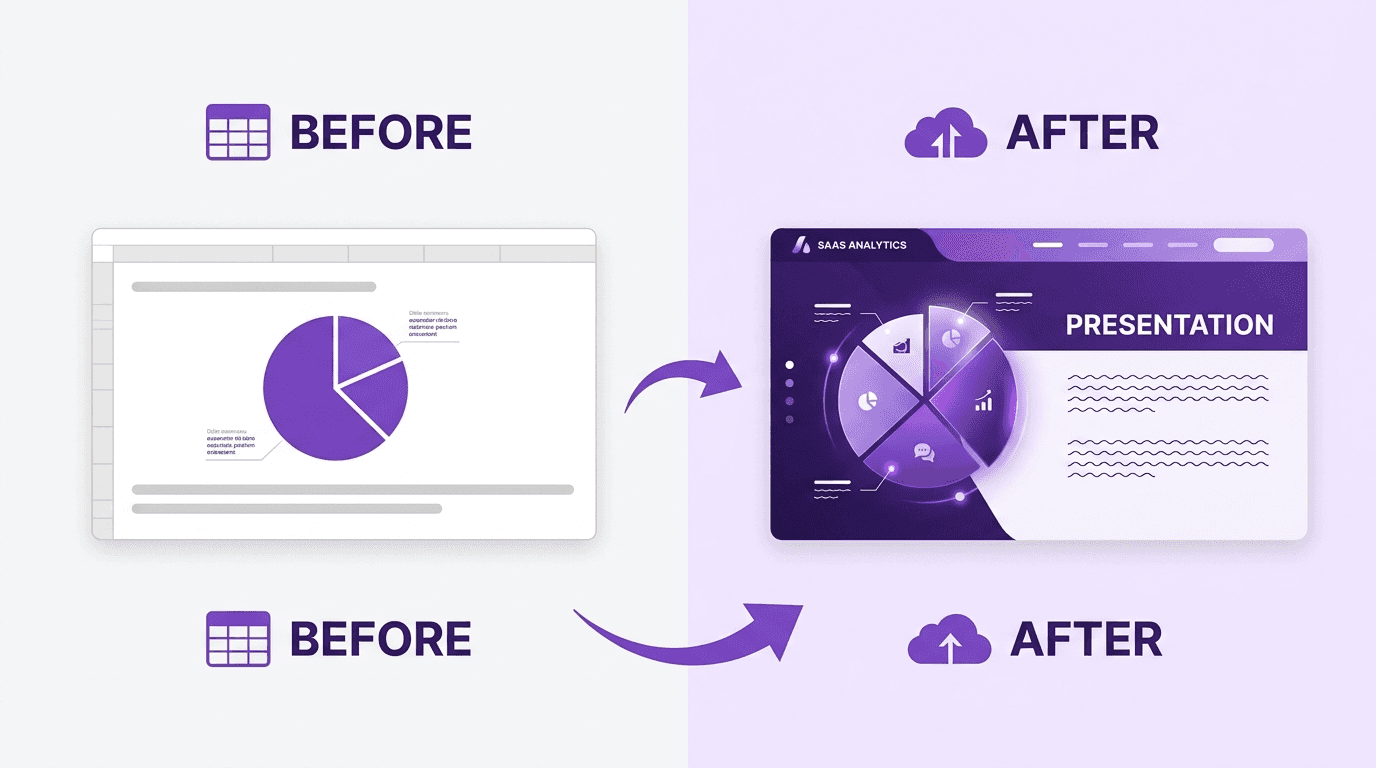
Copying a spreadsheet chart directly into a slide. Excel's default chart styling rarely matches a presentation's design. Reformatting it to match your deck takes real time, or you can generate one that already matches.
Choosing 3-D styling for accuracy-critical data. 3-D pie charts can visually distort slice proportions. Stick to 2-D when precision matters.
How to Present Your Data with Decktopus AI
Once your data is ready, building a matching, presentation-ready chart directly inside your slides is often faster than exporting one from Excel and reformatting it by hand. Decktopus AI generates charts and graphs as part of the presentations it builds, styled to match the rest of your deck automatically.
Why Decktopus AI Is Built for This
AI Presentation Generation builds full decks from a short description, including charts and graphs generated as part of the slide content when your topic calls for data visualization.
Edit with AI lets you adjust a chart's framing with a natural language prompt, for example "turn this into a percentage breakdown," with a preview before anything is applied.
Brand Import via URL keeps chart colors and styling consistent with the rest of your presentation automatically, without manual reformatting.
Beautify (Use as a Resource) can take an existing spreadsheet or document and pull out the key data points to build a new, styled presentation around them.
Export to PDF, PPT, or PNG in Standard or Compressed quality once your deck, and its charts, are finished.
Who This Section Is For
Useful for anyone who needs to turn spreadsheet data into a polished, presentation-ready visual quickly, including marketers reporting on channel mix and founders presenting metrics to investors.
Step-by-Step: Turn Your Data Into a Presentation Chart
Describe your data or topic. Type a short description of what you want to present, or upload a spreadsheet or document via the paperclip icon.
Choose your style. Import your brand from your company URL, apply a saved style, or let AI generate one from scratch.
Review the AI-generated outline. Confirm which sections should include a data visualization before generating the full deck.
Generate the full presentation. Decktopus AI produces the complete deck, including charts and graphs styled to match.
Refine with Edit with AI. Adjust chart framing or labels with a natural language prompt, with a preview before applying and undo always available.
Export or share. Export to PDF, PPT, or PNG, share a live link that updates automatically, or present directly from Presentation Mode.
Get started with Decktopus AI and skip the manual chart reformatting the next time you need a polished data slide.
Frequently Asked Questions
How do I create a simple pie chart in Excel?
Select your data, click Insert, choose the pie chart icon, and pick a chart type. Use the Chart Design and Format tabs to customize colors and labels.
Can I add percentages to an Excel pie chart?
Yes. Use the "Format" tab in the ribbon, or click the "+" button next to the chart, to add data labels showing percentages.
How many categories should a pie chart have?
Ideally five or fewer. Beyond that, slices become too small to read clearly, and a bar chart usually communicates the data better.
What is the difference between a pie chart and a doughnut chart?
A doughnut chart is functionally a pie chart with a hole in the center, often used to display a secondary metric or simply for a different visual style.
Can I create a pie chart in Google Sheets instead of Excel?
Yes, Google Sheets has similar pie chart functionality with a comparable, slightly simplified workflow.
Why does my Excel pie chart look distorted?
3-D pie charts can visually distort slice proportions due to perspective. Switch to a 2-D pie chart for more accurate visual comparisons.
Can Decktopus AI generate charts automatically?
Yes, Decktopus AI generates charts and graphs as part of the full presentations it builds, matched to your deck's style.
Do I need Excel experience to build a good pie chart?
No. The workflow above requires no prior spreadsheet experience, and AI-powered tools can generate a similar visualization directly inside a presentation without manual chart building.
What file formats can I export an Excel chart to?
You can copy it directly into other Office documents, or export the chart as an image file for use elsewhere.
How do I make my chart match my presentation's branding?
In Excel, this requires manually adjusting colors under Chart Design. AI presentation tools that import your brand automatically apply consistent styling instead.
What is the "Pie of Pie" chart used for?
It groups several small slices into a secondary pie chart, which is useful when you have a few dominant categories and several minor ones that would otherwise be too small to read.
Can I change the colors of individual slices in Excel?
Yes. Click on an individual slice twice to select just that slice, then use the paint bucket icon or the Format tab to change its color independently of the rest of the chart.
Is a pie chart the best choice for every dataset?
No. Pie charts work best for showing parts of a whole with a small number of categories. For trends over time or comparisons across many categories, a line or bar chart usually communicates more clearly.
Conclusion
Building a clean pie chart in Excel takes nine straightforward steps once you know where each option lives in the ribbon, and the skill remains genuinely useful for spreadsheet-based reporting. When the goal shifts from spreadsheet analysis to a polished, presentation-ready slide, generating the chart as part of an AI-built deck saves the reformatting step entirely.
Stay Connected
Follow Decktopus for more presentation tips and product updates:
Related posts

How to Build Confidence When Speaking in Public (2026 Guide)
The science behind speaking confidence, the CONFIDENT framework, and the AI practice method that turns nervous presenters into calm, credible speakers.
Templates & How-to

How to Practice Public Speaking Alone (With and Without AI)
The 4 rehearsal methods that actually build public speaking skill, why mirror practice fails, and how AI simulates a real audience for structured feedback.
Templates & How-to

How to Give a TED Talk: Delivery Tips from the Best Speakers (2026)
A structured breakdown of what makes TED talks land, the delivery framework used by top speakers, and the AI practice method that closes the gap.
Templates & How-to