Presentations
Everything You Need to Know About the 10/20/30 Rule of PowerPoint Presentations
Learn what the 10/20/30 Rule is, where it comes from, when to use it, when to break it, and how to build a rule-compliant deck fast.


Decktopus Content Team
What Is the 10/20/30 Rule?
The 10/20/30 Rule is a presentation framework created by Guy Kawasaki that states a pitch deck should have no more than 10 slides, run no longer than 20 minutes, and use no font smaller than 30 points. Each number targets a specific problem: too many ideas, too much time, and unreadable text. The main benefit is that it forces you to distill your pitch to the essentials, which improves audience retention and shortens the time to a decision.
Microsoft research puts the average adult attention span at around 8 seconds, and audience research consistently shows engagement dropping after 20 to 25 minutes of continuous presentation. Guy Kawasaki developed the rule after reviewing thousands of pitch decks as a Silicon Valley venture capitalist. The vast majority of decks he saw failed on structure, length, or legibility, which is exactly what the 10/20/30 Rule fixes in one framework.
For related presentation frameworks, see our guides on how to do a presentation, what makes for a good presentation, and how to make presentations easier to understand.

Presentations in Modern Business
Presentations show up everywhere: sales meetings, investor pitches, board reviews, product launches, classroom lectures, conference talks, and even social settings like PowerPoint Nights. Every professional will give hundreds of presentations across their career, and the quality of those presentations directly shapes influence, funding, promotions, and outcomes.
Yet most presentations fail the same way. They’re too long. They’re stuffed with text. They lose the audience in the first three slides. According to Prezi research, over 70% of professionals say they’ve sat through presentations that felt like a waste of time. Kawasaki’s 10/20/30 Rule was built as a direct fix for exactly that pattern.
For lighter presentation formats, see our best funny PowerPoint night ideas and our roundup of the most interesting presentation topic ideas.
What to Consider Before You Start Building
Whether you follow the 10/20/30 Rule exactly or adapt it for your situation, every presentation should be built on the same five decisions.
1. Topic and Purpose
What is this presentation for? Informing, persuading, inspiring, or entertaining? Your purpose shapes every downstream decision, from the opening hook to the final CTA. Vague purposes create vague presentations.
2. Slide Organization
Structure matters more than design. A logical flow keeps the audience oriented and moves them toward the conclusion. Kawasaki’s 10-slide framework is one structure, but any presentation should have an intentional narrative arc rather than a random slide order.
3. Slide Design
Design supports the message. It doesn’t replace it. Every slide should have one dominant idea, minimal text, and visual clarity. Death by PowerPoint is what happens when design decisions get made slide-by-slide instead of as a system. See our guide on presentation design for more.
4. Time Limit
Match the runtime to the purpose. Pitches: 15 to 20 minutes. Board updates: 10 to 15 minutes. Full workshops: 45 to 60 minutes. Never let the runtime stretch by more than 10% of the plan. Overrunning kills trust with the audience.
5. Delivery Style
Slides support you. You are the presentation. Practice out loud, ideally on video, at least three times. Every strong presenter you’ve admired has rehearsed way more than you think. See our public speaking tips for delivery frameworks.
Where the 10/20/30 Rule Came From
The 10/20/30 Rule was coined by Guy Kawasaki in 2006. Kawasaki was one of Apple’s original evangelists in the 1980s, later became a Silicon Valley venture capitalist, and is now Chief Evangelist at Canva. His career put him in front of thousands of pitch decks.
The pattern he noticed: most pitches failed the same three ways. Too many slides (30, 40, sometimes 60). Too long a runtime (45 minutes, an hour, sometimes two). And too small a font (10 or 12 point text stuffed onto every slide). The 10/20/30 Rule was his answer, distilled into one memorable framework.
Nearly two decades later, it’s still one of the most referenced presentation rules in business, taught in MBA programs, quoted in books, and used by founders every fundraising cycle.
The 10-Slide Pitch Deck Framework
Kawasaki’s version of the rule includes a specific 10-slide outline for a pitch:
[[EMBED:PGRpdiBzdHlsZT0ib3ZlcmZsb3cteDphdXRvO21hcmdpbjoyMHB4IDAiPjx0YWJsZSBzdHlsZT0id2lkdGg6MTAwJTtib3JkZXItY29sbGFwc2U6Y29sbGFwc2U7Zm9udC1zaXplOjE1cHg7bWFyZ2luOjhweCAwIj48dGggc3R5bGU9ImJvcmRlcjoxcHggc29saWQgI2UzZTZlYTtwYWRkaW5nOjEwcHggMTRweDt0ZXh0LWFsaWduOmxlZnQ7YmFja2dyb3VuZDojZjRmNmY4O2ZvbnQtd2VpZ2h0OjYwMCI+PHRyPjx0aCBzdHlsZT0iYm9yZGVyOjFweCBzb2xpZCAjZTNlNmVhO3BhZGRpbmc6MTBweCAxNHB4O3RleHQtYWxpZ246bGVmdDtiYWNrZ3JvdW5kOiNmNGY2Zjg7Zm9udC13ZWlnaHQ6NjAwIj5TbGlkZTwvdGg+PHRoIHN0eWxlPSJib3JkZXI6MXB4IHNvbGlkICNlM2U2ZWE7cGFkZGluZzoxMHB4IDE0cHg7dGV4dC1hbGlnbjpsZWZ0O2JhY2tncm91bmQ6I2Y0ZjZmODtmb250LXdlaWdodDo2MDAiPkNvbnRlbnQ8L3RoPjwvdHI+PC90aGVhZD48dGJvZHk+PHRyPjx0ZCBzdHlsZT0iYm9yZGVyOjFweCBzb2xpZCAjZTNlNmVhO3BhZGRpbmc6MTBweCAxNHB4O3RleHQtYWxpZ246bGVmdDt2ZXJ0aWNhbC1hbGlnbjp0b3AiPjE8L3RkPjx0ZCBzdHlsZT0iYm9yZGVyOjFweCBzb2xpZCAjZTNlNmVhO3BhZGRpbmc6MTBweCAxNHB4O3RleHQtYWxpZ246bGVmdDt2ZXJ0aWNhbC1hbGlnbjp0b3AiPlRpdGxlIChuYW1lLCBjb21wYW55LCBjb250YWN0IGluZm9ybWF0aW9uKTwvdGQ+PC90cj48dHI+PHRkIHN0eWxlPSJib3JkZXI6MXB4IHNvbGlkICNlM2U2ZWE7cGFkZGluZzoxMHB4IDE0cHg7dGV4dC1hbGlnbjpsZWZ0O3ZlcnRpY2FsLWFsaWduOnRvcCI+MjwvdGQ+PHRkIHN0eWxlPSJib3JkZXI6MXB4IHNvbGlkICNlM2U2ZWE7cGFkZGluZzoxMHB4IDE0cHg7dGV4dC1hbGlnbjpsZWZ0O3ZlcnRpY2FsLWFsaWduOnRvcCI+UHJvYmxlbSBvciBvcHBvcnR1bml0eTwvdGQ+PC90cj48dHI+PHRkIHN0eWxlPSJib3JkZXI6MXB4IHNvbGlkICNlM2U2ZWE7cGFkZGluZzoxMHB4IDE0cHg7dGV4dC1hbGlnbjpsZWZ0O3ZlcnRpY2FsLWFsaWduOnRvcCI+MzwvdGQ+PHRkIHN0eWxlPSJib3JkZXI6MXB4IHNvbGlkICNlM2U2ZWE7cGFkZGluZzoxMHB4IDE0cHg7dGV4dC1hbGlnbjpsZWZ0O3ZlcnRpY2FsLWFsaWduOnRvcCI+VmFsdWUgcHJvcG9zaXRpb248L3RkPjwvdHI+PHRyPjx0ZCBzdHlsZT0iYm9yZGVyOjFweCBzb2xpZCAjZTNlNmVhO3BhZGRpbmc6MTBweCAxNHB4O3RleHQtYWxpZ246bGVmdDt2ZXJ0aWNhbC1hbGlnbjp0b3AiPjQ8L3RkPjx0ZCBzdHlsZT0iYm9yZGVyOjFweCBzb2xpZCAjZTNlNmVhO3BhZGRpbmc6MTBweCAxNHB4O3RleHQtYWxpZ246bGVmdDt2ZXJ0aWNhbC1hbGlnbjp0b3AiPlVuZGVybHlpbmcgbWFnaWMgKHRoZSB0ZWNobm9sb2d5IG9yIGFwcHJvYWNoKTwvdGQ+PC90cj48dHI+PHRkIHN0eWxlPSJib3JkZXI6MXB4IHNvbGlkICNlM2U2ZWE7cGFkZGluZzoxMHB4IDE0cHg7dGV4dC1hbGlnbjpsZWZ0O3ZlcnRpY2FsLWFsaWduOnRvcCI+NTwvdGQ+PHRkIHN0eWxlPSJib3JkZXI6MXB4IHNvbGlkICNlM2U2ZWE7cGFkZGluZzoxMHB4IDE0cHg7dGV4dC1hbGlnbjpsZWZ0O3ZlcnRpY2FsLWFsaWduOnRvcCI+QnVzaW5lc3MgbW9kZWw8L3RkPjwvdHI+PHRyPjx0ZCBzdHlsZT0iYm9yZGVyOjFweCBzb2xpZCAjZTNlNmVhO3BhZGRpbmc6MTBweCAxNHB4O3RleHQtYWxpZ246bGVmdDt2ZXJ0aWNhbC1hbGlnbjp0b3AiPjY8L3RkPjx0ZCBzdHlsZT0iYm9yZGVyOjFweCBzb2xpZCAjZTNlNmVhO3BhZGRpbmc6MTBweCAxNHB4O3RleHQtYWxpZ246bGVmdDt2ZXJ0aWNhbC1hbGlnbjp0b3AiPkdvLXRvLW1hcmtldCBwbGFuPC90ZD48L3RyPjx0cj48dGQgc3R5bGU9ImJvcmRlcjoxcHggc29saWQgI2UzZTZlYTtwYWRkaW5nOjEwcHggMTRweDt0ZXh0LWFsaWduOmxlZnQ7dmVydGljYWwtYWxpZ246dG9wIj43PC90ZD48dGQgc3R5bGU9ImJvcmRlcjoxcHggc29saWQgI2UzZTZlYTtwYWRkaW5nOjEwcHggMTRweDt0ZXh0LWFsaWduOmxlZnQ7dmVydGljYWwtYWxpZ246dG9wIj5Db21wZXRpdGl2ZSBhbmFseXNpczwvdGQ+PC90cj48dHI+PHRkIHN0eWxlPSJib3JkZXI6MXB4IHNvbGlkICNlM2U2ZWE7cGFkZGluZzoxMHB4IDE0cHg7dGV4dC1hbGlnbjpsZWZ0O3ZlcnRpY2FsLWFsaWduOnRvcCI+ODwvdGQ+PHRkIHN0eWxlPSJib3JkZXI6MXB4IHNvbGlkICNlM2U2ZWE7cGFkZGluZzoxMHB4IDE0cHg7dGV4dC1hbGlnbjpsZWZ0O3ZlcnRpY2FsLWFsaWduOnRvcCI+TWFuYWdlbWVudCB0ZWFtPC90ZD48L3RyPjx0cj48dGQgc3R5bGU9ImJvcmRlcjoxcHggc29saWQgI2UzZTZlYTtwYWRkaW5nOjEwcHggMTRweDt0ZXh0LWFsaWduOmxlZnQ7dmVydGljYWwtYWxpZ246dG9wIj45PC90ZD48dGQgc3R5bGU9ImJvcmRlcjoxcHggc29saWQgI2UzZTZlYTtwYWRkaW5nOjEwcHggMTRweDt0ZXh0LWFsaWduOmxlZnQ7dmVydGljYWwtYWxpZ246dG9wIj5GaW5hbmNpYWwgcHJvamVjdGlvbnMgYW5kIGtleSBtZXRyaWNzPC90ZD48L3RyPjx0cj48dGQgc3R5bGU9ImJvcmRlcjoxcHggc29saWQgI2UzZTZlYTtwYWRkaW5nOjEwcHggMTRweDt0ZXh0LWFsaWduOmxlZnQ7dmVydGljYWwtYWxpZ246dG9wIj4xMDwvdGQ+PHRkIHN0eWxlPSJib3JkZXI6MXB4IHNvbGlkICNlM2U2ZWE7cGFkZGluZzoxMHB4IDE0cHg7dGV4dC1hbGlnbjpsZWZ0O3ZlcnRpY2FsLWFsaWduOnRvcCI+Q3VycmVudCBzdGF0dXMsIGFjY29tcGxpc2htZW50cywgdGltZWxpbmUsIGFuZCB1c2Ugb2YgZnVuZHM8L3RkPjwvdHI+PC90Ym9keT48L3RhYmxlPjwvZGl2Pg==]]
For deeper pitch guidance, see our pitch deck examples, what is a pitch deck, and how to make the best startup pitch.
Slide 1: Title
Your name, your company name, contact info, and a memorable tagline or one-line company description. This slide is on screen while people are settling in, so it should immediately communicate what your company does.
Slide 2: Problem or Opportunity
State the pain point your product solves. Use a specific, concrete example, ideally with a real customer or market segment. Vague problem statements (“communication is broken”) lose investors. Specific ones (“finance teams spend 12 hours per week reconciling expense reports manually”) land.
Slide 3: Value Proposition
Your product in one sentence. Format: “For [audience] who [pain], [product] is the [category] that [key benefit].” Test it by reading it out loud. If it sounds like buzzword salad, rewrite it.
Slide 4: Underlying Magic
This is your differentiator. What makes your approach work when others didn’t? Technology, business model, distribution, team, or timing. Keep it visual and simple. If you can’t explain it in 60 seconds, you don’t understand it well enough.
Slide 5: Business Model
How you make money. Subscription, transactional, marketplace commission, freemium, enterprise licensing. Add pricing and unit economics if you have them.
Slide 6: Go-to-Market Plan
How you reach customers. Channel strategy, sales approach, marketing motion, target ICP. Investors want to see that you know how to scale, not just how to build.
Slide 7: Competitive Analysis
Who else is in the market, and why you win. A competitive matrix (2x2 or table format) works well here. Never claim you have “no competitors.” That signals either a small market or a founder who hasn’t done research.
For more on positioning, see our guide on competitor analysis.
Slide 8: Management Team
Who’s building this and why they’re the right team. Highlight relevant experience, past exits, or domain expertise. Investors bet on founders more than ideas.
Slide 9: Financial Projections and Key Metrics
Your revenue forecast for 3 to 5 years, plus the key SaaS or business metrics that prove traction. Don’t hockey-stick. Realistic growth signals discipline.
Slide 10: Current Status, Timeline, and Use of Funds
Where you are today, what the next 12 to 18 months look like, and specifically what you’ll do with the money you’re raising. Named milestones tied to funding stages work best. See our guide on the use of funds slide for deeper detail.
For more pitch guidance, see our pitch deck examples, what is a pitch deck, and how to make the best startup pitch.

Why 20 Minutes Is the Ideal Runtime
Kawasaki’s 20-minute limit isn’t arbitrary. It’s grounded in three things.
Attention span research. Audience engagement drops sharply after 20 to 25 minutes of continuous presentation. That’s why lectures, sermons, and TED Talks converge on similar durations.
TED Talk analysis. Every TED Talk is capped at 18 minutes. TED chose that number after studying which talks got shared most. Under 20 minutes turned out to be the sweet spot for retention and virality.
Buffer for the real world. Meetings start late. Tech breaks. People join partway through. Someone asks a question. If you plan 20 minutes and you’re given 60, you have 40 minutes of buffer for questions, discussion, or follow-up conversation. If you plan 60 and you’re given 60, you’re doomed.
The lesson: even when you’re given more time, deliver in 20. Save the rest for engagement. The presenters who dominate the room are almost always the ones who finish early with time to spare.
For more on strong closes, see how to end a presentation with impact.
Why 30-Point Font Matters More Than You Think
The 30-point rule is really three rules disguised as one.
Rule 1: If your text is under 30 points, you probably have too much text. 30-point font limits how much you can fit on a slide, which forces you to keep only what matters. Reduction is a feature, not a limitation.
Rule 2: If you have too much text, you’ll read from the slides. That’s the fastest way to lose an audience. People read faster than you talk. Once they finish, they stop listening.
Rule 3: If the text is small, the back row can’t see it. In a conference room, boardroom, or auditorium, small text is invisible past the front rows. Even on Zoom, phone-sized screens make small text unreadable.
Kawasaki’s alternative rule if 30 feels too rigid: find the age of the oldest audience member and divide by two. If your oldest audience member is 60, use 30-point font. If they’re 40, you can go to 20.
For accessibility considerations, most enterprise brand guidelines now recommend 24 points minimum, with 30 to 36 points as the ideal for body copy in presentations.
Applying the 10/20/30 Rule Slide by Slide
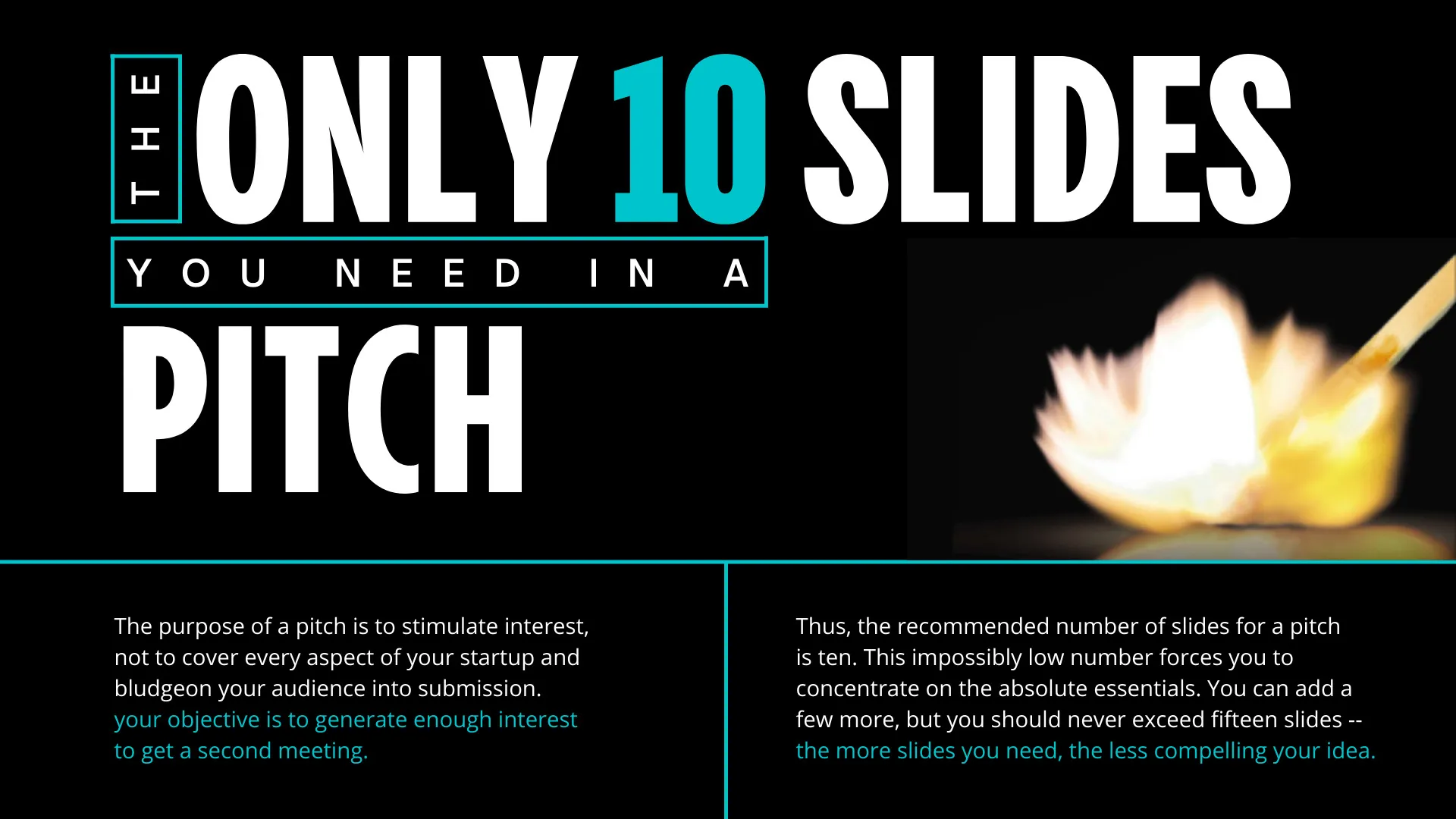
10 Slides Is More Than Enough
The human mind can hold roughly 10 concepts in a single meeting. Any more and slides start blurring together. Use slides as support for your talking points, not as a script. If your topic has more than 10 essential concepts, you probably have two presentations, not one.
20 Minutes Is Ideal for Delivery
Most TED Talks run 20 minutes or less. That’s not an accident. Twenty minutes is long enough to deliver a full argument and short enough to hold attention throughout.
Even when you’re given an hour, keep the presentation to 20 minutes and reserve the rest for Q&A, discussion, or buffer time for late starts and tech issues. For more on strong openings and closings, see our guides on how to start a presentation and how to end a presentation with impact.
30-Point Font Is Better
Nothing kills a pitch faster than tiny text on screen. When the font drops below 30 points, three things happen:
You end up with paragraphs on slides
You read from the slides
The audience reads faster than you talk and stops listening
Kawasaki’s alternative rule: find the age of the oldest person in the audience and divide by two. If the oldest is 50, use 25-point font.

Benefits vs. Downsides of the Rule
Like any framework, the 10/20/30 Rule has trade-offs. Understanding both sides helps you decide when to apply it strictly and when to bend.
[[EMBED:PGRpdiBzdHlsZT0ib3ZlcmZsb3cteDphdXRvO21hcmdpbjoyMHB4IDAiPjx0YWJsZSBzdHlsZT0id2lkdGg6MTAwJTtib3JkZXItY29sbGFwc2U6Y29sbGFwc2U7Zm9udC1zaXplOjE1cHg7bWFyZ2luOjhweCAwIj48dGggc3R5bGU9ImJvcmRlcjoxcHggc29saWQgI2UzZTZlYTtwYWRkaW5nOjEwcHggMTRweDt0ZXh0LWFsaWduOmxlZnQ7YmFja2dyb3VuZDojZjRmNmY4O2ZvbnQtd2VpZ2h0OjYwMCI+PHRyPjx0aCBzdHlsZT0iYm9yZGVyOjFweCBzb2xpZCAjZTNlNmVhO3BhZGRpbmc6MTBweCAxNHB4O3RleHQtYWxpZ246bGVmdDtiYWNrZ3JvdW5kOiNmNGY2Zjg7Zm9udC13ZWlnaHQ6NjAwIj5CZW5lZml0PC90aD48dGggc3R5bGU9ImJvcmRlcjoxcHggc29saWQgI2UzZTZlYTtwYWRkaW5nOjEwcHggMTRweDt0ZXh0LWFsaWduOmxlZnQ7YmFja2dyb3VuZDojZjRmNmY4O2ZvbnQtd2VpZ2h0OjYwMCI+RG93bnNpZGU8L3RoPjwvdHI+PC90aGVhZD48dGJvZHk+PHRyPjx0ZCBzdHlsZT0iYm9yZGVyOjFweCBzb2xpZCAjZTNlNmVhO3BhZGRpbmc6MTBweCAxNHB4O3RleHQtYWxpZ246bGVmdDt2ZXJ0aWNhbC1hbGlnbjp0b3AiPkZvcmNlcyB5b3UgdG8gZGlzdGlsbCB0aGUgcGl0Y2ggdG8gaXRzIGVzc2VudGlhbHM8L3RkPjx0ZCBzdHlsZT0iYm9yZGVyOjFweCBzb2xpZCAjZTNlNmVhO3BhZGRpbmc6MTBweCAxNHB4O3RleHQtYWxpZ246bGVmdDt2ZXJ0aWNhbC1hbGlnbjp0b3AiPjIwIG1pbnV0ZXMgY2FuIGZlZWwgcmVzdHJpY3RpdmUgZm9yIGNvbXBsZXggdG9waWNzPC90ZD48L3RyPjx0cj48dGQgc3R5bGU9ImJvcmRlcjoxcHggc29saWQgI2UzZTZlYTtwYWRkaW5nOjEwcHggMTRweDt0ZXh0LWFsaWduOmxlZnQ7dmVydGljYWwtYWxpZ246dG9wIj5JbXByb3ZlcyBhdWRpZW5jZSByZXRlbnRpb24gd2l0aCBhIGZvY3VzZWQgbmFycmF0aXZlPC90ZD48dGQgc3R5bGU9ImJvcmRlcjoxcHggc29saWQgI2UzZTZlYTtwYWRkaW5nOjEwcHggMTRweDt0ZXh0LWFsaWduOmxlZnQ7dmVydGljYWwtYWxpZ246dG9wIj4xMCBzbGlkZXMgbWF5IGJlY29tZSBjcm93ZGVkIHdoZW4gY292ZXJpbmcgbXVsdGlwbGUgcHJvZHVjdHMgb3IgaWRlYXM8L3RkPjwvdHI+PHRyPjx0ZCBzdHlsZT0iYm9yZGVyOjFweCBzb2xpZCAjZTNlNmVhO3BhZGRpbmc6MTBweCAxNHB4O3RleHQtYWxpZ246bGVmdDt2ZXJ0aWNhbC1hbGlnbjp0b3AiPlJlZHVjZXMgdGV4dC1oZWF2eSBzbGlkZXMgYW5kIGVuY291cmFnZXMgdmlzdWFsIHN0b3J5dGVsbGluZzwvdGQ+PHRkIHN0eWxlPSJib3JkZXI6MXB4IHNvbGlkICNlM2U2ZWE7cGFkZGluZzoxMHB4IDE0cHg7dGV4dC1hbGlnbjpsZWZ0O3ZlcnRpY2FsLWFsaWduOnRvcCI+VGhlIDMwLXBvaW50IGZvbnQgcnVsZSBjYW4gbGltaXQgY2VydGFpbiBkZXNpZ24gbGF5b3V0czwvdGQ+PC90cj48dHI+PHRkIHN0eWxlPSJib3JkZXI6MXB4IHNvbGlkICNlM2U2ZWE7cGFkZGluZzoxMHB4IDE0cHg7dGV4dC1hbGlnbjpsZWZ0O3ZlcnRpY2FsLWFsaWduOnRvcCI+U2lnbmFscyBjb25maWRlbmNlIGFuZCBtYXN0ZXJ5IHRocm91Z2ggY29uY2lzZSBjb21tdW5pY2F0aW9uPC90ZD48dGQgc3R5bGU9ImJvcmRlcjoxcHggc29saWQgI2UzZTZlYTtwYWRkaW5nOjEwcHggMTRweDt0ZXh0LWFsaWduOmxlZnQ7dmVydGljYWwtYWxpZ246dG9wIj5PcmlnaW5hbGx5IGRlc2lnbmVkIGZvciBzdGFydHVwIHBpdGNoZXMgcmF0aGVyIHRoYW4gZXZlcnkgcHJlc2VudGF0aW9uIHR5cGU8L3RkPjwvdHI+PHRyPjx0ZCBzdHlsZT0iYm9yZGVyOjFweCBzb2xpZCAjZTNlNmVhO3BhZGRpbmc6MTBweCAxNHB4O3RleHQtYWxpZ246bGVmdDt2ZXJ0aWNhbC1hbGlnbjp0b3AiPkFsaWducyB3ZWxsIHdpdGggdHlwaWNhbCBhdWRpZW5jZSBhdHRlbnRpb24gc3BhbnM8L3RkPjx0ZCBzdHlsZT0iYm9yZGVyOjFweCBzb2xpZCAjZTNlNmVhO3BhZGRpbmc6MTBweCAxNHB4O3RleHQtYWxpZ246bGVmdDt2ZXJ0aWNhbC1hbGlnbjp0b3AiPlNvbWUgZ3VpZGVsaW5lcyBmZWVsIGxlc3MgcmVsZXZhbnQgd2l0aCBtb2Rlcm4gcHJlc2VudGF0aW9uIHRvb2xzIGFuZCBkaXNwbGF5czwvdGQ+PC90cj48dHI+PHRkIHN0eWxlPSJib3JkZXI6MXB4IHNvbGlkICNlM2U2ZWE7cGFkZGluZzoxMHB4IDE0cHg7dGV4dC1hbGlnbjpsZWZ0O3ZlcnRpY2FsLWFsaWduOnRvcCI+UHJvdmlkZXMgYSByZXVzYWJsZSBmcmFtZXdvcmsgZm9yIGZ1dHVyZSBwcmVzZW50YXRpb25zPC90ZD48dGQgc3R5bGU9ImJvcmRlcjoxcHggc29saWQgI2UzZTZlYTtwYWRkaW5nOjEwcHggMTRweDt0ZXh0LWFsaWduOmxlZnQ7dmVydGljYWwtYWxpZ246dG9wIj5FbmRpbmcgd2l0aCBRJmFtcDtBIGRlcGVuZHMgaGVhdmlseSBvbiBhdWRpZW5jZSBwYXJ0aWNpcGF0aW9uPC90ZD48L3RyPjwvdGJvZHk+PC90YWJsZT48L2Rpdj4=]]
Bottom line: the rule works exceptionally well for pitches, sales presentations, and executive-level summaries. It works less well for training sessions, technical deep-dives, or educational content that requires more slides and more time. Adapt accordingly.

Who Should Use the 10/20/30 Rule?
The rule was designed for pitch decks, meaning presentations where the goal is to reach an agreement, close a deal, or secure funding. But the core principles apply well beyond that.
Founders pitching investors, board members, or partners
Sales reps presenting to enterprise prospects
Consultants proposing engagements or project scopes
Marketers presenting campaign plans or launch strategies
Business development leads pursuing partnerships
Executives giving board or leadership updates
Product leads presenting new features to stakeholders
Startup teams running demo days or Product Hunt launches
For related frameworks and templates, see perfect pitch and how to collaborate on a sales pitch, pitch deck examples, and the best pitch deck generators for founders.
Adapting the Rule for Video Calls and Hybrid Presentations
Kawasaki wrote the 10/20/30 Rule in 2006, before Zoom, Teams, and the rise of hybrid work. Some adjustments help it work in the modern presentation landscape.
Runtime. 20 minutes still holds. If anything, video-call audiences check out faster than in-person audiences. Aim for 15 to 18 minutes on virtual pitches.
Font size. 30 points still works, but the reason has shifted. On a laptop, phone, or second monitor, big font signals restraint. It says “I’ve made choices and this is what matters.”
Slide count. 10 slides still hits the sweet spot. Video calls actually reward simplicity even more, because tab-switching, notifications, and multi-tasking all compete for attention.
Delivery. On camera, energy has to be dialed up 20 to 30% to translate. Practice with your webcam on. Watch yourself back. Adjust.
Interaction. Virtual audiences engage less unless you prompt them. Ask direct questions. Call people by name. Use polls or reactions. See interactive presentation techniques.
Presentation Tips That Go Beyond the Rule
The 10/20/30 Rule handles structure. These principles handle everything else.
Storytelling first. Data supports stories, not the other way around. Every pitch should start with a specific customer or moment, not a market size chart. Founders who lead with story raise money faster and close deals faster.
Visuals over text. One image per slide often lands harder than three bullet points. Ideally every slide has one dominant visual and no more than 10 words of text.
Consistent design system. Same font family, same color palette, same layout patterns. Consistency reduces cognitive load and makes the deck feel professional.
Body language. Eye contact, controlled gestures, upright posture, and steady voice. Practice in front of a mirror, on video, and with a peer who will give honest feedback.
Q&A preparation. Anticipate the top 10 hard questions and prepare 2-sentence answers for each. Investors respect founders who can answer instantly and honestly.
Rehearsal. Say it out loud at least three times before delivery. Record yourself twice. Cut every filler word (“um,” “like,” “so”) from your delivery. Rehearsal is the single biggest lever for improving presentation quality.
For more, see presentation tips, tips for giving persuasive presentations, and how to deliver a memorable technical presentation.
Common Mistakes When Applying the 10/20/30 Rule
Even with a proven framework, people mess it up. Here are the mistakes to avoid.
Sacrificing story for structure. Following the 10-slide framework rigidly without weaving in narrative creates a checklist deck. Every slide should still tell a piece of your story, not just satisfy the outline.
Cramming 15 slides worth of content into 10. If a slide is too dense to read at 30-point font, you’ve broken the rule. Cut content, not font size.
Running past 20 minutes because you rehearsed at 15. Nerves slow you down. If you rehearse at 15 minutes, you’ll probably present at 22 to 25. Rehearse at 12 to 14 to hit 20 in real delivery.
Skipping rehearsal. The rule assumes you’ve practiced. Without rehearsal, even a well-built 10/20/30 deck falls apart.
Reading from slides. The 30-point font limit prevents most of this, but not all. If you find yourself reading, cut the text and add speaker notes instead.
No clear ask. The deck should end with what you want the audience to do next. Book a meeting, invest, sign the contract, approve the campaign. Vague endings kill momentum.
For more, see pitch deck mistakes and 7 mistakes we all made during a presentation.
How to Build Your 10/20/30 Deck with Decktopus AI
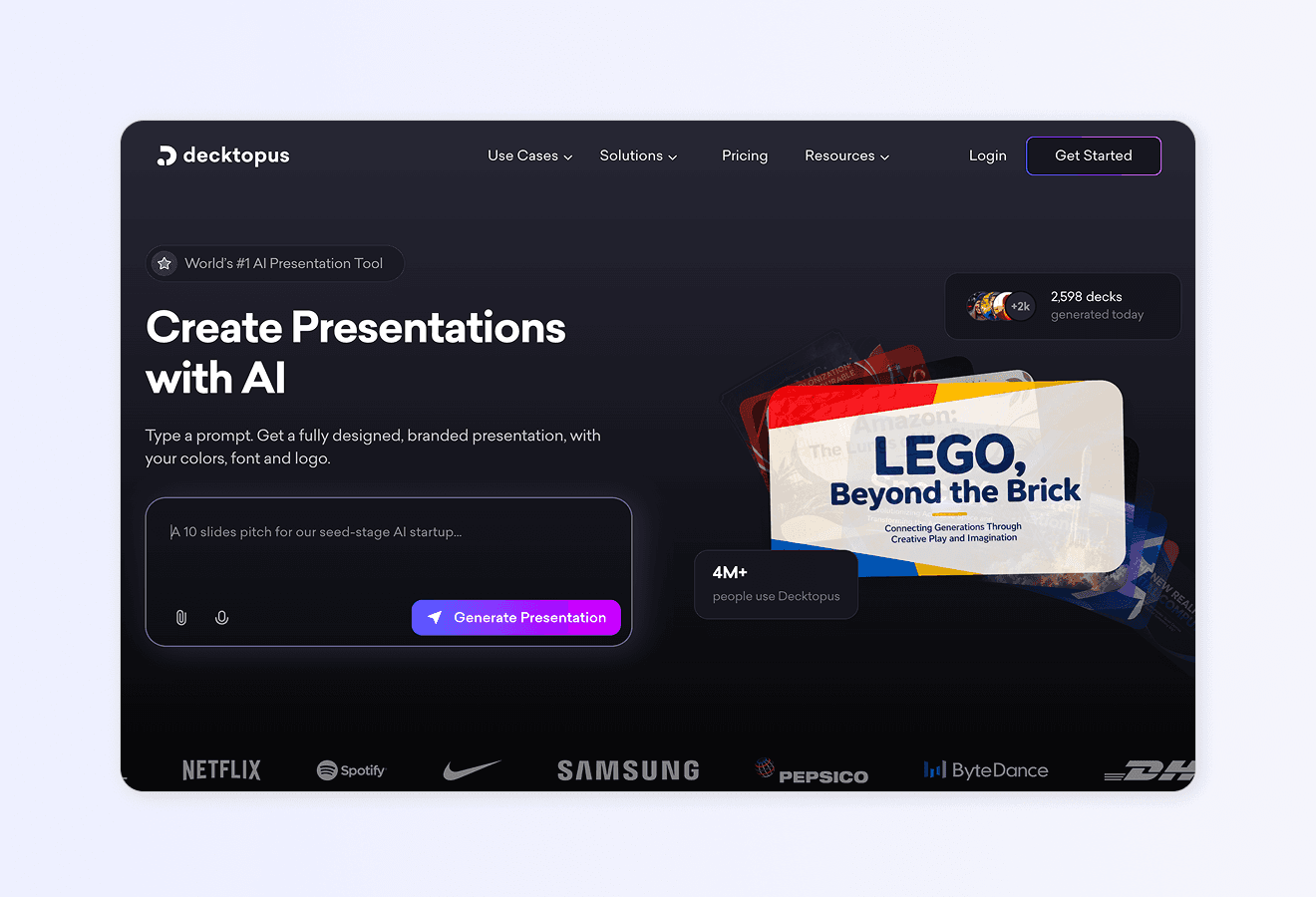
The 10/20/30 Rule tells you what to build. Decktopus AI builds it. Decktopus AI generates a full 10-slide pitch deck from a short description in minutes.
1. Describe your topic. Type something like “Series A pitch deck for a B2B SaaS company using the 10/20/30 Rule.” Or upload your business plan, one-pager, or notes as a supporting file. If you already have an older pitch deck, Decktopus AI’s Beautify feature can redesign it or use it as a source.
2. Choose your style. Pick a brand, reuse a saved look, or start fresh with AI. Decktopus AI will ask how you want your presentation to look. You can apply a saved brand, import your brand directly from your company website URL (which pulls in your logo, colors, and fonts), or let AI generate a style from scratch.
3. Review the outline. Decktopus AI generates a 10-slide structure that follows Kawasaki’s framework: title, problem, value proposition, underlying magic, business model, go-to-market, competitive analysis, team, financials, and ask. Adjust before the full deck is built.
4. Refine with Edit with AI. Click Edit with AI and type instructions like “make slide 6 a visual roadmap” or “add a competitive matrix on slide 7.” All edits are tracked with unlimited version history. Font sizes stay legible automatically.
5. Export or share. Download as PDF, PPT, or PNG. Share via live link. Any updates you make after sharing automatically appear at the same URL, so investors always see the latest version. Or present directly.
You can also use the Loop AI Delivery Coach during rehearsal to get real-time feedback on pacing, filler words, and clarity. It’s especially useful for hitting the 20-minute mark on the first try.
For broader guidance, see the best AI presentation tools, our ultimate presentation tools roundup, and our guide on how to do a presentation.
Ready to build a rule-compliant 10/20/30 pitch deck? Get started with Decktopus AI.
Frequently Asked Questions
What is the 10/20/30 Rule of PowerPoint?
The 10/20/30 Rule states that a PowerPoint pitch deck should have no more than 10 slides, run no longer than 20 minutes, and use no font smaller than 30 points. It was created by Guy Kawasaki to help venture pitches land clearly and concisely.
Who created the 10/20/30 Rule?
Guy Kawasaki, a Silicon Valley venture capitalist and current Chief Evangelist at Canva, coined the rule in 2006 after reviewing thousands of pitch decks. Most of what he saw was too long, too dense, and too small to read.
Why is the 10/20/30 Rule effective?
It aligns three things at once: the number of ideas humans can hold in a single meeting (about 10), the typical attention span for a presentation (around 20 to 25 minutes), and the minimum font size a full audience can read (about 30 points). Hitting all three at the same time is why the rule works.
Should every presentation follow the 10/20/30 Rule?
No. The rule was designed for pitch decks. For workshops, training sessions, or detailed technical presentations, you may need more slides and longer runtime. But even then, the principles (concise, legible, time-disciplined) hold up.
What if I have more than 10 things to cover?
You probably have two presentations, not one. Cut the deck to the essentials and hold the rest for follow-up conversations or appendix slides. Investors and buyers make decisions on structure and clarity, not exhaustiveness.
Can I use the 10/20/30 Rule for TED-style talks?
Yes. Most TED Talks already follow a lighter version of the rule: fewer slides, tighter time, larger text. The core discipline of concision matches TED format almost exactly.
What font size should I use on a Zoom or video call presentation?
30-point font is still a safe minimum for slides shown over video. Even though most viewers watch on a laptop, viewers on phones or on second screens still need readable text. Keep it big.
What is the best tool to build a 10/20/30 pitch deck?
Decktopus AI generates a full 10-slide pitch deck from a short description in minutes with automatic brand import and Loop AI Delivery Coach for rehearsal. For more, see the best pitch deck generators for founders.
Conclusion
Great presentations aren’t accidents. They’re the product of clear structure, disciplined runtime, legible design, and rigorous rehearsal. The 10/20/30 Rule bundles all four into one memorable framework that has held up for nearly two decades because it’s grounded in how humans actually process information.
Ten slides forces prioritization. Twenty minutes matches attention span. Thirty-point font eliminates text-stuffed slides. Together, they turn a scattered pitch into a persuasive one.
Whether you’re pitching investors, closing a sale, presenting to your board, or delivering a keynote, the principles behind the 10/20/30 Rule apply. Adapt where the situation demands, but respect the discipline that makes the rule work: less is more, structure matters, and rehearsal separates the presenters people remember from the ones they forget.
For your next presentation, start with the 10/20/30 framework, layer in strong storytelling, and rehearse until the delivery feels automatic. That’s the formula behind almost every pitch that lands.
For more resources, see the best pitch deck generators for founders, our ultimate presentation tools roundup, and the best AI presentation tools.

Related posts

Webinar Follow-Up Emails: The Sequence That Runs After the Deck Ends
Learn how to build a webinar follow-up email sequence with behavioral segmentation, timely emails, better deliverability, and personalized outreach.
Presentations

Best TED Talks to Improve Your Presentation Skills
Watch ten of the best TED talks for presentation skills and use a practical exercise from each to improve structure, voice, visuals, and confidence.
Presentations

Decktopus AI Best Practices: The Complete Guide, Tips and Tricks (2026)
A complete guide to using Decktopus AI effectively, from writing better prompts and reviewing outlines to rehearsing with Loop and building carousels.
Presentations