Education
Are Presentations Common in College?
You just graduated from high school. There are so many things you will miss, but also so many things you will never... So let's open this fresh chapter with the most asked question: Are presentations common in college? Here's the answer...


Decktopus Content Team
Are Presentations Really That Common in College?
Yes. College presentations are one of the most common assessment formats in modern higher education, and most students will deliver somewhere between 8 and 15 presentations per academic year across their coursework. Every degree program uses them, from computer science to communications, biology to business. The main benefit for students is that college presentations build the exact soft skill (clear communication under pressure) that employers rank as the #1 hiring signal for new graduates.
Research on college coursework shows that the average full-time student now gives 8 to 15 graded presentations per academic year, with humanities, business, communications, and social science majors averaging even more. According to LinkedIn’s Global Talent Trends research, communication remains the top soft skill employers screen for in new graduates, and 92% of hiring managers say soft skills matter as much or more than hard skills. That’s why college presentations have moved from an occasional assignment into a core part of the curriculum across nearly every major.
For related student guides, see our resources on why students hate giving presentations, the best AI tool for students, and a message to students and teachers.
You just graduated from high school. You’re stepping into a new academic chapter, and one of the most common questions incoming students ask is: how much am I going to have to present in college?
The honest answer: a lot. Even if you avoid majors that lean heavily on presentation (like communications, marketing, or business), you’ll still hit at least one to two presentations per class each semester. Multiply that by 4 to 5 classes per semester and 2 semesters per year, and the numbers add up quickly.
Some majors present more than others. Business and communications students often deliver 20+ presentations per year. STEM majors might present 5 to 10, mostly around research findings and lab work. But every major has them. There is no undergraduate degree in modern higher education that lets you skip presentations entirely.

How College Presentations Differ From High School
If you’re expecting college presentations to feel like high school presentations, you’re in for a shift. Here’s what changes.
[[EMBED:PGRpdiBzdHlsZT0ib3ZlcmZsb3cteDphdXRvO21hcmdpbjoyMHB4IDAiPjx0YWJsZSBzdHlsZT0id2lkdGg6MTAwJTtib3JkZXItY29sbGFwc2U6Y29sbGFwc2U7Zm9udC1zaXplOjE1cHg7bWFyZ2luOjhweCAwIj48dGggc3R5bGU9ImJvcmRlcjoxcHggc29saWQgI2UzZTZlYTtwYWRkaW5nOjEwcHggMTRweDt0ZXh0LWFsaWduOmxlZnQ7YmFja2dyb3VuZDojZjRmNmY4O2ZvbnQtd2VpZ2h0OjYwMCI+PHRyPjx0aCBzdHlsZT0iYm9yZGVyOjFweCBzb2xpZCAjZTNlNmVhO3BhZGRpbmc6MTBweCAxNHB4O3RleHQtYWxpZ246bGVmdDtiYWNrZ3JvdW5kOiNmNGY2Zjg7Zm9udC13ZWlnaHQ6NjAwIj5GYWN0b3I8L3RoPjx0aCBzdHlsZT0iYm9yZGVyOjFweCBzb2xpZCAjZTNlNmVhO3BhZGRpbmc6MTBweCAxNHB4O3RleHQtYWxpZ246bGVmdDtiYWNrZ3JvdW5kOiNmNGY2Zjg7Zm9udC13ZWlnaHQ6NjAwIj5IaWdoIFNjaG9vbCBQcmVzZW50YXRpb248L3RoPjx0aCBzdHlsZT0iYm9yZGVyOjFweCBzb2xpZCAjZTNlNmVhO3BhZGRpbmc6MTBweCAxNHB4O3RleHQtYWxpZ246bGVmdDtiYWNrZ3JvdW5kOiNmNGY2Zjg7Zm9udC13ZWlnaHQ6NjAwIj5Db2xsZWdlIFByZXNlbnRhdGlvbjwvdGg+PC90cj48L3RoZWFkPjx0Ym9keT48dHI+PHRkIHN0eWxlPSJib3JkZXI6MXB4IHNvbGlkICNlM2U2ZWE7cGFkZGluZzoxMHB4IDE0cHg7dGV4dC1hbGlnbjpsZWZ0O3ZlcnRpY2FsLWFsaWduOnRvcCI+QXVkaWVuY2Ugc2l6ZTwvdGQ+PHRkIHN0eWxlPSJib3JkZXI6MXB4IHNvbGlkICNlM2U2ZWE7cGFkZGluZzoxMHB4IDE0cHg7dGV4dC1hbGlnbjpsZWZ0O3ZlcnRpY2FsLWFsaWduOnRvcCI+U21hbGwgY2xhc3MgKDIw4oCTMzAgc3R1ZGVudHMpPC90ZD48dGQgc3R5bGU9ImJvcmRlcjoxcHggc29saWQgI2UzZTZlYTtwYWRkaW5nOjEwcHggMTRweDt0ZXh0LWFsaWduOmxlZnQ7dmVydGljYWwtYWxpZ246dG9wIj5MYXJnZXIgbGVjdHVyZXMsIHNvbWV0aW1lcyAxMDArIHN0dWRlbnRzPC90ZD48L3RyPjx0cj48dGQgc3R5bGU9ImJvcmRlcjoxcHggc29saWQgI2UzZTZlYTtwYWRkaW5nOjEwcHggMTRweDt0ZXh0LWFsaWduOmxlZnQ7dmVydGljYWwtYWxpZ246dG9wIj5Db250ZW50IGRlcHRoPC90ZD48dGQgc3R5bGU9ImJvcmRlcjoxcHggc29saWQgI2UzZTZlYTtwYWRkaW5nOjEwcHggMTRweDt0ZXh0LWFsaWduOmxlZnQ7dmVydGljYWwtYWxpZ246dG9wIj5Ccm9hZCBvdmVydmlldyBvZiB0aGUgdG9waWM8L3RkPjx0ZCBzdHlsZT0iYm9yZGVyOjFweCBzb2xpZCAjZTNlNmVhO3BhZGRpbmc6MTBweCAxNHB4O3RleHQtYWxpZ246bGVmdDt2ZXJ0aWNhbC1hbGlnbjp0b3AiPkluLWRlcHRoLCByZXNlYXJjaC1iYWNrZWQgYW5hbHlzaXM8L3RkPjwvdHI+PHRyPjx0ZCBzdHlsZT0iYm9yZGVyOjFweCBzb2xpZCAjZTNlNmVhO3BhZGRpbmc6MTBweCAxNHB4O3RleHQtYWxpZ246bGVmdDt2ZXJ0aWNhbC1hbGlnbjp0b3AiPlRpbWUgZXhwZWN0YXRpb25zPC90ZD48dGQgc3R5bGU9ImJvcmRlcjoxcHggc29saWQgI2UzZTZlYTtwYWRkaW5nOjEwcHggMTRweDt0ZXh0LWFsaWduOmxlZnQ7dmVydGljYWwtYWxpZ246dG9wIj5UeXBpY2FsbHkgNeKAkzEwIG1pbnV0ZXM8L3RkPjx0ZCBzdHlsZT0iYm9yZGVyOjFweCBzb2xpZCAjZTNlNmVhO3BhZGRpbmc6MTBweCAxNHB4O3RleHQtYWxpZ246bGVmdDt2ZXJ0aWNhbC1hbGlnbjp0b3AiPlVzdWFsbHkgMTDigJMyMCBtaW51dGVzIG9yIGFuIGVudGlyZSBjbGFzcyBwZXJpb2Q8L3RkPjwvdHI+PHRyPjx0ZCBzdHlsZT0iYm9yZGVyOjFweCBzb2xpZCAjZTNlNmVhO3BhZGRpbmc6MTBweCAxNHB4O3RleHQtYWxpZ246bGVmdDt2ZXJ0aWNhbC1hbGlnbjp0b3AiPkdyYWRpbmcgcmlnb3I8L3RkPjx0ZCBzdHlsZT0iYm9yZGVyOjFweCBzb2xpZCAjZTNlNmVhO3BhZGRpbmc6MTBweCAxNHB4O3RleHQtYWxpZ246bGVmdDt2ZXJ0aWNhbC1hbGlnbjp0b3AiPkZvY3VzIG9uIGVmZm9ydCBhbmQgcHJlc2VudGF0aW9uIGRlbGl2ZXJ5PC90ZD48dGQgc3R5bGU9ImJvcmRlcjoxcHggc29saWQgI2UzZTZlYTtwYWRkaW5nOjEwcHggMTRweDt0ZXh0LWFsaWduOmxlZnQ7dmVydGljYWwtYWxpZ246dG9wIj5FdmFsdWF0ZXMgY29udGVudCBtYXN0ZXJ5LCByZXNlYXJjaCBxdWFsaXR5LCBhbmQgZGVsaXZlcnk8L3RkPjwvdHI+PHRyPjx0ZCBzdHlsZT0iYm9yZGVyOjFweCBzb2xpZCAjZTNlNmVhO3BhZGRpbmc6MTBweCAxNHB4O3RleHQtYWxpZ246bGVmdDt2ZXJ0aWNhbC1hbGlnbjp0b3AiPkRlc2lnbiBleHBlY3RhdGlvbnM8L3RkPjx0ZCBzdHlsZT0iYm9yZGVyOjFweCBzb2xpZCAjZTNlNmVhO3BhZGRpbmc6MTBweCAxNHB4O3RleHQtYWxpZ246bGVmdDt2ZXJ0aWNhbC1hbGlnbjp0b3AiPkJhc2ljIHByZXNlbnRhdGlvbiBzbGlkZXMgYXJlIHVzdWFsbHkgYWNjZXB0YWJsZTwvdGQ+PHRkIHN0eWxlPSJib3JkZXI6MXB4IHNvbGlkICNlM2U2ZWE7cGFkZGluZzoxMHB4IDE0cHg7dGV4dC1hbGlnbjpsZWZ0O3ZlcnRpY2FsLWFsaWduOnRvcCI+Q2xlYW5lciwgbW9yZSBwcm9mZXNzaW9uYWwgcHJlc2VudGF0aW9ucyBhcmUgZXhwZWN0ZWQ8L3RkPjwvdHI+PHRyPjx0ZCBzdHlsZT0iYm9yZGVyOjFweCBzb2xpZCAjZTNlNmVhO3BhZGRpbmc6MTBweCAxNHB4O3RleHQtYWxpZ246bGVmdDt2ZXJ0aWNhbC1hbGlnbjp0b3AiPkdyb3VwIHdvcms8L3RkPjx0ZCBzdHlsZT0iYm9yZGVyOjFweCBzb2xpZCAjZTNlNmVhO3BhZGRpbmc6MTBweCAxNHB4O3RleHQtYWxpZ246bGVmdDt2ZXJ0aWNhbC1hbGlnbjp0b3AiPkNvbW1vbiBidXQgZ2VuZXJhbGx5IGxvdyBzdGFrZXM8L3RkPjx0ZCBzdHlsZT0iYm9yZGVyOjFweCBzb2xpZCAjZTNlNmVhO3BhZGRpbmc6MTBweCAxNHB4O3RleHQtYWxpZ246bGVmdDt2ZXJ0aWNhbC1hbGlnbjp0b3AiPkNvbW1vbiBhbmQgb2Z0ZW4gY2FycmllcyBzaWduaWZpY2FudCBncmFkaW5nIHdlaWdodDwvdGQ+PC90cj48dHI+PHRkIHN0eWxlPSJib3JkZXI6MXB4IHNvbGlkICNlM2U2ZWE7cGFkZGluZzoxMHB4IDE0cHg7dGV4dC1hbGlnbjpsZWZ0O3ZlcnRpY2FsLWFsaWduOnRvcCI+USZhbXA7QTwvdGQ+PHRkIHN0eWxlPSJib3JkZXI6MXB4IHNvbGlkICNlM2U2ZWE7cGFkZGluZzoxMHB4IDE0cHg7dGV4dC1hbGlnbjpsZWZ0O3ZlcnRpY2FsLWFsaWduOnRvcCI+UmFyZWx5IGluY2x1ZGVzIGEgZm9ybWFsIHF1ZXN0aW9uLWFuZC1hbnN3ZXIgc2Vzc2lvbjwvdGQ+PHRkIHN0eWxlPSJib3JkZXI6MXB4IHNvbGlkICNlM2U2ZWE7cGFkZGluZzoxMHB4IDE0cHg7dGV4dC1hbGlnbjpsZWZ0O3ZlcnRpY2FsLWFsaWduOnRvcCI+UXVlc3Rpb24tYW5kLWFuc3dlciBzZXNzaW9ucyBhcmUgY29tbW9ubHkgZXhwZWN0ZWQ8L3RkPjwvdHI+PHRyPjx0ZCBzdHlsZT0iYm9yZGVyOjFweCBzb2xpZCAjZTNlNmVhO3BhZGRpbmc6MTBweCAxNHB4O3RleHQtYWxpZ246bGVmdDt2ZXJ0aWNhbC1hbGlnbjp0b3AiPlNvdXJjZXMgYW5kIGNpdGF0aW9uczwvdGQ+PHRkIHN0eWxlPSJib3JkZXI6MXB4IHNvbGlkICNlM2U2ZWE7cGFkZGluZzoxMHB4IDE0cHg7dGV4dC1hbGlnbjpsZWZ0O3ZlcnRpY2FsLWFsaWduOnRvcCI+U29tZXRpbWVzIHJlcXVpcmVkPC90ZD48dGQgc3R5bGU9ImJvcmRlcjoxcHggc29saWQgI2UzZTZlYTtwYWRkaW5nOjEwcHggMTRweDt0ZXh0LWFsaWduOmxlZnQ7dmVydGljYWwtYWxpZ246dG9wIj5BbG1vc3QgYWx3YXlzIHJlcXVpcmVkPC90ZD48L3RyPjx0cj48dGQgc3R5bGU9ImJvcmRlcjoxcHggc29saWQgI2UzZTZlYTtwYWRkaW5nOjEwcHggMTRweDt0ZXh0LWFsaWduOmxlZnQ7dmVydGljYWwtYWxpZ246dG9wIj5QcmVzZW50YXRpb24gZm9ybWF0PC90ZD48dGQgc3R5bGU9ImJvcmRlcjoxcHggc29saWQgI2UzZTZlYTtwYWRkaW5nOjEwcHggMTRweDt0ZXh0LWFsaWduOmxlZnQ7dmVydGljYWwtYWxpZ246dG9wIj5QcmltYXJpbHkgaW4tcGVyc29uPC90ZD48dGQgc3R5bGU9ImJvcmRlcjoxcHggc29saWQgI2UzZTZlYTtwYWRkaW5nOjEwcHggMTRweDt0ZXh0LWFsaWduOmxlZnQ7dmVydGljYWwtYWxpZ246dG9wIj5Jbi1wZXJzb24sIGh5YnJpZCwgb3Igb25saW5lIHByZXNlbnRhdGlvbnM8L3RkPjwvdHI+PC90Ym9keT48L3RhYmxlPjwvZGl2Pg==]]

The biggest shift: college presentations are content-driven. You’re being evaluated on the substance of what you present, not just how confidently you deliver it. That means research, structure, and clarity matter more than energy or entertainment.
For a full breakdown of what makes any presentation land, see our guides on what makes for a good presentation and how to make presentations easier to understand.
The 8-Point Framework for Great College Presentations
Use this 8-point framework to build any college presentation from scratch.
[[EMBED:PGRpdiBzdHlsZT0ib3ZlcmZsb3cteDphdXRvO21hcmdpbjoyMHB4IDAiPjx0YWJsZSBzdHlsZT0id2lkdGg6MTAwJTtib3JkZXItY29sbGFwc2U6Y29sbGFwc2U7Zm9udC1zaXplOjE1cHg7bWFyZ2luOjhweCAwIj48dGggc3R5bGU9ImJvcmRlcjoxcHggc29saWQgI2UzZTZlYTtwYWRkaW5nOjEwcHggMTRweDt0ZXh0LWFsaWduOmxlZnQ7YmFja2dyb3VuZDojZjRmNmY4O2ZvbnQtd2VpZ2h0OjYwMCI+PHRyPjx0aCBzdHlsZT0iYm9yZGVyOjFweCBzb2xpZCAjZTNlNmVhO3BhZGRpbmc6MTBweCAxNHB4O3RleHQtYWxpZ246bGVmdDtiYWNrZ3JvdW5kOiNmNGY2Zjg7Zm9udC13ZWlnaHQ6NjAwIj5Qb2ludDwvdGg+PHRoIHN0eWxlPSJib3JkZXI6MXB4IHNvbGlkICNlM2U2ZWE7cGFkZGluZzoxMHB4IDE0cHg7dGV4dC1hbGlnbjpsZWZ0O2JhY2tncm91bmQ6I2Y0ZjZmODtmb250LXdlaWdodDo2MDAiPldoYXQgdG8gRG88L3RoPjwvdHI+PC90aGVhZD48dGJvZHk+PHRyPjx0ZCBzdHlsZT0iYm9yZGVyOjFweCBzb2xpZCAjZTNlNmVhO3BhZGRpbmc6MTBweCAxNHB4O3RleHQtYWxpZ246bGVmdDt2ZXJ0aWNhbC1hbGlnbjp0b3AiPjE8L3RkPjx0ZCBzdHlsZT0iYm9yZGVyOjFweCBzb2xpZCAjZTNlNmVhO3BhZGRpbmc6MTBweCAxNHB4O3RleHQtYWxpZ246bGVmdDt2ZXJ0aWNhbC1hbGlnbjp0b3AiPlB1dCBjb250ZW50IGFuZCBzdG9yeXRlbGxpbmcgZmlyc3Q8L3RkPjwvdHI+PHRyPjx0ZCBzdHlsZT0iYm9yZGVyOjFweCBzb2xpZCAjZTNlNmVhO3BhZGRpbmc6MTBweCAxNHB4O3RleHQtYWxpZ246bGVmdDt2ZXJ0aWNhbC1hbGlnbjp0b3AiPjI8L3RkPjx0ZCBzdHlsZT0iYm9yZGVyOjFweCBzb2xpZCAjZTNlNmVhO3BhZGRpbmc6MTBweCAxNHB4O3RleHQtYWxpZ246bGVmdDt2ZXJ0aWNhbC1hbGlnbjp0b3AiPlVzZSBzdHJvbmcgdmlzdWFscyB0byBzdXBwb3J0IHlvdXIgbWVzc2FnZTwvdGQ+PC90cj48dHI+PHRkIHN0eWxlPSJib3JkZXI6MXB4IHNvbGlkICNlM2U2ZWE7cGFkZGluZzoxMHB4IDE0cHg7dGV4dC1hbGlnbjpsZWZ0O3ZlcnRpY2FsLWFsaWduOnRvcCI+MzwvdGQ+PHRkIHN0eWxlPSJib3JkZXI6MXB4IHNvbGlkICNlM2U2ZWE7cGFkZGluZzoxMHB4IDE0cHg7dGV4dC1hbGlnbjpsZWZ0O3ZlcnRpY2FsLWFsaWduOnRvcCI+Q29sbGFib3JhdGUgZWZmZWN0aXZlbHkgd2l0aCB5b3VyIHRlYW1tYXRlczwvdGQ+PC90cj48dHI+PHRkIHN0eWxlPSJib3JkZXI6MXB4IHNvbGlkICNlM2U2ZWE7cGFkZGluZzoxMHB4IDE0cHg7dGV4dC1hbGlnbjpsZWZ0O3ZlcnRpY2FsLWFsaWduOnRvcCI+NDwvdGQ+PHRkIHN0eWxlPSJib3JkZXI6MXB4IHNvbGlkICNlM2U2ZWE7cGFkZGluZzoxMHB4IDE0cHg7dGV4dC1hbGlnbjpsZWZ0O3ZlcnRpY2FsLWFsaWduOnRvcCI+UHJhY3RpY2UgdW50aWwgeW91ciBkZWxpdmVyeSBmZWVscyBuYXR1cmFsIGFuZCBjb25maWRlbnQ8L3RkPjwvdHI+PHRyPjx0ZCBzdHlsZT0iYm9yZGVyOjFweCBzb2xpZCAjZTNlNmVhO3BhZGRpbmc6MTBweCAxNHB4O3RleHQtYWxpZ246bGVmdDt2ZXJ0aWNhbC1hbGlnbjp0b3AiPjU8L3RkPjx0ZCBzdHlsZT0iYm9yZGVyOjFweCBzb2xpZCAjZTNlNmVhO3BhZGRpbmc6MTBweCAxNHB4O3RleHQtYWxpZ246bGVmdDt2ZXJ0aWNhbC1hbGlnbjp0b3AiPktlZXAgeW91ciBhdWRpZW5jZSBlbmdhZ2VkIHRocm91Z2hvdXQgdGhlIHByZXNlbnRhdGlvbjwvdGQ+PC90cj48dHI+PHRkIHN0eWxlPSJib3JkZXI6MXB4IHNvbGlkICNlM2U2ZWE7cGFkZGluZzoxMHB4IDE0cHg7dGV4dC1hbGlnbjpsZWZ0O3ZlcnRpY2FsLWFsaWduOnRvcCI+NjwvdGQ+PHRkIHN0eWxlPSJib3JkZXI6MXB4IHNvbGlkICNlM2U2ZWE7cGFkZGluZzoxMHB4IDE0cHg7dGV4dC1hbGlnbjpsZWZ0O3ZlcnRpY2FsLWFsaWduOnRvcCI+Q29udGludWUgZGV2ZWxvcGluZyB5b3VyIHB1YmxpYyBzcGVha2luZyBza2lsbHM8L3RkPjwvdHI+PHRyPjx0ZCBzdHlsZT0iYm9yZGVyOjFweCBzb2xpZCAjZTNlNmVhO3BhZGRpbmc6MTBweCAxNHB4O3RleHQtYWxpZ246bGVmdDt2ZXJ0aWNhbC1hbGlnbjp0b3AiPjc8L3RkPjx0ZCBzdHlsZT0iYm9yZGVyOjFweCBzb2xpZCAjZTNlNmVhO3BhZGRpbmc6MTBweCAxNHB4O3RleHQtYWxpZ246bGVmdDt2ZXJ0aWNhbC1hbGlnbjp0b3AiPk1haW50YWluIGFjYWRlbWljIGludGVncml0eSBieSBjaXRpbmcgeW91ciBzb3VyY2VzPC90ZD48L3RyPjx0cj48dGQgc3R5bGU9ImJvcmRlcjoxcHggc29saWQgI2UzZTZlYTtwYWRkaW5nOjEwcHggMTRweDt0ZXh0LWFsaWduOmxlZnQ7dmVydGljYWwtYWxpZ246dG9wIj44PC90ZD48dGQgc3R5bGU9ImJvcmRlcjoxcHggc29saWQgI2UzZTZlYTtwYWRkaW5nOjEwcHggMTRweDt0ZXh0LWFsaWduOmxlZnQ7dmVydGljYWwtYWxpZ246dG9wIj5DaG9vc2UgYSBwcmVzZW50YXRpb24gZGVzaWduIHRoYXQgbWF0Y2hlcyB5b3VyIHRvcGljPC90ZD48L3RyPjwvdGJvZHk+PC90YWJsZT48L2Rpdj4=]]
1. Put Content and Story First
College presentations are content-driven. The professor and your peers are evaluating the substance of your research or analysis before they judge the delivery. Build the content first, then design the slides around it.
Every strong college presentation follows a clear structure: introduction with a hook, thesis or main argument, supporting evidence in a logical sequence, conclusion, and Q&A. That structure serves nearly every subject, from psychology research to computer science projects.
See our guide on how to start a presentation with 10 hooks that instantly grab attention for opening techniques and how to end a presentation with impact for strong closes.
2. Use Strong Visuals Throughout
Text-heavy slides read like a wall to a large audience. Strong visuals (charts, diagrams, images, graphs, and short videos) do the work of keeping attention where words alone can’t.
Rules of thumb:
One dominant idea per slide
Bullet points, not paragraphs
Charts and diagrams over text when possible
Consistent font family and color palette throughout
Sans-serif fonts, minimum 24-point size
For more on visual design, see our presentation design guide.
3. Collaborate Effectively With Teammates
Group presentations are a fact of college life. Coordinating with teammates whose schedules never align is often the hardest part. Ways to make it work:
Divide slides by section and owner
Meet once to align on the thesis, then divide and build
Use shared docs and cloud-based tools so nobody blocks the group
Set internal deadlines earlier than the actual submission date
Rehearse the full presentation together at least once before delivery
Assign a “director” who owns the final integration and quality check
4. Rehearse Until Delivery Feels Natural
Rehearsal is the single biggest lever between a good presentation and a great one. Practice out loud at least three full times. Record yourself once on video. Watch it back and note filler words, pacing, and awkward transitions.
Common mistake: mumbling through rehearsal in your head instead of speaking it out loud. Silent rehearsal doesn’t build fluency. Speaking rehearsal does.
5. Engage Your Audience Actively
Keep the class involved. Options:
Open with a question
Ask for a show of hands on a poll question
Use a live audience response tool if the class allows
Pause deliberately after key points
Take questions during the presentation, not just at the end
Refer to a shared experience the class has (“Everyone here has probably…”)
For more, see our guide on interactive presentation techniques.
6. Enhance Your Public Speaking Skills
Every presentation you give makes the next one easier. Beyond course requirements, work actively on public speaking:
Join a debate club, Toastmasters, or student government
Watch and analyze strong public speakers (see our roundup of the top 5 great public speakers and what we can learn from them)
Record yourself and rewatch honestly
Practice extemporaneous speaking (talking off-the-cuff on a random topic for 2 minutes)
For a fuller framework, see our public speaking tips to deliver the perfect presentation guide.
7. Maintain Academic Integrity
Rules that were flexible in high school become non-negotiable in college:
Meet deadlines (professors don’t extend as easily as high school teachers)
Cite every source
Never plagiarize (universities take this seriously and consequences are severe)
Dress appropriately for formal presentations (business casual is a safe default)
Match humor to the audience (avoid anything that could offend)
Communicate proactively with the professor if problems come up
8. Match the Right Design to Your Topic
Design supports your content. Match aesthetics to the subject: professional and clean for business or law presentations, more visual and expressive for arts or creative disciplines, data-driven and chart-heavy for STEM.
Don’t spend three hours picking fonts. Pick a consistent color palette (two or three colors), a professional sans-serif font, and clean layouts. Then invest your time in the content and rehearsal.
Common Types of College Presentations
Every major has recurring presentation formats. Knowing which type you’re being asked to give helps you match structure to expectation.
[[EMBED:PGRpdiBzdHlsZT0ib3ZlcmZsb3cteDphdXRvO21hcmdpbjoyMHB4IDAiPjx0YWJsZSBzdHlsZT0id2lkdGg6MTAwJTtib3JkZXItY29sbGFwc2U6Y29sbGFwc2U7Zm9udC1zaXplOjE1cHg7bWFyZ2luOjhweCAwIj48dGggc3R5bGU9ImJvcmRlcjoxcHggc29saWQgI2UzZTZlYTtwYWRkaW5nOjEwcHggMTRweDt0ZXh0LWFsaWduOmxlZnQ7YmFja2dyb3VuZDojZjRmNmY4O2ZvbnQtd2VpZ2h0OjYwMCI+PHRyPjx0aCBzdHlsZT0iYm9yZGVyOjFweCBzb2xpZCAjZTNlNmVhO3BhZGRpbmc6MTBweCAxNHB4O3RleHQtYWxpZ246bGVmdDtiYWNrZ3JvdW5kOiNmNGY2Zjg7Zm9udC13ZWlnaHQ6NjAwIj5UeXBlPC90aD48dGggc3R5bGU9ImJvcmRlcjoxcHggc29saWQgI2UzZTZlYTtwYWRkaW5nOjEwcHggMTRweDt0ZXh0LWFsaWduOmxlZnQ7YmFja2dyb3VuZDojZjRmNmY4O2ZvbnQtd2VpZ2h0OjYwMCI+V2hhdCBJdCBDb3ZlcnM8L3RoPjx0aCBzdHlsZT0iYm9yZGVyOjFweCBzb2xpZCAjZTNlNmVhO3BhZGRpbmc6MTBweCAxNHB4O3RleHQtYWxpZ246bGVmdDtiYWNrZ3JvdW5kOiNmNGY2Zjg7Zm9udC13ZWlnaHQ6NjAwIj5UeXBpY2FsIExlbmd0aDwvdGg+PC90cj48L3RoZWFkPjx0Ym9keT48dHI+PHRkIHN0eWxlPSJib3JkZXI6MXB4IHNvbGlkICNlM2U2ZWE7cGFkZGluZzoxMHB4IDE0cHg7dGV4dC1hbGlnbjpsZWZ0O3ZlcnRpY2FsLWFsaWduOnRvcCI+UmVzZWFyY2ggcHJlc2VudGF0aW9uPC90ZD48dGQgc3R5bGU9ImJvcmRlcjoxcHggc29saWQgI2UzZTZlYTtwYWRkaW5nOjEwcHggMTRweDt0ZXh0LWFsaWduOmxlZnQ7dmVydGljYWwtYWxpZ246dG9wIj5GaW5kaW5ncyBmcm9tIGluZGVwZW5kZW50IHJlc2VhcmNoIG9yIGEgbGl0ZXJhdHVyZSByZXZpZXc8L3RkPjx0ZCBzdHlsZT0iYm9yZGVyOjFweCBzb2xpZCAjZTNlNmVhO3BhZGRpbmc6MTBweCAxNHB4O3RleHQtYWxpZ246bGVmdDt2ZXJ0aWNhbC1hbGlnbjp0b3AiPjEw4oCTMjAgbWludXRlczwvdGQ+PC90cj48dHI+PHRkIHN0eWxlPSJib3JkZXI6MXB4IHNvbGlkICNlM2U2ZWE7cGFkZGluZzoxMHB4IDE0cHg7dGV4dC1hbGlnbjpsZWZ0O3ZlcnRpY2FsLWFsaWduOnRvcCI+Q2FzZSBzdHVkeSBhbmFseXNpczwvdGQ+PHRkIHN0eWxlPSJib3JkZXI6MXB4IHNvbGlkICNlM2U2ZWE7cGFkZGluZzoxMHB4IDE0cHg7dGV4dC1hbGlnbjpsZWZ0O3ZlcnRpY2FsLWFsaWduOnRvcCI+QW5hbHlzaXMgb2YgYSByZWFsLXdvcmxkIGNhc2UsIGNvbW1vbmx5IHVzZWQgaW4gYnVzaW5lc3MgYW5kIGxhdzwvdGQ+PHRkIHN0eWxlPSJib3JkZXI6MXB4IHNvbGlkICNlM2U2ZWE7cGFkZGluZzoxMHB4IDE0cHg7dGV4dC1hbGlnbjpsZWZ0O3ZlcnRpY2FsLWFsaWduOnRvcCI+MTDigJMxNSBtaW51dGVzPC90ZD48L3RyPjx0cj48dGQgc3R5bGU9ImJvcmRlcjoxcHggc29saWQgI2UzZTZlYTtwYWRkaW5nOjEwcHggMTRweDt0ZXh0LWFsaWduOmxlZnQ7dmVydGljYWwtYWxpZ246dG9wIj5Qcm9qZWN0IHByZXNlbnRhdGlvbjwvdGQ+PHRkIHN0eWxlPSJib3JkZXI6MXB4IHNvbGlkICNlM2U2ZWE7cGFkZGluZzoxMHB4IDE0cHg7dGV4dC1hbGlnbjpsZWZ0O3ZlcnRpY2FsLWFsaWduOnRvcCI+V2Fsa3Rocm91Z2ggb2YgYSBkZXNpZ24sIGVuZ2luZWVyaW5nLCBvciBzb2Z0d2FyZSBwcm9qZWN0PC90ZD48dGQgc3R5bGU9ImJvcmRlcjoxcHggc29saWQgI2UzZTZlYTtwYWRkaW5nOjEwcHggMTRweDt0ZXh0LWFsaWduOmxlZnQ7dmVydGljYWwtYWxpZ246dG9wIj4xNeKAkzI1IG1pbnV0ZXM8L3RkPjwvdHI+PHRyPjx0ZCBzdHlsZT0iYm9yZGVyOjFweCBzb2xpZCAjZTNlNmVhO3BhZGRpbmc6MTBweCAxNHB4O3RleHQtYWxpZ246bGVmdDt2ZXJ0aWNhbC1hbGlnbjp0b3AiPkRlYmF0ZSBvciBhcmd1bWVudDwvdGQ+PHRkIHN0eWxlPSJib3JkZXI6MXB4IHNvbGlkICNlM2U2ZWE7cGFkZGluZzoxMHB4IDE0cHg7dGV4dC1hbGlnbjpsZWZ0O3ZlcnRpY2FsLWFsaWduOnRvcCI+RGVmZW5kaW5nIGEgcG9zaXRpb24gdXNpbmcgZXZpZGVuY2UgYW5kIGNvdW50ZXJhcmd1bWVudHM8L3RkPjx0ZCBzdHlsZT0iYm9yZGVyOjFweCBzb2xpZCAjZTNlNmVhO3BhZGRpbmc6MTBweCAxNHB4O3RleHQtYWxpZ246bGVmdDt2ZXJ0aWNhbC1hbGlnbjp0b3AiPjXigJMxNSBtaW51dGVzPC90ZD48L3RyPjx0cj48dGQgc3R5bGU9ImJvcmRlcjoxcHggc29saWQgI2UzZTZlYTtwYWRkaW5nOjEwcHggMTRweDt0ZXh0LWFsaWduOmxlZnQ7dmVydGljYWwtYWxpZ246dG9wIj5Cb29rIG9yIGFydGljbGUgcmV2aWV3PC90ZD48dGQgc3R5bGU9ImJvcmRlcjoxcHggc29saWQgI2UzZTZlYTtwYWRkaW5nOjEwcHggMTRweDt0ZXh0LWFsaWduOmxlZnQ7dmVydGljYWwtYWxpZ246dG9wIj5Dcml0aWNhbCBhbmFseXNpcyBvZiBhc3NpZ25lZCByZWFkaW5nIG1hdGVyaWFsPC90ZD48dGQgc3R5bGU9ImJvcmRlcjoxcHggc29saWQgI2UzZTZlYTtwYWRkaW5nOjEwcHggMTRweDt0ZXh0LWFsaWduOmxlZnQ7dmVydGljYWwtYWxpZ246dG9wIj414oCTMTAgbWludXRlczwvdGQ+PC90cj48dHI+PHRkIHN0eWxlPSJib3JkZXI6MXB4IHNvbGlkICNlM2U2ZWE7cGFkZGluZzoxMHB4IDE0cHg7dGV4dC1hbGlnbjpsZWZ0O3ZlcnRpY2FsLWFsaWduOnRvcCI+UG9zdGVyIHByZXNlbnRhdGlvbjwvdGQ+PHRkIHN0eWxlPSJib3JkZXI6MXB4IHNvbGlkICNlM2U2ZWE7cGFkZGluZzoxMHB4IDE0cHg7dGV4dC1hbGlnbjpsZWZ0O3ZlcnRpY2FsLWFsaWduOnRvcCI+UmVzZWFyY2ggc3VtbWFyeSBwcmVzZW50ZWQgYWxvbmdzaWRlIGFuIGludGVyYWN0aXZlIHBvc3RlciBhbmQgUSZhbXA7QTwvdGQ+PHRkIHN0eWxlPSJib3JkZXI6MXB4IHNvbGlkICNlM2U2ZWE7cGFkZGluZzoxMHB4IDE0cHg7dGV4dC1hbGlnbjpsZWZ0O3ZlcnRpY2FsLWFsaWduOnRvcCI+VHlwaWNhbGx5IDXigJMxMCBtaW51dGVzIHBlciBncm91cDwvdGQ+PC90cj48dHI+PHRkIHN0eWxlPSJib3JkZXI6MXB4IHNvbGlkICNlM2U2ZWE7cGFkZGluZzoxMHB4IDE0cHg7dGV4dC1hbGlnbjpsZWZ0O3ZlcnRpY2FsLWFsaWduOnRvcCI+R3JvdXAgcHJvamVjdDwvdGQ+PHRkIHN0eWxlPSJib3JkZXI6MXB4IHNvbGlkICNlM2U2ZWE7cGFkZGluZzoxMHB4IDE0cHg7dGV4dC1hbGlnbjpsZWZ0O3ZlcnRpY2FsLWFsaWduOnRvcCI+Q29sbGFib3JhdGl2ZSBwcmVzZW50YXRpb24gZGVsaXZlcmVkIGJ5IGEgdGVhbSBvZiAz4oCTNiBtZW1iZXJzPC90ZD48dGQgc3R5bGU9ImJvcmRlcjoxcHggc29saWQgI2UzZTZlYTtwYWRkaW5nOjEwcHggMTRweDt0ZXh0LWFsaWduOmxlZnQ7dmVydGljYWwtYWxpZ246dG9wIj4yMOKAkzQwIG1pbnV0ZXM8L3RkPjwvdHI+PHRyPjx0ZCBzdHlsZT0iYm9yZGVyOjFweCBzb2xpZCAjZTNlNmVhO3BhZGRpbmc6MTBweCAxNHB4O3RleHQtYWxpZ246bGVmdDt2ZXJ0aWNhbC1hbGlnbjp0b3AiPkNhcHN0b25lIG9yIHRoZXNpcyBkZWZlbnNlPC90ZD48dGQgc3R5bGU9ImJvcmRlcjoxcHggc29saWQgI2UzZTZlYTtwYWRkaW5nOjEwcHggMTRweDt0ZXh0LWFsaWduOmxlZnQ7dmVydGljYWwtYWxpZ246dG9wIj5QcmVzZW50YXRpb24gYW5kIGRlZmVuc2Ugb2YgYSBmaW5hbCB1bmRlcmdyYWR1YXRlIHJlc2VhcmNoIHByb2plY3Q8L3RkPjx0ZCBzdHlsZT0iYm9yZGVyOjFweCBzb2xpZCAjZTNlNmVhO3BhZGRpbmc6MTBweCAxNHB4O3RleHQtYWxpZ246bGVmdDt2ZXJ0aWNhbC1hbGlnbjp0b3AiPjIw4oCTNDUgbWludXRlczwvdGQ+PC90cj48L3Rib2R5PjwvdGFibGU+PC9kaXY+]]
For topic inspiration, see our guides on most interesting presentation topic ideas, informative speech topics, persuasive speech topics, and argumentative essay topics.
In-Person vs. Online College Presentations
Hybrid and online learning are now permanent parts of higher education. Both formats reward the same fundamentals but each adds its own challenges.
[[EMBED:PGRpdiBzdHlsZT0ib3ZlcmZsb3cteDphdXRvO21hcmdpbjoyMHB4IDAiPjx0YWJsZSBzdHlsZT0id2lkdGg6MTAwJTtib3JkZXItY29sbGFwc2U6Y29sbGFwc2U7Zm9udC1zaXplOjE1cHg7bWFyZ2luOjhweCAwIj48dGggc3R5bGU9ImJvcmRlcjoxcHggc29saWQgI2UzZTZlYTtwYWRkaW5nOjEwcHggMTRweDt0ZXh0LWFsaWduOmxlZnQ7YmFja2dyb3VuZDojZjRmNmY4O2ZvbnQtd2VpZ2h0OjYwMCI+PHRyPjx0aCBzdHlsZT0iYm9yZGVyOjFweCBzb2xpZCAjZTNlNmVhO3BhZGRpbmc6MTBweCAxNHB4O3RleHQtYWxpZ246bGVmdDtiYWNrZ3JvdW5kOiNmNGY2Zjg7Zm9udC13ZWlnaHQ6NjAwIj5GYWN0b3I8L3RoPjx0aCBzdHlsZT0iYm9yZGVyOjFweCBzb2xpZCAjZTNlNmVhO3BhZGRpbmc6MTBweCAxNHB4O3RleHQtYWxpZ246bGVmdDtiYWNrZ3JvdW5kOiNmNGY2Zjg7Zm9udC13ZWlnaHQ6NjAwIj5Jbi1QZXJzb248L3RoPjx0aCBzdHlsZT0iYm9yZGVyOjFweCBzb2xpZCAjZTNlNmVhO3BhZGRpbmc6MTBweCAxNHB4O3RleHQtYWxpZ246bGVmdDtiYWNrZ3JvdW5kOiNmNGY2Zjg7Zm9udC13ZWlnaHQ6NjAwIj5PbmxpbmU8L3RoPjwvdHI+PC90aGVhZD48dGJvZHk+PHRyPjx0ZCBzdHlsZT0iYm9yZGVyOjFweCBzb2xpZCAjZTNlNmVhO3BhZGRpbmc6MTBweCAxNHB4O3RleHQtYWxpZ246bGVmdDt2ZXJ0aWNhbC1hbGlnbjp0b3AiPlNldHVwIHRpbWU8L3RkPjx0ZCBzdHlsZT0iYm9yZGVyOjFweCBzb2xpZCAjZTNlNmVhO3BhZGRpbmc6MTBweCAxNHB4O3RleHQtYWxpZ246bGVmdDt2ZXJ0aWNhbC1hbGlnbjp0b3AiPkFycml2ZSBlYXJseSB0byB0ZXN0IHRoZSByb29tIGFuZCBwcm9qZWN0b3I8L3RkPjx0ZCBzdHlsZT0iYm9yZGVyOjFweCBzb2xpZCAjZTNlNmVhO3BhZGRpbmc6MTBweCAxNHB4O3RleHQtYWxpZ246bGVmdDt2ZXJ0aWNhbC1hbGlnbjp0b3AiPlRlc3QgeW91ciB0ZWNobm9sb2d5IGF0IGxlYXN0IDMwIG1pbnV0ZXMgYmVmb3JlIHRoZSBwcmVzZW50YXRpb248L3RkPjwvdHI+PHRyPjx0ZCBzdHlsZT0iYm9yZGVyOjFweCBzb2xpZCAjZTNlNmVhO3BhZGRpbmc6MTBweCAxNHB4O3RleHQtYWxpZ246bGVmdDt2ZXJ0aWNhbC1hbGlnbjp0b3AiPkJvZHkgbGFuZ3VhZ2U8L3RkPjx0ZCBzdHlsZT0iYm9yZGVyOjFweCBzb2xpZCAjZTNlNmVhO3BhZGRpbmc6MTBweCAxNHB4O3RleHQtYWxpZ246bGVmdDt2ZXJ0aWNhbC1hbGlnbjp0b3AiPllvdXIgZnVsbCBib2R5IGlzIHZpc2libGUsIGFsbG93aW5nIG5hdHVyYWwgZ2VzdHVyZXMgYW5kIG1vdmVtZW50PC90ZD48dGQgc3R5bGU9ImJvcmRlcjoxcHggc29saWQgI2UzZTZlYTtwYWRkaW5nOjEwcHggMTRweDt0ZXh0LWFsaWduOmxlZnQ7dmVydGljYWwtYWxpZ246dG9wIj5Vc3VhbGx5IG9ubHkgeW91ciB1cHBlciBib2R5IGlzIHZpc2libGUsIG9yIHRoZSBjYW1lcmEgbWF5IGJlIHR1cm5lZCBvZmY8L3RkPjwvdHI+PHRyPjx0ZCBzdHlsZT0iYm9yZGVyOjFweCBzb2xpZCAjZTNlNmVhO3BhZGRpbmc6MTBweCAxNHB4O3RleHQtYWxpZ246bGVmdDt2ZXJ0aWNhbC1hbGlnbjp0b3AiPkV5ZSBjb250YWN0PC90ZD48dGQgc3R5bGU9ImJvcmRlcjoxcHggc29saWQgI2UzZTZlYTtwYWRkaW5nOjEwcHggMTRweDt0ZXh0LWFsaWduOmxlZnQ7dmVydGljYWwtYWxpZ246dG9wIj5NYWludGFpbiBkaXJlY3QgZXllIGNvbnRhY3Qgd2l0aCB0aGUgYXVkaWVuY2U8L3RkPjx0ZCBzdHlsZT0iYm9yZGVyOjFweCBzb2xpZCAjZTNlNmVhO3BhZGRpbmc6MTBweCAxNHB4O3RleHQtYWxpZ246bGVmdDt2ZXJ0aWNhbC1hbGlnbjp0b3AiPkxvb2sgaW50byB0aGUgd2ViY2FtIGluc3RlYWQgb2YgeW91ciBvd24gc2NyZWVuPC90ZD48L3RyPjx0cj48dGQgc3R5bGU9ImJvcmRlcjoxcHggc29saWQgI2UzZTZlYTtwYWRkaW5nOjEwcHggMTRweDt0ZXh0LWFsaWduOmxlZnQ7dmVydGljYWwtYWxpZ246dG9wIj5BdWRpbzwvdGQ+PHRkIHN0eWxlPSJib3JkZXI6MXB4IHNvbGlkICNlM2U2ZWE7cGFkZGluZzoxMHB4IDE0cHg7dGV4dC1hbGlnbjpsZWZ0O3ZlcnRpY2FsLWFsaWduOnRvcCI+U3BlYWsgY2xlYXJseSBhbmQgcHJvamVjdCB5b3VyIHZvaWNlIHRocm91Z2hvdXQgdGhlIHJvb208L3RkPjx0ZCBzdHlsZT0iYm9yZGVyOjFweCBzb2xpZCAjZTNlNmVhO3BhZGRpbmc6MTBweCAxNHB4O3RleHQtYWxpZ246bGVmdDt2ZXJ0aWNhbC1hbGlnbjp0b3AiPlVzZSBoZWFkcGhvbmVzIGFuZCBhIHF1YWxpdHkgbWljcm9waG9uZSBmb3IgY2xlYXJlciBhdWRpbzwvdGQ+PC90cj48dHI+PHRkIHN0eWxlPSJib3JkZXI6MXB4IHNvbGlkICNlM2U2ZWE7cGFkZGluZzoxMHB4IDE0cHg7dGV4dC1hbGlnbjpsZWZ0O3ZlcnRpY2FsLWFsaWduOnRvcCI+RW52aXJvbm1lbnQ8L3RkPjx0ZCBzdHlsZT0iYm9yZGVyOjFweCBzb2xpZCAjZTNlNmVhO3BhZGRpbmc6MTBweCAxNHB4O3RleHQtYWxpZ246bGVmdDt2ZXJ0aWNhbC1hbGlnbjp0b3AiPlRoZSBwcmVzZW50YXRpb24gcm9vbSBhbmQgZXF1aXBtZW50IGFyZSB1c3VhbGx5IHByb3ZpZGVkPC90ZD48dGQgc3R5bGU9ImJvcmRlcjoxcHggc29saWQgI2UzZTZlYTtwYWRkaW5nOjEwcHggMTRweDt0ZXh0LWFsaWduOmxlZnQ7dmVydGljYWwtYWxpZ246dG9wIj5Zb3UgYXJlIHJlc3BvbnNpYmxlIGZvciB5b3VyIGJhY2tncm91bmQsIGxpZ2h0aW5nLCBhbmQgc3Vycm91bmRpbmdzPC90ZD48L3RyPjx0cj48dGQgc3R5bGU9ImJvcmRlcjoxcHggc29saWQgI2UzZTZlYTtwYWRkaW5nOjEwcHggMTRweDt0ZXh0LWFsaWduOmxlZnQ7dmVydGljYWwtYWxpZ246dG9wIj5TbGlkZSBzaGFyaW5nPC90ZD48dGQgc3R5bGU9ImJvcmRlcjoxcHggc29saWQgI2UzZTZlYTtwYWRkaW5nOjEwcHggMTRweDt0ZXh0LWFsaWduOmxlZnQ7dmVydGljYWwtYWxpZ246dG9wIj5SZXF1aXJlcyBjb25uZWN0aW5nIHlvdXIgbGFwdG9wIHRvIGEgcHJvamVjdG9yIG9yIGRpc3BsYXk8L3RkPjx0ZCBzdHlsZT0iYm9yZGVyOjFweCBzb2xpZCAjZTNlNmVhO3BhZGRpbmc6MTBweCAxNHB4O3RleHQtYWxpZ246bGVmdDt2ZXJ0aWNhbC1hbGlnbjp0b3AiPlNoYXJlIHlvdXIgc2NyZWVuIGRpcmVjdGx5IHRocm91Z2ggdGhlIG1lZXRpbmcgcGxhdGZvcm08L3RkPjwvdHI+PHRyPjx0ZCBzdHlsZT0iYm9yZGVyOjFweCBzb2xpZCAjZTNlNmVhO3BhZGRpbmc6MTBweCAxNHB4O3RleHQtYWxpZ246bGVmdDt2ZXJ0aWNhbC1hbGlnbjp0b3AiPkF1ZGllbmNlIGVuZ2FnZW1lbnQ8L3RkPjx0ZCBzdHlsZT0iYm9yZGVyOjFweCBzb2xpZCAjZTNlNmVhO3BhZGRpbmc6MTBweCAxNHB4O3RleHQtYWxpZ246bGVmdDt2ZXJ0aWNhbC1hbGlnbjp0b3AiPlJlYWQgZmFjaWFsIGV4cHJlc3Npb25zIGFuZCBib2R5IGxhbmd1YWdlIHRvIGdhdWdlIGF0dGVudGlvbjwvdGQ+PHRkIHN0eWxlPSJib3JkZXI6MXB4IHNvbGlkICNlM2U2ZWE7cGFkZGluZzoxMHB4IDE0cHg7dGV4dC1hbGlnbjpsZWZ0O3ZlcnRpY2FsLWFsaWduOnRvcCI+VXNlIHBvbGxzLCByZWFjdGlvbnMsIGFuZCBjaGF0IHRvIG1lYXN1cmUgZW5nYWdlbWVudDwvdGQ+PC90cj48dHI+PHRkIHN0eWxlPSJib3JkZXI6MXB4IHNvbGlkICNlM2U2ZWE7cGFkZGluZzoxMHB4IDE0cHg7dGV4dC1hbGlnbjpsZWZ0O3ZlcnRpY2FsLWFsaWduOnRvcCI+QmFja3VwIHBsYW48L3RkPjx0ZCBzdHlsZT0iYm9yZGVyOjFweCBzb2xpZCAjZTNlNmVhO3BhZGRpbmc6MTBweCAxNHB4O3RleHQtYWxpZ246bGVmdDt2ZXJ0aWNhbC1hbGlnbjp0b3AiPkJyaW5nIHByaW50ZWQgc2xpZGVzIG9yIGEgYmFja3VwIGNvcHkgaW4gY2FzZSBvZiB0ZWNobmljYWwgaXNzdWVzPC90ZD48dGQgc3R5bGU9ImJvcmRlcjoxcHggc29saWQgI2UzZTZlYTtwYWRkaW5nOjEwcHggMTRweDt0ZXh0LWFsaWduOmxlZnQ7dmVydGljYWwtYWxpZ246dG9wIj5IYXZlIGEgYmFja3VwIGRldmljZSBhbmQgYSByZWxpYWJsZSBpbnRlcm5ldCBjb25uZWN0aW9uIHJlYWR5PC90ZD48L3RyPjwvdGJvZHk+PC90YWJsZT48L2Rpdj4=]]
Online presentations reward preparation. Tech issues are the fastest way to kill your grade. Test everything in advance. Use the same platform, same device, and same setup as the actual presentation.
For related content on online learning, see our guides on how to organize distance learning and improve your online assessment method.
Tips for Group College Presentations
Group presentations are among the most common (and often most frustrating) formats in college. A few practical fixes:
Assign clear ownership per slide. Every slide has one owner. If nobody owns a slide, nobody does the work.
Set internal deadlines. Set your group’s finish date 3 to 5 days before the actual deadline. This gives buffer for the inevitable last-minute fires.
Meet at least twice. Once early to align on thesis and structure. Once late to rehearse the full flow together.
Address the free rider early. If one teammate isn’t pulling their weight, escalate to the group and (if needed) the professor. Better to address it in week 2 than in week 6.
Rehearse the transitions. The awkward pause between one speaker ending and the next starting kills group presentations. Practice the handoffs specifically.
Match presenting style. If half the group is animated and half is monotone, the presentation feels inconsistent. Align on a tone and energy level in rehearsal.
Common Mistakes to Avoid
Reading directly from slides. Fastest way to lose the room. Your slides support you. You are the presentation.
Cramming too much text onto slides. Bullet points, not paragraphs. If your slide has more than 5 lines of text, cut it in half.
Skipping rehearsal. Every strong presenter has practiced. Every struggling one hasn’t.
Not knowing your time limit. Going over signals lack of preparation. Aim to finish 30 seconds early.
Ignoring the rubric. Professors grade to a rubric. Read it word by word before you start building the presentation. Structure your deck to hit every rubric criterion.
Forgetting Q&A prep. Anticipate the top 5 to 10 questions your peers or professor might ask. Prepare answers in advance.
Weak or missing sources. Every claim in a college presentation should be backed by a credible source and cited properly.
No clear conclusion. Ending abruptly (“uh, that’s all I have”) kills the impression you’ve built. Land the plane. Restate the thesis, key evidence, and one memorable takeaway.
For more on common presentation errors, see our 7 mistakes we all made during a presentation guide.
Building Long-Term Presentation Skills for Life After College
Every presentation you deliver in college makes you better prepared for professional life. In the workplace, you’ll present to:
Job interview panels (see our job interview presentations guide)
Clients pitching your services
Executives asking for approval or resources
Investors if you launch or work at a startup
Cross-functional teams during project kickoffs and reviews
Conference audiences if you speak publicly in your field
The skills you build now (structure, storytelling, design, delivery, Q&A prep) compound over your career. Students who take college presentations seriously graduate with a meaningful head start on early-career opportunities. See our guide on ai in education and our resources on different ways to learn and remember a new thing.
How to Build Your College Presentation with Decktopus AI
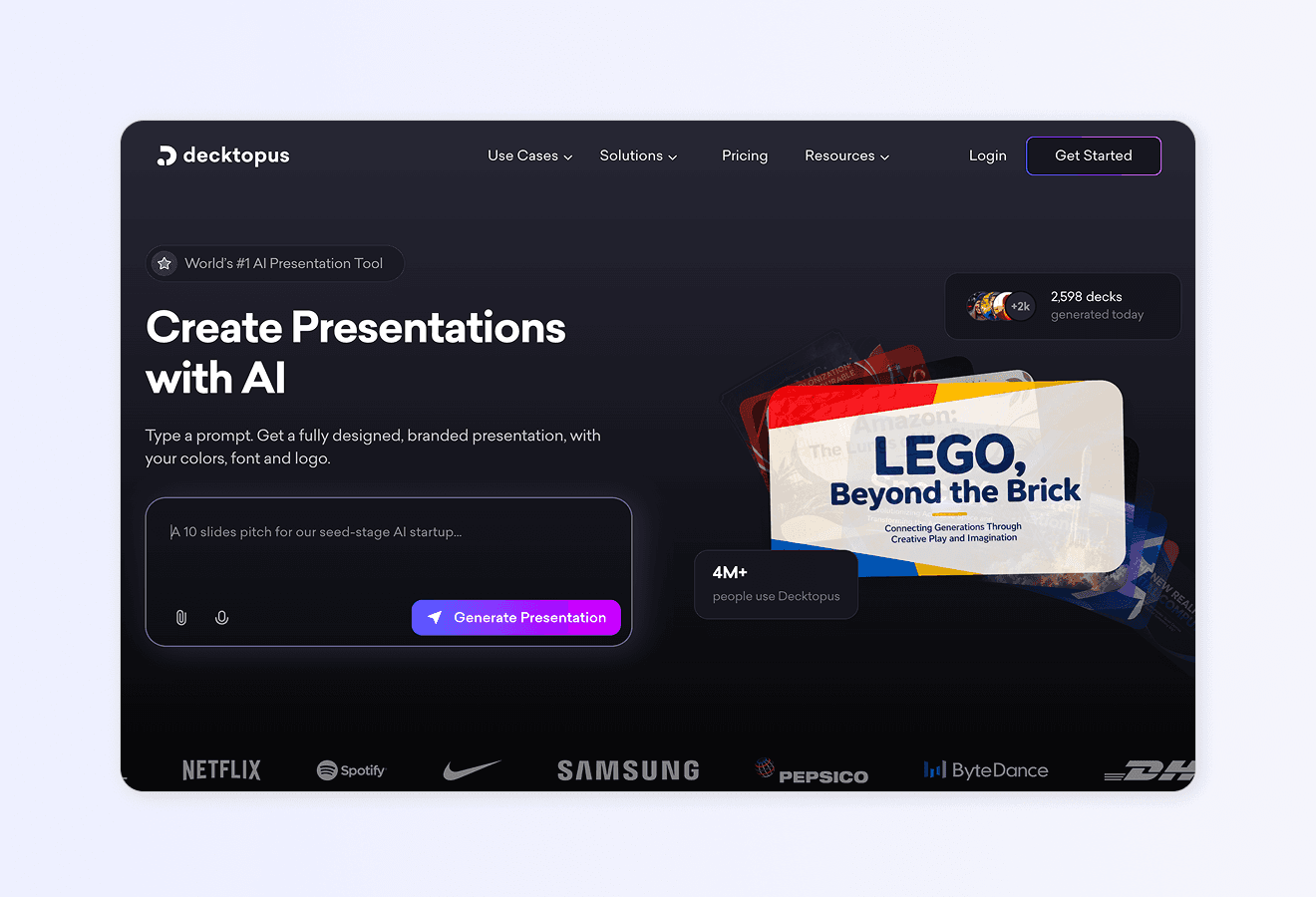
College presentations combine research, writing, design, and rehearsal. Doing all four manually can take 10+ hours per presentation. Decktopus AI generates a full college presentation deck from a short description in minutes.
1. Describe your topic. Type something like “Research presentation on climate change impact on coastal cities for a sophomore environmental science course” or “Case study analysis on Netflix’s DVD-to-streaming pivot for a strategic management class.” Or upload your research notes, essay draft, or rubric as a supporting file. If you already have an older presentation, Decktopus AI’s Beautify feature can redesign it or use it as a source.
2. Choose your style. Pick a brand, reuse a saved look, or start fresh with AI. Decktopus AI will ask how you want your presentation to look. You can apply a saved style, import styling from any website URL, or let AI generate a clean, academic-appropriate style from scratch.
3. Review the outline. Decktopus AI generates a slide-by-slide structure covering intro, thesis, key evidence, analysis, conclusion, and Q&A. Adjust before the full deck is built. This is your chance to align the structure with your professor’s rubric.
4. Refine with Edit with AI. Click Edit with AI and type instructions in plain language: “add a comparison table on slide 5,” “make the data slide more visual,” “add a timeline for the historical background,” “shorten the intro to two bullet points.” All edits are tracked with unlimited version history.
5. Export or share. Download as PDF, PPT, or PNG. Share via live link with auto-update, which is useful for group projects where teammates need the latest version. Or present directly.
You can also use the Loop AI Delivery Coach during rehearsal for real-time feedback on pacing, filler words, and clarity. It’s particularly useful for hitting a specific time limit (like the 10 or 15-minute cap most college presentations have) on the first try instead of the tenth.
For broader guidance, see the best AI presentation tools, our ultimate presentation tools roundup, and our guide on how to do a presentation.
Ready to build a college presentation that earns top marks? Get started with Decktopus AI.
Frequently Asked Questions
How many presentations do college students give per year?
Most full-time college students give between 8 and 15 graded presentations per academic year across their coursework. The exact number depends on major (humanities and business tend to be higher, STEM slightly lower) and the professor’s preferred assessment style.
Do all college majors require presentations?
Yes. Every undergraduate major uses presentations as part of its assessment. Even in STEM majors like computer science or engineering, students present research findings, project demos, or design proposals. Presentations are one of the most universal features of higher education.
How long is a typical college presentation?
Most college presentations run 10 to 20 minutes. Group presentations often run 20 to 40 minutes across all members. Capstone or thesis defenses can run 30 to 45 minutes plus Q&A.
What is the biggest difference between high school and college presentations?
Content depth and research rigor. College presentations are evaluated primarily on the substance of the research or analysis. Delivery matters, but content mastery is what earns top marks.
How do I prepare for a college presentation without getting nervous?
Rehearse out loud at least three full times. Record yourself once and watch it back. Prepare answers for the top 5 to 10 questions you’re likely to be asked. Nerves shrink as familiarity grows.
What tool should I use to build a college presentation fast?
Decktopus AI generates a full college presentation deck from a short topic description in minutes, including structure, content, and clean design. Loop AI Delivery Coach helps with rehearsal. For more, see our roundup of the best AI presentation tools.
How do I handle group presentations where teammates don’t do their share?
Assign clear slide ownership at the first meeting. Set internal deadlines earlier than the professor’s deadline. If a teammate misses their part, address it directly in the group before escalating. If it persists, most professors will accommodate documented group issues.
What should the design of a college presentation look like?
Clean, professional, and consistent. Two or three brand colors, a sans-serif font, minimum 24-point body text, one dominant idea per slide, and visuals over text wherever possible. Avoid heavy animations and busy backgrounds.
How do I cite sources in a college presentation?
Include an in-text citation on the slide where you use a source (footnote or in the corner). Then include a full “References” or “Sources” slide at the end with all citations formatted per your class’s required style (APA, MLA, Chicago).
How do I handle Q&A after a college presentation?
Pause before answering. It’s fine to say “great question, let me think for a second.” Answer honestly. If you don’t know, say so and explain how you’d find out. Faking an answer is the worst move. Confidence matters more than being right about every detail.
Are online college presentations harder than in-person ones?
They have different challenges. Online presentations reward tech preparation and self-directed engagement techniques (polls, reactions, direct questions to attendees). In-person presentations reward energy, physical delivery, and reading the room. Both formats reward research and rehearsal equally.
What if I really hate public speaking?
You’re not alone. See our full guide on why students hate giving presentations and our tips on building confidence. The single biggest fix is repetition. Every presentation you give makes the next one easier. Skipping presentations in college doesn’t make the fear go away. It just delays the moment you have to face it in a work setting.
Should I memorize my presentation word for word?
No. Memorization makes delivery feel robotic and adds pressure. Instead, know your content well enough to speak fluently about each slide without needing to recall exact wording. Practice out loud until the flow feels natural.
What role does AI play in college presentations?
AI tools can generate structure, write drafts, design slides, and provide rehearsal feedback. They speed up the mechanical parts of preparation so you can focus on the substance and delivery. For students, AI is now a legitimate productivity multiplier, as long as you still put in the research and thinking work yourself. For more, see our guide on ai in education.
Conclusion
College presentations aren’t going away. They’re one of the most reliable features of undergraduate education, and every major uses them. The upside: the skills you build presenting in college (structure, storytelling, design, delivery, Q&A prep) become the exact soft skills employers value most when they hire recent graduates.
Start early. Rehearse out loud. Use visuals to do the heavy lifting. Keep slides simple and content strong. Collaborate with teammates using clear ownership and shared deadlines. Cite your sources. Practice public speaking outside of just coursework. And use modern tools to speed up the mechanical work of building the deck so you can invest your time in the substance.
Every college presentation is practice for the professional presentations that come after graduation. Take them seriously and you’ll graduate with a real head start on any career that involves communicating ideas clearly, which is virtually every career.
For more resources, see our guides on what makes for a good presentation, public speaking tips, and an effective presentation, why does it matter.
Related posts

[UPDATED] 8 Niche Areas for Online Courses for 2026
79% of online students said that they preferred online learning to in-school education. What’s more, the e-learning industry is expected to reach 325 billion dollars of value by 2025. As a result, many people dove into online learning systems. Check out these online course domains!
Education

A Conversation on How Decktopus Can Help Ease Student Life for Engineers
In an extended interview with the Vitruvian organizing team, we were able to identify the growing need for a tool or platform for presentation and document creation that would alleviate the time and stress involved for organizations like these.
Education

A Message to Students and Teachers: Decktopus is here to help!
Studies have shown that teachers are spending at least 3.5 billion dollars on class materials and supporting equipment every year. Does that sound fair? Decktopus didn’t think so!
Education