Templates & How-to
Presentation Template Series 1: Homework Presentations
Learn how to build a homework presentation that gets top marks. A complete 11-slide framework with structure, tips, and a walkthrough on how to build it fast with AI.


Decktopus Content Team
A homework presentation is a slide-based deck that students prepare to communicate research, analysis, or project work as part of a school or university assignment. It follows a structured format that usually includes an introduction, key content sections, visuals, a conclusion, and a Q&A slide. The main benefit is that a well-structured deck helps students earn higher grades by making complex information easy for teachers and classmates to follow.
Roughly 49 million K-12 students and over 18 million college students are enrolled across the United States each academic year, and presentation assignments are among the most common project formats at every grade level from elementary through graduate school. A well-structured homework deck has become one of the most important academic skills students carry into the workplace.
If your semester just started, deadlines are right around the corner. And chances are one of those assignments is an online presentation. But the deck isn’t building itself. What now?
The fastest path is a proven structure. Below is the 11-slide homework framework used by top students across every grade level.

The 11-Slide Homework Presentation Framework
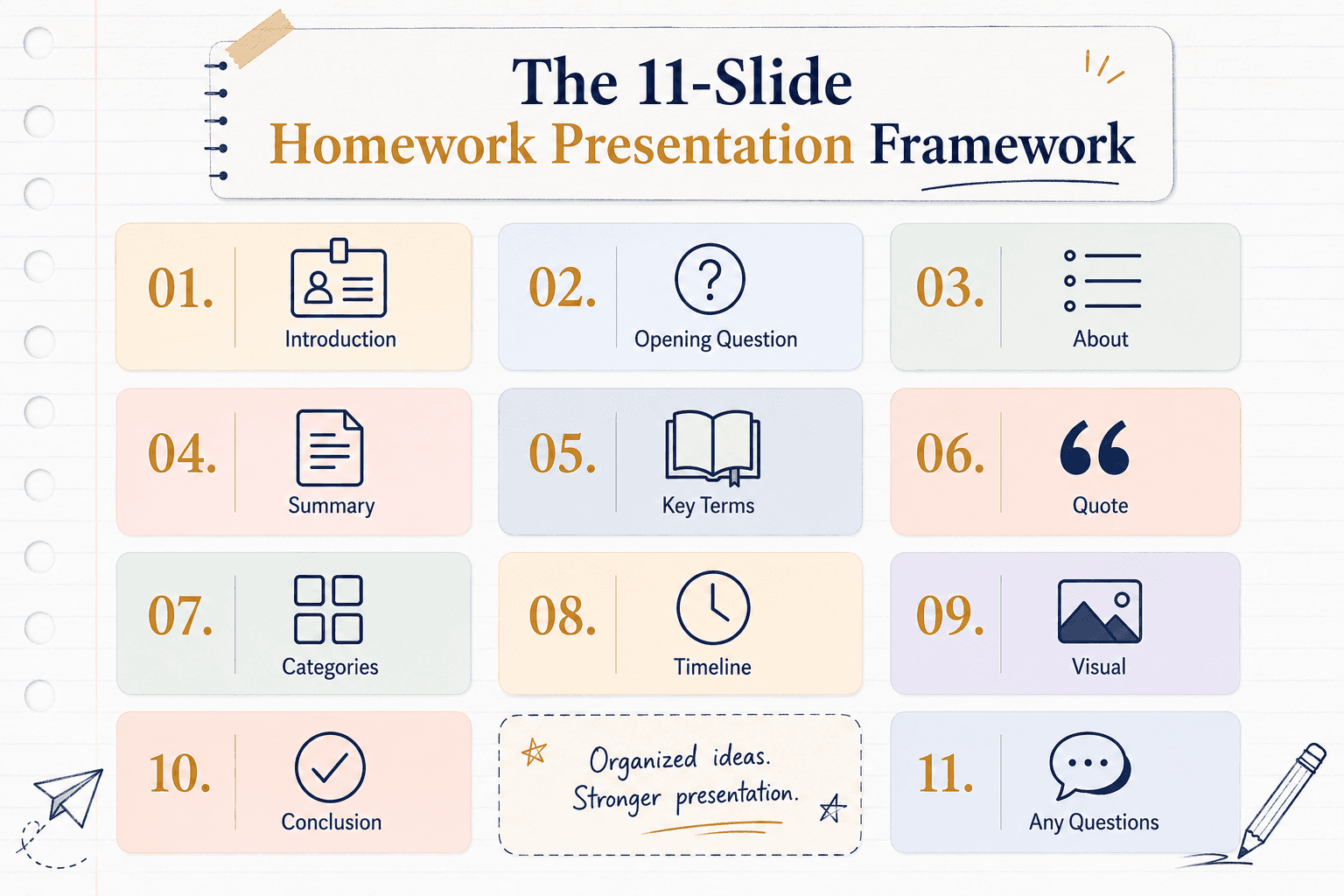
Here’s the full framework, slide by slide.
1. Introductory Slide
Include your name, the assignment title, your class, and your professor’s name. Add an image or short animation that hooks the audience. Always check the rubric first. Some professors want additional info (student ID, date, section number) on the cover slide.
2. Opening Question Slide
Start with a question. This raises audience engagement immediately and makes them mentally invested in the answer. Even a simple “What do you think happens when…” can shift the room from passive listening to active thinking.
For more on hooking an audience, see our guide on how to start a presentation with 10 hooks that instantly grab attention.
3. About Slide
Briefly introduce what your presentation will cover. This is your agenda or roadmap. Give the audience a preview of the structure so they know what to expect.
4. Introduction and Summary Slide
Set the stage. Share your thesis, your central question, or your initial position. This is where your presentation actually starts.
5. Key Terms Slide
List and define the key terms for your topic. This prevents confusion later and shows the teacher you have command of the vocabulary. Even if the terms feel obvious to you, the audience may not know them.
6. Quote Slide
Include a relevant quote from an expert, author, or primary source. Quotes create room for reflection, add authority to your presentation, and can pivot the audience toward a new angle. Use them to reinforce your main message, not distract from it.
7. Categories or Comparison Slide
Break your main topic into subtopics or categories. A table with bullet points, or a two-column comparison, helps the audience see the structure clearly. This is one of the best slides for demonstrating analytical thinking.
For more on framing categorical comparisons, see our guide on competitor analysis.
8. Timeline Slide
If your topic has a historical component, use a timeline to lay out events chronologically. This works well for history, literature, science discoveries, and any topic where sequence matters.
9. Visual Slide
Place a visual around the midpoint of your presentation as a breather. Attention spans are shorter than you think. A visual reset (an infographic, a photo, a chart) gives the audience a moment to refocus before the second half. Visuals should also appear in other slides throughout the deck, not just this one.
10. Conclusion Slide
Restate your main idea, summarize your key points, and highlight the takeaways. This is where you land the plane. Make it memorable.
11. Any Questions Slide
Most teachers expect you to end with a Q&A prompt. Ending on a question invites engagement, reinforces the audience’s understanding, and gives you a chance to underline your main message one more time.
Some assignments also require a bibliography slide after the Q&A. Check your rubric.
[[EMBED:PGRpdiBzdHlsZT0ib3ZlcmZsb3cteDphdXRvO21hcmdpbjoyMHB4IDAiPjx0YWJsZSBzdHlsZT0id2lkdGg6MTAwJTtib3JkZXItY29sbGFwc2U6Y29sbGFwc2U7Zm9udC1zaXplOjE1cHg7bWFyZ2luOjhweCAwIj48dGggc3R5bGU9ImJvcmRlcjoxcHggc29saWQgI2UzZTZlYTtwYWRkaW5nOjEwcHggMTRweDt0ZXh0LWFsaWduOmxlZnQ7YmFja2dyb3VuZDojZjRmNmY4O2ZvbnQtd2VpZ2h0OjYwMCI+PHRyIHN0eWxlPSJiYWNrZ3JvdW5kLWNvbG9yOiMxYTJiNGE7IGNvbG9yOiNmZmZmZmY7Ij48dGggc3R5bGU9ImJvcmRlcjoxcHggc29saWQgI2UzZTZlYTtwYWRkaW5nOjEwcHggMTRweDt0ZXh0LWFsaWduOmxlZnQ7YmFja2dyb3VuZDojZjRmNmY4O2ZvbnQtd2VpZ2h0OjYwMCI+U2xpZGU8L3RoPjx0aCBzdHlsZT0iYm9yZGVyOjFweCBzb2xpZCAjZTNlNmVhO3BhZGRpbmc6MTBweCAxNHB4O3RleHQtYWxpZ246bGVmdDtiYWNrZ3JvdW5kOiNmNGY2Zjg7Zm9udC13ZWlnaHQ6NjAwIj5TZWN0aW9uPC90aD48dGggc3R5bGU9ImJvcmRlcjoxcHggc29saWQgI2UzZTZlYTtwYWRkaW5nOjEwcHggMTRweDt0ZXh0LWFsaWduOmxlZnQ7YmFja2dyb3VuZDojZjRmNmY4O2ZvbnQtd2VpZ2h0OjYwMCI+UHVycG9zZTwvdGg+PC90cj48L3RoZWFkPjx0Ym9keT48dHIgc3R5bGU9ImJhY2tncm91bmQtY29sb3I6I2ZhZjdmMDsiPjx0ZCBzdHlsZT0iYm9yZGVyOjFweCBzb2xpZCAjZTNlNmVhO3BhZGRpbmc6MTBweCAxNHB4O3RleHQtYWxpZ246bGVmdDt2ZXJ0aWNhbC1hbGlnbjp0b3AiPjE8L3RkPjx0ZCBzdHlsZT0iYm9yZGVyOjFweCBzb2xpZCAjZTNlNmVhO3BhZGRpbmc6MTBweCAxNHB4O3RleHQtYWxpZ246bGVmdDt2ZXJ0aWNhbC1hbGlnbjp0b3AiPkludHJvZHVjdGlvbjwvdGQ+PHRkIHN0eWxlPSJib3JkZXI6MXB4IHNvbGlkICNlM2U2ZWE7cGFkZGluZzoxMHB4IDE0cHg7dGV4dC1hbGlnbjpsZWZ0O3ZlcnRpY2FsLWFsaWduOnRvcCI+TmFtZXMsIHRpdGxlLCBjbGFzcywgcHJvZmVzc29yPC90ZD48L3RyPjx0ciBzdHlsZT0iYmFja2dyb3VuZC1jb2xvcjojZmZmZmZmOyI+PHRkIHN0eWxlPSJib3JkZXI6MXB4IHNvbGlkICNlM2U2ZWE7cGFkZGluZzoxMHB4IDE0cHg7dGV4dC1hbGlnbjpsZWZ0O3ZlcnRpY2FsLWFsaWduOnRvcCI+MjwvdGQ+PHRkIHN0eWxlPSJib3JkZXI6MXB4IHNvbGlkICNlM2U2ZWE7cGFkZGluZzoxMHB4IDE0cHg7dGV4dC1hbGlnbjpsZWZ0O3ZlcnRpY2FsLWFsaWduOnRvcCI+T3BlbmluZyBRdWVzdGlvbjwvdGQ+PHRkIHN0eWxlPSJib3JkZXI6MXB4IHNvbGlkICNlM2U2ZWE7cGFkZGluZzoxMHB4IDE0cHg7dGV4dC1hbGlnbjpsZWZ0O3ZlcnRpY2FsLWFsaWduOnRvcCI+SG9vayB0aGUgYXVkaWVuY2U8L3RkPjwvdHI+PHRyIHN0eWxlPSJiYWNrZ3JvdW5kLWNvbG9yOiNmYWY3ZjA7Ij48dGQgc3R5bGU9ImJvcmRlcjoxcHggc29saWQgI2UzZTZlYTtwYWRkaW5nOjEwcHggMTRweDt0ZXh0LWFsaWduOmxlZnQ7dmVydGljYWwtYWxpZ246dG9wIj4zPC90ZD48dGQgc3R5bGU9ImJvcmRlcjoxcHggc29saWQgI2UzZTZlYTtwYWRkaW5nOjEwcHggMTRweDt0ZXh0LWFsaWduOmxlZnQ7dmVydGljYWwtYWxpZ246dG9wIj5BYm91dDwvdGQ+PHRkIHN0eWxlPSJib3JkZXI6MXB4IHNvbGlkICNlM2U2ZWE7cGFkZGluZzoxMHB4IDE0cHg7dGV4dC1hbGlnbjpsZWZ0O3ZlcnRpY2FsLWFsaWduOnRvcCI+UHJldmlldyB0aGUgYWdlbmRhPC90ZD48L3RyPjx0ciBzdHlsZT0iYmFja2dyb3VuZC1jb2xvcjojZmZmZmZmOyI+PHRkIHN0eWxlPSJib3JkZXI6MXB4IHNvbGlkICNlM2U2ZWE7cGFkZGluZzoxMHB4IDE0cHg7dGV4dC1hbGlnbjpsZWZ0O3ZlcnRpY2FsLWFsaWduOnRvcCI+NDwvdGQ+PHRkIHN0eWxlPSJib3JkZXI6MXB4IHNvbGlkICNlM2U2ZWE7cGFkZGluZzoxMHB4IDE0cHg7dGV4dC1hbGlnbjpsZWZ0O3ZlcnRpY2FsLWFsaWduOnRvcCI+U3VtbWFyeTwvdGQ+PHRkIHN0eWxlPSJib3JkZXI6MXB4IHNvbGlkICNlM2U2ZWE7cGFkZGluZzoxMHB4IDE0cHg7dGV4dC1hbGlnbjpsZWZ0O3ZlcnRpY2FsLWFsaWduOnRvcCI+VGhlc2lzIG9yIG1haW4gcG9zaXRpb248L3RkPjwvdHI+PHRyIHN0eWxlPSJiYWNrZ3JvdW5kLWNvbG9yOiNmYWY3ZjA7Ij48dGQgc3R5bGU9ImJvcmRlcjoxcHggc29saWQgI2UzZTZlYTtwYWRkaW5nOjEwcHggMTRweDt0ZXh0LWFsaWduOmxlZnQ7dmVydGljYWwtYWxpZ246dG9wIj41PC90ZD48dGQgc3R5bGU9ImJvcmRlcjoxcHggc29saWQgI2UzZTZlYTtwYWRkaW5nOjEwcHggMTRweDt0ZXh0LWFsaWduOmxlZnQ7dmVydGljYWwtYWxpZ246dG9wIj5LZXkgVGVybXM8L3RkPjx0ZCBzdHlsZT0iYm9yZGVyOjFweCBzb2xpZCAjZTNlNmVhO3BhZGRpbmc6MTBweCAxNHB4O3RleHQtYWxpZ246bGVmdDt2ZXJ0aWNhbC1hbGlnbjp0b3AiPkRlZmluZSB2b2NhYnVsYXJ5PC90ZD48L3RyPjx0ciBzdHlsZT0iYmFja2dyb3VuZC1jb2xvcjojZmZmZmZmOyI+PHRkIHN0eWxlPSJib3JkZXI6MXB4IHNvbGlkICNlM2U2ZWE7cGFkZGluZzoxMHB4IDE0cHg7dGV4dC1hbGlnbjpsZWZ0O3ZlcnRpY2FsLWFsaWduOnRvcCI+NjwvdGQ+PHRkIHN0eWxlPSJib3JkZXI6MXB4IHNvbGlkICNlM2U2ZWE7cGFkZGluZzoxMHB4IDE0cHg7dGV4dC1hbGlnbjpsZWZ0O3ZlcnRpY2FsLWFsaWduOnRvcCI+UXVvdGU8L3RkPjx0ZCBzdHlsZT0iYm9yZGVyOjFweCBzb2xpZCAjZTNlNmVhO3BhZGRpbmc6MTBweCAxNHB4O3RleHQtYWxpZ246bGVmdDt2ZXJ0aWNhbC1hbGlnbjp0b3AiPkFkZCBhdXRob3JpdHkgb3IgcGl2b3Q8L3RkPjwvdHI+PHRyIHN0eWxlPSJiYWNrZ3JvdW5kLWNvbG9yOiNmYWY3ZjA7Ij48dGQgc3R5bGU9ImJvcmRlcjoxcHggc29saWQgI2UzZTZlYTtwYWRkaW5nOjEwcHggMTRweDt0ZXh0LWFsaWduOmxlZnQ7dmVydGljYWwtYWxpZ246dG9wIj43PC90ZD48dGQgc3R5bGU9ImJvcmRlcjoxcHggc29saWQgI2UzZTZlYTtwYWRkaW5nOjEwcHggMTRweDt0ZXh0LWFsaWduOmxlZnQ7dmVydGljYWwtYWxpZ246dG9wIj5DYXRlZ29yaWVzPC90ZD48dGQgc3R5bGU9ImJvcmRlcjoxcHggc29saWQgI2UzZTZlYTtwYWRkaW5nOjEwcHggMTRweDt0ZXh0LWFsaWduOmxlZnQ7dmVydGljYWwtYWxpZ246dG9wIj5CcmVhayB0b3BpYyBpbnRvIHN1YnRvcGljczwvdGQ+PC90cj48dHIgc3R5bGU9ImJhY2tncm91bmQtY29sb3I6I2ZmZmZmZjsiPjx0ZCBzdHlsZT0iYm9yZGVyOjFweCBzb2xpZCAjZTNlNmVhO3BhZGRpbmc6MTBweCAxNHB4O3RleHQtYWxpZ246bGVmdDt2ZXJ0aWNhbC1hbGlnbjp0b3AiPjg8L3RkPjx0ZCBzdHlsZT0iYm9yZGVyOjFweCBzb2xpZCAjZTNlNmVhO3BhZGRpbmc6MTBweCAxNHB4O3RleHQtYWxpZ246bGVmdDt2ZXJ0aWNhbC1hbGlnbjp0b3AiPlRpbWVsaW5lPC90ZD48dGQgc3R5bGU9ImJvcmRlcjoxcHggc29saWQgI2UzZTZlYTtwYWRkaW5nOjEwcHggMTRweDt0ZXh0LWFsaWduOmxlZnQ7dmVydGljYWwtYWxpZ246dG9wIj5TaG93IGNocm9ub2xvZ3kgaWYgcmVsZXZhbnQ8L3RkPjwvdHI+PHRyIHN0eWxlPSJiYWNrZ3JvdW5kLWNvbG9yOiNmYWY3ZjA7Ij48dGQgc3R5bGU9ImJvcmRlcjoxcHggc29saWQgI2UzZTZlYTtwYWRkaW5nOjEwcHggMTRweDt0ZXh0LWFsaWduOmxlZnQ7dmVydGljYWwtYWxpZ246dG9wIj45PC90ZD48dGQgc3R5bGU9ImJvcmRlcjoxcHggc29saWQgI2UzZTZlYTtwYWRkaW5nOjEwcHggMTRweDt0ZXh0LWFsaWduOmxlZnQ7dmVydGljYWwtYWxpZ246dG9wIj5WaXN1YWw8L3RkPjx0ZCBzdHlsZT0iYm9yZGVyOjFweCBzb2xpZCAjZTNlNmVhO3BhZGRpbmc6MTBweCAxNHB4O3RleHQtYWxpZ246bGVmdDt2ZXJ0aWNhbC1hbGlnbjp0b3AiPkF0dGVudGlvbiByZXNldDwvdGQ+PC90cj48dHIgc3R5bGU9ImJhY2tncm91bmQtY29sb3I6I2ZmZmZmZjsiPjx0ZCBzdHlsZT0iYm9yZGVyOjFweCBzb2xpZCAjZTNlNmVhO3BhZGRpbmc6MTBweCAxNHB4O3RleHQtYWxpZ246bGVmdDt2ZXJ0aWNhbC1hbGlnbjp0b3AiPjEwPC90ZD48dGQgc3R5bGU9ImJvcmRlcjoxcHggc29saWQgI2UzZTZlYTtwYWRkaW5nOjEwcHggMTRweDt0ZXh0LWFsaWduOmxlZnQ7dmVydGljYWwtYWxpZ246dG9wIj5Db25jbHVzaW9uPC90ZD48dGQgc3R5bGU9ImJvcmRlcjoxcHggc29saWQgI2UzZTZlYTtwYWRkaW5nOjEwcHggMTRweDt0ZXh0LWFsaWduOmxlZnQ7dmVydGljYWwtYWxpZ246dG9wIj5SZXN0YXRlIG1haW4gcG9pbnQ8L3RkPjwvdHI+PHRyIHN0eWxlPSJiYWNrZ3JvdW5kLWNvbG9yOiNmYWY3ZjA7Ij48dGQgc3R5bGU9ImJvcmRlcjoxcHggc29saWQgI2UzZTZlYTtwYWRkaW5nOjEwcHggMTRweDt0ZXh0LWFsaWduOmxlZnQ7dmVydGljYWwtYWxpZ246dG9wIj4xMTwvdGQ+PHRkIHN0eWxlPSJib3JkZXI6MXB4IHNvbGlkICNlM2U2ZWE7cGFkZGluZzoxMHB4IDE0cHg7dGV4dC1hbGlnbjpsZWZ0O3ZlcnRpY2FsLWFsaWduOnRvcCI+QW55IFF1ZXN0aW9uczwvdGQ+PHRkIHN0eWxlPSJib3JkZXI6MXB4IHNvbGlkICNlM2U2ZWE7cGFkZGluZzoxMHB4IDE0cHg7dGV4dC1hbGlnbjpsZWZ0O3ZlcnRpY2FsLWFsaWduOnRvcCI+USZhbXA7QSBhbmQgbWVzc2FnZSByZWluZm9yY2VtZW50PC90ZD48L3RyPjwvdGJvZHk+PC90YWJsZT48L2Rpdj4=]]
Common Homework Presentation Mistakes to Avoid
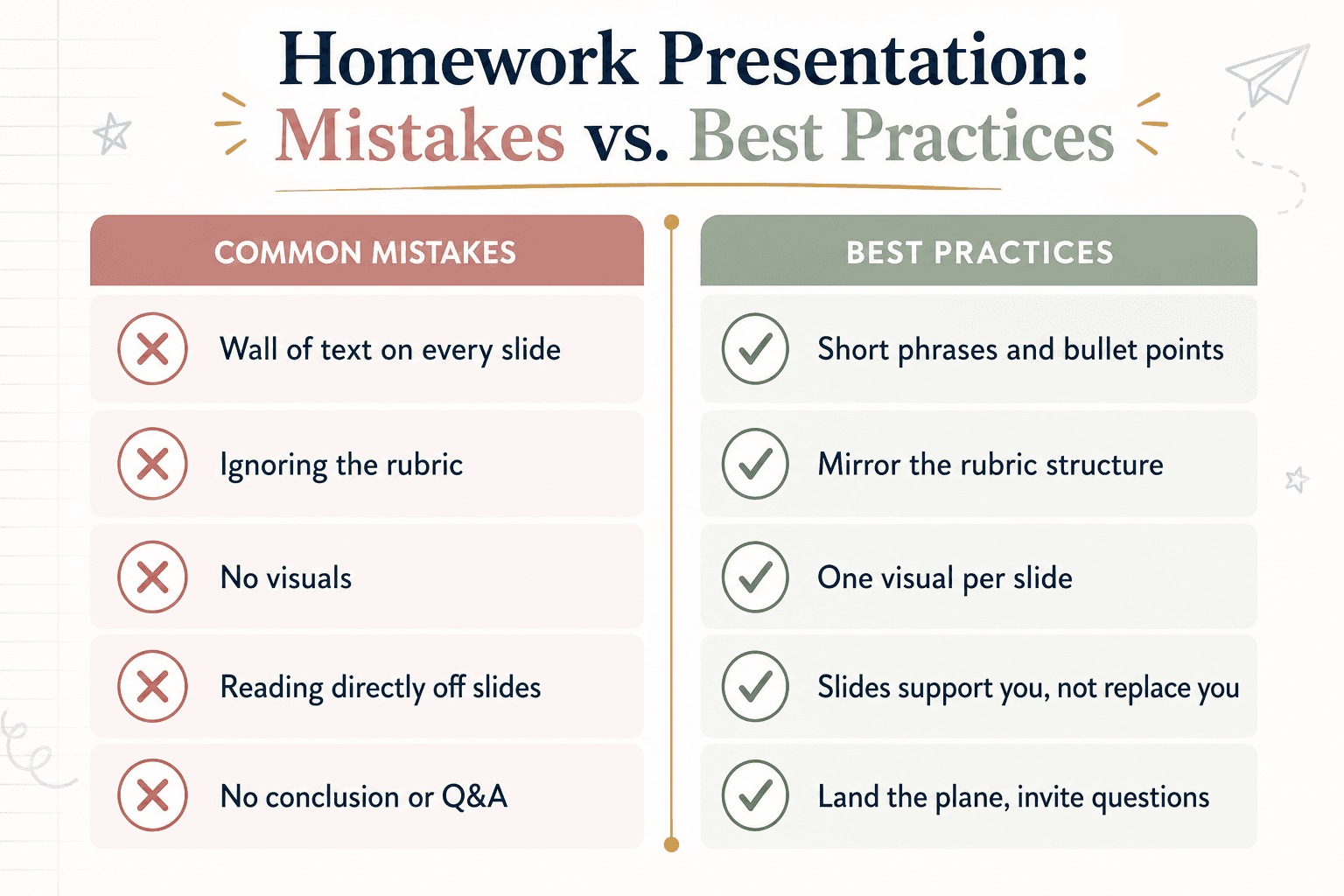
Overloading slides with text. Rubrics reward clarity, not word count. Keep body text to short phrases or bullet points.
Skipping the rubric. Every teacher grades differently. Read the rubric line by line and mirror its structure in your deck.
No visuals. A deck of pure text loses the audience fast. Aim for at least one visual per slide or every other slide.
Reading directly from the slides. Your slides support you. They are not your script. Present the key idea and expand verbally.
No conclusion or Q&A slide. Ending abruptly makes your presentation feel unfinished. Always land the plane.
For more on avoiding presentation pitfalls, see our guide on the 7 mistakes we all made during a presentation and presentation design.
How to Build a Homework Presentation with Decktopus
You have the framework. Now build the deck. Decktopus generates a full homework presentation from a short description in minutes.
Here’s the workflow:
1. Describe your topic. Type something like “Homework presentation on the causes of World War I for 10th grade history.” Or upload your notes, essay draft, or rubric as a supporting file. If you have an older deck, Decktopus’s Beautify feature can redesign it or use it as a source to build a new version.
2. Choose your style. Pick a brand, reuse a saved look, or start fresh with AI. Decktopus will ask how you want your presentation to look. You can apply a saved style, import a style from any website URL, or let AI generate a style for you.
3. Review the outline. Decktopus generates a slide-by-slide structure covering intro, key terms, categories, timeline, conclusion, and Q&A. Adjust before the full deck is built.
4. Refine with Edit with AI. Click Edit with AI and type instructions like “add a comparison table on slide 7,” “make slide 8 a horizontal timeline,” or “add a quote about industrialization on slide 6.” All edits are tracked with unlimited version history.
5. Export or share. Download as PDF, PPT, or PNG. Share via live link (any edits after sharing show up at the same link, so you always send the latest version). Or present directly.
For broader guidance, see our roundup of the best AI presentation tools and our guide on how to do a presentation.
Ready to build a homework deck that earns top marks? Get started with Decktopus.
Frequently Asked Questions
How many slides should a homework presentation have?
Most homework presentations run 8 to 12 slides. The 11-slide framework above covers every section teachers typically look for: intro, agenda, key terms, main content, visuals, conclusion, and Q&A.
What should be on the first slide of a homework presentation?
Your name, the assignment title, the class name, and your professor’s name. Add an image or short animation that previews the topic. Always match the rubric requirements exactly.
How do I make a homework presentation more engaging?
Start with a question. Use visuals on at least every other slide. Include a quote or a real example. Keep body text short. End with a Q&A prompt that invites the audience to reflect.
How long should a homework presentation take to deliver?
Most classroom presentations run 5 to 10 minutes. Aim for about 45 to 60 seconds per slide with the 11-slide framework. Check your rubric for the exact time limit.
Do I need a bibliography slide?
If your assignment requires citations, yes. Add a bibliography slide after your Q&A slide. Format the sources per your class citation style (APA, MLA, Chicago).
What is the best tool to make a homework presentation fast?
Decktopus generates a full deck from a short topic description in minutes. It’s the fastest option for students working against a deadline. For more, see our guide on the best AI presentation tools.
How do I structure a group homework presentation?
Assign each group member one or two sections of the 11-slide framework. Meet once to align on the thesis and key terms, then divide and build. Rehearse the transitions before submitting.
Can I present a homework presentation online?
Yes. Most homework decks are now delivered over Zoom, Google Meet, or Microsoft Teams. Share your live Decktopus link so any last-minute edits appear automatically for your audience.
Related posts

How to Build Confidence When Speaking in Public (2026 Guide)
The science behind speaking confidence, the CONFIDENT framework, and the AI practice method that turns nervous presenters into calm, credible speakers.
Templates & How-to

How to Practice Public Speaking Alone (With and Without AI)
The 4 rehearsal methods that actually build public speaking skill, why mirror practice fails, and how AI simulates a real audience for structured feedback.
Templates & How-to

How to Give a TED Talk: Delivery Tips from the Best Speakers (2026)
A structured breakdown of what makes TED talks land, the delivery framework used by top speakers, and the AI practice method that closes the gap.
Templates & How-to