Education
Tips for Giving Persuasive Presentations (With Real Examples)
The framework, examples, and rehearsal method behind persuasive presentations that actually change minds - from sales pitches to job interviews.


Decktopus Content Team
Persuasion isn't about being charismatic. It's about giving the audience a specific reason to change their mind - and giving it to them in the order their brain accepts.
Research from Robert Cialdini (author of Influence) shows persuasion follows six repeatable principles: reciprocity, commitment, social proof, authority, liking, and scarcity. Presentations that use at least three of them measurably outperform those that don't - regardless of the presenter's natural style.
This guide breaks down the principles, gives you a framework, and shows you real examples. Plus: the rehearsal method that turns a good persuasive deck into one that closes the deal.
You'll get:
The 6 principles of persuasive presentations (with real examples)
The PERSUADE framework for building one
The 5 mistakes that quietly kill persuasive intent
The AI-powered rehearsal method that beats mirror practice
Answers to real presenter questions
The 6 Principles of Persuasive Presentations
Principle | What It Does | Example in a Deck |
|---|---|---|
Reciprocity | Give first, ask second | A useful resource on slide 3 before the ask on slide 12 |
Commitment | Small yeses lead to big yeses | Ask for agreement on the problem before pitching the solution |
Social proof | People do what others do | Customer logos, testimonials, "500+ teams use this" |
Authority | Credible sources build trust | Cite named studies, use industry data |
Liking | People buy from people they like | Personal story in the opening |
Scarcity | Limited = valuable | Deadline, limited spots, exclusive early access |
Use at least three. The best pitch decks use all six across 15 slides.
The PERSUADE Framework
P - Problem stated in the audience's words
E - Evidence for why the problem is expensive
R - Reframe: your unique angle
S - Solution: your specific approach
U - Uplift: what changes for the audience
A - Ask: the exact next step
D - Details: pricing, timeline, terms
E - Endorsements: proof this works
Skip any step and the deck feels either salesy (too much ask, not enough evidence) or academic (too much evidence, no clear ask).
Real Examples of Persuasive Presentations
Steve Jobs, 2007 iPhone Launch
Opened with three "commitment" hooks: "a wide-screen iPod with touch controls," "a revolutionary mobile phone," "a breakthrough internet communicator." Then the reveal: "these are not three separate devices." Audience already agreed each product would be revolutionary before he unified them. Classic commitment-first persuasion.
AirBnB Original Pitch Deck
10 slides. Problem stated in one line. Market sized in one number. Solution in three screenshots. Traction on slide 6. Ask on slide 10. Every slide was one persuasion move - no filler.
Simon Sinek, TED "Start With Why"
Opened with a bold claim ("people don't buy what you do, they buy why you do it"). Backed with three examples (Apple, Wright Brothers, MLK). Each example built commitment. Close: a specific reframe of how to think about leadership.
The 5 Mistakes That Kill Persuasive Presentations
1. Leading with Features Instead of Problem
The audience doesn't care about your feature list until they believe you understand their problem. Every persuasive deck opens with the problem in the audience's language.
2. The Buried Ask
The most important slide sits at slide 14. By then, half the audience is checking email. The ask should be foreshadowed early and delivered concretely.
3. Weak Social Proof
"Customers love us" isn't proof. "42 of the Fortune 500 use this" is. Specific numbers and named references beat vague endorsement.
4. No Scarcity
Without scarcity, the audience defaults to "let me think about it" - and never does. A specific deadline or limited-availability signal converts hesitation into action.
5. Vague Close
"Any questions?" wastes the moment when the audience is most primed. Persuasive closes ask for the specific next step: "Sign the pilot agreement by Friday" not "reach out if interested."
How Loop AI Delivery Coach Rehearses Persuasion
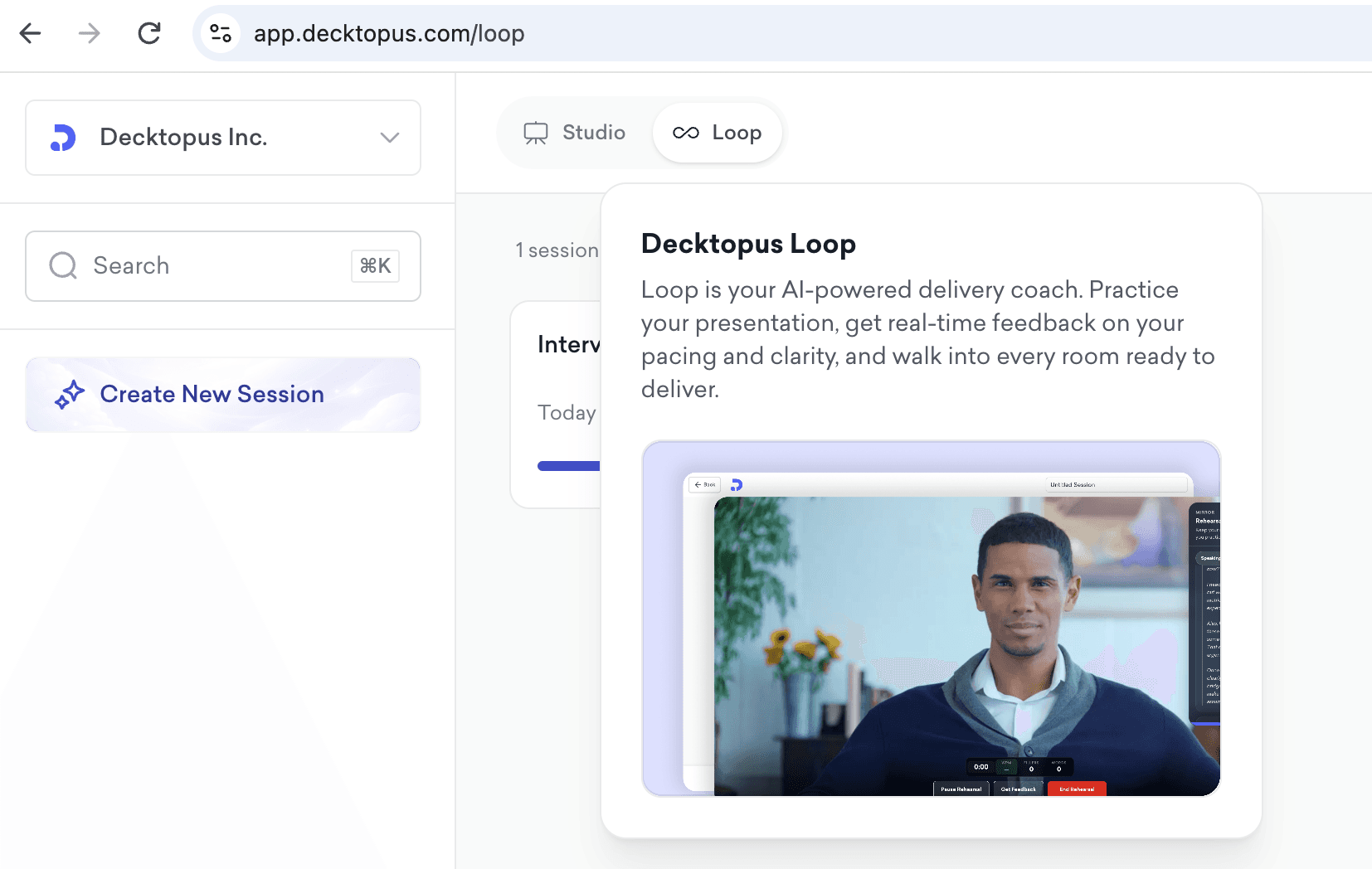
Persuasive delivery isn't about the words on the slide - it's about how those words land under pressure. Loop AI Delivery Coach is Decktopus AI's built-in rehearsal environment. Four AI agents pressure-test your pitch before you deliver it live.
Profiler (Emily) - Simulates the exact audience you're persuading. Investor? Emily's a skeptical investor. Enterprise buyer? She reacts with buyer skepticism. Your persuasion is tested against the actual room.
Architect (Marcus) - Scores whether your persuasive structure holds. Flags when the ask is buried, when the reframe is missing, when the social proof is too generic.
Red Team - Fires the objections your prospect will raise. "Why should I believe your numbers?" "How is this different from [competitor]?" "What if this doesn't work?" Facing these in rehearsal is what turns hesitation into confidence in the room.
Mirror - Records your delivery and plays it back. Persuasion collapses when the presenter's tone doesn't match the words - Mirror shows you where confidence dropped or urgency was missing.
Run your pitch through Loop 3-5 times before a high-stakes persuasive meeting.
Practice persuasive presentations with Loop →
Frequently Asked Questions
What makes a presentation persuasive?
A clear problem statement in the audience's language, real evidence, at least three of Cialdini's six persuasion principles, and a specific ask. Charisma helps but isn't required.
How do I persuade a skeptical audience?
Start by acknowledging their skepticism openly. Ask for agreement on the problem before pitching the solution. Cite external authorities they already trust. Address the two biggest objections proactively.
What's the best structure for a persuasive presentation?
The PERSUADE framework: Problem, Evidence, Reframe, Solution, Uplift, Ask, Details, Endorsements. Skip any step and the deck feels off.
How long should a persuasive presentation be?
Shorter is better. Most persuasive pitches land in 10-15 slides, delivered in 15-20 minutes. Anything longer dilutes the ask.
What's the strongest opening for a persuasive presentation?
State the problem in one specific sentence, in the audience's language. Follow with a surprising data point that quantifies the pain. This earns permission to keep going.
How do I close a persuasive presentation?
With a specific ask that names the next step, the person responsible, and the deadline. "Sign the pilot agreement by Friday" beats "let me know your thoughts."
Can I use humor in a persuasive presentation?
Yes - sparingly. Humor builds liking (one of Cialdini's principles), but too much undercuts authority. One well-placed joke in the opening is enough.
How do I handle objections mid-presentation?
Acknowledge them, answer them, move on. Never argue. Use Red Team rehearsal in Loop to prep for the most likely objections in advance.
What's the biggest mistake in persuasive presentations?
Leading with features instead of the problem. Audiences don't care about what you do until they believe you understand what they're struggling with.
How do I build authority in my presentation?
Cite named studies, use specific data, reference authorities the audience already trusts. Vague claims read as weak; specific citations build credibility.
Can AI help me build a persuasive presentation?
Yes. Decktopus AI generates on-brand persuasive decks from a topic description, and Loop rehearses delivery under simulated audience pressure. The strategic choices stay yours.
How do I know if my presentation is actually persuasive?
Test it. Run through Loop with a target audience persona and see how the AI reacts. If Emily pushes back on your logic, the real prospect will too.
Related Posts
Stay Connected
Related posts

[UPDATED] 8 Niche Areas for Online Courses for 2026
79% of online students said that they preferred online learning to in-school education. What’s more, the e-learning industry is expected to reach 325 billion dollars of value by 2025. As a result, many people dove into online learning systems. Check out these online course domains!
Education

A Conversation on How Decktopus Can Help Ease Student Life for Engineers
In an extended interview with the Vitruvian organizing team, we were able to identify the growing need for a tool or platform for presentation and document creation that would alleviate the time and stress involved for organizations like these.
Education

A Message to Students and Teachers: Decktopus is here to help!
Studies have shown that teachers are spending at least 3.5 billion dollars on class materials and supporting equipment every year. Does that sound fair? Decktopus didn’t think so!
Education