Pitch Deck
Presentation Template Series 2: Airbnb Pitch Deck
Take a look at the famous Airbnb pitch deck. Get inspired by their design and learn what made it one of the most-referenced startup presentations of all time.

Decktopus Content Team
The Airbnb pitch deck is the 11-slide investor presentation that Brian Chesky, Joe Gebbia, and Nathan Blecharczyk used in 2009 to raise Airbnb’s Series Seed round from Sequoia Capital. It works by combining a clear problem statement, a simple solution, market validation with real numbers, and a concise business model into 10 to 15 lightweight slides. The main benefit for founders studying it today is understanding how simplicity and clarity beat volume and detail when pitching to investors.
The Airbnb deck helped the founders raise $600,000 in their 2009 Sequoia-led seed round. By 2020, the company IPO’d at a valuation of over $100 billion. The pitch deck itself has been shared and referenced by hundreds of thousands of founders over the past decade, making it one of the most-studied startup presentations in modern venture history.
If you’re interested in startup success stories, you’ve probably heard of Y Combinator’s 2009 Spring Demo Day. Out of the 84 startups that pitched, 29% were funded (a total of $1.8 billion raised across the batch), and 11% were acquired.
One startup, in particular, caught everyone’s eye: Airbnb. They had a polished pitch deck that has since become one of the most-shared pitch examples in venture history. Let’s break it down and learn what worked.
For deeper context on pitch deck fundamentals, see our guides on pitch deck examples, what is a pitch deck, and the best AI pitch deck generators for founders.
The 11-Slide Airbnb Pitch Framework
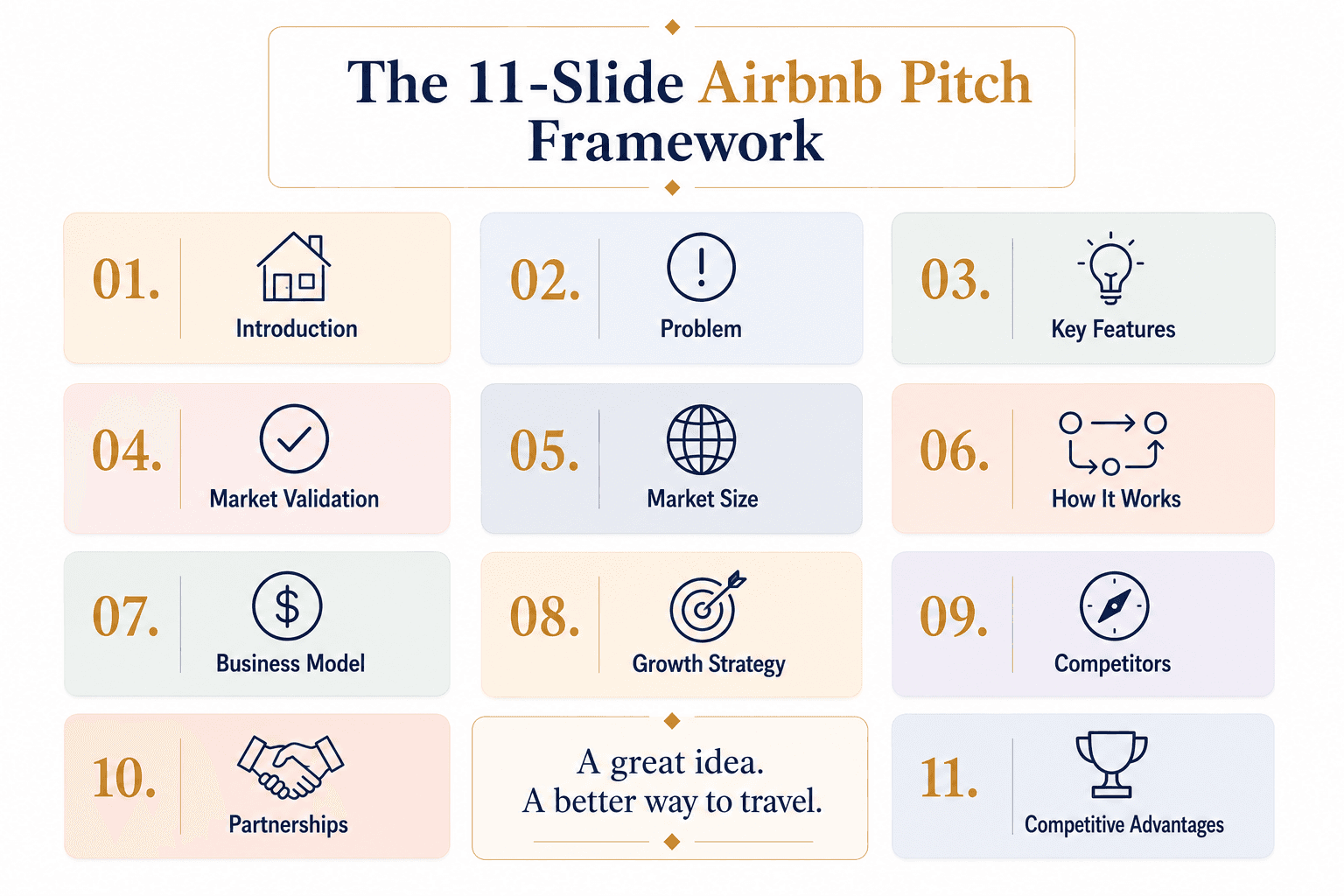
Infographic grid showing the 11-slide Airbnb pitch deck framework from introduction to competitive advantages.
Airbnb’s original pitch deck followed an 11-slide framework. Every strong startup pitch deck since has borrowed from this structure.
Introduction
Problem Statement
Key Features (Solution)
Market Validation
Market Size
How It Works (Product Experience)
Business Model
Target Events and Growth Strategy
Competitors
Partnerships
Competitive Advantages
Below is what each slide covered.
1. Introduction
The intro slide included their startup name, logo, their one-liner (“Book rooms with locals, rather than hotels”), and a representative photo.
The one-liner is the key. In under 10 words, investors knew exactly what the company did and who it served.
2. Problem Statement
They outlined 3 key points for a customer looking to book a room:
The price: The number one concern for customers booking travel online
Far from the city culture: Hotels keep travelers away from the city and its culture
No easy way exists: Booking a room with a local or becoming a host is hard
Three pain points. Specific. Universal. Easy to relate to.
3. Key Features (Solution)
Where does Airbnb come in? They created a web platform where users can rent out their spaces. With this product you can:
Save money when traveling
Make money while hosting
Share culture with a local connection to the city
Three benefits, one for each side of the marketplace (guests, hosts, both).
4. Market Validation
They referenced the current number of total users on similar platforms like Craigslist and Couchsurfing. Showing market validation through competitor traction is powerful. It signals: “This behavior already exists at scale. We just have a better version.”
For more on framing traction in pitches, see our breakdown of pitch deck examples.
5. Market Size
This slide outlined how Airbnb could fill the gap in the massive travel and lodging market. Showing how large the available market is invites more investor attention and typically leads to a better valuation conversation.
6. How It Works (Product Experience)
A step-by-step visual explanation of the product walks the audience through the process:
Search by location
Review listing
Book it
Three steps. Simple. Anyone can imagine using the product from these three words alone.
7. Business Model
How does Airbnb make money? They used a commission model, taking a percentage from each booking. Expected revenue projections were key here.
For more on framing the financial side of a pitch, see our guide on the use of funds slide.
8. Target Events and Growth Strategy
Airbnb explained how they’d capitalize on specific events to drive early growth:
Event-driven demand: Festivals, sports tournaments, conferences, and concerts drive spikes in short-term accommodations
Seasonal adjustments: Summer festivals, winter sports events, holiday seasons
Localized marketing: Targeted campaigns around specific events in key cities
9. Competitors
Listing competitors helped them point to loopholes in the market and how Airbnb had a competitive advantage. The trick isn’t hiding competitors. It’s showing why you win against them.
For more on framing competitive positioning in pitches, see our guide on competitor analysis.
10. Partnerships
Airbnb’s partnerships strengthened their business model:
Hosts: From individual homeowners to professional property managers, the host community was Airbnb’s supply engine
Local governments: Partnerships that ensured compliance while offering economic growth to those areas
Tourism boards and event organizers: Extended reach and enhanced guest experience
Payment providers: Smoother global transactions
11. Competitive Advantages
Airbnb’s differentiators:
Global reach and network: Now operating in over 220 countries and regions
Unique experiences: Beyond accommodation, tours, activities, and local events
Brand recognition: Trusted by millions worldwide
Technology and user experience: Easy search, instant booking, secure payments
Community trust: Guest and host review system builds transparency
Why the Airbnb Pitch Deck Worked
Simple: it is simple.
It is extremely clear, easy to follow, succinct, and visually engaging. There is not too much content on the slides, and the slides are supported with real visuals.
It is easy to keep the audience engaged with the material. It is not a surprise that the Airbnb team was successful with this pitch deck.
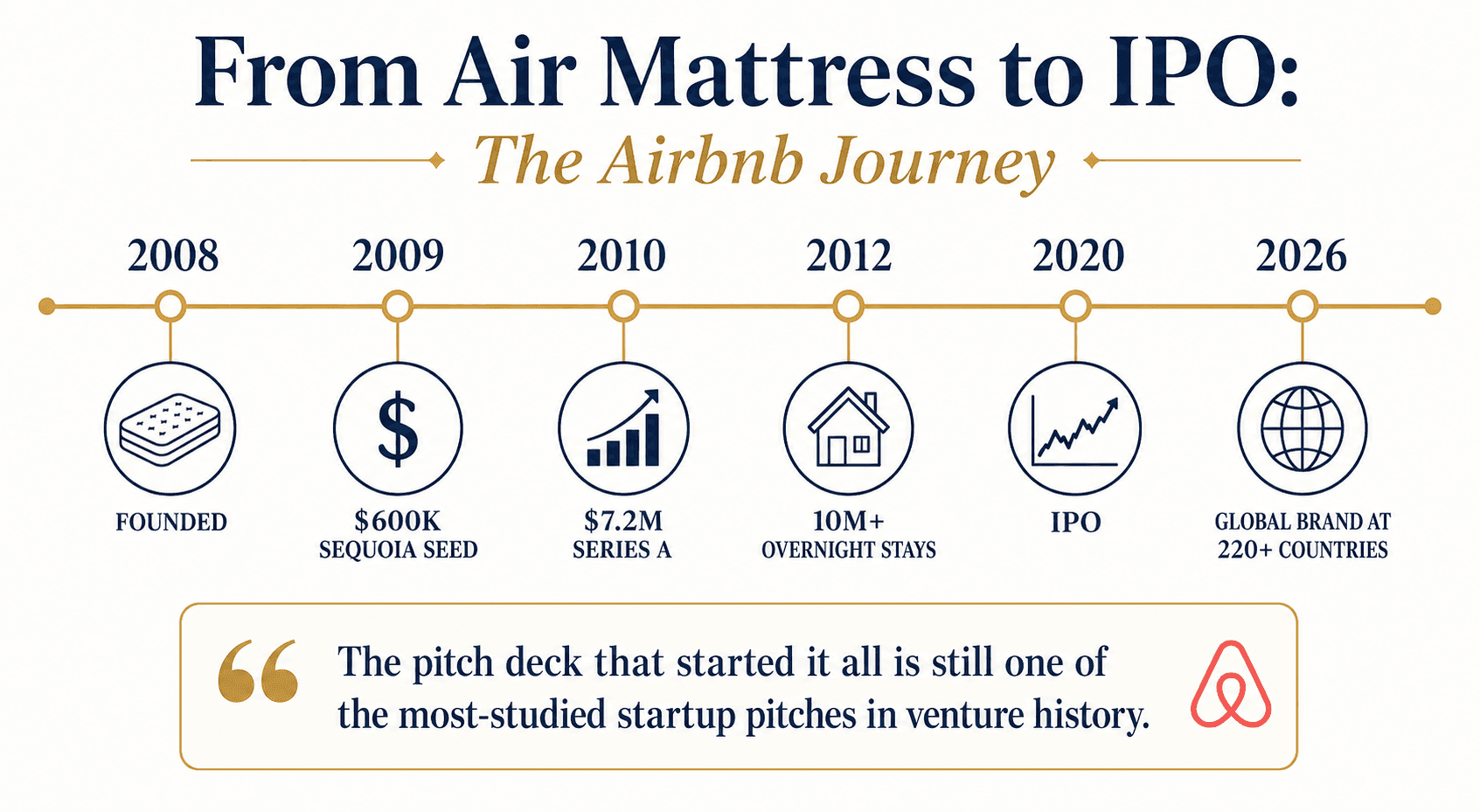
Airbnb was founded in 2008 by Brian Chesky, Joe Gebbia, and Nathan Blecharczyk. Like many other tech unicorns, the company came from a brilliant idea and limited resources. The story doesn’t start in a garage, but on an inflatable mattress. The founders turned their San Francisco apartment into a bed and breakfast and soon had three paying guests.
From a simple idea (renting out an air mattress in their apartment), Airbnb’s founders transformed the travel industry. Their original website, airbedandbreakfast.com, launched in August 2008. Despite early struggles, their innovative approach to lodging quickly gained traction, proving there was real market demand.
To finance their company, the founders famously sold Obama- and McCain-themed cereal boxes during the 2008 election. That story is now part of the company’s legend and is well worth reading.
The 2009 Sequoia-led seed round ($600,000) and a $7.2 million Series A led by Sequoia and Greylock in 2010 kicked off Airbnb’s growth journey. By 2012, they had booked more than 10 million overnight stays.
Airbnb went public in December 2020 and now trades as a public company with a market cap in the tens of billions. The pitch deck that started it all remains one of the most-referenced examples in venture history.
For more on avoiding the mistakes that sink pitches, see our guide on pitch deck mistakes.
What Should Be in a Good Pitch Deck From an Investor’s Perspective?
Investors see hundreds of pitch decks. The ones that stand out follow a clear, compelling structure. They focus on the problem, the solution, and the market opportunity in a way that immediately grabs attention.
A strong pitch deck highlights a scalable business model, a defensible competitive advantage, and traction that proves market demand.
More than just polished slides, investors want data-backed storytelling. Why this idea? Why now? Why is your team the right one to execute?
Beyond structure, investors look for clarity and confidence. They want to see a well-researched market, a clear revenue model, and an understanding of potential risks. A great pitch deck doesn’t overwhelm with details. It provides enough insight to spark interest and lead to a deeper conversation.
For deeper guidance on framing pitches that close, see our breakdowns of how to sell an idea effectively and the best AI pitch deck generators for founders.
What a Solid Pitch Deck Structure Looks Like
Having a structured pitch deck approach is crucial for crafting a compelling investor presentation. A well-designed structure ensures that all key sections (problem, solution, market opportunity, business model, traction, and financials) are covered in a clear, logical flow.
Instead of starting from scratch, a proven framework guides founders in presenting their story effectively while maintaining consistency in design and messaging.
A solid pitch structure also saves time and reduces friction in the fundraising process. Investors expect a familiar structure. Using a proven framework ensures your deck aligns with their expectations, making it easier for them to absorb critical information.
More importantly, it helps founders focus on refining their content rather than getting lost in slide design.
Why Founders Still Reference the Airbnb Pitch Deck in 2026
The Airbnb pitch deck is one of the most-referenced startup presentations because it strikes the perfect balance between clarity, simplicity, and persuasion.
It follows a structured yet concise format, delivering a compelling story with minimal slides while addressing all key investor concerns: problem, solution, market size, business model, and traction.
Founders admire it because it proves that a pitch deck doesn’t need excessive detail or complex visuals to be effective. Instead, it prioritizes storytelling, data-driven insights, and a strong narrative, making it a go-to example for startups seeking investment.
For more on preparing your first startup pitch, see our guide on how to make the best startup pitch.
How to Build Your Own Pitch Deck with Decktopus
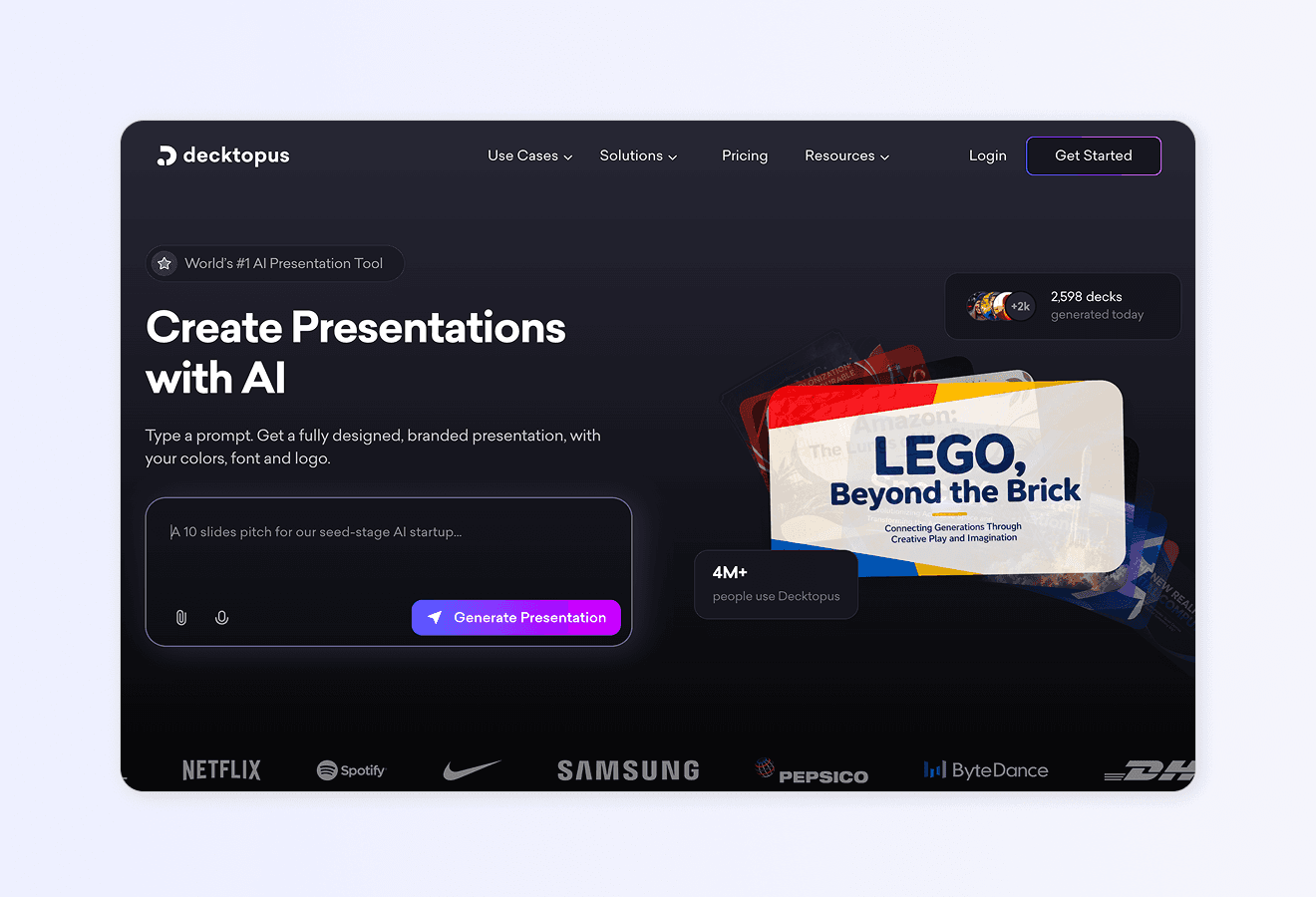
You have the 11-slide Airbnb framework. Now the deck itself needs to be built. Decktopus generates a pitch deck from a short description in minutes, following proven investor structures.
Here’s how the workflow looks:
1. Describe your topic. Type something like “Seed pitch deck for a B2B SaaS startup targeting mid-market HR teams.” Or upload your business plan, one-pager, or notes as a supporting file. If you already have an existing deck, Decktopus’s Beautify feature can redesign it or use it as a source to build a new version.
2. Choose your style. Pick a brand, reuse a saved look, or start fresh with AI. Decktopus will ask how you want your presentation to look. You can apply a saved brand, import your brand directly from your company website URL (which pulls in your logo, colors, and fonts), or let AI generate a style from scratch.
3. Review the outline. Decktopus generates a slide-by-slide structure covering intro, problem, solution, market, business model, traction, competition, team, and ask. Adjust before the full deck is built.
4. Refine with Edit with AI. Click Edit with AI and type instructions like “make the traction slide more visual,” “add a competitive matrix,” or “show market size as a comparison chart.” All edits are tracked with unlimited version history.
5. Export or share. Download as PDF, PPT, or PNG. Share via live link (any edits you make afterward automatically appear at the same link, so investors always see the latest version). Or present directly.
For broader guidance, see our roundup of the best AI presentation tools and our business proposal guide.
Ready to build a pitch deck as compelling as Airbnb’s? Get started with Decktopus.
Frequently Asked Questions
How many slides did Airbnb’s pitch deck have?
The original Airbnb pitch deck was 11 slides. It covered intro, problem, solution, market validation, market size, product experience, business model, growth strategy, competitors, partnerships, and competitive advantages.
How much did Airbnb raise with their pitch deck?
Airbnb raised $600,000 in their 2009 Sequoia-led seed round using this pitch deck. They then raised a $7.2 million Series A led by Sequoia and Greylock in 2010, and continued raising through their December 2020 IPO.
What made Airbnb’s pitch deck effective?
Simplicity. It followed a clear structure, used minimal text, real visuals, and specific data. It answered every question an investor would ask without overwhelming with details.
How long should a modern startup pitch deck be?
Most modern pitch decks run 10 to 15 slides for a seed or Series A round. The Airbnb example was 11 slides. Longer decks risk losing investor attention. Shorter can miss critical sections.
What are the essential slides in a startup pitch deck?
Intro, problem, solution, market size, business model, traction, competitive advantage, team, and the ask. That’s 9 slides at minimum. Add product demo and financial projections for a 10 to 12 slide deck.
How can I make my pitch deck stand out?
Specificity. Real numbers over vague claims. A memorable one-liner. A visual product demo. Traction data. And a clear ask with what the money will unlock. For deeper guidance, see our best pitch deck generators for founders breakdown.
What are the most common pitch deck mistakes?
Vague market claims, hiding competitors, unclear business model, no traction data, and vague asks. See our full breakdown on pitch deck mistakes.
Where can I find inspiration from real startup pitch decks?
Airbnb, Uber, Facebook, and many other successful startups have shared their original pitch decks publicly. For a curated collection, see our pitch deck examples guide.

Related posts
The Ultimate Guide to the Best AI Pitch Deck Generators: Free and Paid Options for Creating Stunning Pitch Decks
Discover the best AI pitch deck generators to streamline creating decks for investors. Ideal for entrepreneurs and startups, these AI tools help craft the perfect pitch deck effortlessly.
Pitch Deck
Top 10 Best AI-Powered Pitch Deck Generators For Founders
Discover the best AI pitch deck generators for founders. Compare top tools that generate investor-ready decks in minutes, apply your brand automatically, and let you focus on the pitch instead of the design.
Pitch Deck

Early Stage Entrepreneur Hack: Talking to Users
You have your idea and you have your pitch deck. You knock on some doors, pitch the idea, and even though your pitch deck looks stunning, the investor is not sure about the idea. They want to see the transactions first. What a bummer!
Pitch Deck