Templates & How-to
Presentation Template Series 4: Progress Report
Learn how to build a strong progress report presentation that keeps stakeholders informed, surfaces risks early, and moves your project forward.


Decktopus Content Team
A progress report is a structured document that provides a detailed account of the progress on a project, sharing completed tasks, milestones, and expectations for the near future. It works by combining recent updates, target tracking, challenges, and risk assessments into one clear communication for stakeholders. The main benefit is keeping investors, supervisors, or team members informed with credible, current information, so decisions get made faster and problems surface before they become disasters.
A polished progress report takes 3 to 5 hours to build from scratch in traditional slide tools. Using a proven 12-section framework and an AI presentation tool can cut that to about 20 minutes, without sacrificing brand or design quality.
Remember the time in primary school when you had a group project that extended throughout the entire semester, and your teacher wanted to continuously schedule check-in meetings? Do you also remember how you feared every second of it because you had left all the work to the last minute?
You had to lie about an imaginary site visit or show unrelated links to research papers, promising the teacher you’d reference them later. Sound familiar?
In the real world, this doesn’t fly. In business, many people will want to check in on your progress:
An investor wants to hear how the startup they invested in is doing
A supervisor wants to learn the latest updates on how the employee’s project is going
A professor is looking to hear the latest findings from your faculty research
A political representative is sharing the progress they have achieved in their term
Why Progress Reports Matter
Progress reports are your go-to communication document with stakeholders. They:
Keep leadership informed without requiring meetings every day
Surface risks and blockers early enough to fix them
Document milestones so contributions are visible
Create a paper trail of decisions, changes, and outcomes
Signal that you’re a reliable, transparent operator
For related structural guidance, see our guides on how to write an executive summary and our business proposal guide.
The 12-Slide Progress Report Framework
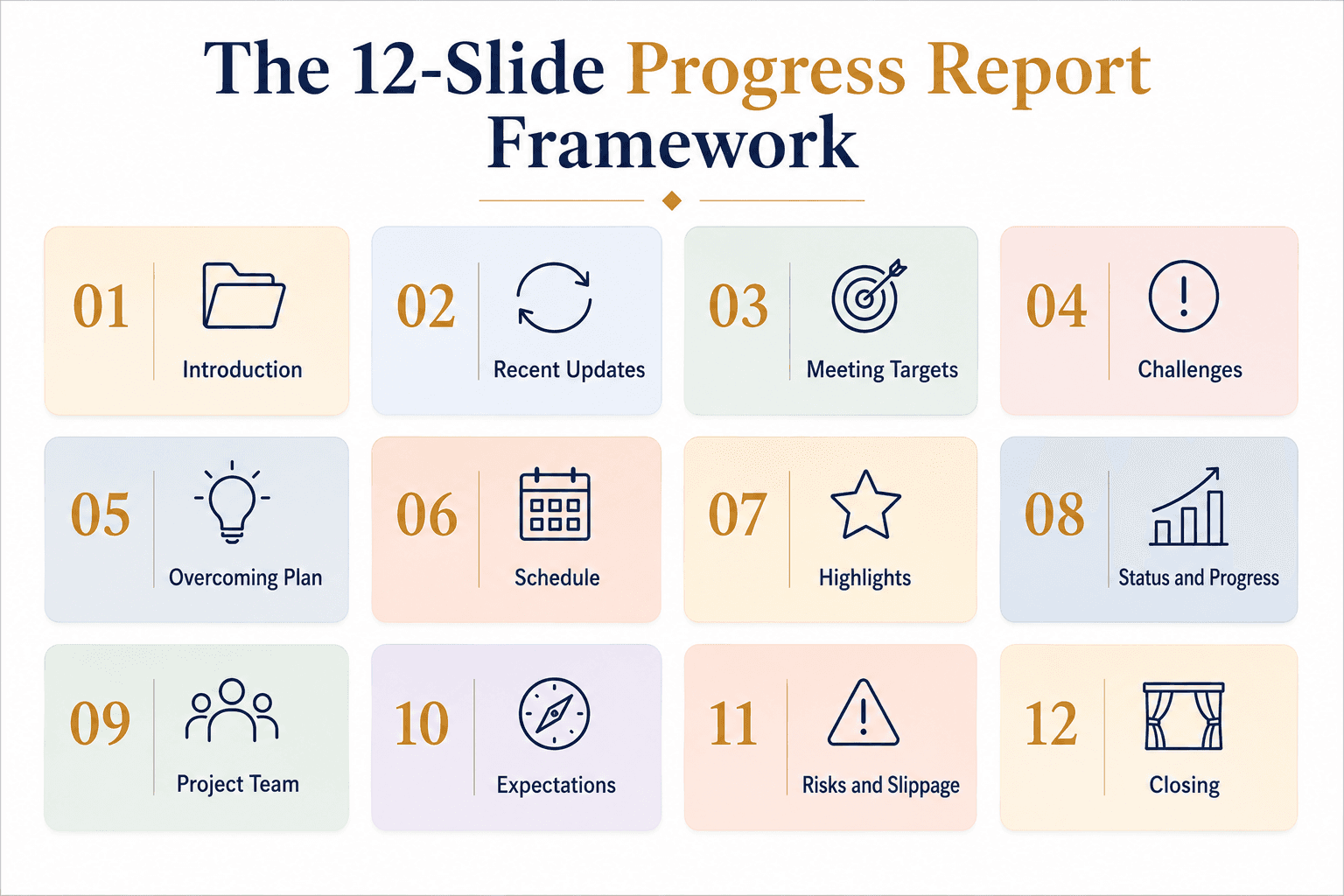
Every strong progress report follows a 12-section framework. Miss any of these and you leave gaps stakeholders will notice.
Introduction Page
Recent Updates and Changes
Meeting Targets Planning
Challenges and Completion
Overcoming Challenges Plan
Schedule Sample
Highlights Resource Slide
Project Status and Work Progress
Project Team
Expectations
Risks and Slippage
Closing
Below is what to include in each section.
How to Prepare a Progress Report Like a Pro
1. Introduction Page
Share your name, the name of your project, your company, and the dates of your project. This is your credibility moment. Keep it clean and clear.
2. Recent Updates and Changes
Has the project scope been changed since you last met? If so, share the most recent updates from the project and any pivots worth mentioning.
Even if nothing changed, say so explicitly. Silence creates doubt.
3. Meeting Targets Planning
Will you hit the quarterly targets? Making a list of previously set targets and referring to each one separately is helpful. Provide data. Use tables for visuals. Use checkmarks to show how much of your targets you’re meeting.
Visualize target progress with bar charts or pie charts for at-a-glance understanding.
4. Challenges and Completion
Do you have any roadblocks? Did you already skip some obstacles? Looking ahead, what could be difficult?
Honesty here matters. Downplaying challenges tanks credibility. Surfacing them proactively builds trust.
5. Overcoming Challenges Plan
What are your plans for resolving these roadblocks? Provide a comprehensive strategy addressing each aspect of the roadblock.
For each challenge, show:
What the roadblock is
Why it’s a roadblock
Your specific plan to overcome it
Timeline for resolution
6. Schedule Sample
When you’re looking at your long-term timeline, are there any changes in the schedule? If so, provide a brief description of why this is necessary.
Schedule changes are inevitable. What matters is showing you saw them coming and have a plan.
7. Highlights Resource Slide
Address what you have accomplished so far. What targets have you met already? How are things looking up for your project?
Lead with wins. Frame your report positively before diving into risks. Confidence is contagious.
8. Project Status and Work Progress
A Project Status and Work Progress Slide is used to communicate project status and updates to project stakeholders. It typically includes a graphical representation of the work completed to date, as well as future work that is planned. Often, these slides include a callout or indication of any risks or issues that the project team is currently tracking.
These slides are typically updated on a weekly or bi-weekly basis. They serve as an important tool for keeping everyone on the same page regarding project progress.
9. Project Team
A project team slide shows the people involved in a project and their respective roles. Most often, this slide is used early in the presentation to give an overview of who’s responsible for each task. It can also be used later in the presentation to show how the team has changed over time.
For more on introducing your team clearly, see our guide on about me presentations.
10. Expectations
What are you expecting from this project in the coming week or the next month? What are your projections for progress? Address:
Upcoming challenges
Milestones expected
Changes in revenue
Growth in the team
Resource needs
11. Risks and Slippage
What will be difficult? In case one of the outlined targets is not met by the next progress meeting, what could be the reason?
Surface known risks and rate their likelihood and impact. A risk you name is a risk you can plan against. A risk you ignore is a risk that will blindside you.
12. Closing
Open the floor to questions. This will help you better understand your supervisor’s expectations from this project and give them the chance to provide feedback. The closing slide should stay on screen during Q&A, so make it a summary of key takeaways, not a generic “Thank You.”
For more on ending presentations with impact, see our guide on how to end a presentation with impact. For opening strong, see how to start a presentation with hooks that grab attention.
Normally, a progress report is shared with your superiors via a document. But given that we’re becoming increasingly visual learners, and building a document from scratch isn’t practical anymore, we recommend giving a progress report presentation a try.
Some Other Types of Progress Reports
Project Progress Report
A Project Progress Report provides an overview of a project’s status to its stakeholders. It includes the project’s start and end dates, work completed, work remaining, and any risks or issues that have arisen during the project.
The purpose is to ensure all stakeholders are kept up-to-date on the project and can make informed decisions about whether or not to continue funding it.
IT Progress Report
An IT Progress Report is a pre-defined format for reporting information technology issues. It typically includes sections for describing the problem, the impact on business operations, proposed solutions, and action items. It helps ensure all important information is included in reports and that reports are consistent in format and content. For more on running technical projects, see our software development-related guidance at Rapidops.
Weekly Project Progress Report
A weekly progress report outlines the key milestones achieved, tasks remaining, and overall progress of a project. It can be used by team members, managers, or organizations to keep track of projects. The report can be customized to include sections on budget, schedule, resources, deliverables, and risks and issues. It’s typically updated weekly.
For more on how modern teams run internal meetings and reporting cadences, see our guide on how to prepare a meeting presentation and how to build a team presentation system with AI.
How to Build Your Progress Report Deck with Decktopus
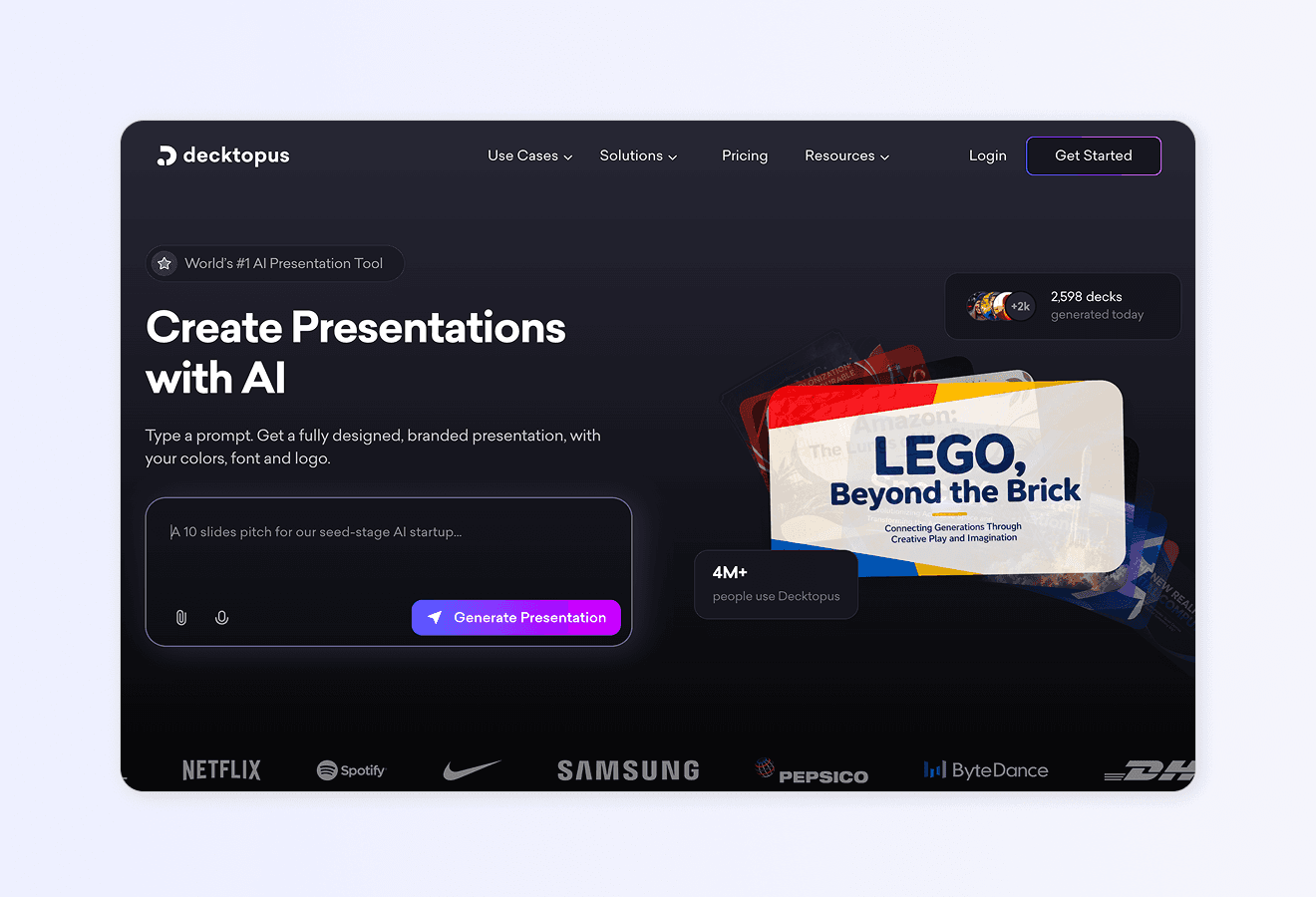
You have the 12-section framework. Now the deck itself needs to be built. Decktopus generates a progress report presentation from a short description in minutes.
Here’s how the workflow looks:
1. Describe your topic. Type something like “Weekly progress report for a product launch project, focused on completed milestones, current blockers, and next-week priorities.” Or upload your project notes as a supporting file.
2. Choose your style. Pick a brand, reuse a saved look, or start fresh with AI. Decktopus will ask how you want your presentation to look. You can apply a saved brand, import your brand directly from your company website URL (which pulls in your logo, colors, and fonts), or let AI generate a style from scratch.
3. Review the outline. Decktopus generates a slide-by-slide structure covering introduction, updates, targets, challenges, plan, schedule, highlights, team, expectations, risks, and closing. Adjust the order before the full deck is built.
4. Refine with Edit with AI. Click Edit with AI and type instructions like “make the target tracking slide more visual,” “show challenges as a comparison chart,” or “regenerate the timeline slide with a Gantt-style visual.” All edits are tracked with unlimited version history.
5. Export or share. Download as PDF, PPT, or PNG. Share via live link (any edits you make afterward automatically appear at the same link, so recipients always see the latest version). Or present directly.
For broader guidance on AI presentation workflows, see our roundup of the best AI presentation tools.
Ready to build your progress report? Get started with Decktopus.
Frequently Asked Questions
What is a progress report?
A progress report is a document that provides an overview of a project’s status, including completed work, current work, upcoming milestones, and risks or challenges. Its purpose is to keep stakeholders informed and enable data-driven decisions.
How do you write a progress report?
There’s no single template for a progress report, since they serve different purposes. Common elements include: a description of the project, your progress to date (usually as a percentage), any challenges you’ve encountered, what you plan to do next, and a timeline for completion. Adapt to your specific context and audience.
How often should progress reports be sent?
Depends on the project cadence. Fast-moving projects (product launches, campaigns) get weekly reports. Longer projects (research, construction) get bi-weekly or monthly reports. High-visibility executive reports may need to be quarterly. Match the cadence to the decision-making rhythm.
How long should a progress report be?
Most progress reports run 10 to 15 slides. Anything longer suggests you haven’t prioritized what matters. The 12-section framework above is a solid baseline.
What should I do if the project is behind schedule?
Surface it early and specifically. Show what’s causing the delay, what you’re doing to catch up, and a revised timeline. Stakeholders respect transparency far more than they respect optimism that turns out to be wrong.
What’s the difference between a progress report and a status update?
A status update is short and usually informal (a message, email, or brief note). A progress report is a structured document covering multiple dimensions (targets, risks, team, timeline) and is often presented in a meeting. Status updates are daily or weekly. Progress reports are weekly to monthly.
Can I use the same progress report for multiple audiences?
Not effectively. Investors need to see traction and financial metrics. Team leads need operational detail. Executives want the summary. Reuse the underlying framework, but tailor emphasis and depth for each audience.
What’s the best format for a progress report?
For live meetings, use a slide deck. For asynchronous updates, share a live link that stays current. For long-term reference, export as PDF. Decktopus supports all three (PDF, PPT, and shareable link with auto-update).
Related posts

How to Build Confidence When Speaking in Public (2026 Guide)
The science behind speaking confidence, the CONFIDENT framework, and the AI practice method that turns nervous presenters into calm, credible speakers.
Templates & How-to

How to Practice Public Speaking Alone (With and Without AI)
The 4 rehearsal methods that actually build public speaking skill, why mirror practice fails, and how AI simulates a real audience for structured feedback.
Templates & How-to

How to Give a TED Talk: Delivery Tips from the Best Speakers (2026)
A structured breakdown of what makes TED talks land, the delivery framework used by top speakers, and the AI practice method that closes the gap.
Templates & How-to