AI & Tools
What Is Agentic AI? Meaning, Examples, and Use Cases
What is agentic AI, and why does it matter? Learn how it works, see real-world examples, and find out how Decktopus uses it to build smarter presentations.


Decktopus Content Team
You typed a prompt. You got a slide. But you still spent 45 minutes fixing the structure, rewriting the copy, and choosing layouts. That is not AI doing the work. That is AI doing one step.
Agentic AI is different. It does not wait for you to guide every move. It takes a goal, maps out a plan, executes the steps, and adjusts along the way, all on its own.
That shift, from reactive to proactive, is why 83% of organizations surveyed in the 2025 Cisco AI Readiness Index said they planned to deploy agentic AI systems. It is not hype. It is a real change in what AI can handle for you, and understanding it helps you make smarter decisions about the tools you use.
What Is Agentic AI?
Agentic AI refers to AI systems that can take action independently. Not just respond to a prompt, but plan, decide, and complete multi-step tasks without you coordinating every step.
Traditional AI is like a calculator. You give it an input, it gives you an output. Agentic AI is more like a capable teammate. You give it a goal, and it figures out how to get there.
The core difference: agentic AI understands a goal, breaks it into steps, takes action, checks the results, and adjusts as needed. That loop is what separates it from everything that came before.
How Agentic AI Works
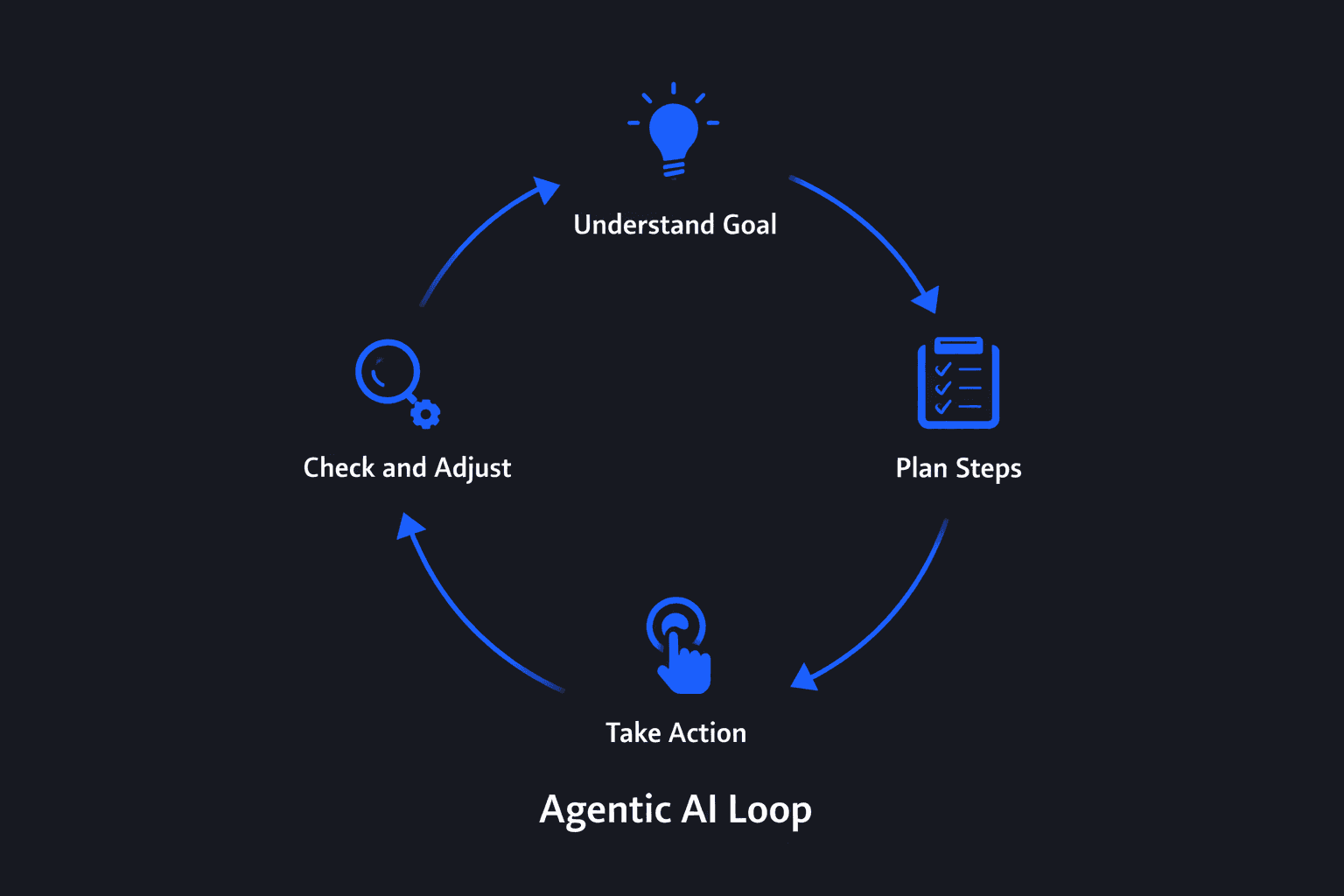
Every agentic AI system runs on a loop of four core actions:
1. Understand the goal. The system interprets your objective and translates it into something it can act on. Not just “make a presentation” but what kind, for whom, with what information.
2. Break it into steps. It maps out a logical sequence. What needs to happen first? What depends on what? This planning layer is what makes agentic AI feel different from a chatbot.
3. Take action. This is where it earns its name. It executes tasks, pulls information, generates content, formats outputs, and makes decisions without you clicking through every step.
4. Check and adjust. The system evaluates its own output. If something is off, it of course corrects. That self-monitoring loop is what makes agentic systems feel less like tools and more like collaborators.
Agentic AI vs. Traditional AI: The Real Difference
The simplest way to put it: traditional AI responds. Agentic AI acts.
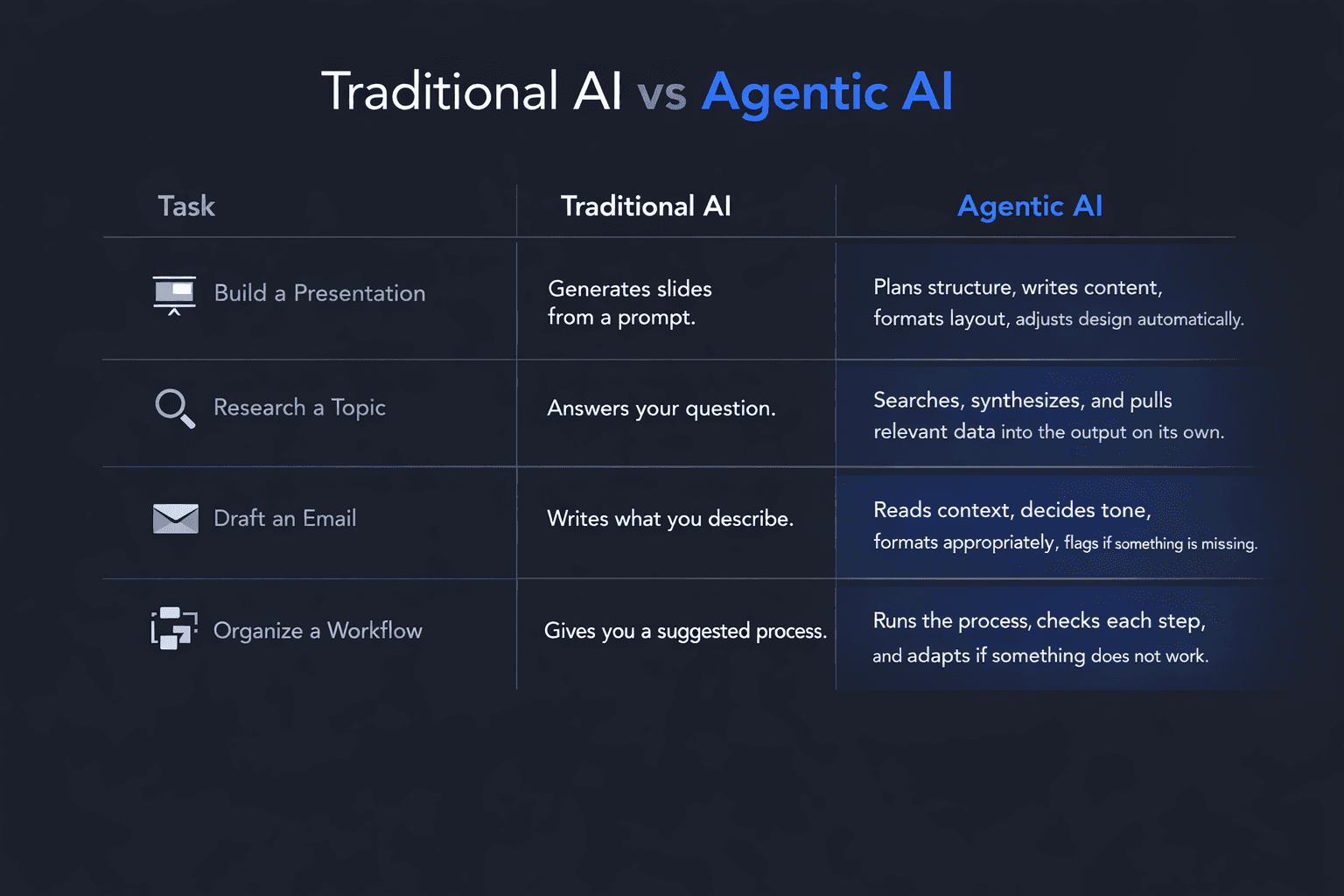
For a simple one-off question, a standard AI model is fine. But for anything involving multiple steps, decisions along the way, or a multi-part output, agentic AI is significantly more capable.
Why This Matters Right Now
For years, AI was passive. It answered questions, generated paragraphs, or suggested edits when asked. Useful, but it still left all the coordination work to you.
Agentic AI shifts that balance. It removes the overhead of managing multi-step tasks manually, which is where most of the time actually goes in knowledge work. Not the thinking, but the sequencing, formatting, adjusting, and following through. A context store helps support this process by preserving relevant information across steps, enabling agents to execute workflows more efficiently and consistently. Not the thinking, but the sequencing, formatting, adjusting, and following through. In customer-facing operations, an AI customer service agent like Chatbase applies this same model — trained on your own business data, it handles Tier-1 queries end-to-end and routes complex cases to humans without manual intervention.
For everyday tasks like drafting emails, organizing data, creating presentations, or running small workflows, agentic AI can handle the process from start to finish.
How Decktopus Uses Agentic AI
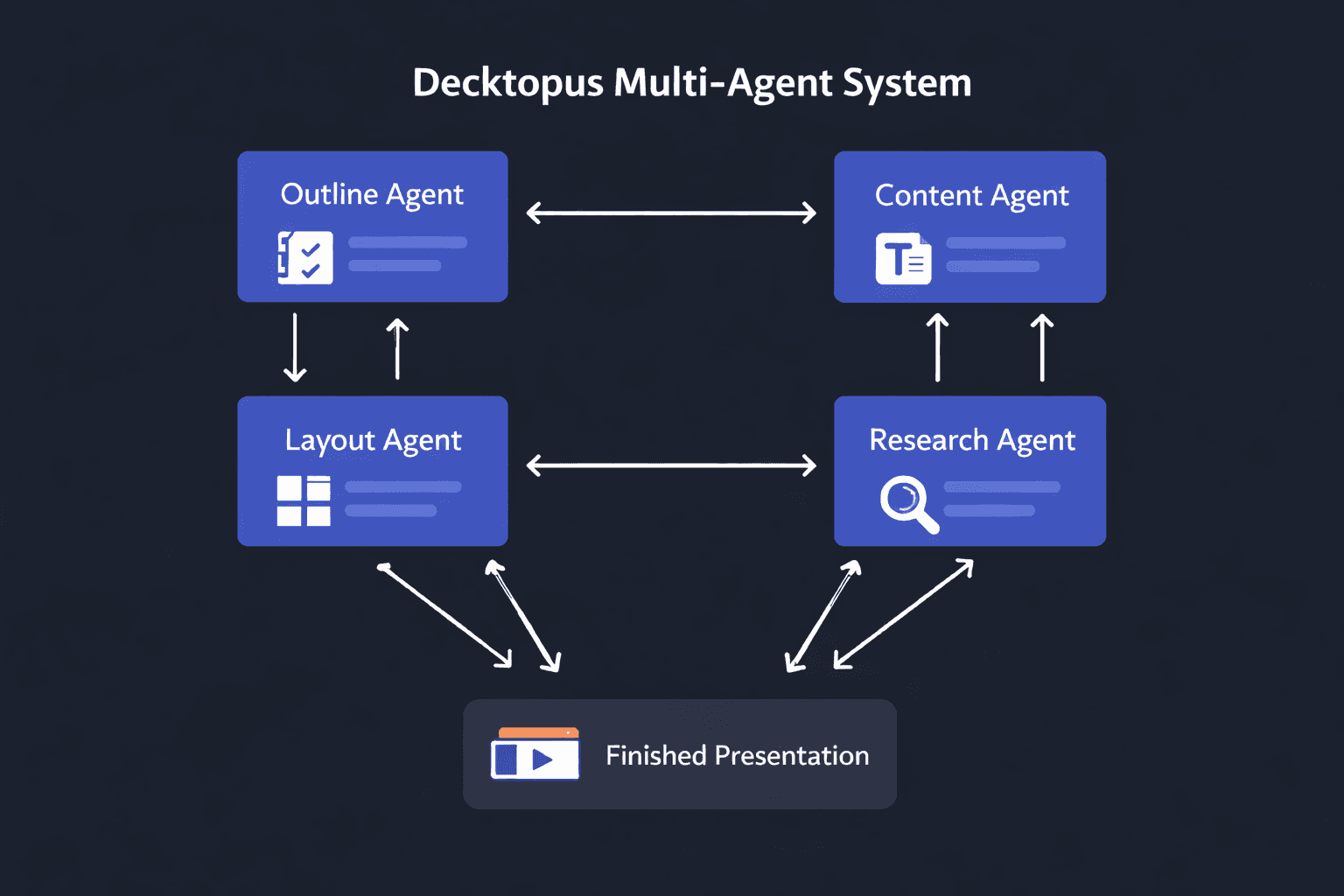
Here is what this looks like in practice. When you type a topic into Decktopus, you are not just triggering one AI model. You are activating a multi-agent system where each agent has a specific role.
Here is what happens behind the scenes:
One agent creates the outline, deciding the logical flow of your presentation based on your topic and goal. Another refines the content, writing and adjusting copy for each slide. A layout agent handles the design, keeping spacing, hierarchy, and visual structure consistent throughout. And when your topic needs more depth, an agent decides on its own whether to pull in online research.
These agents do not work one after the other in a simple chain. They communicate, check each other’s output, and course correct. The result is a presentation that feels thought through, not just generated.
We broke this down in a carousel. Here is a quick look:
[[EMBED:PGEgaHJlZj0iaHR0cHM6Ly93d3cuaW5zdGFncmFtLmNvbS9wL0RSemFRdUFpRVU5LyIgdGFyZ2V0PSJfYmxhbmsiIHJlbD0ibm9vcGVuZXIiIHN0eWxlPSJkaXNwbGF5OmlubGluZS1ibG9jaztwYWRkaW5nOjEycHggMjRweDtib3JkZXI6MXB4IHNvbGlkICNlM2U2ZWE7Ym9yZGVyLXJhZGl1czoxMHB4O3RleHQtZGVjb3JhdGlvbjpub25lO2NvbG9yOiM0ZjYxZmY7Zm9udC13ZWlnaHQ6NjAwO21hcmdpbjoxNnB4IDAiPlZpZXcgdGhpcyBwb3N0IG9uIEluc3RhZ3JhbSDihpI8L2E+]]
For more on how teams are using this in real workflows, check out how to build a team presentation system with AI and our full guide on AI-powered presentation creation.
What Agentic AI Is Not
It is worth being clear about what agentic AI does not mean, because the term gets stretched.
It is not automation in the traditional sense. Automation follows fixed rules. If X happens, do Y. Agentic AI reasons. It can handle situations it has not explicitly been programmed for, because it is working from goals, not scripts.
It is not the same as a smart chatbot. A chatbot responds to what you say. An agent decides what to do next, even when you have not told it.
And it is not magic. Agentic AI still needs clear goals to work well. The more specific your input, the better the output. Think of it like briefing a good employee: vague instructions lead to vague results.
FAQ
Is agentic AI the same as automation?
Not exactly. Traditional automation follows fixed rules: if this happens, do that. Agentic AI reasons through goals. It can handle new situations, make decisions mid-task, and adjust when something does not go as planned. It is more flexible and more capable than rule-based automation.
Do I need to be technical to use agentic AI tools?
No. Tools like Decktopus are built so that anyone can use the benefits of agentic AI without understanding how it works under the hood. You give it a topic or goal, and the system handles the rest.
Is agentic AI safe to use for work?
Yes, for most everyday tasks. The key is using tools that are built with guardrails, so the agents are working within defined boundaries. Decktopus, for example, keeps agents focused on your presentation goal rather than allowing them to take unrestricted actions.
How is agentic AI different from ChatGPT?
ChatGPT is a powerful language model that responds to prompts. It does one thing at a time based on what you ask. Agentic AI systems coordinate multiple steps and decisions to complete a broader goal, often without you prompting each step individually.
The clearest way to understand what agentic AI feels like is to use it. Decktopus is built on a multi-agent system that takes your topic and handles everything from outline to finished slides.
You do not need to manage the steps. That is the point.
Related posts

8 AI Startups That Nailed Their Branding with a .AI Domain
Artificial intelligence continues to reshape the way we live and work. As an essential tool now powering a great number of industries, it’s no surprise that AI is driving a new era of search, too.
AI & Tools

5 Best AI Audio Enhancement Tools in 2026
AI Audio Enhancement Tools: Elevating Your Sound Experience
AI & Tools

AI Checker 2026: Unveiling the Latest in AI Detection Technology - ChatGPT, GPT-3, and Beyond
Explore the power of AI content checkers with our comprehensive guide. Discover how these intelligent tools enhance accuracy and efficiency in various applications. Stay ahead in 2026 with insights on the latest advancements and practical tips for leveraging AI checkers and chatgpt detectors effectively.
AI & Tools