Presentations
How to Start a Presentation: 10 Hooks That Instantly Grab Attention
Want to wow your audience from slide one? Learn 10 powerful ways to open a presentation and build your opening slide with Decktopus in under 2 minutes.


Decktopus Content Team
🧠 The First 30 Seconds of Your Presentation Are Everything
Let’s be honest—most presentations start with a whimper, not a bang.
“Hi, my name is…”
“Thanks for having me…”
“This presentation will cover…”
By the time you’ve finished your intro, your audience is already checking their phone. The truth is: in presentations, first impressions are everything.
In fact, research shows we form judgments about speakers in under a second, and attention spans now average just 8 seconds—shorter than a goldfish’s. If you don’t hook your audience immediately, you risk losing them completely.
That’s why your opening slide isn’t just a formality. It’s your secret weapon.
In this guide, you’ll learn 10 proven ways to start a presentation with impact, and how to build each one in minutes using Decktopus, the AI-powered presentation builder that makes you look like a design genius.

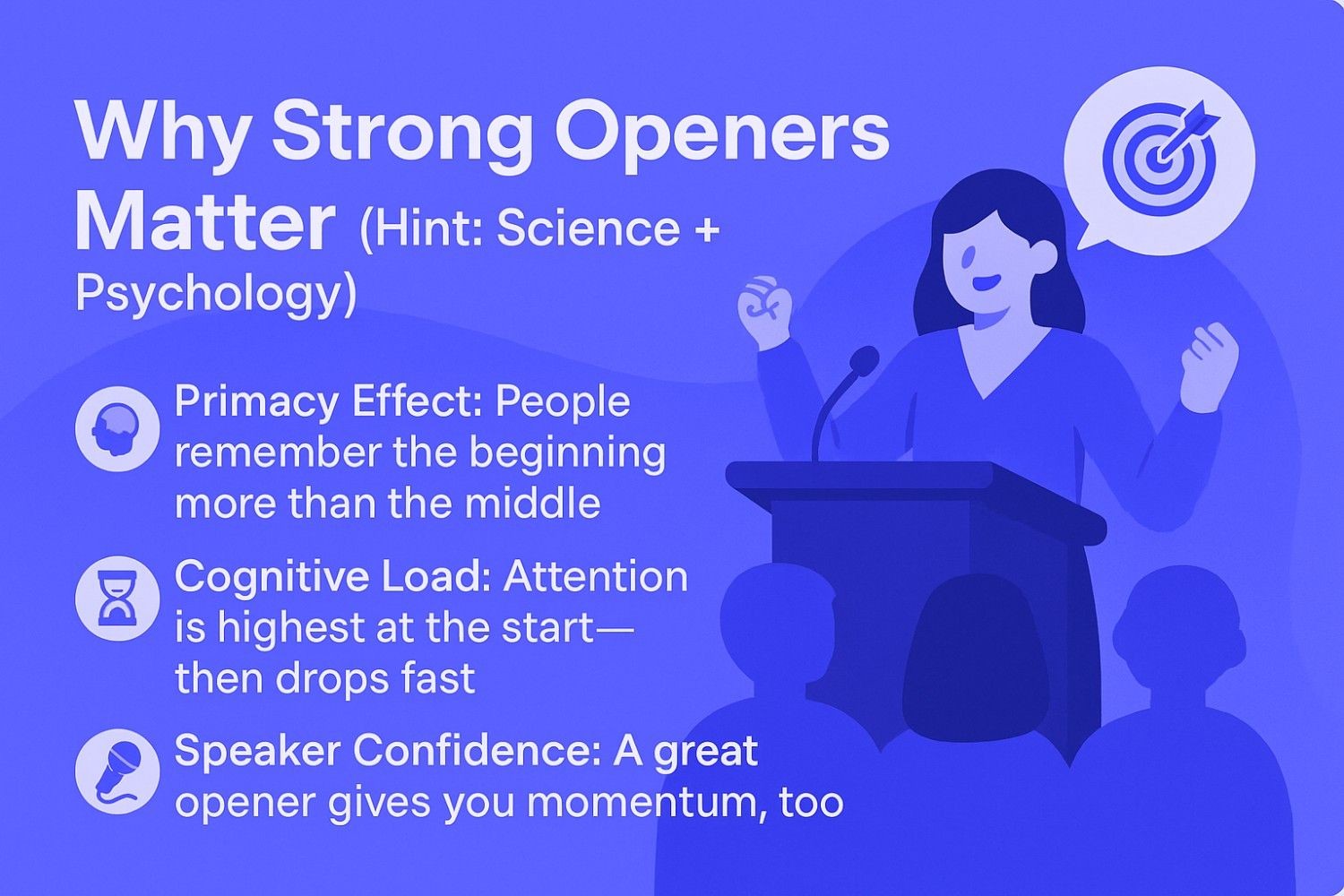
🎯 Why Strong Openers Matter (Hint: Science + Psychology)
Before we jump into the hooks, here’s why the start of your presentation matters so much:
🧠 Primacy Effect: People remember the beginning more than the middle.
⏳ Cognitive Load: Attention is highest at the start—then drops fast.
🎤 Speaker Confidence: A great opener gives you momentum, too.
You don’t need to be a TED speaker to nail this. You just need the right strategy and the right tool.
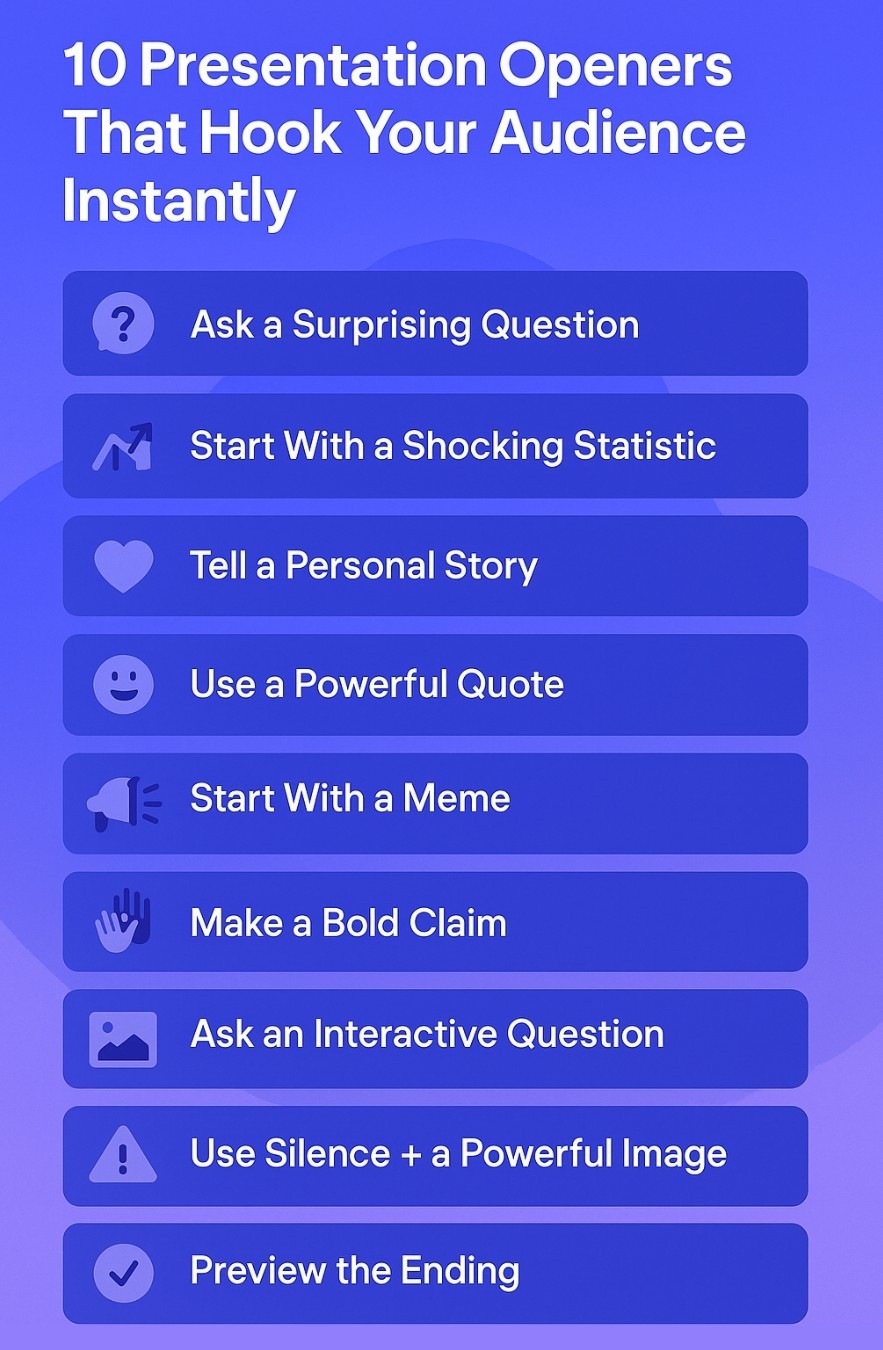
🔟 10 Presentation Openers That Hook Your Audience Instantly
Each of the following techniques includes a real example and the perfect Decktopus template to bring it to life.
1. Ask a Surprising Question
“What if I told you most pitch decks fail before slide two?”
Curiosity activates the brain. The audience leans in, wondering where you’re going.
2. Start With a Shocking Statistic
“The average attention span is now 8 seconds—shorter than a goldfish.”
Cold, hard numbers = instant credibility and emotional reaction.
3. Tell a Personal Story
“Five years ago, I pitched to 12 investors. Only one showed up—and she left early.”
Stories build trust. Vulnerability creates emotional connection.
4. Use a Powerful Quote
“Design is intelligence made visible.” — Alina Wheeler
The right quote sets the tone, builds authority, and previews your message.
5. Start With a Meme or Relatable Visual
Show: chaotic slide full of tiny text
Caption: “My deck before Decktopus.”
Humor is sticky. A visual laugh sets the vibe and keeps things human.
6. Make a Bold Claim
“I’m going to show you how to sell your idea in 3 slides.”
Confidence attracts attention. Then you just have to deliver.
7. Ask an Interactive Question
“How many of you have presented this year?” (hands go up)
Engagement starts with involvement. Make your audience part of the story.
8. Use Silence + a Powerful Image
Show: photo of a burning laptop. Wait 5 seconds.
Silence is disruptive—and it makes visuals speak louder.
9. Show a Visual Problem
Slide 1: Cluttered slide. Slide 2: Beautiful, clean design.
Ask: “Which one would you rather sit through?”
Contrast makes your message memorable.
10. Preview the Ending
“By the end of this, you’ll pitch better than 90% of founders.”
A bold promise up front builds anticipation and purpose.
🎥 Real-Life Examples: 4 Killer Intro Lines That Work
Want to see powerful openers in action?
This short video breaks down four killer intro lines that instantly engage your audience, and backs each one with examples and psychology.
👉 Watch now:
1. Reference a Well-Known Person
Mentioning the struggles or story of someone famous—like J.K. Rowling—shows your audience that success comes from humble beginnings.
🧠 Why it works: It creates inspiration and connection through shared humanity.
2. Tell a Funny Story or Joke
Humor relaxes the room. A quick, tasteful joke builds likability and breaks tension.
🧠 Why it works: People listen to people they like. If they laugh, they’re with you.
Example from the video: “Life is short. If you don’t believe me, ask a butterfly.” – Ellen DeGeneres
3. Use Mystery or Intrigue
Start with a cliffhanger or surprising confession to build anticipation.
🧠 Why it works: Our brains need to close curiosity loops.
Example from the video: “A little over 20 years ago, I did something I regret… something I wish no one knew.”
4. Tell a Relatable Story
Begin with a short story that reflects a universal experience—like a teacher you loved, or your first crush.
🧠 Why it works: Relatable storytelling activates empathy and attention.
🎬 These aren’t just clever tricks—they’re proven psychological tactics. And the best part? You can recreate each one inside Decktopus with our AI-powered opener templates.
👉 Try building one now with Decktopus.
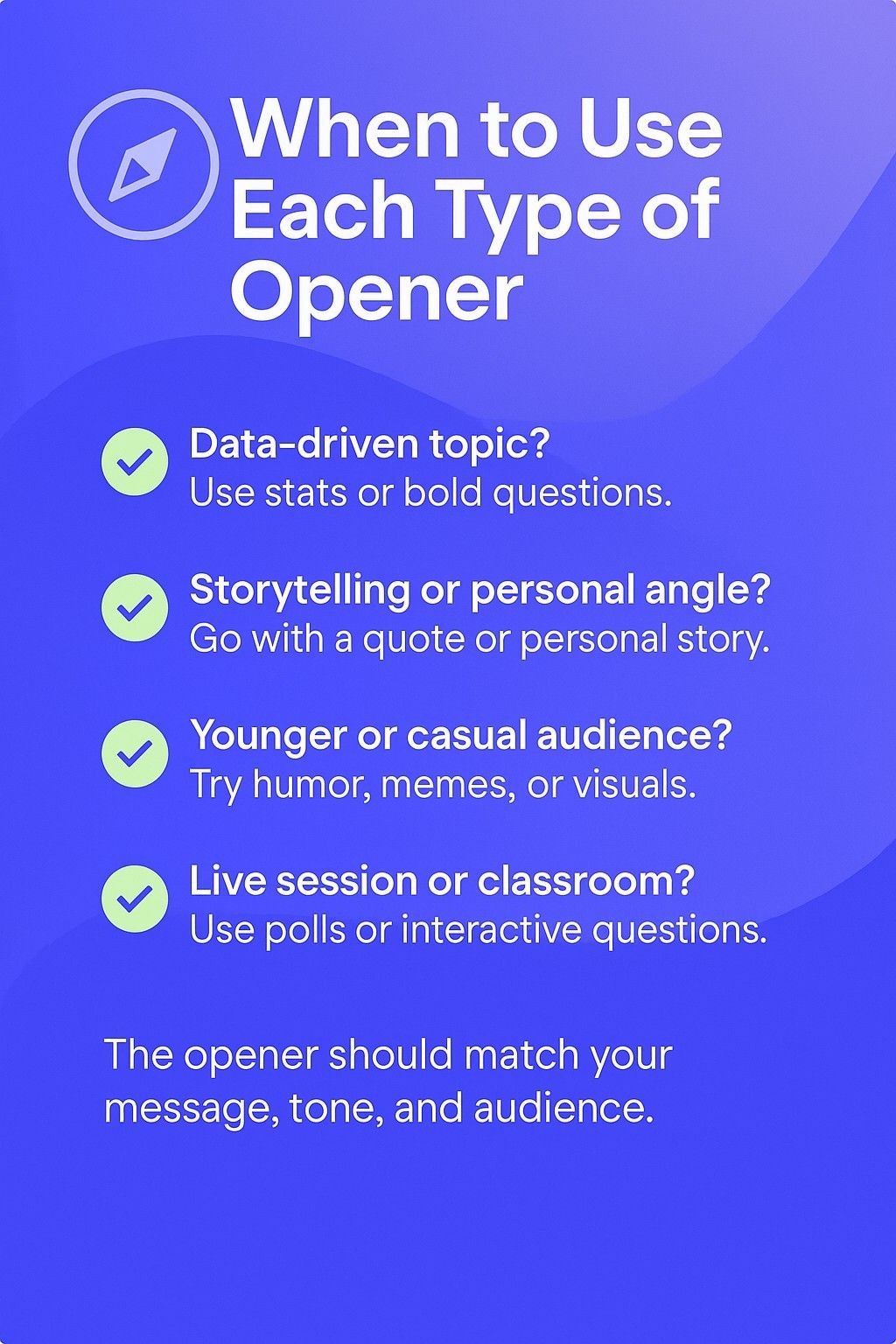
🧭 When to Use Each Type of Opener
Not sure which hook fits your presentation? Here’s a quick guide:
✅ Data-driven topic? Use stats or bold questions.
✅ Storytelling or personal angle? Go with a quote or personal story.
✅ Younger or casual audience? Try humor, memes, or visuals.
✅ Live session or classroom? Use polls or interactive questions.
The opener should match your message, tone, and audience.
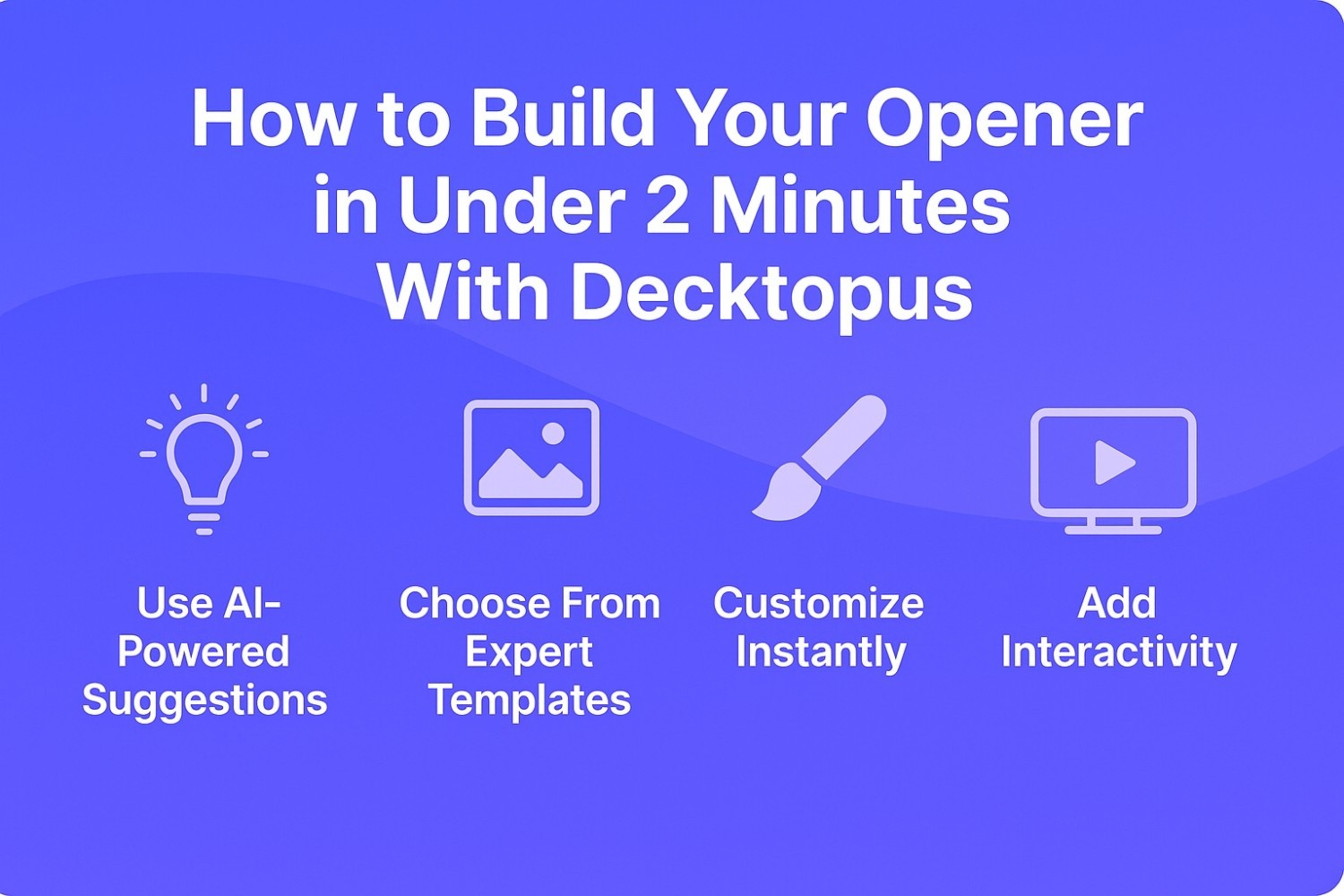
🛠️ How to Build Your Opener in Under 2 Minutes With Decktopus
No need to design from scratch or agonize over formatting. Here’s how Decktopus helps you create magnetic opening slides:
1. Describe Your Topic, Get Your Opening Slide
Tell Decktopus what your presentation is about and it generates a complete, structured deck with your opening slide already in place. No blank slide, no formatting decisions.
2. Refine Your Hook
Type what you want on your opening slide — your stat, your quote, your question — and Decktopus updates the slide instantly. The focus stays on your message, not the design.
3. Adjust Tone and Structure
If the opening needs a different angle, describe the change and Decktopus rewrites the slide around it. Iterate until the hook feels right for your audience.
4. Practice Before You Present
Use Decktopus’s built-in delivery coaching to rehearse your opening and get real-time feedback. A great hook on the slide only works if the delivery lands.
Rehearse Your Opening Hook with Loop AI Delivery Coach
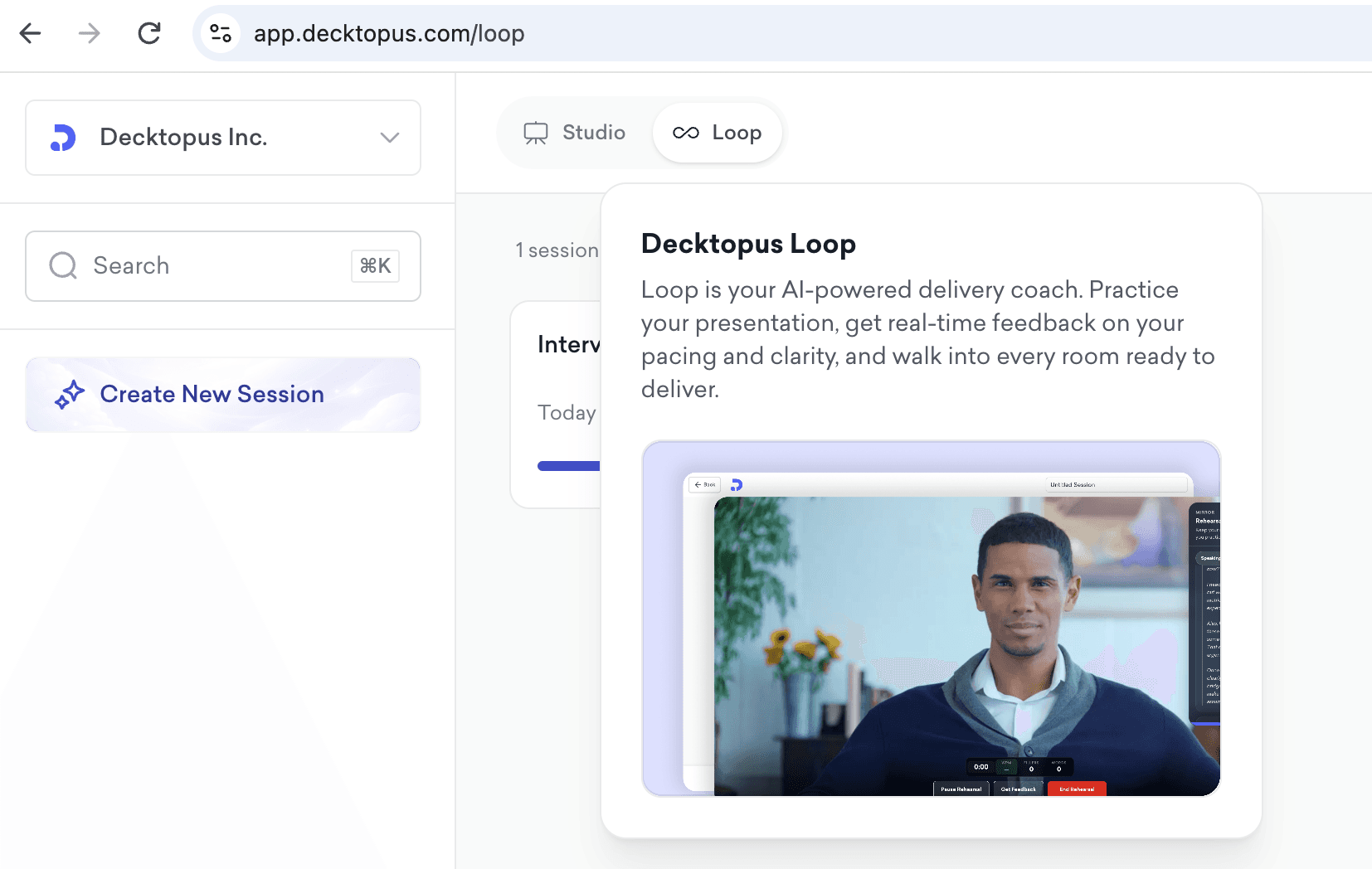
A great hook on the slide is only half the battle. The delivery of that first 30 seconds - your tone, your pacing, the pause after your opening line - is what turns a written hook into a moment the audience remembers.
Loop AI Delivery Coach is Decktopus AI's built-in rehearsal environment for exactly this. Once your opening slide is built, Loop puts you in front of four AI agents that stress-test how the hook actually lands when spoken.
The 4 Loop Agents That Sharpen Your Opener
Profiler (Emily) - Simulates the audience you're actually opening for. If you're opening a pitch to skeptical investors, Emily reacts like a skeptical investor. If you're kicking off a keynote for engineers, her responses mirror that room. She tells you whether your hook lands with the right people, not just in the abstract.
Architect (Marcus) - Reviews the structure of your opening 60 seconds. Flags when the hook takes too long to land, when your transition to slide two is clunky, or when the stat you led with needs more setup to hit.
Red Team - Fires the "wait, what?" questions your bold opening might trigger. If you open with "Most pitch decks fail before slide two," Red Team will ask "based on what data?" - before the real audience does.
Mirror - Records your opening delivery and plays it back with metrics: pace on the first sentence, pause after the hook, filler count in the intro. You'll hear exactly whether your opener sounded confident or rushed.
How to Rehearse Your Hook with Loop
Build the opening slide in Decktopus AI
Open Loop and define your audience persona
Deliver the opening 60 seconds - Emily reacts, Marcus scores flow
Face Red Team's follow-ups on your hook
Review Mirror playback and refine pace, pauses, delivery
Repeat until the opening lands cold, even under pressure
Most presenters run their hook through Loop 2-3 times before a high-stakes talk. It's the difference between hoping the opening works and knowing it does.
Rehearse your next opening with Loop →
🎬 Final Thoughts: Don’t Just Start—Start Strong
Your opener sets the tone for everything that follows. Don’t waste it.
Whether you lead with a surprising stat, a personal story, or a visual punchline, one thing’s clear: your first 30 seconds matter more than your last 10 minutes.
Your audience deserves more than a dull start. Make the first slide unforgettable, so the rest gets heard.
✅ Ready to Hook Your Audience?
Build your first slide in 2 minutes, no design skills needed.
🔗 Keep Learning
Related posts

Webinar Follow-Up Emails: The Sequence That Runs After the Deck Ends
Learn how to build a webinar follow-up email sequence with behavioral segmentation, timely emails, better deliverability, and personalized outreach.
Presentations

Best TED Talks to Improve Your Presentation Skills
Watch ten of the best TED talks for presentation skills and use a practical exercise from each to improve structure, voice, visuals, and confidence.
Presentations

Decktopus AI Best Practices: The Complete Guide, Tips and Tricks (2026)
A complete guide to using Decktopus AI effectively, from writing better prompts and reviewing outlines to rehearsing with Loop and building carousels.
Presentations