Presentations
How to Generate Business Leads: A Complete Guide With Framework
Learn how to generate business leads with a proven 6-step framework, practical tactics, and channel comparisons that actually convert.

Decktopus Content Team
Generating business leads is the process of finding and attracting people who are genuinely interested in what your company sells. It is the first step in every sales pipeline, and it decides how much revenue your team can realistically close in a quarter.
Companies that prioritize lead generation see 133% more revenue than companies that do not, according to research cited by MarketingSherpa. That gap is not about luck. It comes down to having a repeatable process for finding, qualifying, and nurturing the right prospects.
Table of Contents
What Are Business Leads?
Why Business Leads Matter
What Is Lead Generation?
Types of Business Leads
The 6-Step Lead Generation Framework
Practical Tactics for Generating Leads
Lead Generation Channels Compared
Before and After: A Lead Generation Makeover
Common Mistakes to Avoid
How to Build Your Lead Generation Deck with Decktopus AI
Frequently Asked Questions
Conclusion
Stay Connected
What Are Business Leads?
A business lead is any person or company that has shown interest in your products or services. They are not customers yet.
They are simply people who raised their hand in some way. That could be filling out a form, downloading a guide, or replying to an email.

Leads show up in many forms. A referral from a happy customer counts. So does a reply to a cold email or a sign-up for your newsletter.
The common thread is intent. A lead has expressed some level of interest, even if they are not ready to buy today.
Why Business Leads Matter
Leads are the raw material of every sales team. Without a steady flow of them, even the best closers run out of people to talk to.
Leads help you understand your buyers before you ever get on a call. Their behavior tells you what they care about and what problem they are trying to solve.

A strong lead pipeline also protects revenue during slow months. When one channel dries up, a diversified base of leads keeps the pipeline moving.
This works best alongside strong internal workforce development, so the people handling those leads are equipped to convert them.
What Is Lead Generation?
Lead generation is the process of attracting, qualifying, and converting prospects into customers. It combines marketing, content, and outreach into one system.
The goal is not just to collect names. It is to build a pipeline of people who are a genuine fit for what you sell.
A healthy lead generation engine touches every part of a brand's growth strategy, from first impression to closed deal.
Types of Business Leads
Not every lead is at the same stage. Sorting them correctly saves your sales team time and keeps your pipeline organized.
Lead Type | Definition | Best Next Action |
|---|---|---|
Cold Lead | Has had no direct interaction with your brand | Nurture with content, do not pitch yet |
Marketing Qualified Lead (MQL) | Engaged with content, downloaded a resource | Move into an email nurture sequence |
Sales Qualified Lead (SQL) | Ready for a direct sales conversation | Book a call or demo immediately |
Referral Lead | Introduced by an existing customer | Reach out personally within 24 hours |

The 6-Step Lead Generation Framework
Use this framework to build a repeatable system instead of chasing leads one at a time.

Define your ideal customer. Write down the exact job title, company size, and problem you solve best.
Pick two channels, not ten. Focus beats spreading thin across every platform at once.
Create one strong lead magnet. A guide, template, or tool that solves a real, narrow problem.
Build a simple capture process. A form, a landing page, and a clear next step.
Follow up within 24 hours. Response speed is one of the biggest predictors of conversion.
Review and refine monthly. Track which channel and message actually convert, then double down.
Practical Tactics for Generating Leads
Use Social Media With a Plan
Platforms like LinkedIn are strong places to find leads if you show up consistently. Comment on posts in your niche and share your own insights.

A Linktree-style link hub makes it easy for interested visitors to find your offers in one place.
Run Targeted Email Campaigns
Email remains one of the highest-converting lead channels when it is used well. Share useful tips, not just promotions.

Some teams also test cold email outreach tools to reach new prospects directly, especially early on when an audience is still small.
Show Up at Industry Events
In-person events build trust faster than almost any digital channel. Bring a clear one-line pitch and follow up within a day.

Publish Content That Solves Real Problems
Blog posts, guides, and short videos that genuinely help your audience earn trust before you ever pitch.

Pairing helpful content with thoughtful journey mapping makes the entire experience feel personal instead of generic.
Test Paid Advertising Carefully
Paid channels like LinkedIn Ads or Google Ads can speed up lead flow once you know your message works organically. Start small and track cost per lead closely.
Partner With Complementary Businesses
Referral partnerships with businesses that share your audience, but do not compete with you, are one of the most underused lead sources.

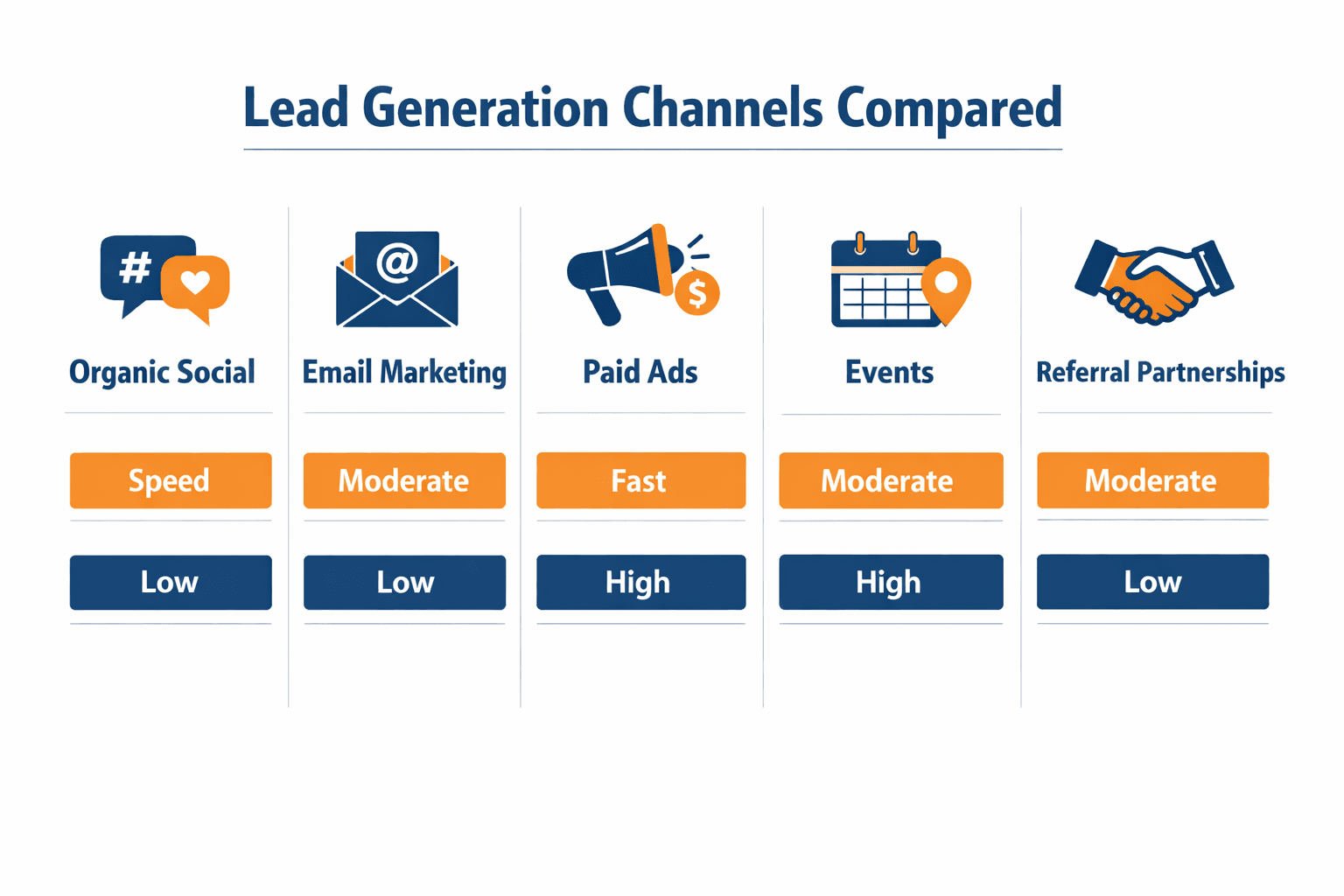
Lead Generation Channels Compared
Channel | Time to First Results | Cost | Best For |
|---|---|---|---|
Organic Social | 4-8 weeks | Low | Building trust over time |
Email Marketing | 2-4 weeks | Low to medium | Nurturing existing contacts |
Paid Ads | Days | Medium to high | Fast, scalable lead volume |
Events and Networking | Immediate | Medium | High-trust, high-value leads |
Referral Partnerships | Weeks to months | Low | High-quality, pre-qualified leads |
Before and After: A Lead Generation Makeover
Before | After |
|---|---|
Posting on five platforms with no clear message | Focused presence on two platforms with a consistent voice |
Generic newsletter with no segmentation | Segmented email sequences based on lead behavior |
Following up with leads after a week or more | Following up within 24 hours of first contact |
No clear lead magnet | One sharp, specific resource tied to a real problem |
Common Mistakes to Avoid
Chasing every channel at once spreads your team too thin to do anything well. Pick a few and commit.
Waiting too long to follow up is one of the most common ways leads go cold. Speed matters more than most teams realize.
Treating every lead the same wastes time on people who are not ready to buy. Segment based on intent and stage.
Skipping the tracking step means you never learn which channel actually works. Review your numbers monthly, not just once a year.
How to Build Your Lead Generation Deck with Decktopus AI
Every lead generation strategy eventually needs to be pitched, whether that is to your leadership team, investors, or a prospective partner. Decktopus AI turns that strategy into a polished deck in minutes instead of hours.
Why Decktopus AI Is Built for Lead Generation Decks
Describe your lead generation plan in a sentence, like "a 6-step B2B lead generation strategy for a SaaS company targeting mid-market clients," and Decktopus AI generates a full outline first, then a complete deck once you approve it.
Brand Import pulls your logo, colors, and typography straight from your company website, so your lead gen strategy deck looks consistent with the rest of your marketing on the first try.
Edit with AI lets you refine slides with plain language prompts like "make the framework section a numbered visual" or "add a slide comparing our top two channels," with a preview before anything is applied.
Decktopus AI vs. Traditional Tools
Task | Traditional Slide Tools | Decktopus AI |
|---|---|---|
Building the outline | Manual, from a blank page | Generated automatically, editable before full build |
Matching your brand | Manual formatting, slide by slide | One-click Brand Import from your website |
Editing content | Manual text and layout edits | Natural language prompts with Edit with AI |
Practicing the pitch | No built-in tool | Loop AI Delivery Coach with real-time feedback |
Who This Is For
This workflow fits sales teams, marketers, and founders who need to pitch a lead generation plan internally or to a client.
Step-by-Step Workflow
Describe your topic, like "our Q3 lead generation plan for the sales team," or upload existing notes via the paperclip icon.
Choose your style: import your brand from your company URL, apply a saved style, or let AI generate one from scratch.
Review the AI-generated outline and adjust section order or titles before generating the full deck.
Generate the full presentation with content, layout, and design complete.
Refine with Edit with AI or Edit Text, with every change tracked in unlimited version history.
Add images by generating custom AI visuals or pulling from the built-in Unsplash and Freepik library.
Rehearse with Loop AI Delivery Coach before you present to leadership or a client.
Export to PDF, PPT, or PNG, share a live link that updates automatically, or present directly in full-screen Presentation Mode.
Get started with Decktopus AI and turn your lead generation strategy into a deck your team can actually use.
Frequently Asked Questions
What is the fastest way to generate business leads?
Paid advertising tends to produce the fastest results, though referral partnerships and warm email outreach convert at a higher rate over time.
How many leads does a small business need per month?
This depends on your close rate and deal size, but a good starting benchmark is enough leads to fill 3 to 5 sales conversations per week.
What is the difference between a lead and a prospect?
A lead has shown some interest, while a prospect has been qualified as a realistic fit for your product or service.
Is cold email still effective for lead generation?
Yes, when it is personalized and targeted at the right audience, cold email remains a reliable and low-cost lead source.
How long does it take to see results from lead generation?
Paid channels can produce leads within days, while organic channels like content and social media typically take 4 to 8 weeks.
What is a marketing qualified lead?
A marketing qualified lead has engaged with your content, such as downloading a guide, but has not yet been vetted by sales.
What is a sales qualified lead?
A sales qualified lead has been vetted and is considered ready for a direct conversation with a salesperson.
How do referrals fit into a lead generation strategy?
Referrals are typically the highest-converting lead source because they come with built-in trust from an existing customer.
Should small businesses use social media for lead generation?
Yes, especially platforms like LinkedIn, which work well for building visibility and credibility with a smaller marketing budget.
What makes a good lead magnet?
A good lead magnet solves one specific, narrow problem quickly, rather than trying to cover too many topics at once.
How often should a lead generation strategy be reviewed?
Monthly reviews work well for most teams, giving enough data to spot trends without overreacting to short-term noise.
Can event networking still generate meaningful leads?
Yes, in-person events often produce higher-trust leads than digital channels because of the face-to-face connection.
What is the biggest mistake companies make with lead generation?
Spreading effort across too many channels at once, rather than focusing on the two or three that fit their audience best.
Conclusion
Generating business leads does not require chasing every channel at once. It requires a clear framework, a few focused tactics, and consistent follow-up.
Start with your ideal customer, pick two channels, and build one strong lead magnet. Review your results monthly and double down on what works.
Once you have a repeatable system, turning that strategy into a compelling deck for your team or leadership becomes the easy part, especially with a tool like Decktopus AI built to speed up exactly that step.
Stay Connected
Follow Decktopus AI for more guides on sales, marketing, and presentation strategy:
Related posts

Webinar Follow-Up Emails: The Sequence That Runs After the Deck Ends
Learn how to build a webinar follow-up email sequence with behavioral segmentation, timely emails, better deliverability, and personalized outreach.
Presentations

Best TED Talks to Improve Your Presentation Skills
Watch ten of the best TED talks for presentation skills and use a practical exercise from each to improve structure, voice, visuals, and confidence.
Presentations

Decktopus AI Best Practices: The Complete Guide, Tips and Tricks (2026)
A complete guide to using Decktopus AI effectively, from writing better prompts and reviewing outlines to rehearsing with Loop and building carousels.
Presentations