Education
100 Argumentative Essay Topics and How to Write a Winning Essay
Explore 100 argumentative essay topics by category, plus a step-by-step writing guide, essay format, examples, and mistakes to avoid.


Decktopus Content Team
What Is an Argumentative Essay?
The Characteristics of a Well-Structured Argumentative Essay
How to Choose a Strong Argumentative Essay Topic
100 Argumentative Essay Topics by Category
How to Write an Argumentative Essay Step by Step
The Argumentative Essay Format
Argumentative vs. Other Essay Types
The 5-Part CLAIM Framework for Persuasive Essays
Example Thesis Statements
Common Mistakes to Avoid
How to Build Your Argumentative Essay Presentation with Decktopus AI
FAQ
Conclusion
Stay Connected
What Is an Argumentative Essay?
An argumentative essay is a piece of academic writing where you take a clear position on a debatable topic and defend it with evidence and reasoning. Its main benefit is that it trains you to think critically and persuade others with facts instead of opinions.
According to the National Assessment of Educational Progress (NAEP), only 27% of U.S. eighth and twelfth graders performed at or above the Proficient level in writing in 2011. Strong argument skills are rare, which is exactly why they stand out in class, in exams, and later at work.
An argumentative essay goes beyond summarizing information or telling a story. It asks you to choose a viewpoint and back it up with strong arguments and supporting data.
That makes it different from an informative essay, which seeks to present facts and details without taking sides. In an argumentative essay, you are having a persuasive conversation with the reader.
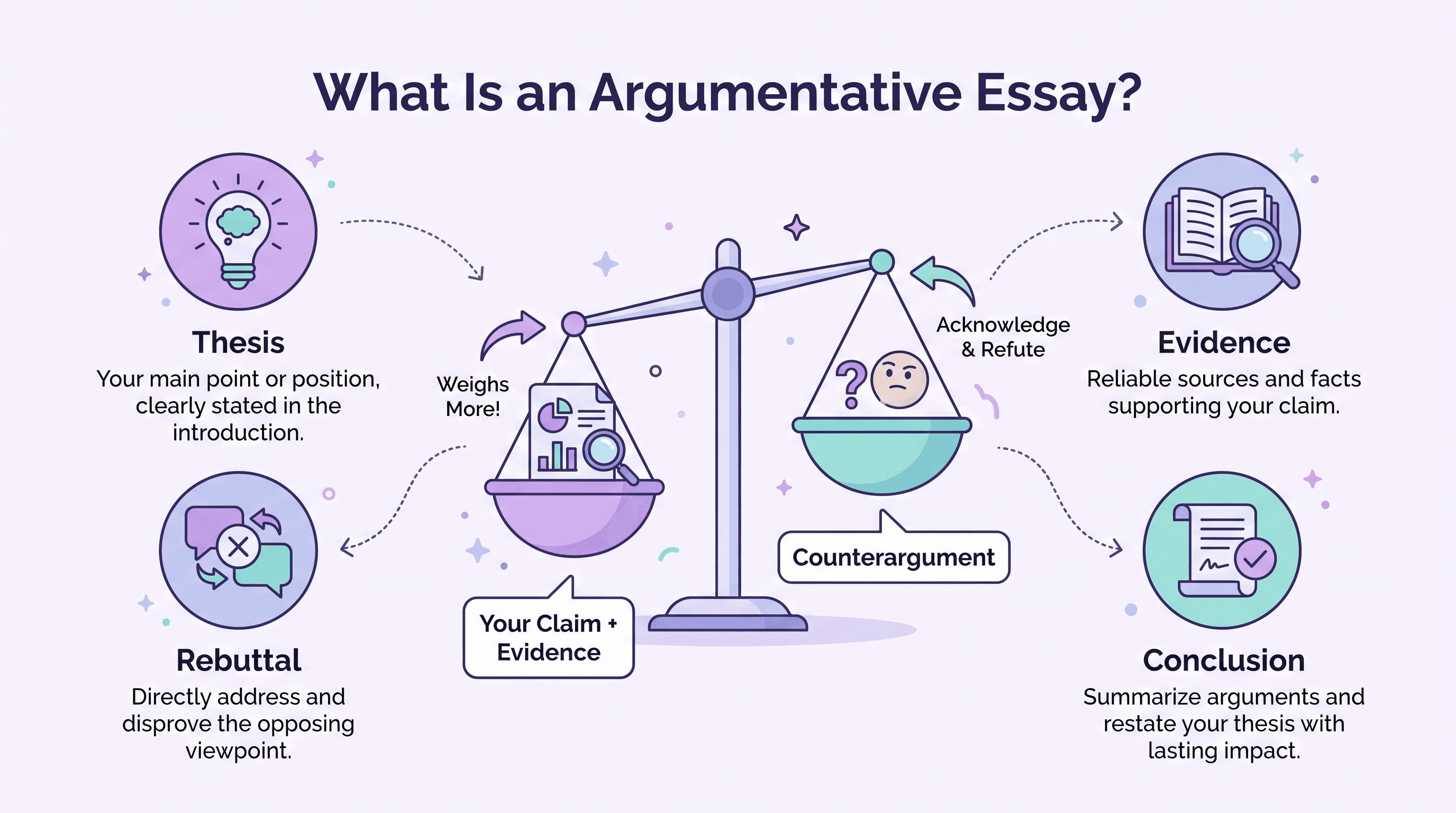
When writing an argumentative essay, the writer must pick a debatable subject and write a clear thesis statement that sums up the main point of contention. The body then works like a structured debate, using examples, data, and reasoning to support one side while addressing the other.
A strong argumentative essay also shows that you understand the subject deeply. This guide gives you 100 topic ideas, a step-by-step writing process, and a framework for building an argument that holds up.
The Characteristics of a Well-Structured Argumentative Essay
An argumentative essay with a strong framework is like a well-built house. Each part has a job, and together they make the whole argument stronger.
Clearly Stated Thesis
A short, precise thesis statement is the foundation of the essay. It states your main claim and tells the reader exactly what you will defend.
Hook and Context in the Introduction
Open with a hook that draws readers in, then give the background they need. End the introduction with your thesis.
Logical and Coherent Structure
Each body paragraph should focus on one idea. Smooth transitions connect those ideas into a single, easy-to-follow line of reasoning.
Supporting Evidence and Examples
Strong evidence carries the argument. Use data, expert views, studies, and real-world cases that directly support your claims.
Recognition of Counterarguments
A good essay admits that other views exist and responds to them. This shows fairness and makes your own position more convincing.
Persuasive Conclusion
The conclusion restates your thesis and explains why it matters. It should leave the reader thinking about your argument.
Appropriate Tone and Language
Use clear, accurate language that suits your audience. A persuasive but respectful tone builds authority and trust.
Careful Revision and Editing
Strong essays go through several rounds of editing. Revision fixes errors, tightens arguments, and improves clarity.
How to Choose a Strong Argumentative Essay Topic
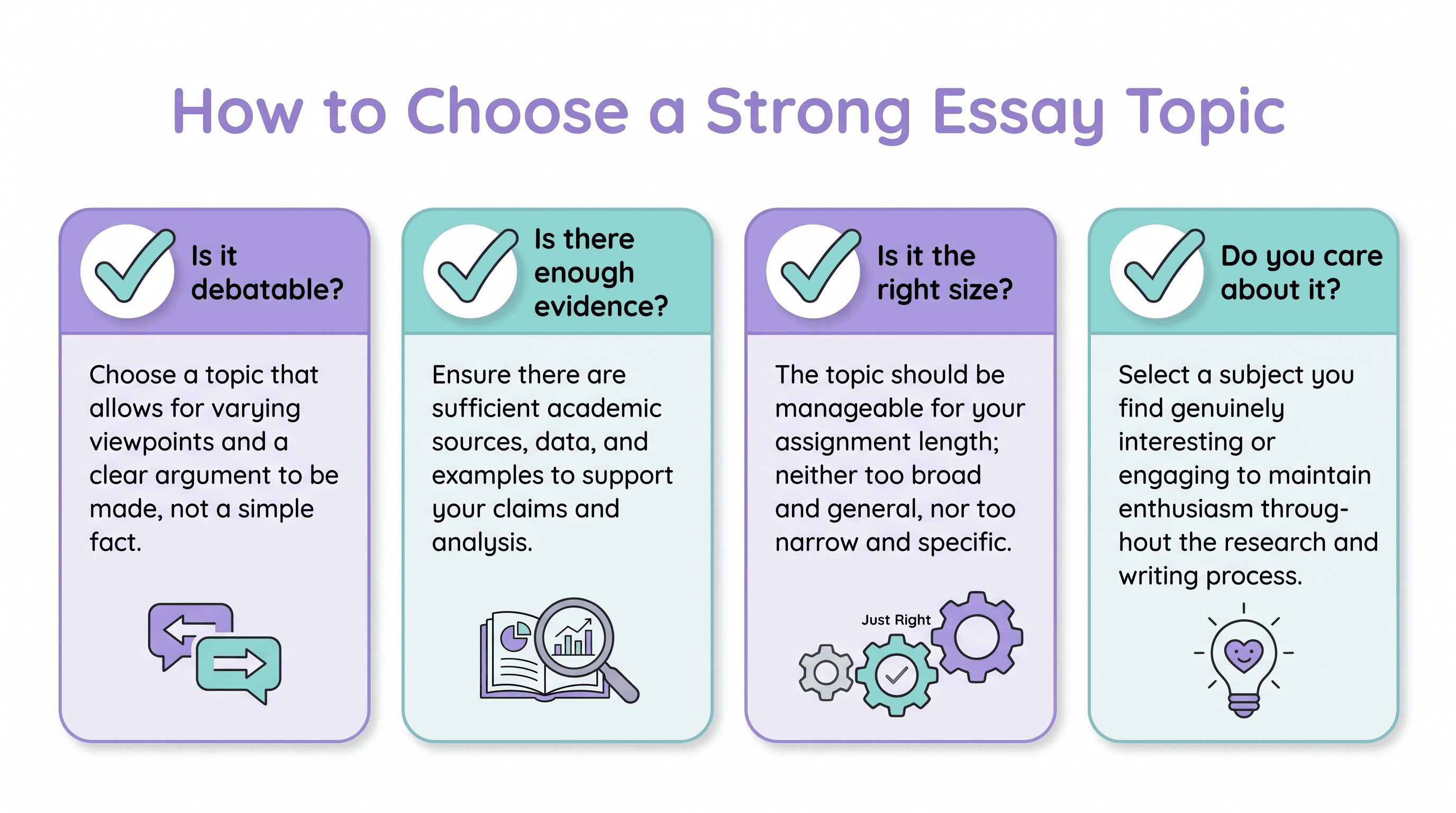
A great topic makes the whole essay easier to write. Before you commit, run your idea through these four checks.
Is it debatable? Reasonable people should be able to disagree. "Pollution is bad" is not debatable, but "Cities should ban cars from downtown areas" is.
Is there enough evidence? You need credible sources on both sides so you can support your view and answer objections.
Is it the right size? Narrow broad topics until you can cover them well in your word count.
Do you care about it? Curiosity makes research easier and your writing more convincing.
100 Argumentative Essay Topics by Category
Here are 100 argumentative essay topics across 10 categories. Use them as they are, or narrow one down to fit your assignment.
Culture and Society Topics
These topics explore how social media, celebrity culture, and cultural trends shape values and relationships.
Has social media done more harm than good to relationships?
Should the voting age be lowered to 16?
Is cultural appropriation in the fashion industry harmful?
Has technology made modern parenting harder?
Does celebrity culture have a negative effect on society?
Does art shape society, or does society shape art?
Is modern feminism inclusive enough?
Is censorship ever justified in the digital era?
Does popular culture have too much influence on young people?
Should influencers be required to label all paid content?
Education Topics
These topics look at how schools teach, test, and prepare students for the future.
Does standardized testing measure student ability accurately?
Should financial literacy be a required school subject?
Does technology in the classroom help or hurt learning?
Are single-gender schools more effective?
Does homeschooling have more advantages than disadvantages?
Should arts education get the same funding as STEM?
Should college tuition be free?
Is online learning as effective as in-person learning?
Are school dress codes necessary or restrictive?
Should students be allowed to use AI tools for homework?
Health and Well-Being Topics
These topics cover diet, mental health, medicine, and the role of government in public health.
Should fast food carry health warnings like tobacco?
Should junk food be banned in schools?
Is a vegan diet healthier than a balanced diet with meat?
Should medical marijuana be legal everywhere?
Is social media harmful to teen mental health?
Should vaccinations be mandatory for school attendance?
Should governments tax sugary drinks?
Is obesity a personal responsibility or a social problem?
Is genetic engineering of humans ethical?
Should schools start later to help students sleep more?
Environment and Sustainability Topics
These topics deal with climate, pollution, animals, and how we use resources.
Should single-use plastic bags be banned?
Should governments fund renewable energy over fossil fuels?
Is deforestation the biggest threat to biodiversity?
Are governments doing enough to protect the environment?
Should zoos be banned?
Is climate change mainly caused by human activity?
Is animal testing ever justified?
Is sustainable living realistic for most families?
Should air travel face stricter environmental rules?
Is overconsumption a bigger problem than overpopulation?
Science and Technology Topics
These topics weigh the benefits and risks of new technology and research.
Is artificial intelligence a blessing or a curse?
Is human cloning ever ethical?
Has the digital age destroyed personal privacy?
Is space exploration worth the cost?
Do video games improve cognitive skills?
Should scientific research ever be restricted?
Can technology solve climate change?
Are self-driving cars safer than human drivers?
Should gene editing be used to prevent disease?
Should social media platforms be responsible for misinformation?
Politics and Government Topics
These topics examine laws, elections, and the power of government.
Should governments regulate the economy more?
Do strict immigration laws help or hurt a country?
Should politicians have term limits?
Is universal basic income a good idea?
Should the Electoral College be abolished?
Is government surveillance worth the loss of privacy?
Does lobbying have too much influence on policy?
Should gun control laws be stricter?
Should campaign spending be limited?
Is the United Nations still effective?
Morality and Ethics Topics
These topics ask hard questions about right and wrong.
Is the death penalty ever justified?
Should animals have the same rights as humans?
Should euthanasia be legal?
Can war ever be ethical?
Should genetic testing results be private?
Is it ever acceptable to lie?
Is assisted reproductive technology ethical?
Should free speech be limited to stop hate speech?
Should humans be genetically enhanced?
Is it ethical to eat meat?
Business and Economics Topics
These topics look at money, work, and how companies behave.
What is the best way to reduce income inequality?
Should the minimum wage be raised?
Does globalization hurt local economies?
Is corporate social responsibility sincere or just marketing?
Should advertising to children be banned?
Should governments bail out failing companies?
Will automation create more jobs than it destroys?
Should monopolies face stricter regulation?
Should cryptocurrencies be regulated like banks?
Should CEO salaries be capped?
Family and Relationships Topics
These topics explore modern families and how people connect.
Should parents be legally responsible for their children's actions?
How does divorce affect children in the long term?
Do children of same-sex parents face unique challenges?
Do family dynamics shape a child's success more than school?
Should grandparents play a bigger role in raising children?
Has online dating improved relationships?
Should children have smartphones before age 13?
Should paid parental leave be required by law?
Is it better for children to grow up with siblings?
Should teenagers have part-time jobs?
Sports and Entertainment Topics
These topics are great for students who want a lively debate.
Should college athletes be paid?
Are esports real sports?
Should violent video games be regulated?
Should performance-enhancing drugs be allowed in sports?
Do streaming services hurt the film industry?
Should contact sports be banned for children?
Do reality TV shows do more harm than good?
Should athletes use their platform for political causes?
Are professional athletes overpaid?
Should music with explicit lyrics be age-restricted?
How to Write an Argumentative Essay Step by Step
Choose a debatable topic. Pick a subject that interests you and sparks discussion. Look at it from several angles before you commit.
Do thorough research. Use books, academic journals, and trusted websites. Take notes on key points, evidence, and counterarguments.
Write a clear thesis statement. Sum up your main claim in one or two sentences. It is the road map for your whole essay.
Write an engaging introduction. Start with a hook, such as a surprising fact, a question, or a quote. Give background, then state your thesis.
Organize your ideas logically. Give each body paragraph one main argument. Start each paragraph with a topic sentence.
Support your claims with evidence. Use a range of sources. Explain how each piece of evidence supports your thesis.
Address counterarguments. Present the strongest opposing views fairly. Then explain why your position still holds.
Keep your tone consistent. Balance formal language with clear, readable sentences.
Write a strong conclusion. Restate your main ideas and why they matter. Do not add new evidence at the end.
[[EMBED:PGlmcmFtZSBzcmM9Imh0dHBzOi8vd3d3LnlvdXR1YmUuY29tL2VtYmVkL29BVUt4cjk0NlNJIiB0aXRsZT0iWW91VHViZSB2aWRlbyIgZnJhbWVib3JkZXI9IjAiIGFsbG93PSJhY2NlbGVyb21ldGVyO2F1dG9wbGF5O2NsaXBib2FyZC13cml0ZTtlbmNyeXB0ZWQtbWVkaWE7Z3lyb3Njb3BlO3BpY3R1cmUtaW4tcGljdHVyZSIgYWxsb3dmdWxsc2NyZWVuIHN0eWxlPSJ3aWR0aDoxMDAlO2FzcGVjdC1yYXRpbzoxNi85O2JvcmRlcjowO2JvcmRlci1yYWRpdXM6MTJweDttYXJnaW46OHB4IDAiPjwvaWZyYW1lPg==]]
The Argumentative Essay Format
Writing a strong argumentative essay requires a mastery of organization and strategy in addition to language skills. Just like a house needs a blueprint, an argumentative essay follows a set format.
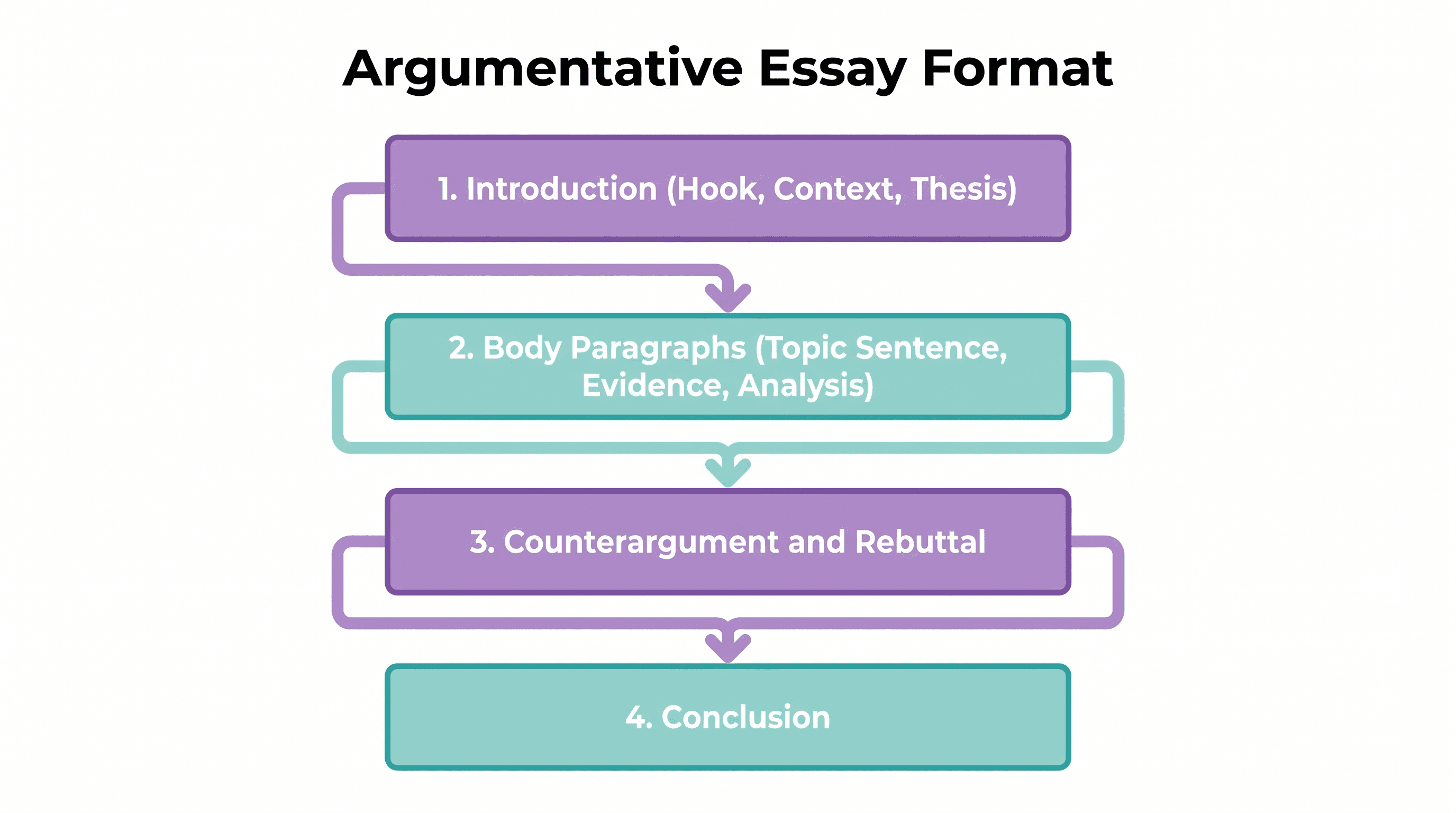
1. Introduction
Hook: Grab attention with a question, a short story, a surprising fact, or a quote.
Context: Give the background readers need to understand the issue.
Thesis: State the position you will defend and the main reasons behind it.
2. Body Paragraphs
Topic sentence: Introduce the main idea of the paragraph.
Evidence: Add data, examples, expert opinions, or first-hand accounts.
Analysis: Explain how the evidence supports your thesis.
Transition: Link the paragraph to the next point.
3. Counterarguments and Rebuttal
Recognition: Present the strongest opposing views fairly.
Rebuttal: Explain why your position is stronger or better supported.
4. Conclusion
Recap: Sum up your main points.
Restate the thesis: Show why your argument matters.
Final thought: End with a memorable line, a thought-provoking question, or a call to action.
Argumentative vs. Other Essay Types
Students often mix up argumentative, persuasive, and expository essays. This table shows the key differences.
Essay Type | Goal | Main Tool | Addresses Other Side? |
|---|---|---|---|
Argumentative | Prove a position with evidence | Research and logic | Yes, always |
Persuasive | Convince the reader to agree or act | Emotion and logic | Sometimes |
Expository | Explain a topic clearly | Facts and examples | No |
Narrative | Tell a story | Description and plot | No |
This second table shows how weak and strong essays compare on each element.
Element | Weak Essay | Strong Essay |
|---|---|---|
Thesis | Vague or states a fact | Clear, debatable claim |
Evidence | Opinions and generalizations | Cited data and expert sources |
Counterarguments | Ignored | Presented fairly and rebutted |
Structure | Ideas jump around | One idea per paragraph with transitions |
Conclusion | Repeats the introduction | Shows why the argument matters |
The 5-Part CLAIM Framework for Persuasive Essays
Use the CLAIM framework to check every argument before you submit. Each letter is one test your essay should pass.
C: Clear thesis. Can a reader repeat your main claim in one sentence?
L: Logical order. Does each paragraph build on the one before it?
A: Authoritative evidence. Is every key claim backed by a credible source?
I: Inclusion of the other side. Did you present and rebut the strongest counterargument?
M: Memorable ending. Does your conclusion explain why the argument matters?
Framework Step | Question to Ask | Quick Fix |
|---|---|---|
Clear thesis | Is my claim specific? | Add "because" and your top reasons |
Logical order | Do ideas flow? | Order points from weakest to strongest |
Authoritative evidence | Is each claim sourced? | Replace opinions with data |
Inclusion of other side | Did I rebut objections? | Add a counterargument paragraph |
Memorable ending | Will readers remember it? | End with a question or call to action |
Example Thesis Statements
Here is how a broad topic becomes a strong, debatable thesis.
Topic: Free college. Thesis: "Public colleges should be tuition-free because it would widen access to education, reduce student debt, and strengthen the workforce."
Topic: Social media and teens. Thesis: "Social media platforms should limit features for users under 16 because constant comparison harms teen self-esteem."
Topic: School start times. Thesis: "High schools should start no earlier than 8:30 a.m. because more sleep improves attention, grades, and safety."
Common Mistakes to Avoid
Choosing a topic that isn't debatable. If no one disagrees, there is no argument.
Writing a weak thesis. A vague claim leads to a vague essay.
Relying on opinion. Every main point needs evidence.
Ignoring the other side. Skipping counterarguments makes your essay look one-sided.
Using unreliable sources. Stick to academic, government, and respected news sources.
Adding new ideas in the conclusion. The ending should wrap up, not open new debates.
Skipping revision. Most essays improve a lot on the second and third draft.
How to Build Your Argumentative Essay Presentation with Decktopus AI
Many teachers ask students to present their argument to the class, or to defend it in a debate. Turning your essay into slides is a great way to practice, because it forces you to reduce each argument to its clearest form.
Once your essay is written, you can turn it into a presentation with Decktopus. Decktopus's AI builds the structure, content, and design for you, so you can spend your time on the argument itself.
Why Decktopus AI Is Built for Student Presentations
AI Presentation Generation. Type "Argumentative presentation: high schools should start later, with 3 arguments and a rebuttal" and get a full deck.
AI Outline Generation. Review each slide as a card before generating, so your thesis, arguments, counterargument, and conclusion are in the right order.
Beautify. Upload your essay or notes and choose Use as a Resource to build a new deck from its key points.
Edit with AI. Ask for changes like "add a slide with the strongest counterargument and my rebuttal."
AI Image Generation and stock images. Add visuals from a description or search Unsplash and Freepik.
Loop AI Delivery Coach. The Red Team stage simulates your audience and asks tough, topic-specific questions one at a time, so you can practice defending your position before class.
Presentation Mode and export. Present full-screen from Decktopus AI, or export to PDF, PPT, or PNG on Pro and Business plans.
Students get 50% off all plans with the code SUPPORTEDUCATION.
Decktopus AI vs. Traditional Tools for Class Presentations
Task | Traditional Slide Tools | Decktopus AI |
|---|---|---|
Turn an essay into slides | Copy and paste by hand | Upload it and use Beautify |
Structure the argument | Start from a blank slide | Reviewable AI outline |
Design | Manual formatting | Designed deck in minutes |
Prepare for rebuttals | Practice alone | Loop Red Team asks tough questions |
Rehearse delivery | No feedback | Loop Mirror gives a Readiness Score |
Who This Is For
High school and university students preparing debate or class presentations
Teachers building lessons on argument and persuasion, with ideas from our education templates
Debate club members practicing rebuttals
Anyone who needs an online presentation maker for school
Step-by-Step: Build Your Argumentative Essay Presentation
Describe your topic. Type something like "Should college athletes be paid? Thesis, three arguments, one counterargument, and rebuttal." Or upload your essay via the paperclip icon. With Beautify, choose Use as a Resource (extract key points and build a new deck with a required prompt) or Redesign (keep your text and structure, apply a new design).
Choose your style. Pick a saved brand or style, import a brand from a website URL, or create a new style from a base (Minimal, Bold, Dark, or Let AI pick).
Review the AI-generated outline. Each slide appears as a card. Edit, reorder, duplicate, or delete slides, and use the Adjust button to change your style.
Generate the full presentation. Decktopus AI creates the complete deck with content, layout, and design.
Refine with Edit with AI or Edit Text. Try "make the thesis slide shorter," "add a statistic slide for my second argument," or "simplify the language for a 9th-grade class." AI optimizes your prompt and checks with you before applying, with preview and undo. Use Edit Text for manual changes (5 credits per edit). Unlimited version history keeps every change.
Add images. Generate AI images, upload photos via the paperclip icon, or search Unsplash and Freepik.
Rehearse with Loop AI Delivery Coach. The Profiler gathers context about your class or debate, The Architect shapes your narrative and speaking notes, The Red Team asks tough questions, and The Mirror scores your rehearsal on pacing, filler words, and more.
Export or share. Export to PDF, PPT, or PNG (Standard or Compressed). Share a live link that updates automatically, embed the deck, or present in full-screen Presentation Mode. Use Deck Analytics to see who viewed your shared deck and which slides held attention.
Ready to turn your argument into a presentation? Get started with Decktopus AI.
FAQ
[[EMBED:PGRpdiBzdHlsZT0ib3ZlcmZsb3cteDphdXRvO21hcmdpbjoyMHB4IDAiPjx0YWJsZSBzdHlsZT0id2lkdGg6MTAwJTtib3JkZXItY29sbGFwc2U6Y29sbGFwc2U7Zm9udC1zaXplOjE1cHg7bWFyZ2luOjhweCAwIj48dHI+PHRoIHN0eWxlPSJib3JkZXI6MXB4IHNvbGlkICNlM2U2ZWE7cGFkZGluZzoxMHB4IDE0cHg7dGV4dC1hbGlnbjpsZWZ0O2JhY2tncm91bmQ6I2Y0ZjZmODtmb250LXdlaWdodDo2MDAiPkFuc3dlcnM8L3RoPjx0aCBzdHlsZT0iYm9yZGVyOjFweCBzb2xpZCAjZTNlNmVhO3BhZGRpbmc6MTBweCAxNHB4O3RleHQtYWxpZ246bGVmdDtiYWNrZ3JvdW5kOiNmNGY2Zjg7Zm9udC13ZWlnaHQ6NjAwIj5RdWVzdGlvbnM8L3RoPjwvdHI+PHRyPjx0ZCBzdHlsZT0iYm9yZGVyOjFweCBzb2xpZCAjZTNlNmVhO3BhZGRpbmc6MTBweCAxNHB4O3RleHQtYWxpZ246bGVmdDt2ZXJ0aWNhbC1hbGlnbjp0b3AiPldoYXQgaXMgYW4gYXJndW1lbnRhdGl2ZSBlc3NheT88L3RkPjx0ZCBzdHlsZT0iYm9yZGVyOjFweCBzb2xpZCAjZTNlNmVhO3BhZGRpbmc6MTBweCAxNHB4O3RleHQtYWxpZ246bGVmdDt2ZXJ0aWNhbC1hbGlnbjp0b3AiPkFuIGFyZ3VtZW50YXRpdmUgZXNzYXkgaXMgYSB0eXBlIG9mIHdyaXRpbmcgaW4gd2hpY2ggdGhlIHdyaXRlciBhZG9wdHMgYSBwb3NpdGlvbiBvbiBhIGdpdmVuIHN1YmplY3QsIHByb3ZpZGVzIHJlYXNvbnMgYW5kIHByb29mIHRvIGJhY2sgdXAgdGhhdCBwb3NpdGlvbiwgYW5kIHRoZW4gYXR0ZW1wdHMgdG8gcGVyc3VhZGUgdGhlIHJlYWRlciB0byBhZ3JlZSB3aXRoIHRoZW0uPC90ZD48L3RyPjx0cj48dGQgc3R5bGU9ImJvcmRlcjoxcHggc29saWQgI2UzZTZlYTtwYWRkaW5nOjEwcHggMTRweDt0ZXh0LWFsaWduOmxlZnQ7dmVydGljYWwtYWxpZ246dG9wIj5Ib3cgY2FuIEkgcGljayBhIHN0cm9uZyB0b3BpYyBmb3IgbXkgYXJndW1lbnRhdGl2ZSBlc3NheT88L3RkPjx0ZCBzdHlsZT0iYm9yZGVyOjFweCBzb2xpZCAjZTNlNmVhO3BhZGRpbmc6MTBweCAxNHB4O3RleHQtYWxpZ246bGVmdDt2ZXJ0aWNhbC1hbGlnbjp0b3AiPlRoaW5rIG9mIHN1YmplY3RzIHRoYXQgcGlxdWUgeW91ciBjdXJpb3NpdHksIGFyZSBkZWJhdGFibGUsIGFuZCBoYXZlIHBsZW50eSBvZiByZXNlYXJjaCBpbmZvcm1hdGlvbi4gU2VsZWN0IHRvcGljcyB0aGF0IHdpbGwgaW50ZXJlc3QgeW91ciByZWFkZXJzIGFuZCBmb3J3YXJkIHRoZSBnb2FsIG9mIHlvdXIgZXNzYXkuPC90ZD48L3RyPjwvdGFibGU+PC9kaXY+]]
What is a good argumentative essay topic?
A good topic is debatable, interesting to you, and backed by enough credible evidence on both sides. It should also be narrow enough to cover well in your word count.
How long is an argumentative essay?
Most school essays are five paragraphs or about 800 to 1,200 words. College essays are often longer, so always check your assignment.
What are the 5 parts of an argumentative essay?
The five parts are the introduction, thesis, body paragraphs with evidence, counterargument and rebuttal, and conclusion.
What is the difference between argumentative and persuasive essays?
An argumentative essay relies mainly on evidence and logic and always addresses the other side. A persuasive essay can lean more on emotion to convince the reader.
How do I write a strong thesis statement?
State a specific, debatable claim and add your main reasons. A simple formula is "X should happen because of A, B, and C."
How many sources should an argumentative essay have?
Aim for at least three to five credible sources for a short essay. Longer research essays usually need more.
Where do counterarguments go in an argumentative essay?
Most writers place the counterargument just before the conclusion. You can also address objections inside each body paragraph.
Can I use "I" in an argumentative essay?
Many teachers prefer third person for a more formal tone. Check your assignment guidelines, since some instructors allow first person.
What are easy argumentative essay topics for beginners?
Try familiar topics like school start times, school uniforms, homework limits, or phones in class. They are easy to research and relate to.
What makes an argumentative essay persuasive?
Clear logic, strong evidence, and a fair response to the other side. A confident, respectful tone also helps.
How do I end an argumentative essay?
Restate your thesis in new words, sum up your main points, and explain why the issue matters. Finish with a strong final thought or call to action.
Can I turn my argumentative essay into a presentation?
Yes. Upload your essay to Decktopus AI and use Beautify to build a presentation from its key points, then rehearse with Loop AI Delivery Coach.
How can I practice defending my argument?
Ask a friend to play the other side, or use Loop AI Delivery Coach. Its Red Team stage asks challenging questions and gives feedback on each answer.
Conclusion
Argumentative essays teach one of the most useful skills you can learn: making a clear claim and defending it with evidence. The 100 topics above give you a starting point for almost any class or interest.
Choose a debatable topic, write a sharp thesis, support it with credible sources, and take the other side seriously. Then run your draft through the CLAIM framework before you submit.
When it is time to present your argument, make your slides as strong as your writing. Get started with Decktopus AI and rehearse your rebuttals before you face the class.
Stay Connected
Follow Decktopus AI for more writing and presentation tips:
Related posts

[UPDATED] 8 Niche Areas for Online Courses for 2026
79% of online students said that they preferred online learning to in-school education. What’s more, the e-learning industry is expected to reach 325 billion dollars of value by 2025. As a result, many people dove into online learning systems. Check out these online course domains!
Education

A Conversation on How Decktopus Can Help Ease Student Life for Engineers
In an extended interview with the Vitruvian organizing team, we were able to identify the growing need for a tool or platform for presentation and document creation that would alleviate the time and stress involved for organizations like these.
Education

A Message to Students and Teachers: Decktopus is here to help!
Studies have shown that teachers are spending at least 3.5 billion dollars on class materials and supporting equipment every year. Does that sound fair? Decktopus didn’t think so!
Education