Other
How to Make Your Business More Adaptable in a Fast-Changing World
Most businesses don't fail because the market changed — they fail because they couldn't change with it. Learn the concrete steps to build real adaptability into your decision-making, operations, people, and culture.

Decktopus Content Team
Most businesses do not fail because the market has changed. They fail because they could not change with it. That distinction matters because one is a problem you cannot control, and the other is one you can actually do something about.
Business adaptability comes down to a set of concrete decisions about how you structure your teams, run your operations, and grow your people. When those decisions are made deliberately, you end up with a business that can absorb shocks, respond to new information, and keep moving. When they are not, you end up permanently one disruption away from a crisis.
This article is about what you can actually change, starting now.
Find Out Where Your Business Actually Gets Stuck
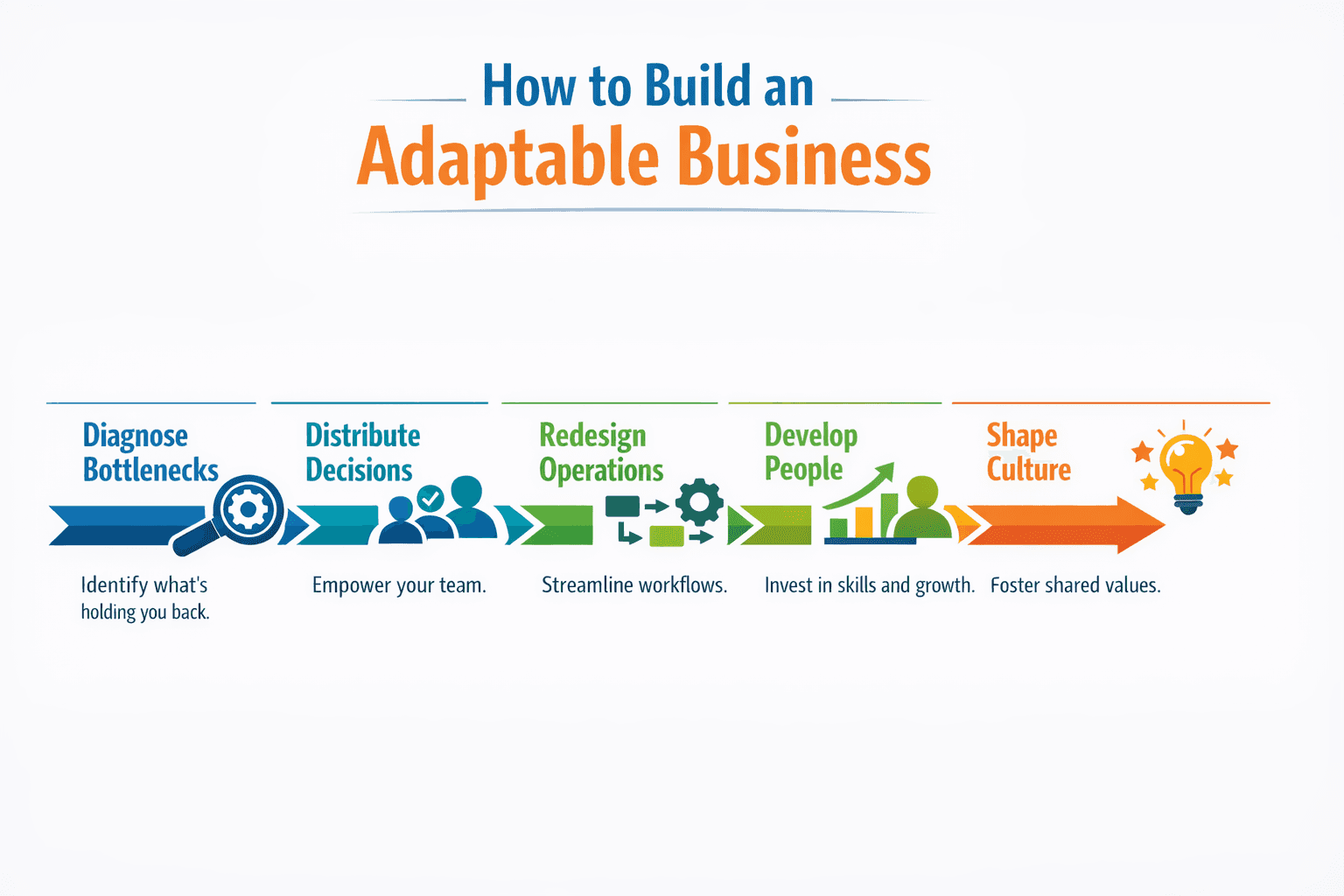
Before making any changes, you need to know where the rigidity lives. Most leaders have a rough sense that their organization is slow or stuck, but they misdiagnose the cause. They blame people when the real issue is the process. They redesign the org chart when the real issue is information flow. They run culture workshops when the real issue is that failure is still quietly punished.
A useful starting point is four questions:
Where do decisions stall? Is it unclear who owns them, or do approvals require people too far removed from the actual work?
Where do problems surface late? Which issues do you typically find out about after they have already compounded, and what blocked earlier detection?
Where has your team stopped experimenting? Which parts of the business run on assumptions that have never been tested?
Where is critical knowledge trapped? Are key processes locked inside specific people rather than documented and shared?
The answers will point you toward the highest-leverage places to start. Business adaptability gets built by fixing the specific bottlenecks that slow down sensing and responding, and those bottlenecks are rarely where leadership assumes they are.
Worth trying: Run this diagnostic not just with your leadership team, but with the people closest to day-to-day operations. Frontline employees almost always know where the real friction points are. They just rarely get asked.
Push Decision-Making Closer to the Work
The speed of response depends almost entirely on where in the organization decisions are made. If every significant call has to travel up the hierarchy for approval and back down again, you are structurally slow regardless of how capable your people are.
The aim is to put decision-making authority as close as possible to the people with the most relevant information, while making sure those people have what they need to actually use it. Leadership oversight stays in place; what changes is where the weight of everyday calls lands.
Map Who Decides What, Then Write It Down
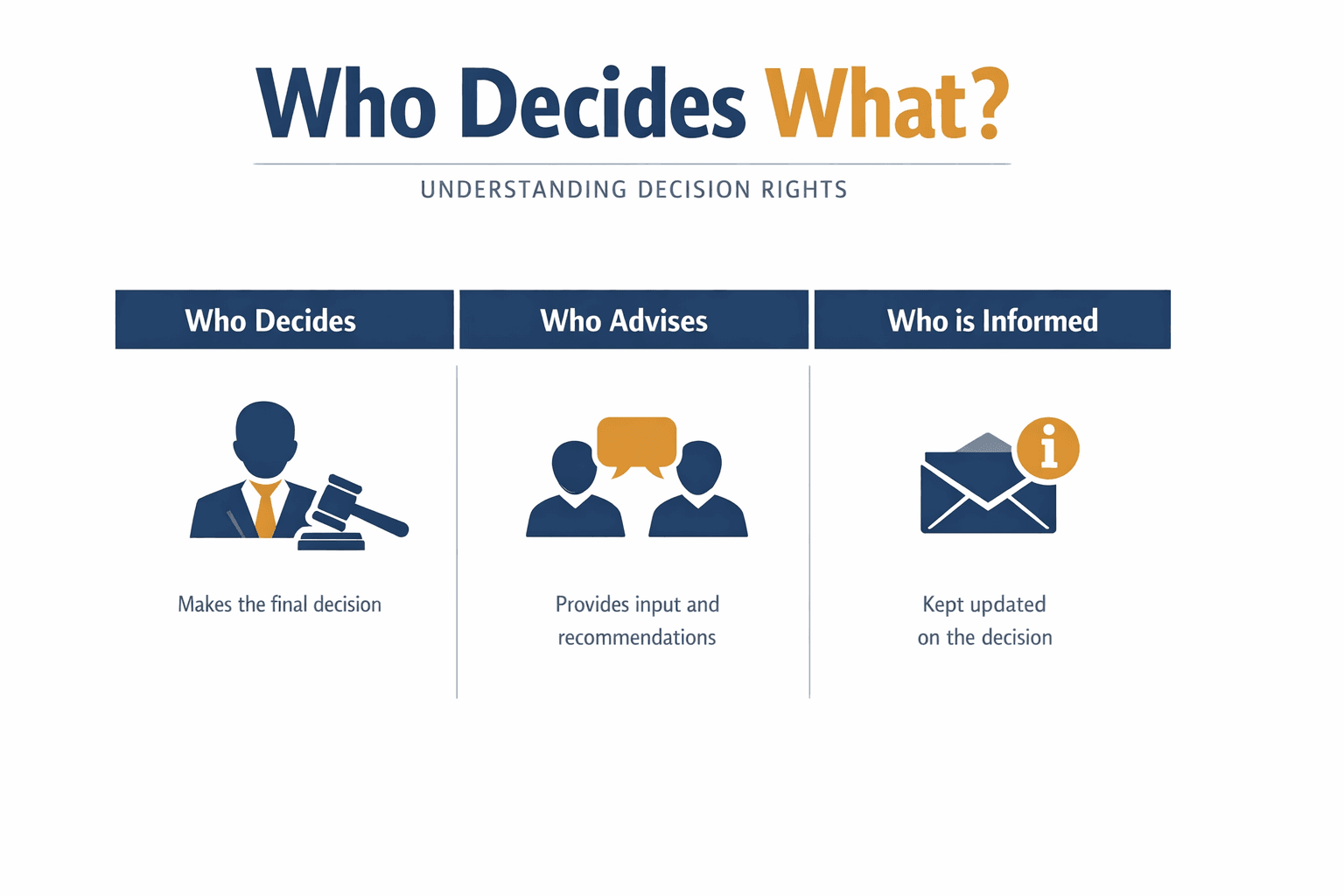
One of the most practical tools for improving business adaptability is a decision rights framework. For each major category of decision, define:
Who decides: The single person accountable for making the call.
Who advises: The people whose input should be sought before deciding.
Who is informed: The people who need to know the outcome, but not necessarily before it happens.
Most businesses have never made these distinctions explicit, which means decisions get delayed by unnecessary consultation or are made by people without the right context. Writing it down and sharing it widely removes a surprising amount of friction.
Note: This framework is sometimes called a RACI matrix in project management circles (Responsible, Accountable, Consulted, Informed). It has been around for decades precisely because it works. If your organization already uses RACI for projects but not for ongoing operational decisions, that gap is worth closing.
Stop Gatekeeping Data
Distributed decision-making only works when the people making decisions have access to the right information. If your team has authority on paper but has to wait days for a report or route a basic question through another department to get a number, that authority is functionally useless.
Audit what your frontline teams and mid-level managers can actually access in real time, and close the gaps. The more clearly people can see what is happening, the faster they can act without waiting to be told.
Design Operations That Bend Before They Break
Operational adaptability is the difference between a business that absorbs a sudden demand spike, a supply chain disruption, or a shift in customer expectations, and one that seizes up. Efficiency matters, but efficiency optimized for one set of conditions makes you brittle the moment those conditions change.
Do Not Tune Everything for Best-Case Conditions
Many businesses design their operations around the assumption that things will stay roughly the same. Headcount is sized for current volume. Supplier relationships are built around a single source. Processes are tuned for the most common case with no slack for variation.
Redundancy and flexibility built into operations work like insurance, and like most insurance, you do not appreciate them until you need them. In practice, that might look like:
Maintaining relationships with backup suppliers before you need them
Designing processes with modular steps that can be paused, accelerated, or handed off without a full rebuild
Keeping a small reserve of capacity, in bandwidth or budget, specifically for absorbing unexpected demands
Cross-training team members so that key tasks do not depend on a single person
Tighten the Loop Between Action and Feedback
One of the most underrated changes a business can make is compressing the time between doing something and finding out whether it worked. The longer that gap, the more you invest in a direction that might need to change, and the harder the correction becomes.
This applies everywhere. How quickly do you get real data after a product or process change? How often do you get honest input from your team on what is and is not working? Are you reviewing market signals weekly or quarterly?
Shorter feedback cycles rarely require more effort. They usually require changing when you look at information you are already collecting. A workable rhythm: weekly operational check-ins at the team level, monthly strategic reviews at the leadership level, and a continuous process for surfacing customer signals rather than waiting for a periodic survey.
Use Technology to Speed Up Where It Actually Matters
Technology does not make a business adaptable on its own. But the right tools, used well, remove the friction that makes adaptation slow and expensive. The key word is remove. The best technology investments here are the ones that make existing decisions faster and clearer, not the ones that add new systems to manage.
The most useful categories for an adaptable business:
Visibility tools: Real-time dashboards and analytics that give teams a clear picture of what is happening, so decisions are based on current reality rather than last month’s report.
Coordination tools: Platforms that cut the time required to get the right people aligned on a decision or a direction change.
Automation of routine work: Taking repetitive, rule-based tasks off people’s plates so they have capacity for the non-routine situations that need actual judgment.
Forecasting and scenario tools: Tools that help leadership think through how different external conditions would affect the business before those conditions arrive.
AI Is Already Changing What Is Possible Here
A few years ago, meaningful AI adoption in business required significant technical investment and a dedicated data team. That bar has dropped considerably, and it is worth being specific about where AI is actually useful for adaptability rather than treating it as a general-purpose answer to everything.
The strongest current use cases are:
Demand forecasting: AI models pick up on patterns across more variables than traditional forecasting methods, which means fewer inventory surprises and better resource planning.
Anomaly detection in operations: Instead of waiting for a metric to cross a threshold someone set manually, AI tools can flag unusual patterns in real time, before the problem compounds.
Processing customer signals at scale: Feedback, reviews, support tickets, and behavioral data all contain useful information that most businesses never fully read. AI can surface the patterns that matter without requiring someone to manually review thousands of data points.
Faster experimentation: AI-assisted tools can help teams design, run, and analyze tests more quickly, which shortens the feedback cycles that adaptability depends on.
The question most teams run into is not whether these tools are useful, but which problems are worth solving with them versus simpler methods. That is often where companies turn to AI consulting services, less to get a technology recommendation and more to get a clear-eyed read on where the complexity is justified and where it is not.
Done well, it tends to save businesses from both under-investing in AI where it would genuinely help and over-investing in it where it would just create more overhead.
The broader caution still stands: technology amplifies what your organization already does. Sort out the underlying process first, then use technology to extend it.
Hire and Develop People Who Can Work With Uncertainty
Processes and systems can only take you so far. At some point, an adaptable business depends on whether the people in it can think clearly and act well in situations they have never encountered before. That is a capability worth building deliberately.
Look for People Who Have Had to Figure Things Out
Technical skills age. The ability to learn in unfamiliar situations, reason under uncertainty, and update your approach based on new information tends to last much longer. When evaluating candidates, look for a range: people who have succeeded in more than one context, who have genuinely changed their mind about something and can explain why, and who stay functional when the path is not clear.
A few approaches that reveal this better than a standard competency checklist:
Present a scenario with incomplete information and watch whether they ask clarifying questions or just fill in the blanks with assumptions
Ask them to describe a time they had to significantly change their approach mid-project, what prompted it, and what they learned
Ask about something they believed strongly in the past that they no longer believe, and what shifted their thinking
Build Learning Into the Schedule, Not the Benefits Package
Most businesses treat learning as something that happens alongside the work: a training day here, a conference there, a line item in the benefits package. That model produces occasional updates to a workforce that needs continuous ones.
An adaptable business builds learning into the regular rhythm of how work gets done:
Project retrospectives that examine what the team actually learned about the problem, not just what happened logistically
Internal knowledge-sharing sessions where teams present what they tried, what failed, and what surprised them
Rotation opportunities that expose people to parts of the business outside their usual area
A real expectation, backed by time and budget, that people stay current in their field
The payoff compounds. A workforce that learns continuously is also a workforce more at ease with change, because change is already part of how they work rather than something that arrives and disrupts everything.
Deal With the Culture Problems That Quietly Kill Flexibility
Culture is the part of the adaptability conversation that most leaders acknowledge, and few actually change. Saying the organization values learning from failure is easy. Behaving that way when something goes wrong and someone needs to answer for it, is much harder.
The patterns that most reliably undermine an otherwise adaptable business:
Punishing failure publicly: When people see that a mistake leads to blame rather than inquiry, they stop taking the risks that adaptation requires. They protect themselves, and the organization pays for it.
Rewarding certainty over honesty: When leaders are expected to have all the answers, people stop raising problems early. Things go wrong quietly until they can no longer be hidden.
Staying loyal to a plan past its useful life: There is a real difference between persisting through difficulty and staying committed to an approach that has stopped working. Organizations that cannot tell those apart burn through time and resources defending decisions long past the point where changing course was the smarter move.
None of these shift with a policy update or a values statement. They change when leaders behave differently: asking better questions when things go wrong, visibly updating their own views when the evidence warrants it, and treating uncertainty as something to name rather than paper over.
Something to consider: A useful test for whether your culture genuinely supports adaptability is what happens the week after a project fails. Is the conversation focused on what was learned, or on who is responsible? The answer tells you more about your culture than any internal survey will.
Watch the Signals Your Competitors Are Ignoring
Everything covered so far helps a business respond better once change has arrived. The most adaptable businesses also put real effort into seeing it coming earlier, which gives them more time and better options.
This does not require a dedicated research function. It requires building a few consistent habits into how leadership spends its attention:
Set aside time each month, even just an hour, to look at signals from adjacent markets and industries, not only your own. Disruption tends to arrive from directions you are not watching.
Track customer behavior directly and on an ongoing basis. What are people asking for that you do not currently offer? What are they quietly stopping doing, and why?
Keep a small set of experimental initiatives running at any given time, ones that test assumptions about where the business might need to go next. The goal is to build relevant knowledge before you need it, so when a pivot becomes necessary, you have options already in development rather than a blank slate.
When you do decide to change direction, commit to it fully. The businesses that struggle most are the ones that shift direction slowly, holding onto enough of the old approach to prevent the new one from gaining traction.
Adaptability Is Built, One Decision at a Time
A lot of businesses describe themselves as adaptable. Far fewer have done the work of actually becoming so. The difference shows up not in mission statements but in how fast decisions get made, how early problems surface, how willing people are to change course, and how well the organization holds together when the unexpected arrives.
Building a genuinely adaptable business means making real changes to decision structures, operational design, hiring practices, and leadership behavior. It means measuring the right things and being honest about what you find. It means treating the capacity to change as something worth actively investing in, year after year.
That work is never completely done. But businesses that take it seriously build something that compounds over time: an organization that gets better at adapting the more it does it, in a world that is not going to stop changing.
Related posts

5 Reasons Why Design Matters in 2026
Design has become such a hot word for many industries including medical technology, consumer packaged goods, and, even, retail banking.
Other

Clubhouse: A Proof of Online Living
Clubhouse has quickly become extremely popular in the online communication and media domain, serving as proof that digital tools and solutions will become additionally significant both during and post pandemic.
Other

Covid-19 Vaccine Faq Sheet
Vaccines allow your immune system to familiarize itself with the virus so that it can fight better in the case that you are exposed to the virus in the near future.
Other