Presentations
Decktopus vs Prezi? 2026's Best Presentation Software Face-Off
Choosing between Decktopus AI vs Prezi! Dive into a head-to-head comparison on usability, features, and cost to find the 2026 interactive powerhouse for your presentations!


Alara Akçasız
In 2026, presentations are no longer just “slides.” They are sales assets, teaching tools, investor stories, webinar companions, internal reports, onboarding materials, and brand touchpoints. The old workflow of opening PowerPoint, staring at a blank slide, searching for a template, rewriting bullet points, fixing alignment, and manually adjusting brand colors is becoming less acceptable for teams that need speed.
That is why AI presentation tools are becoming so popular. They promise something very simple but very valuable: less time building slides, more time communicating ideas.
Two tools that often come up in this category are Decktopus and Prezi. Both help users create more engaging presentations, but they are built around very different philosophies.
Decktopus is an AI-first presentation assistant built to create structured, branded, ready-to-present decks quickly. Prezi is a visual storytelling platform known for its zoomable canvas, dynamic motion, and interactive presentation style.
So the real question is not just “Which one is better?”
The better question is:
Do you need to create professional, on-brand presentations faster — or do you need to create a highly visual, motion-based storytelling experience?
This comparison will help you decide.
What is Decktopus?
Decktopus is an AI-powered presentation assistant that helps users turn a prompt, topic, outline, raw text, or document into a complete presentation. Instead of starting with a blank canvas, users can generate a structured deck with slide titles, content, visuals, and layouts in minutes.
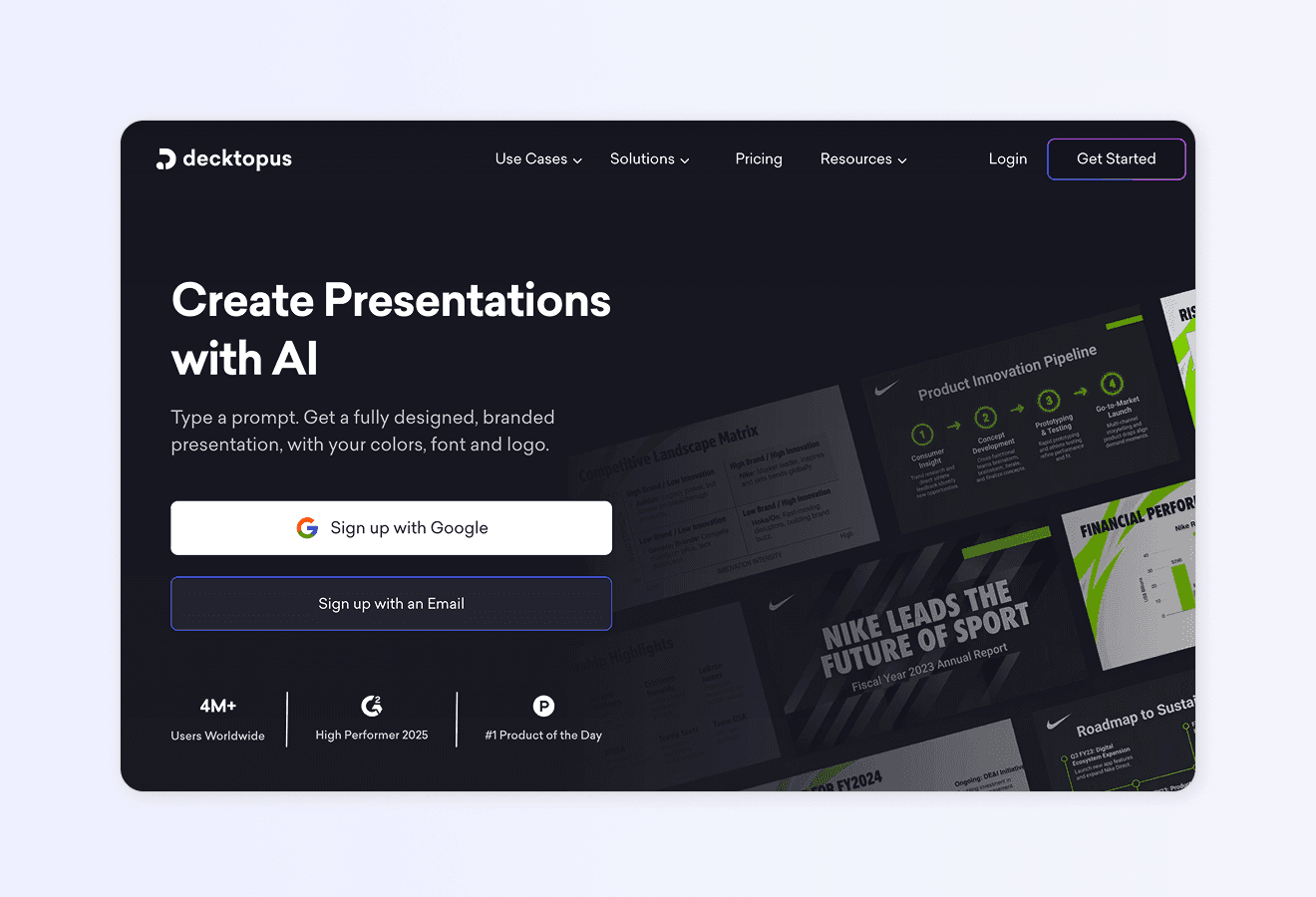
The core idea behind Decktopus is simple: most people do not want to “design slides.” They want a finished presentation that looks professional, follows a clear structure, and is ready to present with minimal manual effort.
Decktopus replaces the traditional workflow:
Open PowerPoint → choose a template → write content → design slides → fix formatting → add visuals → check consistency
with a much faster workflow:
Enter prompt → generate deck → refine → present
This makes Decktopus especially useful for professionals who create presentations often, such as sales teams, marketers, founders, consultants, educators, and small business owners.
How Decktopus Works: Core Features
AI Slide Generation
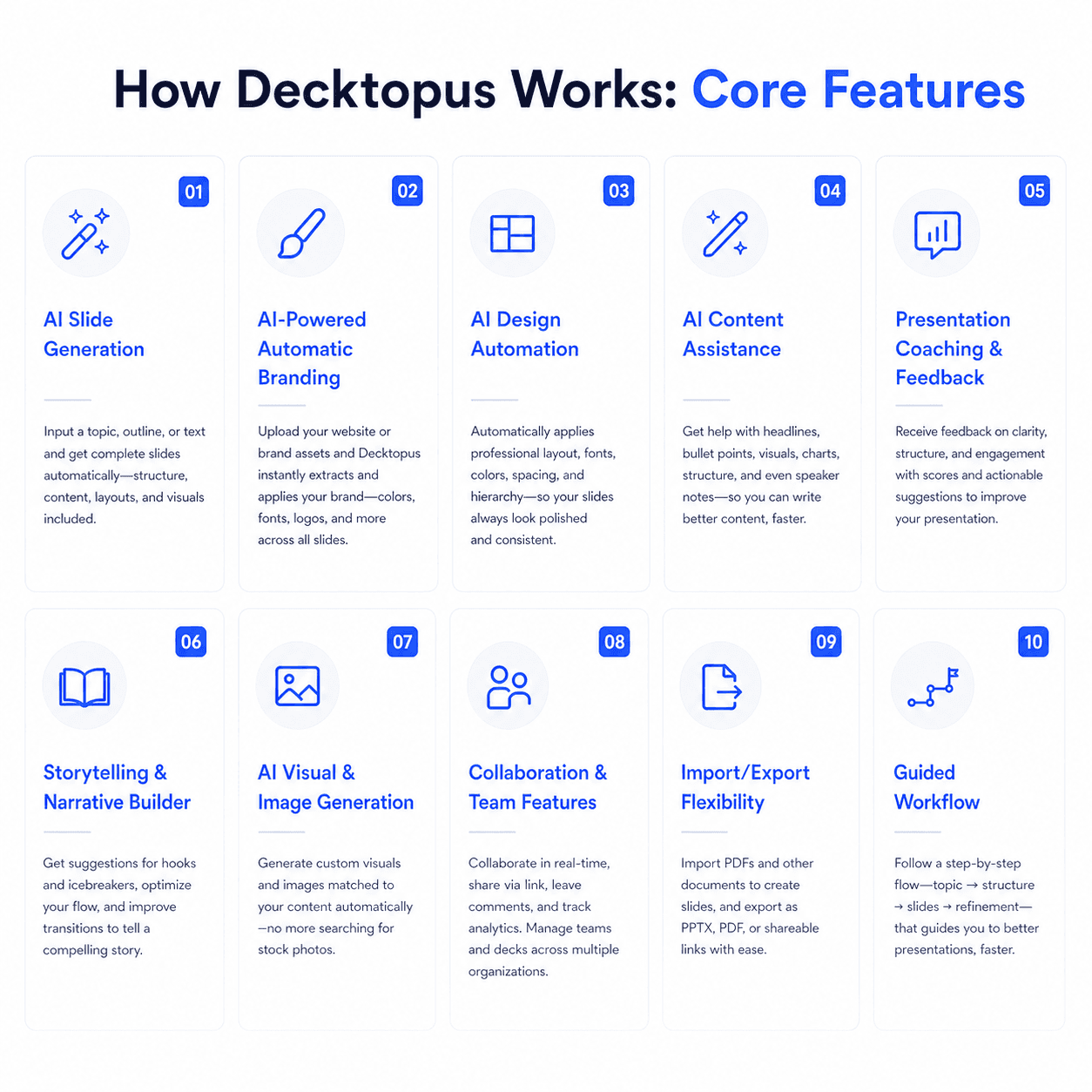
At the heart of Decktopus is its AI slide generation engine. Users can start with a topic, outline, raw notes, or document, and Decktopus turns that input into a full presentation structure.
The AI can help generate:
Slide titles
Bullet points
Section flow
Visual layouts
Speaker notes
Suggested images and icons
Presentation structure
This is valuable because the hardest part of creating a presentation is often not designing one slide. It is figuring out the entire flow.
What should come first?
How many slides should there be?
How much detail belongs on each slide?
How do you make the argument easy to follow?
Decktopus helps solve that by creating a logical first version of the deck. Users can then refine the content instead of building from zero.
AI-Powered Automatic Branding
This is one of Decktopus’s strongest differentiators.
Decktopus can automatically apply brand identity to presentations by using brand assets or a website URL. Instead of manually choosing fonts, colors, logo placements, and visual styles, users can create presentations that feel aligned with their existing brand.
This is especially important because brand consistency is one of the biggest hidden problems in business presentations.
A sales deck may use one color palette.
A marketing report may use another.
A founder pitch deck may use an outdated logo.
A client proposal may look nothing like the company website.
For small teams, this usually happens because no designer is available. For larger teams, it happens because too many people are creating decks in different tools with different habits.
Decktopus helps by making brand consistency part of the creation process.
This is useful for:
Sales teams that need branded pitch decks
Marketing teams creating campaign reports
Agencies managing multiple client brands
Startups without formal brand guidelines
Consultants creating client-facing proposals
Founders preparing investor presentations
Instead of treating branding as a final formatting step, Decktopus builds it into the workflow.
AI Design Automation
Decktopus also automates design decisions such as layout, spacing, hierarchy, and visual balance.
This matters because most business users are not trained designers. They may know what looks “wrong,” but they may not know how to fix it.
Common presentation problems include:
Too much text on one slide
Weak visual hierarchy
Inconsistent font sizes
Poor alignment
Random image placement
Confusing slide flow
Inconsistent spacing
Decktopus reduces this manual design work by generating slides that already follow a clean structure.
The goal is not to give users infinite creative control. The goal is to help them get a professional result faster.
AI Content Assistance
Decktopus does not only design slides. It also helps with content.
It can support users with:
Better headlines
Clearer bullet points
Speaker notes
Presentation scripts
Q&A preparation
Tips for improving communication
Storytelling structure
This is important because many presentation tools focus only on visuals. But a beautiful presentation with weak logic is still a weak presentation.
Decktopus helps users think through the content, not just the design.
For example, a founder preparing a pitch deck may need help turning a messy product idea into a clear investor narrative. A sales professional may need help turning product features into customer benefits. A teacher may need help organizing a lesson into a sequence students can follow.
Decktopus supports that thinking process.
Presentation Coaching and Feedback
Another important part of Decktopus is presentation preparation.
Creating slides is only one part of presenting. The other part is delivery.
Decktopus includes features that help users prepare for the actual presentation experience, such as speaker notes, tips, and possible audience questions.
This makes Decktopus more than just a slide generator. It works more like a presentation assistant that helps with both the deck and the delivery.
Interactive Elements
Decktopus also supports interactive elements such as forms, Q&A sections, and engagement features. These can be useful for webinars, workshops, training sessions, lead generation presentations, and sales conversations.
Instead of treating the presentation as a static file, Decktopus allows the deck to become more interactive and useful after sharing.
Import and Export Flexibility
Decktopus supports common presentation workflows by allowing users to import or export content in different formats. For example, users can use the PDF to PPT feature to transform existing documents into presentations.
Decks can also be exported or shared depending on the user’s workflow.
This matters because teams rarely work in one tool only. A presentation may start as a PDF, become a deck, get shared as a link, and later need to be exported for a stakeholder.
Decktopus is designed to fit into that reality.
Decktopus also includes Loop, an AI delivery coach that guides you through four preparation stages: a Profiler gathers context about your audience, an Architect designs your narrative and speaking notes, a Red Team simulates tough audience questions, and a Mirror scores your rehearsal on pacing, energy, and filler words. Prezi Video lets you overlay slides on your webcam, but it doesn't coach your delivery or score your readiness.
Another recent addition is Beautify: upload an existing presentation and either redesign it with a fresh visual style or use it as a resource to build an entirely new deck. Prezi can import PowerPoint files, but converting them into its zooming canvas format requires significant manual rework.
Advantages of Using Decktopus
Automatic Brand Intelligence
Decktopus’s automatic branding capability is one of its biggest advantages over many presentation tools.
For many teams, brand consistency is not a creative problem. It is an operational problem.
The team knows the brand exists.
The logo exists somewhere.
The colors exist somewhere.
The font rules exist somewhere.
But in the day-to-day rush of creating sales decks, reports, proposals, and internal updates, people do not always follow those rules.
Decktopus reduces that friction by helping users create branded decks faster.
This is particularly valuable for agencies and consultants because they often work across multiple client brands. Manually setting up and applying a different brand identity for every client can become a serious time sink.
Extreme Speed
Decktopus is built for speed.
This is useful when you need:
A sales deck before a meeting
A pitch deck draft before investor outreach
A report presentation from raw notes
A webinar deck from an outline
A client proposal from existing content
A classroom presentation from lesson material
The difference is not just saving 10 minutes. For high-frequency presentation creators, this can save hours every week.
Beginner-Friendly Workflow
Decktopus is especially strong for non-designers.
Many people do not want a complex design tool. They want a guided workflow that helps them get from idea to finished deck.
Decktopus reduces blank canvas anxiety by giving users a starting point. This is important because blank slides create decision fatigue.
What template should I use?
How many slides should I create?
What should each slide say?
Where should the image go?
Is this too much text?
Decktopus handles much of that first-pass decision-making.
Strong Fit for Business Presentations
Decktopus is especially useful for practical business presentations, such as:
Sales decks
Pitch decks
Marketing reports
Training decks
Proposal presentations
Internal updates
Product explainers
Customer onboarding materials
Investor presentations
These are not always presentations where you need dramatic motion or cinematic effects. Most of the time, you need clarity, structure, speed, and brand consistency.
That is exactly where Decktopus performs well.
All-in-One Presentation Workflow
Without Decktopus, many users create presentations by combining multiple tools:
ChatGPT for content
Canva for visuals
PowerPoint for slides
Google Drive for assets
Brand guidelines for colors
Stock photo websites for images
A designer for cleanup
Decktopus brings much of this workflow into one place.
That means less context switching and fewer opportunities for the deck to become inconsistent.
Considerations When Using Decktopus
Decktopus is powerful, but it is not the right tool for every presentation workflow.
Less Pixel-Level Control Than Traditional Design Tools
If you are a professional designer who wants full creative control over every object, animation, transition, spacing rule, and visual detail, Decktopus may feel more structured than a freeform design tool.
That is not necessarily a weakness. It is a tradeoff.
Decktopus prioritizes speed, consistency, and automation over unlimited manual customization.
AI Output Still Needs Human Review
Like any AI tool, Decktopus can create a strong first draft, but users should still review the deck.
You may want to refine:
Messaging
Slide order
Examples
Data points
Tone
Visual choices
Speaker notes
The best workflow is not “AI does everything.”
The best workflow is:
Human gives direction → AI creates structure → human reviews → AI helps refine
Internet Connection Required
Decktopus is a web-based platform, so users need an internet connection to create and edit presentations.
Who is Decktopus For?
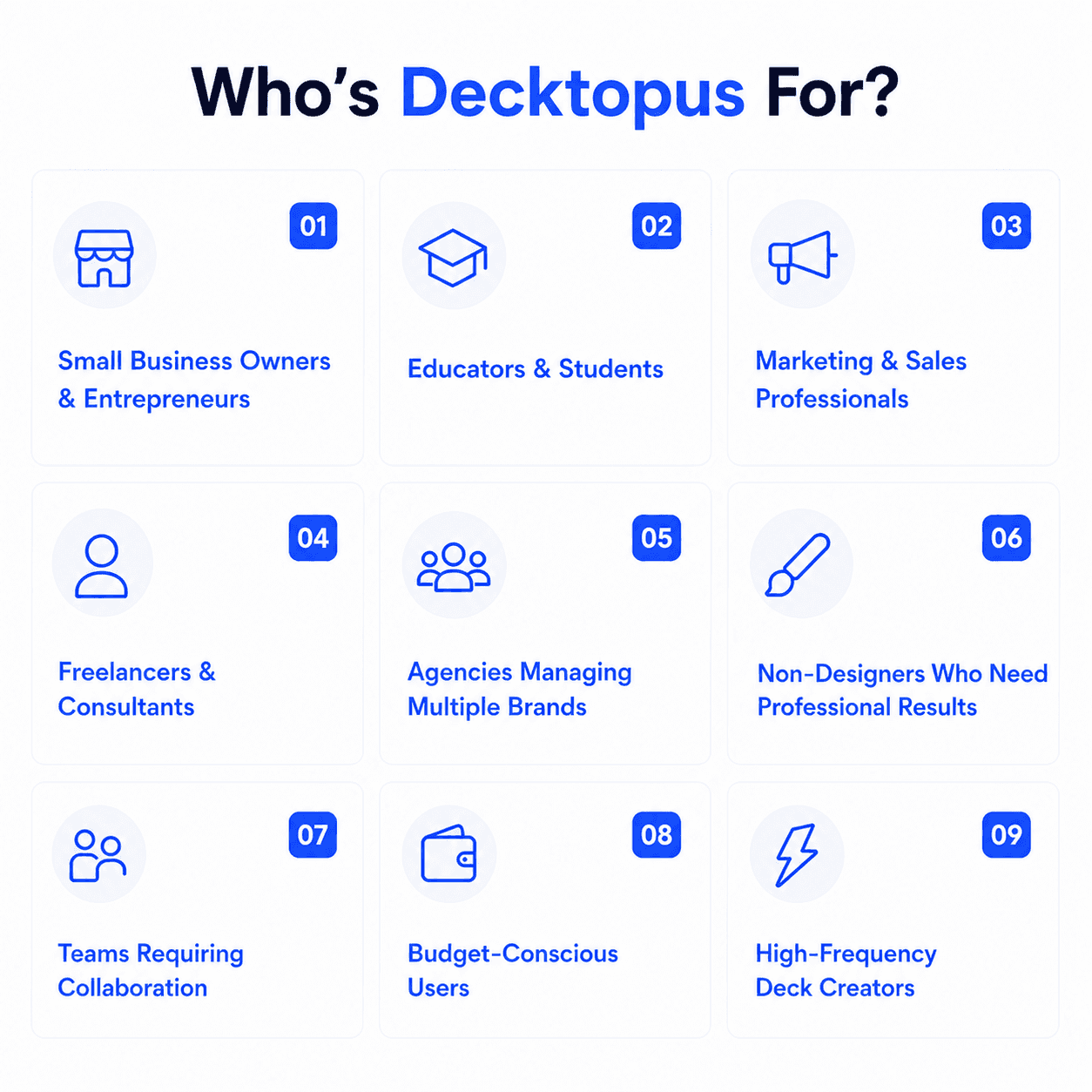
Founders and Entrepreneurs
Founders often need presentations before they have a full marketing or design team.
They need:
Investor decks
Sales decks
Product explainers
Partnership proposals
Demo day presentations
Decktopus is useful because it helps founders move quickly without waiting for a designer.
A founder can start with a rough idea and get a structured presentation draft in minutes. This is especially helpful in early-stage startups where speed matters more than perfect polish.
Sales Teams
Sales teams create presentations constantly.
They need decks for:
Discovery calls
Product demos
Proposals
Enterprise pitches
Follow-up materials
Case study presentations
The challenge is that sales teams also need consistency. Every sales deck should feel aligned with the brand, but salespeople do not always have time to manually design slides.
Decktopus helps sales teams create consistent, branded, professional decks without turning every salesperson into a designer.
Marketing Teams
Marketing teams need presentations for campaigns, reports, strategy documents, webinars, and internal updates.
Decktopus is useful because marketers often have ideas and data but limited time to turn them into polished decks.
It helps transform marketing thinking into presentable assets faster.
Agencies and Consultants
Agencies and consultants often create client-facing presentations. These need to look professional because the presentation itself becomes part of the perceived value.
Decktopus is useful for:
Client proposals
Monthly reports
Strategy decks
Campaign plans
Audit presentations
Workshop materials
The branding workflow is particularly useful for agencies managing multiple client identities.
Educators and Trainers
Educators need presentations that are clear, structured, and easy to follow.
Decktopus can help turn lesson topics into slide decks quickly. Trainers can also use interactive elements and Q&A preparation to make sessions more engaging.
Non-Designers
This is one of the clearest Decktopus audiences.
If someone needs a professional presentation but does not have design skills, Decktopus gives them a guided way to create something polished.
When Decktopus Might Not Be the Right Fit
Decktopus may not be ideal if you:
Need highly cinematic motion effects
Want a non-linear zoomable storytelling canvas
Prefer full manual design control
Are creating an experimental visual presentation
Need offline editing
Want to build a presentation that feels more like an interactive map than a slide deck
For those cases, Prezi may be a better fit.
What is Prezi?
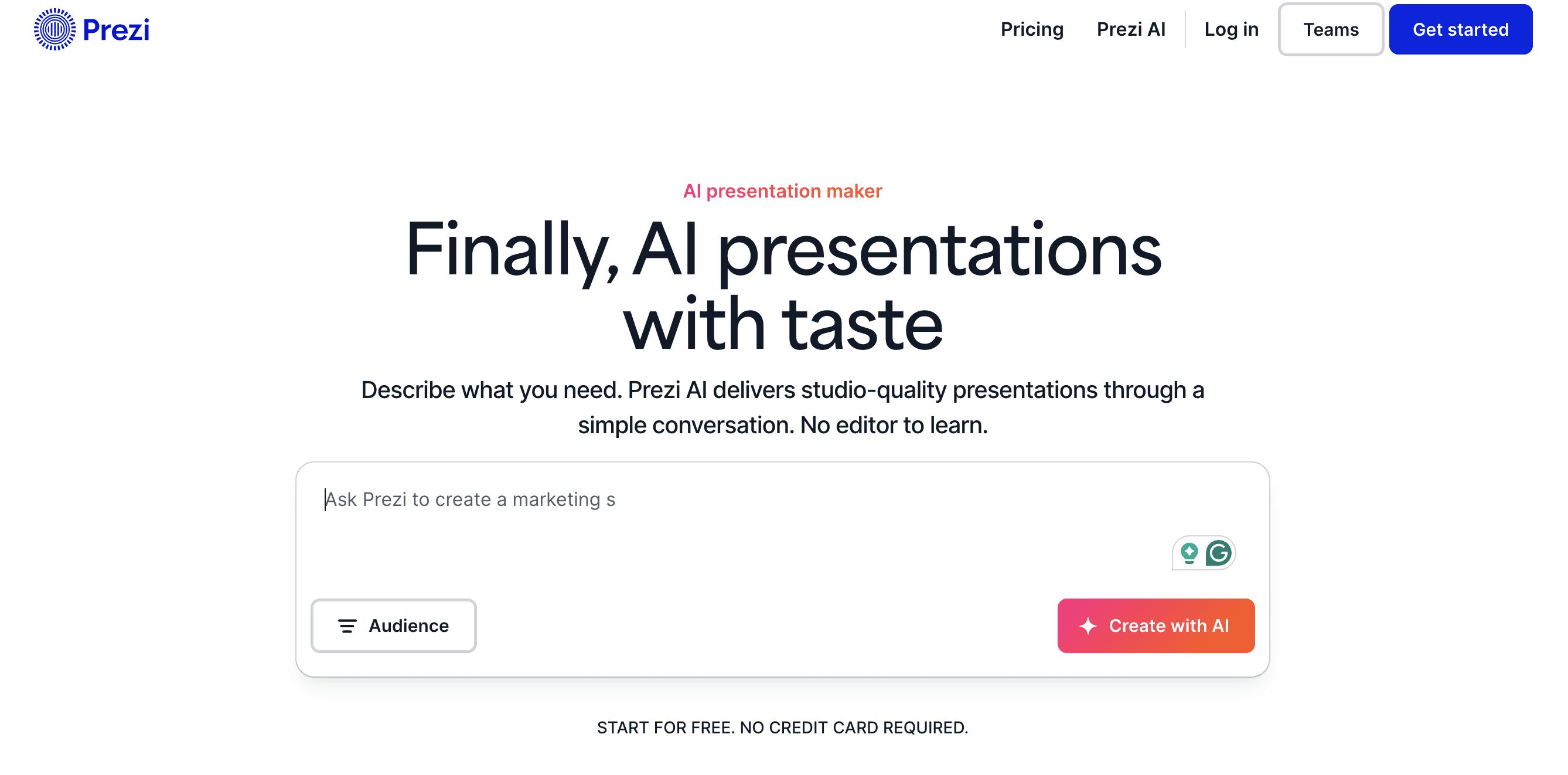
Prezi is a presentation platform best known for its zoomable, non-linear presentation format. Instead of moving through traditional slides one by one, Prezi lets users create presentations on a large visual canvas, then zoom into different sections as the story unfolds.
This makes Prezi very different from traditional slide tools.
A standard slide deck is linear:
Slide 1 → Slide 2 → Slide 3 → Slide 4
A Prezi presentation can feel more spatial:
Big idea → zoom into topic A → zoom out → zoom into topic B → show relationship → zoom into detail
This makes Prezi especially useful when you want the audience to understand how ideas connect.
According to Prezi’s own website, Prezi AI can create a complete presentation from a prompt or uploaded file such as a PDF, PPT, or DOC, and users can refine the result conversationally by asking the AI to adjust tone, rework slides, change colors, or add sections. Prezi also emphasizes its unique interactive presentation format and dynamic visual storytelling.
How Prezi Works: Core Features
Zoom-Based Presentation Canvas
Prezi’s signature feature is its zoomable canvas.
Rather than creating a series of isolated slides, users create a visual map of their content. The presentation then moves through that map by zooming in and out.
This can be powerful for topics that involve:
Systems
Processes
Relationships
Big-picture thinking
Timelines
Frameworks
Educational concepts
Strategic narratives
For example, a consultant explaining a business transformation strategy might use the full Prezi canvas to show the entire transformation roadmap, then zoom into each stage.
A teacher explaining the solar system might show the full system first, then zoom into each planet.
A founder explaining market opportunity might show the big market landscape, then zoom into the customer segment they are targeting.
This format makes Prezi especially strong when the structure of the idea matters visually.
Prezi AI
Prezi has added AI presentation creation features to its platform.
Prezi AI allows users to start from a topic or upload files, then generate a custom presentation. Prezi describes its AI as a way to create visually dynamic presentations and bring ideas to life from uploaded files or prompts.
Prezi’s AI can help with:
Presentation drafts
Layouts
Visual themes
AI-generated images
Text transformation
Content refinement
Prezi’s AI is particularly interesting because it is not only trying to create slides. It is trying to create dynamic visual stories.
That makes it different from standard AI slide generators.
Conversational Refinement
Prezi’s website explains that after the AI generates a deck, users can refine it through chat by asking for adjustments such as tone changes, slide reworks, new sections, or color palette changes.
This is useful because AI-generated presentations rarely come out perfect on the first try.
A user might ask:
“Make this more professional”
“Add a section about market size”
“Make the tone more persuasive”
“Change the colors”
“Simplify this slide”
“Add more visuals”
This conversational editing workflow helps make AI feel more like an assistant than a one-time generator.
Prezi Video
One of Prezi’s strongest differentiators is Prezi Video.
Prezi Video allows presenters to appear on screen alongside their content. Instead of hiding behind screen share, the presenter stays visible while the visuals appear beside them.
This is especially valuable for:
Remote sales calls
Online classes
Webinars
Virtual conferences
Hybrid meetings
Training sessions
Thought leadership videos
Prezi says Prezi Video helps users keep virtual meetings, webinars, and online conferences personal by showing both the presenter and the visual aids together.
This is a major advantage for people who present live often.
Video Conferencing Integrations
Prezi Video works with popular video conferencing platforms. Prezi’s blog notes compatibility with tools such as Zoom, Microsoft Teams, Google Meet, Webex, and GoToWebinar.
This makes Prezi especially practical for remote-first teams, educators, coaches, and salespeople.
PowerPoint Import
Prezi also supports transforming existing PowerPoint slides into Prezi presentations. Prezi’s FAQ explains that users can upload a PowerPoint slide deck to Prezi Present and convert it into an interactive Prezi presentation.
This matters because many teams already have years of existing PowerPoint content.
Instead of starting over, users can repurpose existing slide decks into something more dynamic.
Templates and Visual Design
Prezi offers templates and visual structures that help users create dynamic presentations without building everything from scratch.
This is useful for users who want a more creative, visual format but still need some design support.
Collaboration and Team Features
Prezi supports collaborative workflows, especially for teams. Prezi’s own materials mention shared collaboration features and team-friendly controls for organizations that need consistency across presentations.
For larger organizations, this can help teams review, refine, and align on messaging.
Advantages of Using Prezi
Strong Visual Storytelling
Prezi’s biggest advantage is storytelling.
The zoomable canvas helps users show how ideas connect. This can make presentations feel more engaging than traditional slide decks.
Instead of presenting isolated points, users can build a visual journey.
This is useful when the goal is not just to inform, but to make the audience remember the structure of the idea.
Great for Live Presentations
Prezi can be especially effective when a presenter is actively guiding the audience.
The movement, zooming, and spatial structure can help hold attention in a live environment.
This makes Prezi useful for:
Keynotes
Lectures
Workshops
Sales demos
Webinars
Conference presentations
Strong Remote Presentation Experience
Prezi Video is one of the platform’s most practical advantages.
In remote meetings, traditional screen share often makes the presenter disappear. Prezi Video keeps the presenter visible with the content.
That can create a more personal and engaging experience.
For educators, salespeople, and trainers, this can be a real advantage.
More Creative Freedom
Prezi gives users more room to create a non-traditional presentation experience.
If you do not want a standard slide-by-slide deck, Prezi gives you a more flexible format.
This is useful for creative presenters who want to design something memorable.
Good for Explaining Big-Picture Ideas
Prezi is especially good when the relationship between concepts matters.
For example:
A strategy map
A customer journey
A business ecosystem
A learning framework
A product roadmap
A market landscape
A process breakdown
The zoomable format helps users move between the big picture and details.
Considerations When Using Prezi
Steeper Learning Curve
Prezi is more unique than a standard slide tool. That uniqueness is a strength, but it also creates a learning curve.
Users need to think spatially.
Instead of asking, “What goes on slide 3?” they need to ask, “How should this idea live on the canvas?”
That can take more time.
Motion Can Become Distracting
Prezi’s zooming effect is memorable, but it needs to be used carefully.
Too much movement can make a presentation feel overwhelming. In some cases, it can even distract from the message.
This is especially true for serious business presentations where clarity matters more than visual drama.
Less Ideal for Fast, Everyday Business Decks
If you need to create a simple sales deck, monthly report, internal update, or proposal quickly, Prezi may be more tool than you need.
Its strengths are strongest when the presentation benefits from visual storytelling. For routine business decks, Decktopus may be faster and more practical.
Brand Setup Requires More Manual Work
Prezi allows customization, but it does not offer the same kind of automatic brand extraction workflow that Decktopus emphasizes.
This means users may need to manually adjust colors, fonts, logos, and templates to match brand guidelines.
For one presentation, that may not be a big issue. For teams creating many presentations, it becomes more important.
Not Every Audience Expects a Prezi-Style Presentation
Some audiences prefer traditional slide decks.
For example:
Investors may expect a standard pitch deck
Enterprise buyers may expect a clean sales deck
Executives may expect a structured report
Internal teams may want something easy to skim
Prezi can still work in these contexts, but the format needs to be used carefully.
Who is Prezi For?
Educators and Trainers
Prezi is a strong fit for educators because it helps explain relationships between ideas.
A teacher can use Prezi to show a big concept, then zoom into each part. This can make lessons more engaging and easier to follow.
For example, a biology teacher could show the human body, then zoom into organs, systems, and processes.
A business professor could show a company strategy map, then zoom into market, product, operations, and financials.
Public Speakers and Keynote Presenters
Prezi is useful for presenters who want to create a memorable live experience.
If the presentation is more performance-driven, Prezi’s motion and spatial storytelling can make it stand out.
This is why Prezi is often associated with dynamic talks, creative presentations, and non-linear storytelling.
Sales Teams Doing Live Demos
Prezi can be useful for sales teams when they want to guide prospects through a story visually.
For example, a salesperson could show the full customer problem landscape, then zoom into pain points, solution areas, product features, and ROI.
Prezi Video can also help salespeople stay visible during remote demos.
Coaches, Consultants, and Workshop Facilitators
Prezi can work well for workshops because it helps structure complex topics visually.
A consultant running a strategy workshop could use Prezi to move between:
The full framework
Each pillar
Examples
Discussion questions
Action steps
The format can make the session feel more interactive.
Creative Professionals
Designers, marketers, brand strategists, and creative presenters may appreciate Prezi because it gives them a less traditional format.
If the goal is to create something visually different, Prezi offers more storytelling flexibility than a typical slide deck.
When Prezi Might Not Be the Right Fit
Prezi may not be ideal if you:
Need a presentation very quickly
Prefer traditional slide decks
Want automatic brand extraction
Create many repetitive business presentations
Need a simple report or proposal
Do not want to spend time learning a new format
Want a deck that can be easily edited by anyone on the team
Need a presentation that feels conservative or executive-friendly
For these situations, Decktopus may be the more practical choice.
What are the Main Differences Between Decktopus and Prezi?
1. Presentation Format
The biggest difference is the format.
Decktopus creates slide-based presentations. This makes it familiar, practical, and easy to use in business contexts.
Prezi creates zoomable, canvas-based presentations. This makes it more dynamic and visually distinctive.
Decktopus is better for:
Standard business decks
Sales presentations
Reports
Pitch decks
Proposals
Training materials
Prezi is better for:
Visual storytelling
Live talks
Educational journeys
Concept maps
Big-picture frameworks
Remote video presentations
2. AI Workflow
Decktopus is more AI-first in the sense that the product is built around fast presentation generation.
The user gives an input, and Decktopus creates a structured presentation.
Prezi also has AI presentation creation. Its AI can generate polished presentations from prompts or uploaded files and allows conversational refinement.
However, Prezi’s core identity remains tied to visual storytelling and dynamic presentations.
In simple terms:
Decktopus uses AI to help you finish a business-ready deck faster.
Prezi uses AI to help you create a more visual and dynamic presentation experience.
3. Branding
Decktopus has a stronger advantage for automatic branding.
Decktopus can help users create brand-consistent presentations quickly by applying brand elements such as colors, logos, and style.
Prezi supports customization and team controls, but branding is more manual.
This matters for teams that create decks often.
If a sales team creates 20 decks a month, brand setup friction becomes expensive. If an agency works with 12 clients, manual branding becomes even more painful.
Decktopus is better for fast brand consistency.
4. Speed
Decktopus is generally faster for creating traditional business presentations.
Prezi can create engaging presentations, but its format usually requires more thinking and refinement.
This is not because Prezi is inefficient. It is because Prezi is asking users to build a more spatial, dynamic experience.
That takes more planning.
If you need a quick professional deck, Decktopus wins.
If you need a memorable visual journey, Prezi may be worth the extra time.
5. Ease of Use
Decktopus is easier for most business users because it follows a familiar slide-based structure.
Prezi is easy enough once users understand the format, but the zoomable canvas requires a different mindset.
Decktopus reduces decision fatigue.
Prezi expands creative possibilities.
That is the tradeoff.
6. Live and Remote Presenting
Prezi has a major advantage with Prezi Video.
The ability to appear alongside content during video calls is valuable for remote presenters. Prezi Video works with major platforms including Zoom, Microsoft Teams, Google Meet, Webex, and GoToWebinar.
Decktopus is stronger at creating the deck.
Prezi is stronger at making the live presentation feel visually engaging.
7. Business Readiness
Decktopus is more practical for business users who need a polished, ready-to-present deck.
Prezi can be business-ready too, but its dynamic format is not always the best fit for every business environment.
For example, a finance update may not need zoomable motion. A board presentation may need clarity and structure more than visual movement.
Decktopus is better when the output needs to be clean, professional, and easy to share.
Quick Comparison: Which One Fits You?
Choose Decktopus if you:
Want to create presentations quickly
Need AI-generated business decks
Want automatic brand consistency
Create presentations often
Do not want to manually design slides
Need sales decks, pitch decks, reports, or proposals
Work in marketing, sales, consulting, education, or startups
Want a beginner-friendly workflow
Prefer structured, traditional presentations
Need a deck that is easy to export and share
Create LinkedIn or Instagram carousels as a recurring content habit
Create LinkedIn or Instagram carousels as a recurring content habit
Choose Prezi if you:
Want a dynamic, zoomable presentation
Care deeply about visual storytelling
Present live or remotely often
Want to appear alongside your content on video
Need to explain complex relationships between ideas
Are creating a keynote, lecture, workshop, or visual story
Enjoy creative control
Have time to build a more custom presentation experience
Feature Comparison Table
[[EMBED:PGRpdiBzdHlsZT0ib3ZlcmZsb3cteDphdXRvO21hcmdpbjoyMHB4IDAiPjxzdHlsZT4uZHRrLXRibCwuZHRrLXRibCAqe2JveC1zaXppbmc6Ym9yZGVyLWJveDttYXJnaW46MDtwYWRkaW5nOjB9LmR0ay10Ymx7Zm9udC1mYW1pbHk6J1BvcHBpbnMnLHN5c3RlbS11aSxzYW5zLXNlcmlmO2NvbG9yOiMyRDM0MzY7bWF4LXdpZHRoOjg2MHB4O21hcmdpbjowIGF1dG87Ym9yZGVyOjFweCBzb2xpZCAjRThFQUYwO2JvcmRlci1yYWRpdXM6MjBweDtvdmVyZmxvdzpoaWRkZW47YmFja2dyb3VuZDojZmZmfS5kdGstdGJsIC5oZWFke3BhZGRpbmc6MjZweCAyOHB4IDIwcHh9LmR0ay10YmwgLmhlYWQgaDJ7Zm9udC1zaXplOmNsYW1wKDIycHgsNXZ3LDMycHgpO2ZvbnQtd2VpZ2h0OjcwMDtsaW5lLWhlaWdodDoxLjF9LmR0ay10YmwgLmhlYWQgcHtjb2xvcjojNzg4MDhBO2ZvbnQtc2l6ZToxNXB4O21hcmdpbi10b3A6NHB4fS5kdGstdGJsIC5yb3d7ZGlzcGxheTpncmlkO2dyaWQtdGVtcGxhdGUtY29sdW1uczoxLjdmciAxZnIgMWZyO2JvcmRlci10b3A6MXB4IHNvbGlkICNFOEVBRjB9LmR0ay10YmwgLnJvdy5oZWFkZXJ7Ym9yZGVyLXRvcDowfS5kdGstdGJsIC5jZWxse3BhZGRpbmc6MTRweCAxNnB4O2Rpc3BsYXk6ZmxleDtmbGV4LWRpcmVjdGlvbjpjb2x1bW47anVzdGlmeS1jb250ZW50OmNlbnRlcjthbGlnbi1pdGVtczpjZW50ZXI7dGV4dC1hbGlnbjpjZW50ZXI7Z2FwOjZweDttaW4taGVpZ2h0OjYwcHh9LmR0ay10YmwgLmZlYXR7YWxpZ24taXRlbXM6ZmxleC1zdGFydDt0ZXh0LWFsaWduOmxlZnQ7Zm9udC13ZWlnaHQ6NTAwO2ZvbnQtc2l6ZToxNnB4O2xpbmUtaGVpZ2h0OjEuM30uZHRrLXRibCAuY29sLWR0a3tiYWNrZ3JvdW5kOiNFRUVCRkR9LmR0ay10YmwgLnJvdzpudGgtY2hpbGQoZXZlbikgLmZlYXR7YmFja2dyb3VuZDojRkFGQUZDfS5kdGstdGJsIC5yb3c6bnRoLWNoaWxkKGV2ZW4pIC5jb2wtY29tcHtiYWNrZ3JvdW5kOiNGQUZBRkN9LmR0ay10YmwgLmhlYWRlciAuY2VsbHtmb250LXdlaWdodDo2MDA7Zm9udC1zaXplOjE4cHg7bWluLWhlaWdodDphdXRvO3BhZGRpbmc6MTZweH0uZHRrLXRibCAuaGVhZGVyIC5jb2wtZHRre2JhY2tncm91bmQ6IzZDNUNFNztjb2xvcjojZmZmO2JvcmRlci1yYWRpdXM6MTBweCAxMHB4IDAgMH0uZHRrLXRibCAuYnt3aWR0aDoyOHB4O2hlaWdodDoyOHB4O2JvcmRlci1yYWRpdXM6NTAlO2Rpc3BsYXk6aW5saW5lLWZsZXg7YWxpZ24taXRlbXM6Y2VudGVyO2p1c3RpZnktY29udGVudDpjZW50ZXI7Y29sb3I6I2ZmZjtmb250LXNpemU6MTVweDtmb250LXdlaWdodDo3MDA7bGluZS1oZWlnaHQ6MTtmbGV4OjAgMCAyOHB4fS5kdGstdGJsIC55ZXN7YmFja2dyb3VuZDojMjJCMjZDfS5kdGstdGJsIC5ub3tiYWNrZ3JvdW5kOiNFODU0NUN9LmR0ay10YmwgLnBhcnR7YmFja2dyb3VuZDojRjBBQTI4fS5kdGstdGJsIC5ub3Rle2ZvbnQtc2l6ZToxMnB4O2NvbG9yOiM3ODgwOEE7bGluZS1oZWlnaHQ6MS4zO3dvcmQtd3JhcDpicmVhay13b3JkO21heC13aWR0aDoxMDAlfS5kdGstdGJsIC5sYmx7ZGlzcGxheTpub25lO2ZvbnQtc2l6ZToxM3B4O2NvbG9yOiM3ODgwOEE7Zm9udC13ZWlnaHQ6NTAwfS5kdGstdGJsIC52YWx7ZGlzcGxheTpmbGV4O2FsaWduLWl0ZW1zOmNlbnRlcjtnYXA6OHB4O2ZsZXgtd3JhcDpub3dyYXB9LmR0ay10YmwgLmZvb3R7ZGlzcGxheTpmbGV4O2ZsZXgtd3JhcDp3cmFwO2dhcDoxMHB4O2p1c3RpZnktY29udGVudDpzcGFjZS1iZXR3ZWVuO2FsaWduLWl0ZW1zOmNlbnRlcjtwYWRkaW5nOjE2cHggMjhweDtib3JkZXItdG9wOjFweCBzb2xpZCAjRThFQUYwO2NvbG9yOiM3ODgwOEE7Zm9udC1zaXplOjEzcHh9LmR0ay10YmwgLmxlZ2VuZHtkaXNwbGF5OmZsZXg7Z2FwOjE2cHh9LmR0ay10YmwgLmxlZ2VuZCBzcGFue2Rpc3BsYXk6aW5saW5lLWZsZXg7YWxpZ24taXRlbXM6Y2VudGVyO2dhcDo2cHh9LmR0ay10YmwgLmxlZ2VuZCAuYnt3aWR0aDoxOXB4O2hlaWdodDoxOXB4O2ZvbnQtc2l6ZToxMXB4O2ZsZXg6MCAwIDE5cHh9QG1lZGlhKG1heC13aWR0aDo1NjBweCl7LmR0ay10YmwgLmhlYWRlcntkaXNwbGF5Om5vbmV9LmR0ay10YmwgLnJvd3tncmlkLXRlbXBsYXRlLWNvbHVtbnM6MWZyO2JvcmRlci10b3A6MDtwYWRkaW5nOjZweCAwO2JvcmRlci1ib3R0b206MXB4IHNvbGlkICNFOEVBRjB9LmR0ay10YmwgLnJvdzpsYXN0LWNoaWxke2JvcmRlci1ib3R0b206MH0uZHRrLXRibCAuY2VsbHttaW4taGVpZ2h0OmF1dG87cGFkZGluZzo5cHggMThweDthbGlnbi1pdGVtczpmbGV4LXN0YXJ0O3RleHQtYWxpZ246bGVmdH0uZHRrLXRibCAuZmVhdHtmb250LXdlaWdodDo2MDA7Zm9udC1zaXplOjE2cHg7cGFkZGluZy1ib3R0b206MnB4O2JhY2tncm91bmQ6dHJhbnNwYXJlbnQhaW1wb3J0YW50fS5kdGstdGJsIC5jb2wtZHRrLC5kdGstdGJsIC5jb2wtY29tcHtiYWNrZ3JvdW5kOnRyYW5zcGFyZW50IWltcG9ydGFudDtmbGV4LWRpcmVjdGlvbjpyb3chaW1wb3J0YW50O2p1c3RpZnktY29udGVudDpzcGFjZS1iZXR3ZWVuO3dpZHRoOjEwMCU7Z2FwOjEycHg7cGFkZGluZzo2cHggMTRweDttYXJnaW46MnB4IDE0cHh9LmR0ay10YmwgLmNvbC1kdGt7Ym9yZGVyLWxlZnQ6M3B4IHNvbGlkICM2QzVDRTc7Ym9yZGVyLXJhZGl1czo0cHg7YmFja2dyb3VuZDojRUVFQkZEIWltcG9ydGFudH0uZHRrLXRibCAuY29sLWNvbXB7Ym9yZGVyLWxlZnQ6M3B4IHNvbGlkICNFOEVBRjB9LmR0ay10YmwgLmxibHtkaXNwbGF5OmlubGluZX0uZHRrLXRibCAuZm9vdHtwYWRkaW5nOjE2cHggMThweDtmbGV4LWRpcmVjdGlvbjpjb2x1bW47YWxpZ24taXRlbXM6ZmxleC1zdGFydH19PC9zdHlsZT48ZGl2IGNsYXNzPSJkdGstdGJsIj48ZGl2IGNsYXNzPSJoZWFkIj48aDI+RGVja3RvcHVzIHZzLiBQcmV6aTwvaDI+PHA+QUkgcHJlc2VudGF0aW9uIGZlYXR1cmUgY29tcGFyaXNvbjwvcD48L2Rpdj48ZGl2IGNsYXNzPSJyb3cgaGVhZGVyIj48ZGl2IGNsYXNzPSJjZWxsIGZlYXQiPkZlYXR1cmU8L2Rpdj48ZGl2IGNsYXNzPSJjZWxsIGNvbC1kdGsiPkRlY2t0b3B1czwvZGl2PjxkaXYgY2xhc3M9ImNlbGwgY29sLWNvbXAiPlByZXppPC9kaXY+PC9kaXY+PGRpdiBjbGFzcz0icm93Ij48ZGl2IGNsYXNzPSJjZWxsIGZlYXQiPkF1dG9tYXRpYyBicmFuZCBleHRyYWN0aW9uIGZyb20gYSBVUkw8L2Rpdj48ZGl2IGNsYXNzPSJjZWxsIGNvbC1kdGsiPjxkaXYgY2xhc3M9InZhbCI+PHNwYW4gY2xhc3M9ImxibCI+RGVja3RvcHVzPC9zcGFuPjxzcGFuIGNsYXNzPSJiIHllcyI+4pyTPC9zcGFuPjwvZGl2PjwvZGl2PjxkaXYgY2xhc3M9ImNlbGwgY29sLWNvbXAiPjxkaXYgY2xhc3M9InZhbCI+PHNwYW4gY2xhc3M9ImxibCI+UHJlemk8L3NwYW4+PHNwYW4gY2xhc3M9ImIgbm8iPuKclTwvc3Bhbj48L2Rpdj48c3BhbiBjbGFzcz0ibm90ZSI+TWFudWFsIGJyYW5kIGtpdDwvc3Bhbj48L2Rpdj48L2Rpdj48ZGl2IGNsYXNzPSJyb3ciPjxkaXYgY2xhc3M9ImNlbGwgZmVhdCI+RW5kLXRvLWVuZCBBSSBkZWNrIGZyb20gYSBwcm9tcHQ8L2Rpdj48ZGl2IGNsYXNzPSJjZWxsIGNvbC1kdGsiPjxkaXYgY2xhc3M9InZhbCI+PHNwYW4gY2xhc3M9ImxibCI+RGVja3RvcHVzPC9zcGFuPjxzcGFuIGNsYXNzPSJiIHllcyI+4pyTPC9zcGFuPjwvZGl2PjwvZGl2PjxkaXYgY2xhc3M9ImNlbGwgY29sLWNvbXAiPjxkaXYgY2xhc3M9InZhbCI+PHNwYW4gY2xhc3M9ImxibCI+UHJlemk8L3NwYW4+PHNwYW4gY2xhc3M9ImIgcGFydCI+4oCTPC9zcGFuPjwvZGl2PjxzcGFuIGNsYXNzPSJub3RlIj5BSSBhc3Npc3RzLCBub3QgZnVsbCBnZW5lcmF0aW9uPC9zcGFuPjwvZGl2PjwvZGl2PjxkaXYgY2xhc3M9InJvdyI+PGRpdiBjbGFzcz0iY2VsbCBmZWF0Ij5BSSBkZWxpdmVyeSBjb2FjaGluZyAmYW1wOyBwcmFjdGljZSBtb2RlPC9kaXY+PGRpdiBjbGFzcz0iY2VsbCBjb2wtZHRrIj48ZGl2IGNsYXNzPSJ2YWwiPjxzcGFuIGNsYXNzPSJsYmwiPkRlY2t0b3B1czwvc3Bhbj48c3BhbiBjbGFzcz0iYiB5ZXMiPuKckzwvc3Bhbj48L2Rpdj48L2Rpdj48ZGl2IGNsYXNzPSJjZWxsIGNvbC1jb21wIj48ZGl2IGNsYXNzPSJ2YWwiPjxzcGFuIGNsYXNzPSJsYmwiPlByZXppPC9zcGFuPjxzcGFuIGNsYXNzPSJiIG5vIj7inJU8L3NwYW4+PC9kaXY+PC9kaXY+PC9kaXY+PGRpdiBjbGFzcz0icm93Ij48ZGl2IGNsYXNzPSJjZWxsIGZlYXQiPkFJIENhcm91c2VsIE1ha2VyIChMaW5rZWRJbiAvIElHKTwvZGl2PjxkaXYgY2xhc3M9ImNlbGwgY29sLWR0ayI+PGRpdiBjbGFzcz0idmFsIj48c3BhbiBjbGFzcz0ibGJsIj5EZWNrdG9wdXM8L3NwYW4+PHNwYW4gY2xhc3M9ImIgeWVzIj7inJM8L3NwYW4+PC9kaXY+PC9kaXY+PGRpdiBjbGFzcz0iY2VsbCBjb2wtY29tcCI+PGRpdiBjbGFzcz0idmFsIj48c3BhbiBjbGFzcz0ibGJsIj5QcmV6aTwvc3Bhbj48c3BhbiBjbGFzcz0iYiBubyI+4pyVPC9zcGFuPjwvZGl2PjwvZGl2PjwvZGl2PjxkaXYgY2xhc3M9InJvdyI+PGRpdiBjbGFzcz0iY2VsbCBmZWF0Ij5BSSBpbWFnZSBnZW5lcmF0aW9uPC9kaXY+PGRpdiBjbGFzcz0iY2VsbCBjb2wtZHRrIj48ZGl2IGNsYXNzPSJ2YWwiPjxzcGFuIGNsYXNzPSJsYmwiPkRlY2t0b3B1czwvc3Bhbj48c3BhbiBjbGFzcz0iYiB5ZXMiPuKckzwvc3Bhbj48L2Rpdj48L2Rpdj48ZGl2IGNsYXNzPSJjZWxsIGNvbC1jb21wIj48ZGl2IGNsYXNzPSJ2YWwiPjxzcGFuIGNsYXNzPSJsYmwiPlByZXppPC9zcGFuPjxzcGFuIGNsYXNzPSJiIG5vIj7inJU8L3NwYW4+PC9kaXY+PC9kaXY+PC9kaXY+PGRpdiBjbGFzcz0icm93Ij48ZGl2IGNsYXNzPSJjZWxsIGZlYXQiPkRvY3VtZW50IC8gUERGIGltcG9ydCB0byBkZWNrPC9kaXY+PGRpdiBjbGFzcz0iY2VsbCBjb2wtZHRrIj48ZGl2IGNsYXNzPSJ2YWwiPjxzcGFuIGNsYXNzPSJsYmwiPkRlY2t0b3B1czwvc3Bhbj48c3BhbiBjbGFzcz0iYiB5ZXMiPuKckzwvc3Bhbj48L2Rpdj48L2Rpdj48ZGl2IGNsYXNzPSJjZWxsIGNvbC1jb21wIj48ZGl2IGNsYXNzPSJ2YWwiPjxzcGFuIGNsYXNzPSJsYmwiPlByZXppPC9zcGFuPjxzcGFuIGNsYXNzPSJiIHllcyI+4pyTPC9zcGFuPjwvZGl2PjxzcGFuIGNsYXNzPSJub3RlIj5QUFQgaW1wb3J0PC9zcGFuPjwvZGl2PjwvZGl2PjxkaXYgY2xhc3M9InJvdyI+PGRpdiBjbGFzcz0iY2VsbCBmZWF0Ij5TdG9yeXRlbGxpbmcgdHVuZWQgdG8geW91ciBwdXJwb3NlPC9kaXY+PGRpdiBjbGFzcz0iY2VsbCBjb2wtZHRrIj48ZGl2IGNsYXNzPSJ2YWwiPjxzcGFuIGNsYXNzPSJsYmwiPkRlY2t0b3B1czwvc3Bhbj48c3BhbiBjbGFzcz0iYiB5ZXMiPuKckzwvc3Bhbj48L2Rpdj48L2Rpdj48ZGl2IGNsYXNzPSJjZWxsIGNvbC1jb21wIj48ZGl2IGNsYXNzPSJ2YWwiPjxzcGFuIGNsYXNzPSJsYmwiPlByZXppPC9zcGFuPjxzcGFuIGNsYXNzPSJiIHBhcnQiPuKAkzwvc3Bhbj48L2Rpdj48c3BhbiBjbGFzcz0ibm90ZSI+Wm9vbWluZyBuYXJyYXRpdmU8L3NwYW4+PC9kaXY+PC9kaXY+PGRpdiBjbGFzcz0icm93Ij48ZGl2IGNsYXNzPSJjZWxsIGZlYXQiPkJyYW5kLWNvbnNpc3RlbnQgdGVhbSB0ZW1wbGF0ZXM8L2Rpdj48ZGl2IGNsYXNzPSJjZWxsIGNvbC1kdGsiPjxkaXYgY2xhc3M9InZhbCI+PHNwYW4gY2xhc3M9ImxibCI+RGVja3RvcHVzPC9zcGFuPjxzcGFuIGNsYXNzPSJiIHllcyI+4pyTPC9zcGFuPjwvZGl2PjwvZGl2PjxkaXYgY2xhc3M9ImNlbGwgY29sLWNvbXAiPjxkaXYgY2xhc3M9InZhbCI+PHNwYW4gY2xhc3M9ImxibCI+UHJlemk8L3NwYW4+PHNwYW4gY2xhc3M9ImIgeWVzIj7inJM8L3NwYW4+PC9kaXY+PHNwYW4gY2xhc3M9Im5vdGUiPkJyYW5kIEtpdCAoQnVzaW5lc3MpPC9zcGFuPjwvZGl2PjwvZGl2PjxkaXYgY2xhc3M9InJvdyI+PGRpdiBjbGFzcz0iY2VsbCBmZWF0Ij5ObyBkZXNpZ24gc2tpbGxzIHJlcXVpcmVkPC9kaXY+PGRpdiBjbGFzcz0iY2VsbCBjb2wtZHRrIj48ZGl2IGNsYXNzPSJ2YWwiPjxzcGFuIGNsYXNzPSJsYmwiPkRlY2t0b3B1czwvc3Bhbj48c3BhbiBjbGFzcz0iYiB5ZXMiPuKckzwvc3Bhbj48L2Rpdj48L2Rpdj48ZGl2IGNsYXNzPSJjZWxsIGNvbC1jb21wIj48ZGl2IGNsYXNzPSJ2YWwiPjxzcGFuIGNsYXNzPSJsYmwiPlByZXppPC9zcGFuPjxzcGFuIGNsYXNzPSJiIHBhcnQiPuKAkzwvc3Bhbj48L2Rpdj48c3BhbiBjbGFzcz0ibm90ZSI+TGVhcm5pbmcgY3VydmUgZm9yIHpvb20gVUk8L3NwYW4+PC9kaXY+PC9kaXY+PGRpdiBjbGFzcz0icm93Ij48ZGl2IGNsYXNzPSJjZWxsIGZlYXQiPkNsZWFuIFBvd2VyUG9pbnQgKC5wcHR4KSBleHBvcnQ8L2Rpdj48ZGl2IGNsYXNzPSJjZWxsIGNvbC1kdGsiPjxkaXYgY2xhc3M9InZhbCI+PHNwYW4gY2xhc3M9ImxibCI+RGVja3RvcHVzPC9zcGFuPjxzcGFuIGNsYXNzPSJiIHllcyI+4pyTPC9zcGFuPjwvZGl2PjwvZGl2PjxkaXYgY2xhc3M9ImNlbGwgY29sLWNvbXAiPjxkaXYgY2xhc3M9InZhbCI+PHNwYW4gY2xhc3M9ImxibCI+UHJlemk8L3NwYW4+PHNwYW4gY2xhc3M9ImIgcGFydCI+4oCTPC9zcGFuPjwvZGl2PjxzcGFuIGNsYXNzPSJub3RlIj5QREYgZXhwb3J0OyBsaW1pdGVkIFBQVDwvc3Bhbj48L2Rpdj48L2Rpdj48ZGl2IGNsYXNzPSJyb3ciPjxkaXYgY2xhc3M9ImNlbGwgZmVhdCI+UHJlc2VudCBmcm9tIGFueSBicm93c2VyPC9kaXY+PGRpdiBjbGFzcz0iY2VsbCBjb2wtZHRrIj48ZGl2IGNsYXNzPSJ2YWwiPjxzcGFuIGNsYXNzPSJsYmwiPkRlY2t0b3B1czwvc3Bhbj48c3BhbiBjbGFzcz0iYiB5ZXMiPuKckzwvc3Bhbj48L2Rpdj48L2Rpdj48ZGl2IGNsYXNzPSJjZWxsIGNvbC1jb21wIj48ZGl2IGNsYXNzPSJ2YWwiPjxzcGFuIGNsYXNzPSJsYmwiPlByZXppPC9zcGFuPjxzcGFuIGNsYXNzPSJiIHllcyI+4pyTPC9zcGFuPjwvZGl2PjwvZGl2PjwvZGl2PjxkaXYgY2xhc3M9InJvdyI+PGRpdiBjbGFzcz0iY2VsbCBmZWF0Ij5aYXBpZXIgaW50ZWdyYXRpb248L2Rpdj48ZGl2IGNsYXNzPSJjZWxsIGNvbC1kdGsiPjxkaXYgY2xhc3M9InZhbCI+PHNwYW4gY2xhc3M9ImxibCI+RGVja3RvcHVzPC9zcGFuPjxzcGFuIGNsYXNzPSJiIHllcyI+4pyTPC9zcGFuPjwvZGl2PjwvZGl2PjxkaXYgY2xhc3M9ImNlbGwgY29sLWNvbXAiPjxkaXYgY2xhc3M9InZhbCI+PHNwYW4gY2xhc3M9ImxibCI+UHJlemk8L3NwYW4+PHNwYW4gY2xhc3M9ImIgbm8iPuKclTwvc3Bhbj48L2Rpdj48L2Rpdj48L2Rpdj48ZGl2IGNsYXNzPSJyb3ciPjxkaXYgY2xhc3M9ImNlbGwgZmVhdCI+UmVhbC10aW1lIGNvLWVkaXRpbmc8L2Rpdj48ZGl2IGNsYXNzPSJjZWxsIGNvbC1kdGsiPjxkaXYgY2xhc3M9InZhbCI+PHNwYW4gY2xhc3M9ImxibCI+RGVja3RvcHVzPC9zcGFuPjxzcGFuIGNsYXNzPSJiIG5vIj7inJU8L3NwYW4+PC9kaXY+PHNwYW4gY2xhc3M9Im5vdGUiPlNoYXJlZCBhY2Nlc3MgKEJ1c2luZXNzKTwvc3Bhbj48L2Rpdj48ZGl2IGNsYXNzPSJjZWxsIGNvbC1jb21wIj48ZGl2IGNsYXNzPSJ2YWwiPjxzcGFuIGNsYXNzPSJsYmwiPlByZXppPC9zcGFuPjxzcGFuIGNsYXNzPSJiIHllcyI+4pyTPC9zcGFuPjwvZGl2PjwvZGl2PjwvZGl2PjxkaXYgY2xhc3M9InJvdyI+PGRpdiBjbGFzcz0iY2VsbCBmZWF0Ij5FbnRyeSBwcmljZTwvZGl2PjxkaXYgY2xhc3M9ImNlbGwgY29sLWR0ayI+PGRpdiBjbGFzcz0idmFsIj48c3BhbiBjbGFzcz0ibGJsIj5EZWNrdG9wdXM8L3NwYW4+PHNwYW4gY2xhc3M9ImIgeWVzIj7inJM8L3NwYW4+PC9kaXY+PHNwYW4gY2xhc3M9Im5vdGUiPiQ5Ljk5L21vPC9zcGFuPjwvZGl2PjxkaXYgY2xhc3M9ImNlbGwgY29sLWNvbXAiPjxkaXYgY2xhc3M9InZhbCI+PHNwYW4gY2xhc3M9ImxibCI+UHJlemk8L3NwYW4+PHNwYW4gY2xhc3M9ImIgeWVzIj7inJM8L3NwYW4+PC9kaXY+PHNwYW4gY2xhc3M9Im5vdGUiPiQ3L21vIChTdGFuZGFyZCk8L3NwYW4+PC9kaXY+PC9kaXY+PGRpdiBjbGFzcz0iZm9vdCI+PGRpdj5VcGRhdGVkIEp1bHkgMjAyNiAmbmJzcDvCtyZuYnNwOyBkZWNrdG9wdXMuY29tPC9kaXY+PGRpdiBjbGFzcz0ibGVnZW5kIj48c3Bhbj48c3BhbiBjbGFzcz0iYiB5ZXMiPuKckzwvc3Bhbj5ZZXM8L3NwYW4+PHNwYW4+PHNwYW4gY2xhc3M9ImIgcGFydCI+4oCTPC9zcGFuPlBhcnRpYWw8L3NwYW4+PHNwYW4+PHNwYW4gY2xhc3M9ImIgbm8iPuKclTwvc3Bhbj5Obzwvc3Bhbj48L2Rpdj48L2Rpdj48L2Rpdj48L2Rpdj4=]]
Five Ways Decktopus Beats Prezi
1. Decktopus is Faster for Business Presentations
Speed is one of Decktopus’s clearest advantages.
Most business users are not trying to create a cinematic presentation. They need a clean, structured, professional deck for a real use case.
That use case might be:
A sales call tomorrow
A monthly marketing report
A client proposal
An investor intro deck
A team update
A webinar outline
A training session
Decktopus is better suited for these fast, practical workflows.
Prezi can create more visually memorable presentations, but it usually requires more time to think through the canvas, motion, and spatial structure.
If the priority is “I need a solid deck quickly,” Decktopus wins.
2. Decktopus Has Stronger Automatic Branding
Decktopus’s branding workflow is a major advantage for teams.
Brand consistency is one of the most common presentation problems inside companies. It is also one of the most annoying to fix manually.
Decktopus helps users create on-brand presentations faster by applying brand identity as part of the creation process.
This is especially useful for:
Sales teams
Agencies
Marketing teams
Founders
Consultants
Client-facing professionals
Prezi supports customization, but users still need to think more manually about how the presentation should match the brand.
Decktopus makes brand consistency easier.
3. Decktopus is Easier for Non-Designers
Prezi is powerful, but the format requires a visual storytelling mindset.
Decktopus is more accessible for people who simply need a good presentation.
A non-designer can use Decktopus without learning how to structure a zoomable canvas. They can enter a prompt, generate a deck, refine the slides, and present.
This makes Decktopus a better fit for teams where many people need to create decks but not everyone has design or storytelling experience.
4. Decktopus is Better for Repeatable Presentation Workflows
Many teams create the same types of presentations repeatedly.
For example:
Weekly reports
Sales proposals
Client updates
Training decks
Strategy summaries
Pitch decks
Product explainers
Decktopus works well for repeatable workflows because it is structured, fast, and brand-aware.
Prezi is stronger when each presentation needs to feel like a unique visual experience.
That makes Prezi great for special presentations, but Decktopus better for everyday business output.
5. Decktopus Supports the Whole Presentation Process
Decktopus is not only about creating slides. It also helps with preparation.
Features like speaker notes, tips, Q&A support, and AI content assistance help users prepare to deliver the presentation, not just design it.
This matters because a presentation is not successful because the slides exist. It is successful when the presenter communicates clearly.
Decktopus supports both creation and readiness.
Pricing and Plans
Decktopus offers pricing plans for different user needs. You can check the latest details on the Decktopus pricing page.
Prezi also offers multiple plan types. According to Prezi’s official support documentation, Prezi has plans for individual users, including a free Basic license, and AI features can include credits for AI presentation generation, PDF/PPT import, AI image creation, and AI text transformation depending on plan type.
Prezi’s own pricing page also promotes a 14-day free trial and paid plans for advanced features.
Because pricing can change, the safest recommendation is to check:
before making a final decision.
Frequently Asked Questions
1. Is Prezi still relevant in 2026?
Yes, Prezi is still relevant in 2026, especially for users who want dynamic, visual, and interactive presentations.
Its biggest strengths are the zoomable canvas, Prezi AI, and Prezi Video. These features make it useful for educators, trainers, speakers, remote presenters, and people who want to create memorable visual stories.
However, Prezi is not always the best fit for fast, everyday business decks. For that use case, Decktopus may be more practical.
2. Is Decktopus better than Prezi?
Decktopus is better than Prezi if your priority is speed, AI-powered deck creation, automatic branding, and business-ready presentations.
Prezi is better if your priority is visual storytelling, live engagement, and dynamic presentation movement.
So the answer depends on the job.
Choose Decktopus for practical business decks.
Choose Prezi for visual storytelling experiences.
3. Which tool is better for business presentations?
For most business presentations, Decktopus is the better fit.
Business users usually need:
Speed
Clarity
Brand consistency
Professional structure
Easy sharing
Minimal design work
Decktopus is built around those needs.
Prezi can be useful for business presentations when the goal is to create a more memorable live experience, but it may be too complex for routine business decks.
4. Which tool is better for educators?
Prezi is often better for educators who want to teach visually and show relationships between ideas.
Its zoomable canvas makes it easier to explain systems, frameworks, timelines, and complex topics.
Decktopus is better for educators who need to quickly create structured lesson presentations without spending much time on design.
5. Which tool is easier to use?
Decktopus is generally easier for most users because it follows a familiar slide-based workflow and uses AI to generate the presentation structure.
Prezi has a moderate learning curve because users need to think in terms of a visual canvas rather than traditional slides.
6. Can Prezi create presentations with AI?
Yes. Prezi AI can create presentations from prompts or uploaded files, including formats such as PDF, PPT, and DOC, according to Prezi’s website. Users can also refine AI-generated presentations conversationally.
7. Can Decktopus create branded presentations?
Yes. Decktopus is especially strong for creating branded presentations because it can apply brand elements such as colors, fonts, logos, and visual style to presentations.
This is one of its biggest advantages over tools that require more manual brand setup.
8. Which tool is better for remote presentations?
Prezi is stronger for remote presentation delivery because of Prezi Video. It allows presenters to appear alongside their content during video calls and works with tools like Zoom, Microsoft Teams, Google Meet, Webex, and GoToWebinar.
Decktopus is stronger for creating the presentation itself.
9. Which tool is better for sales teams?
Decktopus is better for sales teams that need to create many branded decks quickly.
Prezi is better for salespeople who rely heavily on live demos and want a more dynamic way to present remotely.
10. Which tool should agencies choose?
Most agencies will find Decktopus more practical because it supports faster branded presentation creation, especially across multiple clients.
Prezi can still be useful for special creative pitches or workshops where visual storytelling matters more than speed.
Final Verdict: Decktopus vs Prezi
Decktopus and Prezi are both strong presentation tools, but they solve different problems.
Prezi is best when the presentation itself needs to feel like an experience. Its zoomable canvas, visual storytelling style, Prezi AI, and Prezi Video make it a strong choice for educators, speakers, trainers, and remote presenters.
Decktopus is best when the user needs to create a professional, branded, ready-to-present business deck quickly. Its AI-first workflow, automatic branding, guided structure, and presentation preparation features make it especially useful for founders, sales teams, marketers, agencies, consultants, and non-designers.
The simplest way to decide is this:
If you need a memorable visual journey, choose Prezi.
If you need a fast, professional, on-brand presentation, choose Decktopus.
For most business users in 2026, the bigger pain is not “my presentation does not zoom.” The bigger pain is:
I do not have time to build this deck
My slides do not look professional
My team keeps going off-brand
I do not know how to structure the story
I need something ready today
That is where Decktopus has the stronger everyday advantage.
Prezi wins on dynamic storytelling.
Decktopus wins on speed, branding, structure, and business practicality.
Ready to create your next presentation faster? Start with Decktopus and turn your idea into a ready-to-present deck in minutes.
Related posts

Webinar Follow-Up Emails: The Sequence That Runs After the Deck Ends
Learn how to build a webinar follow-up email sequence with behavioral segmentation, timely emails, better deliverability, and personalized outreach.
Presentations

Best TED Talks to Improve Your Presentation Skills
Watch ten of the best TED talks for presentation skills and use a practical exercise from each to improve structure, voice, visuals, and confidence.
Presentations

Decktopus AI Best Practices: The Complete Guide, Tips and Tricks (2026)
A complete guide to using Decktopus AI effectively, from writing better prompts and reviewing outlines to rehearsing with Loop and building carousels.
Presentations