Business & Strategy
AI Tools for Students: The Complete Guide to Smarter Learning in 2026
Discover the best AI tools for students across writing, research, presentations, studying, and productivity. Includes comparison tables and responsible use guidelines.

Decktopus Content Team
AI Tools for Students: The Complete Guide to Smarter Learning in 2026
Artificial intelligence is transforming how students learn, research, write, and present. From generating study materials in seconds to building presentation-ready projects without design skills, AI tools are closing the gap between what students need to produce and the time they have to produce it.
According to EDUCAUSE's 2024 Students and Technology Report, more than half of students reported using generative AI tools for coursework. The shift is not about replacing learning — it is about removing friction from the mechanical parts of academic work so students can spend more time on critical thinking, analysis, and creative problem-solving.
This guide covers the best AI tools available to students in 2026 across five categories — writing, research, presentations, studying, and productivity — with honest assessments of what each tool does well and where it falls short.
Table of Contents
Why AI Tools Matter for Students
AI Writing Tools for Students
AI Research Tools for Students
AI Presentation Tools for Students
AI Study and Learning Tools
AI Productivity Tools for Students
How to Choose the Right AI Tool
AI Tools and Academic Integrity
How Students Use Decktopus AI for Academic Presentations
Frequently Asked Questions
Conclusion
Stay Connected
Why AI Tools Matter for Students in 2026
Students face a consistent set of pressures: heavy course loads, tight deadlines, the expectation to produce polished work across multiple formats (essays, presentations, reports, research papers), and limited time to learn specialized tools like design software or data analysis platforms.
AI tools address these pressures by automating the repetitive, time-consuming parts of academic work:
Research synthesis: AI can scan hundreds of papers and surface relevant findings in minutes instead of hours.
First-draft generation: AI writing tools produce structured drafts that students can then refine, argue with, and improve — starting from something is faster than starting from nothing.
Presentation design: AI presentation tools eliminate the hours students spend formatting slides, choosing colors, and aligning text boxes.
Study material creation: AI generates flashcards, practice questions, and summaries from lecture notes or textbook chapters.
Language support: For international students, AI translation and grammar tools level the playing field for producing academic work in a second or third language.
The key distinction: AI tools should accelerate the mechanical parts of academic work, not replace the intellectual parts. Using AI to format a presentation is a productivity gain. Using AI to generate an essay you submit without understanding is academic dishonesty.
The tools in this guide are selected for how well they support genuine learning.
AI Writing Tools for Students
ChatGPT (OpenAI)
ChatGPT remains the most widely used AI tool among students for brainstorming, outlining, and generating first drafts. It handles a wide range of writing tasks: essays, lab reports, creative writing prompts, email drafts, and code explanations.
The free tier (GPT-4o mini) is sufficient for most student needs, while the Plus plan provides access to more capable models.
Best for: Brainstorming ideas, creating outlines, explaining complex concepts in simpler language, drafting emails to professors.
Limitation: Can generate plausible-sounding but factually incorrect information. Always verify claims against primary sources.
Claude (Anthropic)
Claude excels at longer, more nuanced writing tasks. It handles academic writing well — literature reviews, argumentative essays, research summaries — and tends to produce more balanced, carefully reasoned output than some competitors.
It is particularly strong at analyzing and comparing texts.
Best for: Long-form academic writing, text analysis, research synthesis, nuanced argumentation.
Limitation: Knowledge cutoff means it may not have the very latest research. Supplement with current sources.
Grammarly
Grammarly focuses on writing improvement rather than generation. It catches grammar, punctuation, and style issues, suggests clarity improvements, and checks for unintentional plagiarism.
The free tier handles basic grammar; Premium adds style, tone, and clarity suggestions.
Best for: Polishing final drafts, catching errors before submission, improving writing clarity over time.
Limitation: Style suggestions can be generic. Academic writing sometimes requires constructions that Grammarly flags as "too complex."
Quillbot
Quillbot specializes in paraphrasing, summarizing, and grammar checking. Its paraphrasing tool helps students restate ideas in their own words (useful when synthesizing sources), and the summarizer condenses long articles into key points.
Best for: Paraphrasing source material for literature reviews, summarizing long readings, grammar checking.
Limitation: Over-reliance on paraphrasing tools can lead to writing that technically avoids plagiarism detection but doesn't demonstrate understanding.
AI Research Tools for Students
Consensus
Consensus searches across peer-reviewed academic papers and uses AI to synthesize findings. Ask a research question in natural language and get a summary of what the scientific literature says, with links to the supporting papers.
Best for: Literature reviews, finding evidence for arguments, understanding the scientific consensus on a topic.
Semantic Scholar
Semantic Scholar uses AI to analyze and connect research papers. Its TLDR feature generates one-sentence summaries of papers, and its citation analysis helps students identify the most influential papers on a topic.
Best for: Finding seminal papers, understanding citation networks, quickly scanning paper relevance.
Elicit
Elicit automates parts of the research workflow: finding relevant papers, extracting key claims, and organizing findings into structured tables. It is particularly useful for systematic reviews and evidence synthesis.
Best for: Systematic literature reviews, extracting data from multiple papers, organizing research findings.
Perplexity AI
Perplexity combines web search with AI synthesis, providing sourced answers to questions. Unlike ChatGPT, every claim includes a citation you can verify.
The Academic Focus mode filters results to peer-reviewed sources.
Best for: Quick research questions with sourced answers, exploring unfamiliar topics, verifying claims.
AI Presentation Tools for Students
Decktopus AI
Decktopus AI generates complete, presentation-ready decks from a topic description. Students describe their presentation ("10-slide presentation on climate change mitigation strategies for Environmental Science 101") and get a fully designed deck with content, layout, and visuals.
The AI handles structure and design so students can focus on understanding and presenting their material.
Best for: Class presentations, group projects, thesis defenses, student organization pitches. Decktopus for Students
Gamma
Gamma creates presentation-style documents from text prompts. The output is more of a web-based document than a traditional slide deck, which works well for some formats but less well for in-class presentations that need to be projected.
Best for: Report-style presentations, online sharing, content-heavy decks.
Beautiful.ai
Beautiful.ai uses AI to handle slide layout and design rules automatically. Students add content and the AI adjusts spacing, alignment, and visual hierarchy.
It enforces good design principles without requiring design knowledge.
Best for: Design-conscious presentations, pitch decks, visual projects.
Comparison: AI Presentation Tools for Students
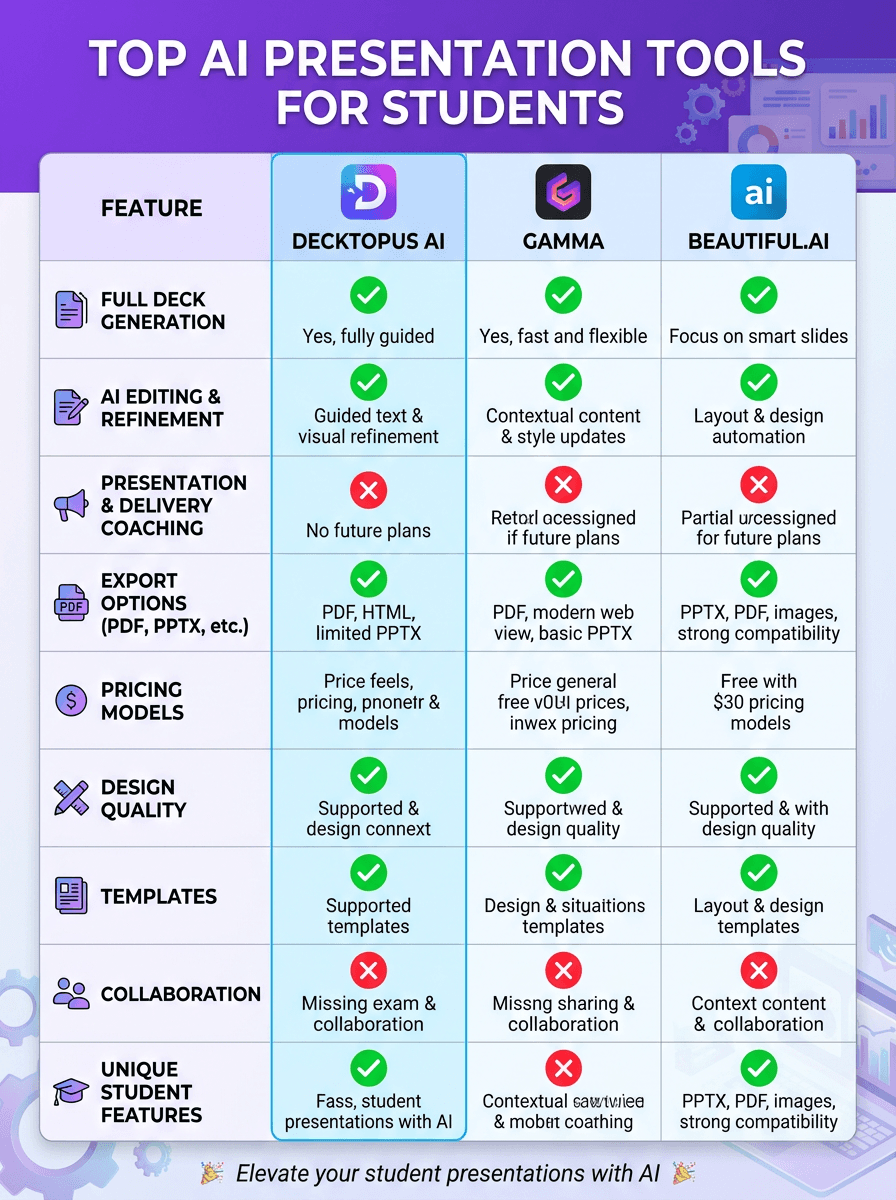
Feature | Decktopus AI | Gamma | Beautiful.ai |
Full deck from prompt | Yes | Yes | Partial |
AI editing with natural language | Yes, with preview + undo | Limited | No |
Delivery rehearsal | Loop AI Coach | No | No |
Export to PPT/PDF | Yes (PDF, PPT, PNG) | PDF, PPT | PDF, PPT |
Brand import from URL | Yes | No | Manual |
Live shareable link | Yes, auto-updates | Yes | Yes |
AI Study and Learning Tools
NotebookLM (Google)
NotebookLM lets students upload their own sources (lecture notes, PDFs, articles) and creates an AI assistant grounded in that specific material. It generates summaries, answers questions, and creates study guides — all based on the student's actual course content, not general knowledge.
Best for: Exam preparation from specific course materials, understanding lecture notes, generating study questions.
Anki + AI Add-ons
Anki is the gold standard for spaced repetition flashcards. AI add-ons now generate flashcards automatically from notes or textbook passages, eliminating the hours students spend creating cards manually while preserving Anki's proven learning algorithm.
Best for: Memorization-heavy courses (medicine, law, languages), long-term retention.
Explain Like I'm Five (ELI5) Tools
Several AI tools specialize in simplifying complex concepts. Students can paste a dense paragraph from a textbook and get a clear, jargon-free explanation.
This is especially valuable for students encountering new fields where the specialized vocabulary is itself a barrier.
Best for: Understanding complex concepts in unfamiliar fields, building intuition before diving into technical details.
AI Productivity Tools for Students
Notion AI
Notion AI integrates directly into Notion's workspace — where many students already organize their notes, projects, and schedules. It can summarize meeting notes, generate action items, draft content within existing documents, and answer questions about your own notes.
Best for: Students already using Notion for organization, project management for group work.
Otter.ai
Otter.ai transcribes lectures and meetings in real time, generating searchable, timestamped transcripts. Students can search for specific topics across all their recorded lectures and generate summaries of key points.
Best for: Lecture transcription, accessibility, reviewing spoken content from classes or study groups.
Todoist + AI
Todoist's AI features help students organize tasks from natural language input ("study for chemistry exam next Tuesday, break it into 3 sessions this week") and suggest task priorities based on deadlines and workload.
Best for: Task management, deadline tracking, breaking large projects into manageable steps.
How to Choose the Right AI Tool for Your Needs
If You Need To… | Best Tool | Why |
Write a first draft of an essay | ChatGPT or Claude | Strong at structured, long-form writing |
Find academic sources | Consensus or Semantic Scholar | Searches peer-reviewed literature specifically |
Create a class presentation | Decktopus AI | Full deck from a topic prompt, with delivery coaching |
Study for an exam | NotebookLM + Anki | Course-specific study guides plus spaced repetition |
Polish a final draft | Grammarly | Catches errors and improves clarity |
Transcribe a lecture | Otter.ai | Real-time transcription with search |
Redesign an existing presentation | Decktopus AI (Beautify) | Upload PDF/PPT, AI rebuilds or redesigns it |
AI Tools and Academic Integrity: What Students Need to Know
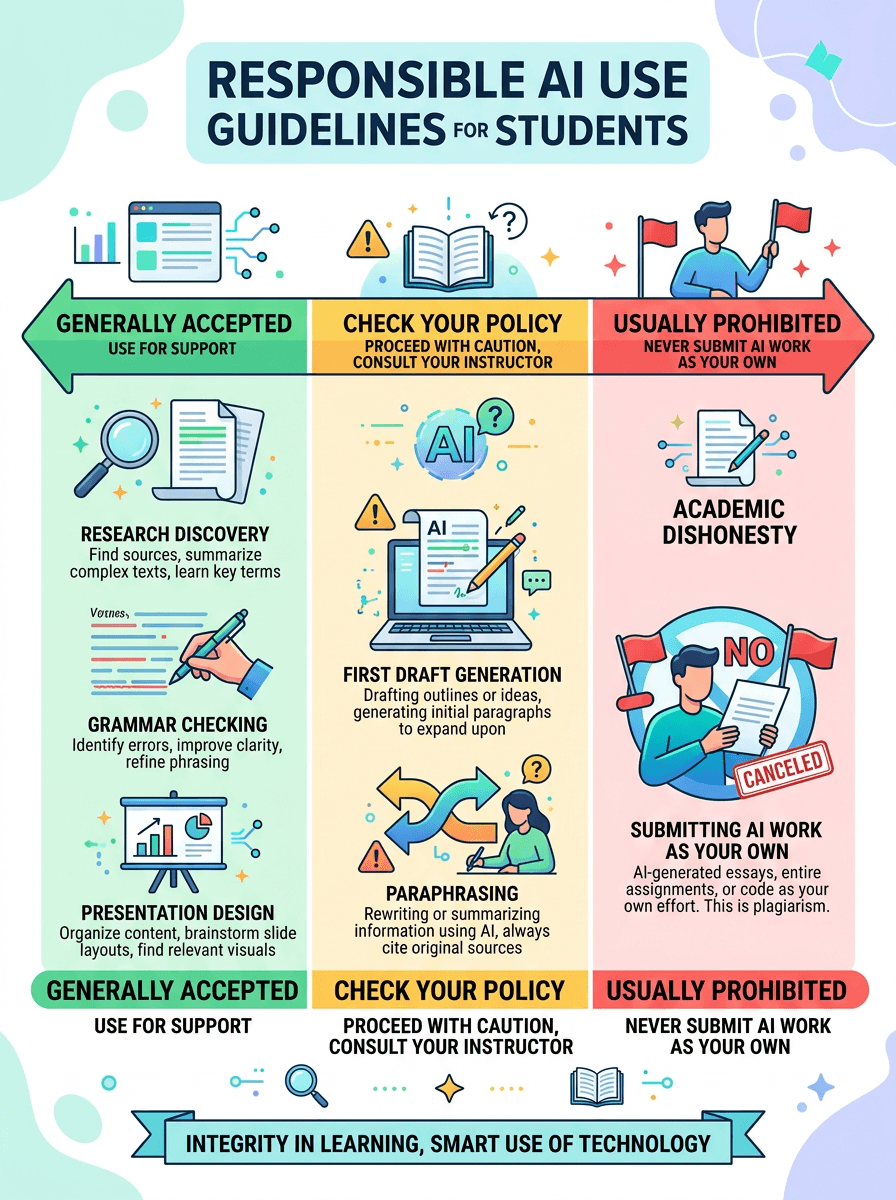
Using AI tools responsibly requires understanding your institution's academic integrity policies, which vary significantly. Some universities have embraced AI as a learning tool with clear usage guidelines, while others restrict or prohibit AI-generated content in submissions.
General Principles for Responsible AI Use
Disclose AI usage when required. Many professors now ask students to note which AI tools they used and how. Transparency is always safer than concealment.
Use AI for process, not product. Using AI to brainstorm ideas, create outlines, check grammar, or generate practice questions supports learning. Submitting AI-generated text as your own work does not.
Verify everything. AI tools can generate plausible-sounding but incorrect information. Always check facts, citations, and claims against primary sources.
Understand the material. If you cannot explain what you submitted without looking at it, you did not learn from the process regardless of what tools you used.
Check your syllabus. Every course may have different AI policies. When in doubt, ask your professor before submitting AI-assisted work.
Where AI Use Is Generally Accepted
Grammar and spell checking (Grammarly, built-in tools)
Research discovery (finding papers, not writing about them)
Study material generation (flashcards, practice questions for personal use)
Presentation design and formatting
Brainstorming and outlining (as a starting point, not a final product)
Translation assistance for non-native speakers
How Students Use Decktopus AI for Academic Presentations
Presentations are one of the most time-consuming academic tasks — not because the content is hard, but because the formatting is. Students spend hours choosing layouts, aligning text, finding images, and adjusting fonts instead of focusing on the material they need to present.
Decktopus AI eliminates that friction.
Why Students Choose Decktopus AI
AI Presentation Generation: Describe your topic ("15-minute presentation on CRISPR gene editing for Biology 201") and Decktopus AI generates a complete deck with structure, content, and design. Review and customize the AI-generated outline before generating slides.
Beautify: Already have a presentation that needs better design? Upload your existing PDF or PPT. Use as a Resource extracts the key content and builds a new deck (prompt required). Redesign keeps your text and structure but applies professional visual design (prompt optional).
Edit with AI: Refine any slide with natural language instructions. "Make this slide more data-focused" or "simplify this explanation for a non-technical audience." Preview changes before applying, with undo available.
Loop AI Delivery Coach: Rehearse your presentation with real-time feedback on delivery. Particularly valuable for students preparing for thesis defenses, conference presentations, or any graded oral component.
AI Image Generation: Generate custom diagrams, charts, and visual aids from text descriptions instead of searching for stock photos that do not match your topic.
Live Link Sharing: Share a live link with group project members or professors that auto-updates when you make changes. No need to re-export and re-send files every time you revise.
Export Options: PDF, PPT, or PNG (Standard or Compressed, Pro and Business plans) for submitting alongside papers or uploading to learning management systems.
Student Use Cases for Decktopus AI
Class presentations: Generate a complete deck from your topic, then spend your time understanding and rehearsing the material instead of formatting slides. Decktopus for Students
Group projects: One team member generates the base deck, shares via live link, and the team refines collaboratively.
Thesis and dissertation defenses: Use Loop AI Delivery Coach to rehearse your defense presentation with delivery feedback.
Student organization pitches: Create professional funding requests, event proposals, or recruitment presentations.
Course summaries: Turn lecture notes into visual study decks using Beautify's Use as a Resource feature.
Step-by-Step: Creating a Student Presentation with Decktopus AI
Enter your topic. Describe what you are presenting, the course context, and any requirements (number of slides, topics to cover). Upload existing materials via the paperclip icon if you have notes, papers, or slides to build from.
Review the AI-generated outline. Check that the structure covers your requirements. Add, remove, or reorder sections.
Generate the full presentation. Decktopus AI creates slides with content, layout, and design.
Refine with Edit with AI or Edit Text. Use natural language to adjust individual slides. Preview before applying.
Add visuals. AI-generated images, your own uploads, or stock images from Unsplash/Freepik.
Rehearse with Loop AI Coach. Practice your delivery and get real-time feedback.
Export or share. Download as PDF/PPT/PNG, share via live link, or present directly in Presentation Mode.
Frequently Asked Questions About AI Tools for Students
Are AI tools considered cheating in school?
It depends on how you use them and your institution's policies. Using AI for brainstorming, grammar checking, or presentation design is generally accepted.
Submitting AI-generated essays or answers as your own work without disclosure violates most academic integrity policies. Always check your course syllabus and ask your professor when unsure.
What is the best AI tool for writing essays?
For brainstorming and first drafts, ChatGPT and Claude are the most capable. For polishing final drafts, Grammarly catches errors and improves clarity.
The best approach uses both: an AI assistant for the initial structure and a grammar tool for the final polish, with your own critical thinking throughout.
Can AI tools help with math and science courses?
Yes. ChatGPT and Claude can explain concepts, work through practice problems step-by-step, and help debug code. Wolfram Alpha remains the gold standard for computational mathematics.
For research-heavy science courses, Consensus and Semantic Scholar help find and synthesize relevant papers.
What is the best AI tool for creating student presentations?
Decktopus AI is purpose-built for generating complete presentations from a topic description. It handles structure, content, and design automatically, and includes a delivery rehearsal coach (Loop AI) that helps students practice before presenting.
Are AI tools expensive for students?
Most AI tools offer meaningful free tiers. ChatGPT, Claude, Grammarly, Perplexity, and Semantic Scholar all have free versions sufficient for regular student use.
Decktopus AI, NotebookLM, and Consensus also offer accessible entry points for students.
How do I cite AI-generated content?
APA 7th edition recommends citing AI-generated text as a personal communication or software output, noting the tool name, version, and date. MLA suggests treating AI output as a generated source with the tool as the author.
Check your institution's specific citation guidelines, as standards are still evolving.
Can professors detect AI-generated work?
AI detection tools exist (Turnitin, GPTZero) but are not perfectly reliable — they produce both false positives and false negatives. The more you edit and personalize AI-generated content, the less detectable it becomes.
However, the goal should be genuine learning, not evading detection.
What AI tools work best for group projects?
For collaborative presentations, Decktopus AI's live link sharing lets team members work from the same always-current version. Notion AI helps organize group project tasks and notes.
Google Workspace with Gemini integration provides collaborative document editing with AI assistance.
How can international students benefit from AI tools?
AI writing tools help with grammar, idiom usage, and academic tone in a second language. Translation tools have improved dramatically.
Grammarly's tone suggestions help match the expected register of academic writing. AI presentation tools like Decktopus AI remove the language barrier from visual communication entirely.
Should I use AI for studying or just for creating assignments?
Both, but in different ways. For studying, use AI to generate practice questions, create flashcards, and get alternative explanations of difficult concepts.
For assignments, use AI to brainstorm, outline, and polish — but do the thinking and writing yourself. The learning happens in the struggle with the material, not in the output.
What is the difference between AI presentation tools and PowerPoint?
Traditional tools like PowerPoint require you to build every slide manually: choosing layouts, typing content, formatting text, finding images. AI presentation tools like Decktopus AI generate complete presentations from a description of your topic, handling design and structure so you can focus on content and delivery.
Can I use Decktopus AI to turn my notes into a presentation?
Yes. Upload your notes, papers, or existing slides using the paperclip icon. Beautify's "Use as a Resource" mode extracts the key content and builds a new, well-designed presentation around it.
This is ideal for turning messy lecture notes into a study presentation or converting a paper into a visual format for a class presentation.
How do AI tools handle citations and references?
Research-focused AI tools like Consensus and Perplexity AI provide citations with their outputs. General AI assistants like ChatGPT and Claude can format citations but may generate incorrect references — always verify.
For reliable citation management, use dedicated tools like Zotero or Mendeley alongside AI research tools.
What are the limitations of AI tools for students?
AI tools can produce factually incorrect information, struggle with very recent or niche topics, and cannot replace genuine understanding of course material. They work best as accelerators for students who already understand the fundamentals and need help with execution, formatting, or exploring ideas.
Will AI replace the need for presentation skills?
No. AI can create the slides, but the ability to present clearly, handle questions, and communicate ideas persuasively remains a human skill that employers consistently rank among the most valuable.
Tools like Decktopus AI's Loop AI Delivery Coach actually help students improve their presentation skills by providing practice feedback.
Conclusion: Using AI Tools to Learn Better, Not Just Faster
AI tools are now a permanent part of the student toolkit. The students who benefit most are not those who use AI to avoid work, but those who use it to redirect their effort toward higher-order thinking: analyzing, arguing, creating, and presenting ideas rather than formatting documents and searching databases manually.
Start with the tools that address your biggest time sinks. If you spend hours formatting presentations, try Decktopus AI.
If you struggle with research synthesis, try Consensus or Semantic Scholar. If grammar slows you down, start with Grammarly. Build your AI toolkit gradually, and always use these tools to support learning, not replace it.
Stay Connected
Follow Decktopus for the latest updates, tips, and resources:
Related posts

How to Improve Communication Skills at Work (2026 Practical Guide)
The 5 workplace communication skills that matter most, the CLEAR framework, and the AI practice method that turns weak communicators into strong ones.
Business & Strategy

Job Interview Sample Questions: How to Practice Your Answers (2026)
The 20 most common interview questions, the STAR framework for answers, and the AI practice method that turns rehearsed responses into confident ones.
Business & Strategy

How to Negotiate a Raise: The Script, Practice Method & Tips That Actually Work
A step-by-step script for negotiating a raise, common mistakes to avoid, and the AI practice method that turns a nervous ask into a confident one.
Business & Strategy