Sales & Proposals
Sales Strategy: Types, Examples, and How to Build a Winning Plan
Learn what a sales strategy is, the main types, a 7-step framework to build your plan, real examples, and common mistakes to avoid.

Decktopus Content Team
What Is a Sales Strategy?
Why Sales Strategy Matters
Types of Sales Strategy
Why You Should Create a Sales Strategy
How to Create a Sales Strategy Step by Step
Inbound vs. Outbound Sales Strategy
Sales Strategy Examples
Sales Strategies Compared
The 7-Step SELLING Sales Strategy Framework
Common Mistakes to Avoid
How to Build Your Sales Strategy Deck with Decktopus AI
FAQ
Conclusion
Stay Connected
What Is a Sales Strategy?
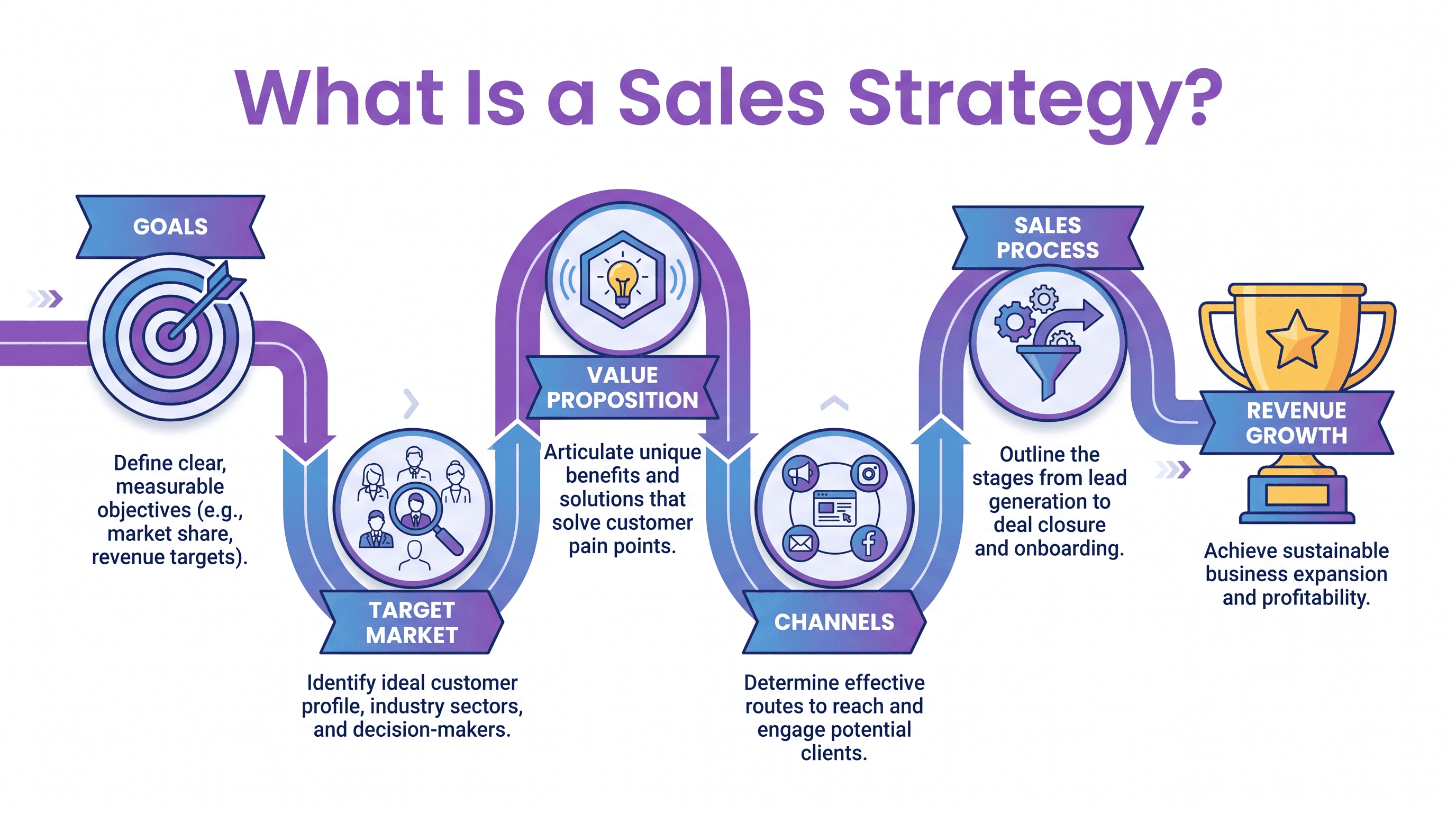
A sales strategy is a structured plan that defines who you sell to, how you reach them, and how you turn them into loyal customers. Its main benefit is focus: every rep knows which deals to chase and how to win them.
Gartner research found that B2B buyers spend only about 17% of their buying time meeting with potential suppliers. With so little face time, a clear strategy decides whether those few conversations turn into revenue.
A sales strategy works as a road map for all sales activity, from finding prospects and generating leads to closing deals and building lasting relationships. It covers your target market, goals, channels, value proposition, and sales process.
It also includes regular reviews, so you can adjust based on results and market changes. This guide explains the main types of sales strategy, a step-by-step process, and real examples you can adapt.
Why Sales Strategy Matters
An effective sales strategy is more than a plan on paper. It connects daily sales activity with company goals and helps teams work toward the same targets.
In a competitive market, strategy is often the difference between a company that grows and one that just survives. Teams with a clear plan waste less time and close more of the right deals.
Types of Sales Strategy
The right strategy depends on your industry, market, products, and goals. Most approaches fall into these main types.
Direct Sales Strategy
Salespeople contact prospects directly through meetings, calls, email, or chat. It is common in retail, real estate, and B2B sales.
Indirect Sales Strategy
You sell through intermediaries like wholesalers, retailers, distributors, or online marketplaces. Partners help you reach new customers and markets.
Inbound Sales Strategy
You attract leads with content marketing, SEO, and social media. Helpful resources build trust and guide buyers through the funnel.
Outbound Sales Strategy
You reach out first through cold calls, email outreach, and direct mail. It can feel more intrusive, but it produces fast results and lets you target specific accounts.
Consultative Sales Strategy
Reps act as trusted advisors who diagnose problems before recommending solutions. It works best for complex or high-value products.
Relationship-Based Sales Strategy
The focus is long-term trust and loyalty. Reps learn each client's goals and provide personal, ongoing support.
Online Sales Strategy
You use websites, social platforms, and marketplaces to attract and convert buyers. It is essential for e-commerce and increasingly for B2B too.
Channel Sales Strategy
Third parties such as affiliates, agents, or resellers sell on your behalf. This can expand reach and lower costs.

The best approach depends on what you sell, who you sell to, and how competitive your market is. Many companies combine several types.
Why You Should Create a Sales Strategy
Clear direction. Everyone knows the goals, target market, and plan.
Smarter resource allocation. You invest in the tools, people, and campaigns with the best returns.
Sharper focus. Reps spend time on the most promising leads.
Better customer understanding. Research into needs and pain points improves conversion and satisfaction.
Competitive advantage. A clear value proposition helps you stand out.
How to Create a Sales Strategy Step by Step
[[EMBED:PGlmcmFtZSBzcmM9Imh0dHBzOi8vd3d3LnlvdXR1YmUuY29tL2VtYmVkL05OejBQaFd2YzhBIiB0aXRsZT0iWW91VHViZSB2aWRlbyIgZnJhbWVib3JkZXI9IjAiIGFsbG93PSJhY2NlbGVyb21ldGVyO2F1dG9wbGF5O2NsaXBib2FyZC13cml0ZTtlbmNyeXB0ZWQtbWVkaWE7Z3lyb3Njb3BlO3BpY3R1cmUtaW4tcGljdHVyZSIgYWxsb3dmdWxsc2NyZWVuIHN0eWxlPSJ3aWR0aDoxMDAlO2FzcGVjdC1yYXRpbzoxNi85O2JvcmRlcjowO2JvcmRlci1yYWRpdXM6MTJweDttYXJnaW46OHB4IDAiPjwvaWZyYW1lPg==]]
Step 1: Set Specific, Measurable Goals
Set sales targets that support your wider business goals. Examples include entering a new market, winning a set number of new clients, or growing a new revenue stream.
Step 2: Identify Your Market
Research your target customers' needs, habits, and problems. Study market trends and competitors to find openings.
Step 3: Create a Value Proposition
Explain clearly how your product solves customer problems better than alternatives. A strong value proposition makes it easy for buyers to choose you.
Step 4: Select Your Sales Channels
Choose how you will reach customers: a direct sales team, online sales, partners, or a mix. Consider customer preferences, reach, and cost.
Step 5: Build Your Sales Process
Map the steps that turn leads into customers: lead generation, qualification, nurturing, closing, and follow-up after the sale. Businesses are increasingly automating the lead response stage with an AI call answering service that ensures every inbound call from a prospect is handled instantly, keeping the pipeline moving 24/7.
Creating a repeatable sales process is only part of building a high-performing sales organization. Many businesses also invest in sales enablement platforms like Rox to give sales teams access to buyer intelligence, CRM insights, and AI-powered recommendations that help prioritize opportunities, personalize customer interactions, and execute their sales strategy more consistently.
Step 6: Set Targets and Allocate Resources
Assign budget, people, training, and technology to support the plan. Set realistic quotas based on goals, market potential, and past results, then break them into milestones with rewards.
[[EMBED:PGRpdiBzdHlsZT0ib3ZlcmZsb3cteDphdXRvO21hcmdpbjoyMHB4IDAiPjx0YWJsZSBzdHlsZT0id2lkdGg6MTAwJTtib3JkZXItY29sbGFwc2U6Y29sbGFwc2U7Zm9udC1zaXplOjE1cHg7bWFyZ2luOjhweCAwIj48dHI+PHRoIHN0eWxlPSJib3JkZXI6MXB4IHNvbGlkICNlM2U2ZWE7cGFkZGluZzoxMHB4IDE0cHg7dGV4dC1hbGlnbjpsZWZ0O2JhY2tncm91bmQ6I2Y0ZjZmODtmb250LXdlaWdodDo2MDAiPlN0ZXA8L3RoPjx0aCBzdHlsZT0iYm9yZGVyOjFweCBzb2xpZCAjZTNlNmVhO3BhZGRpbmc6MTBweCAxNHB4O3RleHQtYWxpZ246bGVmdDtiYWNrZ3JvdW5kOiNmNGY2Zjg7Zm9udC13ZWlnaHQ6NjAwIj5EZXNjcmlwdGlvbjwvdGg+PC90cj48dHI+PHRkIHN0eWxlPSJib3JkZXI6MXB4IHNvbGlkICNlM2U2ZWE7cGFkZGluZzoxMHB4IDE0cHg7dGV4dC1hbGlnbjpsZWZ0O3ZlcnRpY2FsLWFsaWduOnRvcCI+U3RlcCAxPC90ZD48dGQgc3R5bGU9ImJvcmRlcjoxcHggc29saWQgI2UzZTZlYTtwYWRkaW5nOjEwcHggMTRweDt0ZXh0LWFsaWduOmxlZnQ7dmVydGljYWwtYWxpZ246dG9wIj5JZGVudGlmeSBzYWxlcyBvYmplY3RpdmVzIGFuZCBnb2Fscy4gRGVmaW5lIHdoYXQgeW91IGFpbSB0byBhY2hpZXZlIHdpdGggeW91ciBzYWxlcyBwbGFuLjwvdGQ+PC90cj48dHI+PHRkIHN0eWxlPSJib3JkZXI6MXB4IHNvbGlkICNlM2U2ZWE7cGFkZGluZzoxMHB4IDE0cHg7dGV4dC1hbGlnbjpsZWZ0O3ZlcnRpY2FsLWFsaWduOnRvcCI+U3RlcCAyPC90ZD48dGQgc3R5bGU9ImJvcmRlcjoxcHggc29saWQgI2UzZTZlYTtwYWRkaW5nOjEwcHggMTRweDt0ZXh0LWFsaWduOmxlZnQ7dmVydGljYWwtYWxpZ246dG9wIj5BbmFseXplIHlvdXIgdGFyZ2V0IG1hcmtldCBhbmQgY3VzdG9tZXJzLiBVbmRlcnN0YW5kIHRoZWlyIG5lZWRzLCBwcmVmZXJlbmNlcywgYW5kIGJlaGF2aW9ycyB0byB0YWlsb3IgeW91ciBzYWxlcyBhcHByb2FjaC48L3RkPjwvdHI+PHRyPjx0ZCBzdHlsZT0iYm9yZGVyOjFweCBzb2xpZCAjZTNlNmVhO3BhZGRpbmc6MTBweCAxNHB4O3RleHQtYWxpZ246bGVmdDt2ZXJ0aWNhbC1hbGlnbjp0b3AiPlN0ZXAgMzwvdGQ+PHRkIHN0eWxlPSJib3JkZXI6MXB4IHNvbGlkICNlM2U2ZWE7cGFkZGluZzoxMHB4IDE0cHg7dGV4dC1hbGlnbjpsZWZ0O3ZlcnRpY2FsLWFsaWduOnRvcCI+RGV2ZWxvcCBzYWxlcyBzdHJhdGVnaWVzIGFuZCB0YWN0aWNzLiBEZXRlcm1pbmUgaG93IHlvdSB3aWxsIHJlYWNoIGFuZCBlbmdhZ2Ugd2l0aCB5b3VyIHRhcmdldCBhdWRpZW5jZSBlZmZlY3RpdmVseS48L3RkPjwvdHI+PHRyPjx0ZCBzdHlsZT0iYm9yZGVyOjFweCBzb2xpZCAjZTNlNmVhO3BhZGRpbmc6MTBweCAxNHB4O3RleHQtYWxpZ246bGVmdDt2ZXJ0aWNhbC1hbGlnbjp0b3AiPlN0ZXAgNDwvdGQ+PHRkIHN0eWxlPSJib3JkZXI6MXB4IHNvbGlkICNlM2U2ZWE7cGFkZGluZzoxMHB4IDE0cHg7dGV4dC1hbGlnbjpsZWZ0O3ZlcnRpY2FsLWFsaWduOnRvcCI+Q3JlYXRlIGEgc2FsZXMgZm9yZWNhc3QgYW5kIGJ1ZGdldC4gRXN0aW1hdGUgeW91ciBleHBlY3RlZCBzYWxlcyByZXZlbnVlIGFuZCBhbGxvY2F0ZSByZXNvdXJjZXMgYWNjb3JkaW5nbHkuPC90ZD48L3RyPjx0cj48dGQgc3R5bGU9ImJvcmRlcjoxcHggc29saWQgI2UzZTZlYTtwYWRkaW5nOjEwcHggMTRweDt0ZXh0LWFsaWduOmxlZnQ7dmVydGljYWwtYWxpZ246dG9wIj5TdGVwIDU8L3RkPjx0ZCBzdHlsZT0iYm9yZGVyOjFweCBzb2xpZCAjZTNlNmVhO3BhZGRpbmc6MTBweCAxNHB4O3RleHQtYWxpZ246bGVmdDt2ZXJ0aWNhbC1hbGlnbjp0b3AiPkltcGxlbWVudCB5b3VyIHNhbGVzIHBsYW4uIFB1dCB5b3VyIHN0cmF0ZWdpZXMgaW50byBhY3Rpb24sIG1vbml0b3IgcHJvZ3Jlc3MsIGFuZCBtYWtlIGFkanVzdG1lbnRzIGFzIG5lZWRlZC48L3RkPjwvdHI+PHRyPjx0ZCBzdHlsZT0iYm9yZGVyOjFweCBzb2xpZCAjZTNlNmVhO3BhZGRpbmc6MTBweCAxNHB4O3RleHQtYWxpZ246bGVmdDt2ZXJ0aWNhbC1hbGlnbjp0b3AiPlN0ZXAgNjwvdGQ+PHRkIHN0eWxlPSJib3JkZXI6MXB4IHNvbGlkICNlM2U2ZWE7cGFkZGluZzoxMHB4IDE0cHg7dGV4dC1hbGlnbjpsZWZ0O3ZlcnRpY2FsLWFsaWduOnRvcCI+U2V0IGdvYWxzIGFuZCBhbGxvY2F0ZSByZXNvdXJjZXMuIEFzc2lzdCB5b3VyIHNhbGVzIHBsYW4gd2l0aCB0aGUgYWxsb2NhdGlvbiBvZiByZXNvdXJjZXMgaW5jbHVkaW5nIG1vbmV5LCBzdGFmZiwgdHJhaW5pbmcsIGFuZCB0ZWNobm9sb2d5LiBBc3NpZ24gcmVzb3VyY2VzIGluIGFjY29yZGFuY2Ugd2l0aCB0aGUgcmVzb3VyY2VzIHJlcXVpcmVkIHRvIGNhcnJ5IG91dCB5b3VyIHNhbGVzIHBsYW4gc3VjY2Vzc2Z1bGx5LiBEZXRlcm1pbmUgeW91ciB0ZWFtJ3MgcmVhbGlzdGljIHNhbGVzIGdvYWxzIGFuZCBxdW90YXMgYmFzZWQgb24geW91ciBvd24gZ29hbHMsIHRoZSBwb3RlbnRpYWwgb2YgdGhlIG1hcmtldCwgYW5kIHBhc3QgcmVzdWx0cy4gRGl2aWRlIHVwIHlvdXIgZ29hbHMgaW50byBkb2FibGUgbWlsZXN0b25lcyBhbmQgb2ZmZXIgcmV3YXJkcyB0byB5b3VyIHNhbGVzIHRlYW0gdG8gaGVscCB0aGVtIHJlYWNoIHRoZWlyIG9iamVjdGl2ZXMuPC90ZD48L3RyPjwvdGFibGU+PC9kaXY+]]
Step 7: Measure, Review, and Adjust
Track win rates, deal size, sales cycle length, and pipeline coverage. Review results regularly and adjust your plan as the market changes.
Inbound vs. Outbound Sales Strategy
Inbound Strategy
Focus: Attract prospects with useful content and build trust.
Methods: Blogging, SEO, social media, email, and content marketing.
Communication: Personalized and on the buyer's terms.
Example: A software company publishes tutorials and videos that solve common industry problems, so prospects come to trust it before they buy.
Outbound Strategy
Focus: Reach out directly to chosen prospects.
Methods: Cold calls, email campaigns, direct mail, and advertising.
Communication: Company-initiated and often one-way at first.
Example: A sales team calls a list of target accounts to introduce a new product and book demos.
Main Differences
Inbound pulls prospects in over time, while outbound reaches out to create quick connections. Inbound relies on buyers opting in, while outbound contacts them first.
Most companies combine both to reach and engage their target market.
Sales Strategy Examples
Consultative Selling
A financial advisory firm spends time learning each client's goals and risk tolerance. Advisors then recommend tailored solutions, which builds long-term trust.
Inbound Sales and Content Marketing
A SaaS company publishes blog posts, whitepapers, and webinars for its niche. It nurtures the leads this content attracts until they become paying customers.
Sales Representative Planning Document
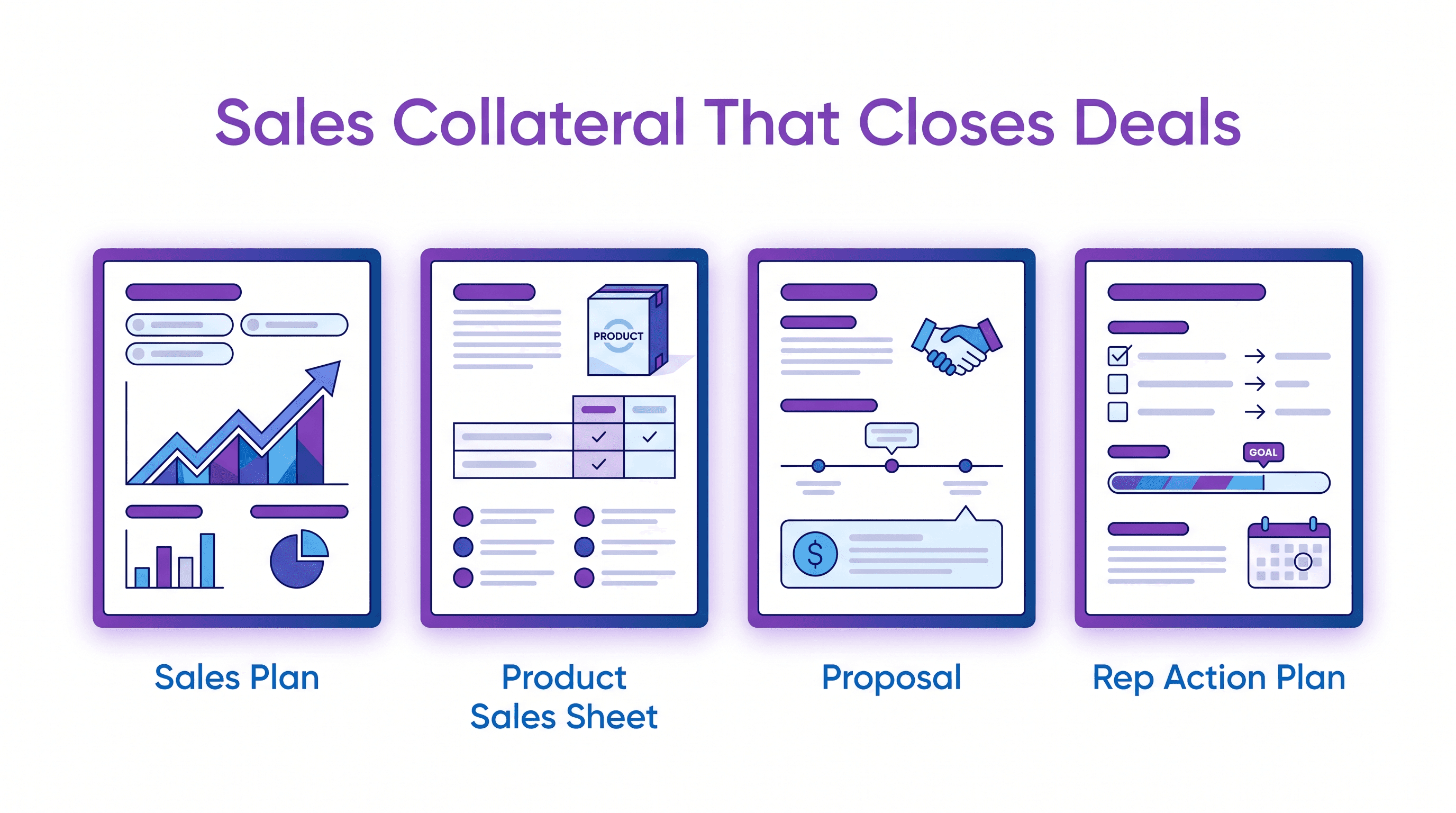
A sales rep writes a plan listing goals, target accounts, and action steps. For the rep, this document acts as a road map for daily activity and progress tracking.
Sales Plan
A sales manager outlines objectives, targets, market analysis, and positioning in a sales plan template that the whole team can follow. It keeps everyone aligned on the same plan.
Product Sales Sheet
A marketing team creates a product sales sheet template for each product, covering features, benefits, pricing, and testimonials. Reps use it in meetings and pitches.
Standard Sales Documents
A company builds a shared format for proposals and agreements. This template keeps branding, messaging, and terms consistent across all sales documents.
Industry-Specific Sales Sheet
An oil and gas company creates a sales sheet that highlights its exploration resources and drilling capabilities. Its team uses it to present opportunities to partners and investors.
Sales Strategies Compared
Strategy | Best For | Speed to Results | Cost |
|---|---|---|---|
Direct | High-touch B2B and real estate | Medium | High |
Indirect / Channel | Scaling into new markets | Medium | Medium |
Inbound | Education-heavy products | Slow at first, then compounding | Low to medium |
Outbound | Targeting specific accounts | Fast | Medium to high |
Consultative | Complex or high-value deals | Slow | High |
Online | E-commerce and self-serve SaaS | Fast | Low to medium |
This second table compares inbound and outbound side by side.
Factor | Inbound | Outbound |
|---|---|---|
Who starts the conversation | The buyer | The seller |
Main tools | Content, SEO, social | Calls, email, ads |
Lead quality | Usually warmer | Varies |
Control over targeting | Lower | Higher |
Best used for | Building trust over time | Fast pipeline creation |
The 7-Step SELLING Sales Strategy Framework
Set goals. Define measurable revenue and customer targets.
Explore the market. Research buyers, competitors, and trends.
Lock in your value proposition. State clearly why buyers should choose you.
Line up channels. Choose direct, indirect, inbound, outbound, or a mix.
Implement a process. Map every stage from lead to renewal.
Nurture your team. Provide training, tools, and incentives.
Gauge and adjust. Review results and refine the plan.
Step | Key Metric | Owner |
|---|---|---|
Set goals | Revenue target | Sales leadership |
Explore the market | Ideal customer profile | Sales and marketing |
Lock in value proposition | Win rate vs. competitors | Product marketing |
Line up channels | Cost per acquisition | Sales leadership |
Implement a process | Stage conversion rates | Sales operations |
Nurture your team | Quota attainment | Sales managers |
Gauge and adjust | Pipeline coverage | Whole team |
Common Mistakes to Avoid
Vague goals. "Sell more" is not a strategy.
Targeting everyone. A clear ideal customer profile makes every step easier.
Talking features, not outcomes. Buyers care about results.
No defined process. Without stages, deals stall and forecasts fail.
Weak follow-up. Many deals are lost simply because no one followed up.
Ignoring data. Track what works and change what doesn't.
Never updating the plan. Markets change, so your strategy should too.
How to Build Your Sales Strategy Deck with Decktopus AI
A sales strategy only works when the team understands it and leadership backs it. Companies can use Decktopus to turn their sales plan into a clear, persuasive presentation.
Decktopus AI is an end-to-end presentation system that takes you from idea to delivery and tracking. Sales reps can also rehearse tough buyer conversations with Decktopus AI, using Loop AI Delivery Coach to practice objection handling before the real meeting.
Why Decktopus AI Is Built for Sales Teams
AI Presentation Generation. Type "2026 sales strategy for our mid-market SaaS team: goals, ICP, channels, and quarterly targets" and get a full deck.
AI Outline Generation. Review each slide as a card before generating, so your plan follows a clear order.
Beautify. Upload an existing PDF sales plan and turn it into a presentation. Choose Redesign to keep your text and apply a new look, or Use as a Resource to build a new deck. You can also convert files with our PDF to PPT tool.
Brand Import. Pull your logo, colors, and fonts from your website, or a prospect's, for a tailored pitch.
Edit with AI. Ask for things like "add an objection-handling slide for pricing concerns."
Loop AI Delivery Coach. The Red Team simulates your buyers and asks tough, context-specific questions, and The Mirror scores your rehearsal.
Deck Analytics. See who opened your proposal, how long they spent, and which slides they focused on, so you follow up at the right moment.
Email Gate. Require an email before viewers access a shared deck to capture new leads from forwarded proposals.
Custom Domain (Business plan). Share decks on your own subdomain for a branded experience.
Team Collaboration (Business plan). Give teammates access to shared sales decks.
Decktopus also connects to the tools your team already uses: create decks inside ChatGPT with the Decktopus AI app, or through the Decktopus MCP server in tools like Claude Code and Cursor.
Decktopus AI vs. Traditional Tools for Sales Decks
Need | Traditional Slide Tools | Decktopus AI |
|---|---|---|
Build a sales deck | Hours of formatting | Full deck from a prompt |
Reuse an old PDF plan | Rebuild by hand | Beautify from an uploaded file |
Prepare for objections | Role-play if a colleague is free | Loop Red Team on demand |
Know if the buyer read it | No visibility | Deck Analytics with slide-level attention |
Capture new leads | Separate form tool | Email Gate on the share link |
Update after sending | Send a new version | Live link updates automatically |
Who This Is For
Sales teams presenting strategy and quarterly plans
Account executives building tailored proposals
Business development reps preparing outreach decks
Founders leading early sales
Customer success teams running renewal and upsell reviews
Step-by-Step: Build Your Sales Strategy Deck
Describe your topic. Type something like "Annual sales strategy for a B2B cybersecurity company: targets, channels, process, and team plan." Or upload an existing plan via the paperclip icon. With Beautify, choose Use as a Resource (extract key points and build a new deck with a required prompt) or Redesign (keep text and structure, apply a new design).
Choose your style. Pick a saved brand or style, import a brand from a website URL, or create a new style from a base (Minimal, Bold, Dark, or Let AI pick).
Review the AI-generated outline. Each slide appears as a card. Edit, reorder, duplicate, or delete slides, and use the Adjust button to change your style.
Generate the full presentation. Decktopus AI produces the complete deck with content, layout, and design.
Refine with Edit with AI or Edit Text. Try "turn our quarterly targets into a chart," "add a slide comparing inbound and outbound," or "make the tone more executive." AI optimizes your prompt and double-checks before applying, with preview and undo. Use Edit Text for manual changes (5 credits per edit). Unlimited version history keeps every change.
Add images. Generate AI images, upload product photos via the paperclip icon, or search Unsplash and Freepik.
Rehearse with Loop AI Delivery Coach. The Profiler gathers context about your meeting, The Architect builds your narrative and speaking notes, The Red Team simulates buyer questions, and The Mirror scores your rehearsal.
Export or share. Export to PDF, PPT, or PNG (Standard or Compressed). Share a live link that updates automatically, embed the deck, or present in full-screen Presentation Mode. On the Business plan, use a Custom Domain. Turn on the Email Gate to collect viewer emails, and use Deck Analytics to see who viewed, for how long, and where they dropped off.
Ready to turn your sales strategy into a deck that gets buy-in? Get started with Decktopus AI.
FAQ
What is a sales strategy?
A sales strategy is a plan for reaching sales goals. It defines your target market, channels, value proposition, and sales process.
Why is a sales strategy important?
It gives your team direction, focuses effort on the best opportunities, and connects sales activity to business goals.
What are the main elements of a sales strategy?
Goals, target market, value proposition, sales channels, sales process, resources, and performance tracking.
What are the main types of sales strategy?
Direct, indirect, inbound, outbound, consultative, relationship-based, online, and channel sales.
What is the difference between inbound and outbound sales?
Inbound attracts buyers with content, so they come to you. Outbound reaches out to prospects first through calls, email, and ads.
How do I create a sales strategy?
Set goals, research your market, define your value proposition, choose channels, build a process, allocate resources, and review results regularly.
What is a sales strategy plan?
It is the written version of your strategy, with targets, timelines, owners, and budgets. Many teams present it as a slide deck.
How often should I update my sales strategy?
Review it at least quarterly and update it whenever your market, product, or results change significantly.
What KPIs measure a sales strategy?
Common KPIs include win rate, average deal size, sales cycle length, pipeline coverage, and quota attainment.
What is consultative selling?
Consultative selling means diagnosing a buyer's problem before recommending a solution. It works best for complex or high-value products.
How can AI help with sales strategy?
AI can prioritize leads, answer inbound calls, draft outreach, and build sales decks. It speeds up busy work so reps can focus on buyers.
How can I tell if a prospect read my sales deck?
Share it as a Decktopus AI live link and check Deck Analytics. You will see who viewed it, for how long, and which slides held attention.
How can I practice handling sales objections?
Use Loop AI Delivery Coach in Decktopus AI. The Red Team simulates your buyers and gives feedback after each answer.
Conclusion
A strong sales strategy is the foundation of steady growth. It aligns your team, focuses resources, and helps you win the right customers.
Set clear goals, understand your market, choose the right mix of strategies, and build a repeatable process. Then review and adjust as results come in.
Use the SELLING framework to keep your plan on track. When it is time to present it, get started with Decktopus AI and build a sales strategy deck that earns buy-in.
Stay Connected
Follow Decktopus AI for more sales and presentation tips:
Related posts

Struggling to Find New Clients? 5 Proven Tips to Turn Prospecting Into Growth
Struggling to find new clients? Discover 5 proven tips, from proposals to paid ads, to build a steady pipeline of new business.
Sales & Proposals

Cracking the Code: Mastering B2B Sales Strategies & Techniques
Discover the essential guide to mastering B2B sales strategies and techniques, uncovering the secrets behind successful business-to-business selling. Explore the B2B sales process, optimize your team's performance, and elevate your approach to selling products for businesses.
Sales & Proposals

Mastering Proposals: Exploring the Best Business Proposal Tools and Software Solutions
Discover the best business proposal tools, including PandaDoc and Proposable, to streamline your proposal process and win more clients.
Sales & Proposals