Templates & How-to
How to Build Confidence When Speaking in Public (2026 Guide)
The science behind speaking confidence, the CONFIDENT framework, and the AI practice method that turns nervous presenters into calm, credible speakers.


İlayda Tunaboylu
Speaking confidence is the earned belief that you can deliver spoken material in front of an audience without your nervous system taking over your delivery. According to the National Institute of Mental Health, roughly 73% of adults experience significant public speaking anxiety, but a 2023 Journal of Applied Psychology meta-analysis found structured rehearsal reduces measured anxiety by 47% within 6 weeks.
Confidence is not a personality trait. It's a skill that compounds with preparation and reps. This guide breaks down the science of speaking confidence, gives you a framework, and shows you the practice method that turns nervous presenters into calm ones. For the broader delivery playbook, see our guide on public speaking tips.
You'll get:
Why speaking confidence is a skill, not a trait
The CONFIDENT framework
6 mistakes that quietly prevent confidence from building
The AI method that accelerates confidence reps
Answers to real questions from anxious and introverted speakers
Speaking Confidence Is a Skill, Not a Trait
The most common myth about speaking confidence is that some people are born with it. They're not. What looks like natural confidence is almost always the result of hidden reps.
Confidence in public speaking is built from three sources:
Preparation depth. You know the material cold, so you're not fighting content and nerves at the same time.
Rehearsal reps. You've delivered the material out loud enough times that the delivery is automatic.
Recovery familiarity. You've made small mistakes in practice enough times that they no longer trigger panic in real settings.
The people who look most confident are the ones who've done the most preparation, not the ones with the boldest personality. For the structured practice method that builds those reps, see how to practice public speaking alone.
The CONFIDENT Framework
Letter | Component | What It Does |
|---|---|---|
C | Content mastered | You know the material so deeply that delivery holds up under pressure |
O | Opening memorized | The first sentence is locked cold |
N | Nerves reframed | You call the physical symptoms "excitement" not "anxiety" |
F | Filler cut | Rehearsal reps have removed the "um" and "like" patterns |
I | Interaction rehearsed | You've practiced Q&A pushback so it doesn't blindside you |
D | Delivery timed | Every rehearsal is on the actual clock |
E | Eye contact planned | You know which zones of the room to rotate through |
N | Nutrition and rest | Sleep and hydration before high-stakes speeches, no exceptions |
T | Trigger words on notes | Notes are anchors, not scripts |
Skip any three and confidence collapses under pressure. Nail all nine and you deliver calmly whether you feel nervous or not.
The 6 Mistakes That Prevent Confidence From Building
1. Waiting Until You Feel Confident to Practice
Confidence follows practice, not the other way around. You will feel nervous during your first practice session. Do it anyway.
2. Practicing in Your Head
Silent rehearsal builds silent skill. Every out-loud rep is worth ten silent ones for confidence building.
3. Rehearsing Only in Front of a Mirror
Mirrors don't push back. Real audiences do. Practicing against a wall means real audiences will surprise you every time.
4. Avoiding Q&A Rehearsal
Q&A is where confidence collapses most often. If you only rehearse the scripted portion, you're building brittle confidence.
5. Comparing Yourself to Professional Speakers
TED speakers rehearse 60 to 200 hours per talk. Comparing your first talk to their polished delivery is not a fair comparison. Compare yourself to your last talk, not to a stage veteran. If you want to see what that level of prep looks like, our guide on how to give a TED talk breaks down the process.
6. Skipping Recovery Practice
The confidence to recover from a mistake is different from the confidence to deliver a rehearsed line. Practice recovering: intentionally lose your place, then get back on track.
How Loop AI Delivery Coach Builds Confidence Faster
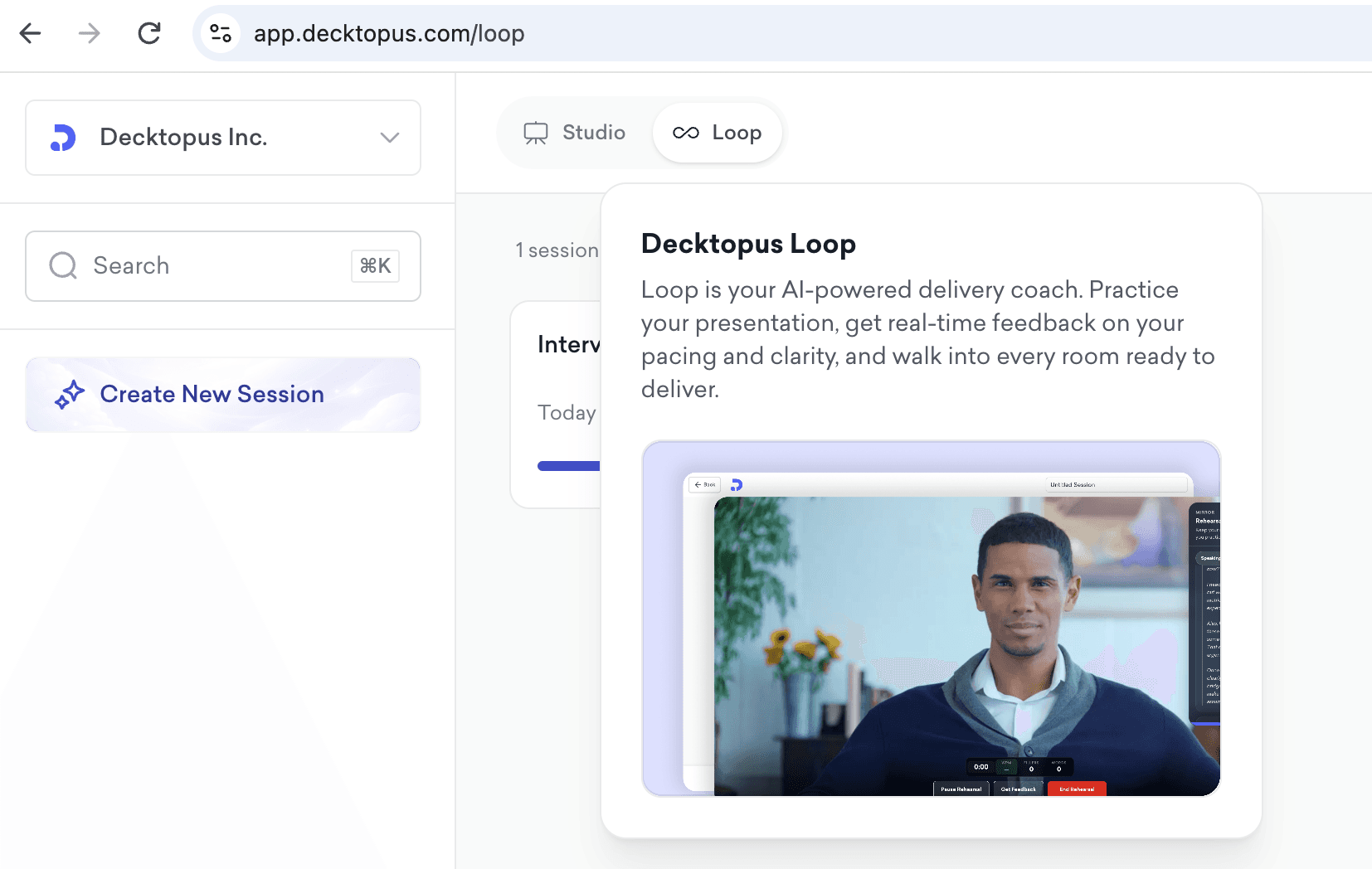
Confidence is built from reps. But not any reps, structured reps with real feedback. Historically that required a professional speaking coach. Loop AI Delivery Coach automates that inside Decktopus AI.
The 4 Loop Agents
Profiler (Emily) simulates your actual audience. Practicing against a realistic listener (not a wall) builds real confidence, not false confidence.
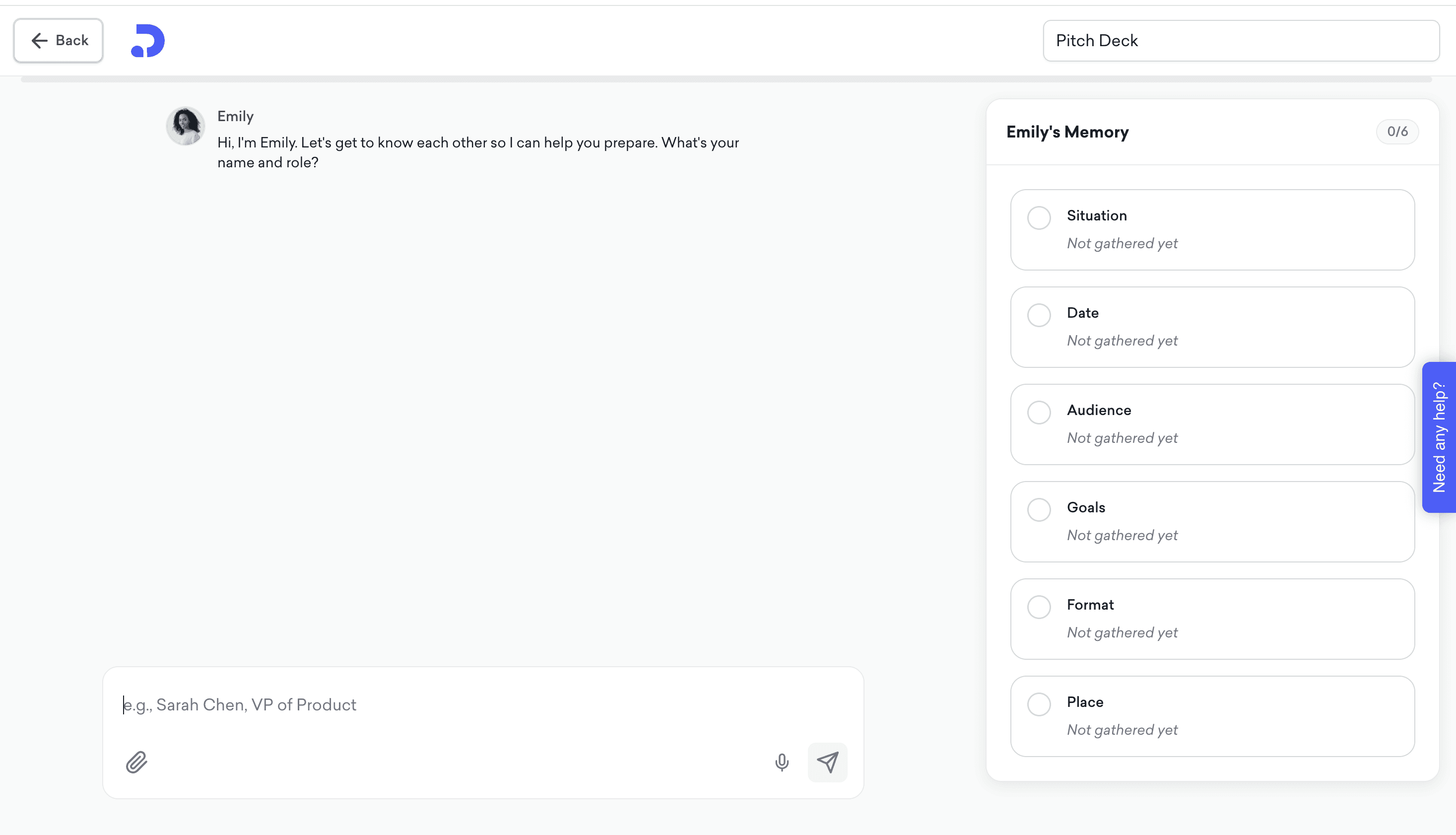
Architect (Marcus) scores your structure. If your speech has structural weakness, you'll get nervous defending it live. Fixing structure in rehearsal removes that source of anxiety.
Red Team fires hard Q&A questions. Facing them repeatedly in practice means they no longer surprise you live.
Mirror records and plays back with metrics: filler count, pace, pause length, tone variance. Confidence often grows from watching yourself sound better than you thought.
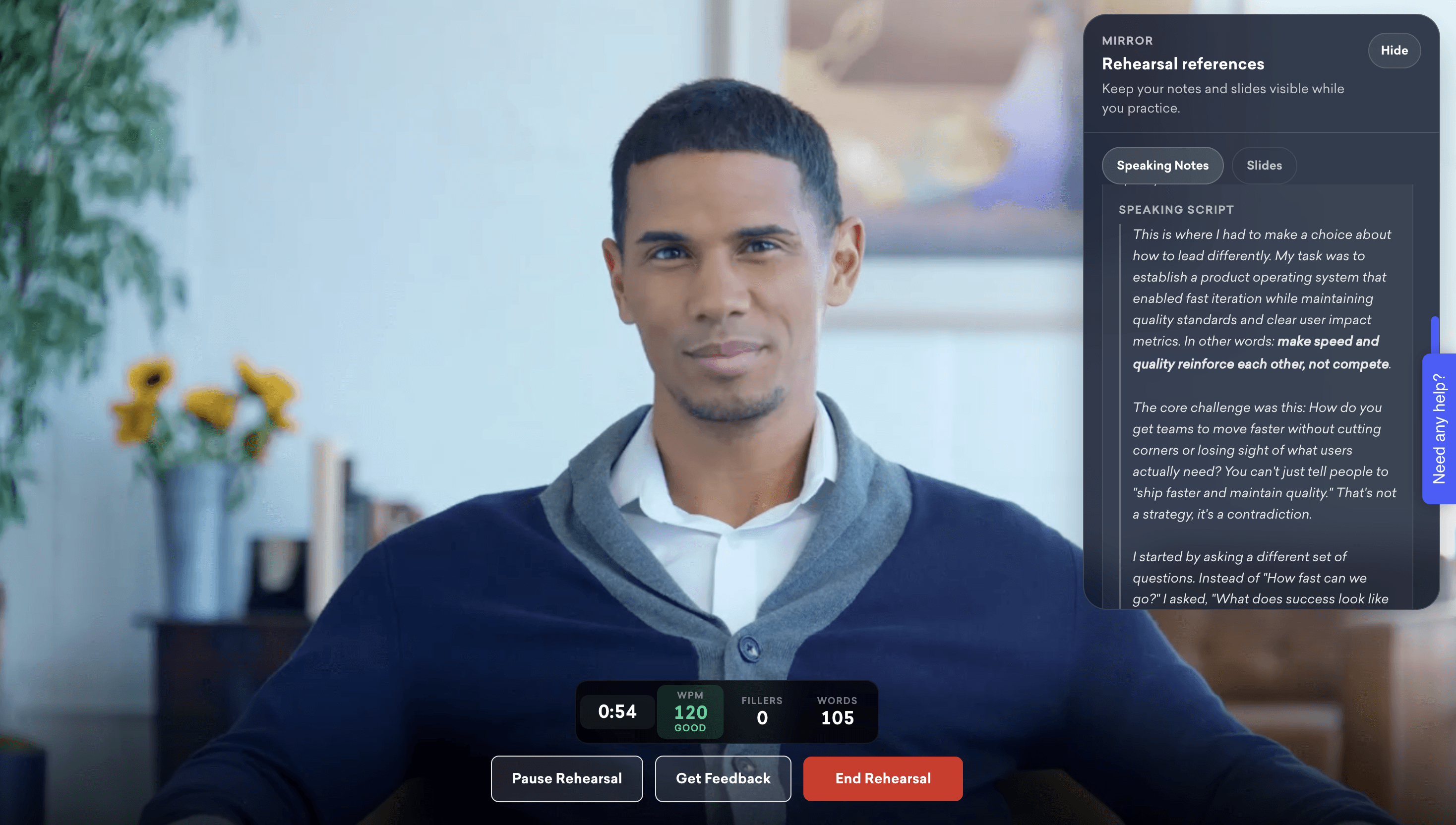
Loop Workflow for Building Speaking Confidence
Pick a speech, presentation, or pitch you have coming up (or invent one)
Open Loop, describe the audience
Deliver the material, Emily reacts, Marcus scores structure
Face Red Team questions until answers feel routine
Review Mirror playback, note what you did well and what improved from last session
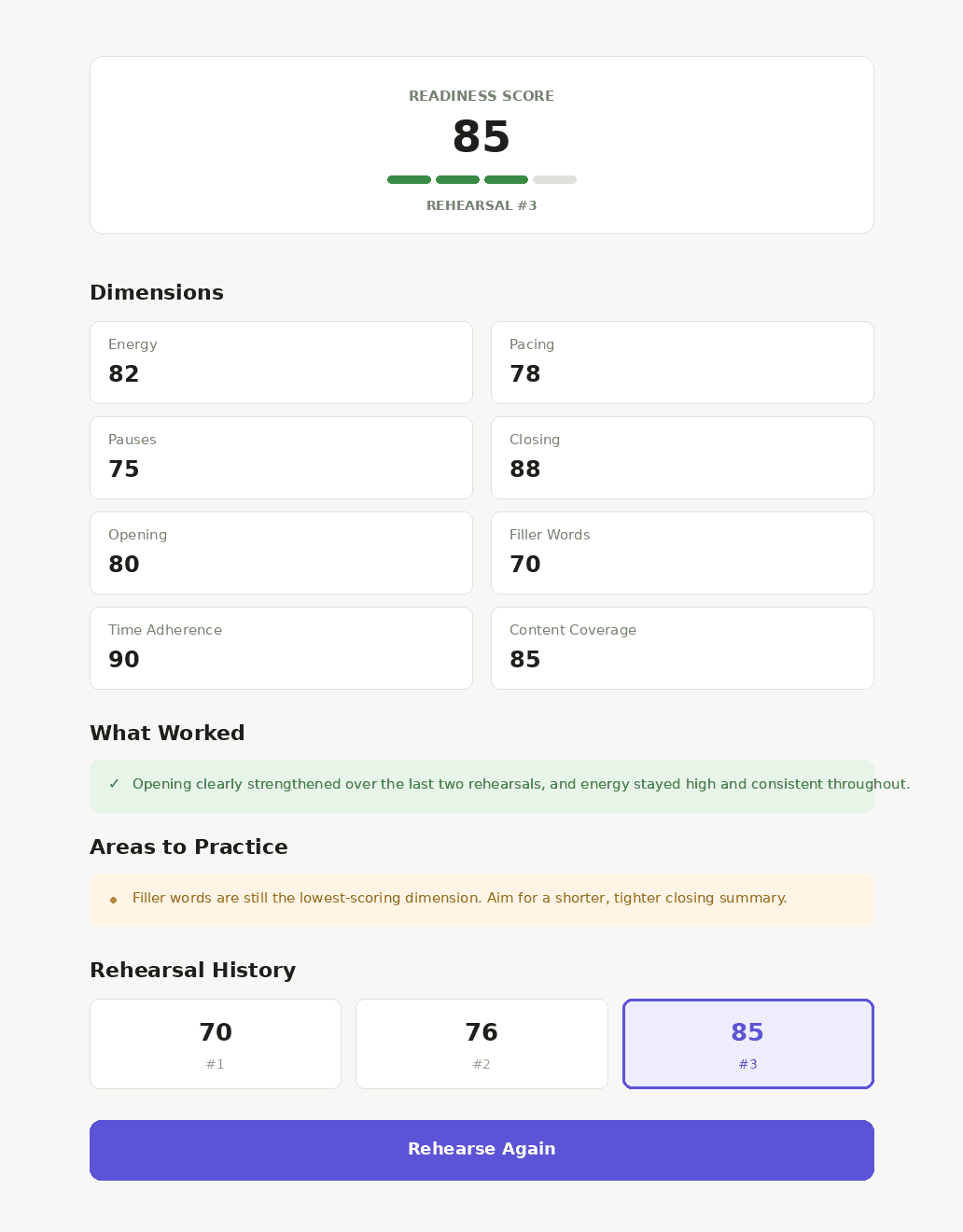
Repeat 2 to 3 times per week
Most anxious speakers report meaningful confidence gains after 4 to 6 Loop sessions. The reps compound, and the fear of being blindsided drops with every session. Whether you're prepping an elevator pitch, interview answers, or a raise conversation, the same practice framework applies.
Build your speaking confidence with Loop AI Delivery Coach →
Pre-Speech Confidence Ritual
Sleep 7 to 8 hours the night before
Eat protein 2 hours before, no caffeine within 60 minutes
Hydrate throughout the morning
One full cold rehearsal 3 hours before
Physical warm-up (jumping jacks, deep breathing) 30 minutes before
Two deep breaths, longer exhale than inhale, right before you go on
Anchor eye contact on one friendly face for the first 15 seconds
Frequently Asked Questions
Can I really build public speaking confidence, or is it a personality trait?
You can build it. Confidence in public speaking is the result of preparation, rehearsal reps, and familiarity with recovery. Personality affects the starting point, not the ceiling.
How long does it take to become a confident public speaker?
Most people see meaningful confidence gains in 6 to 12 weeks with 2 to 3 practice sessions per week. Full transformation from anxious to genuinely comfortable usually takes 6 to 12 months of consistent practice.
What is the fastest way to build speaking confidence?
Structured rehearsal with real audience feedback. Loop AI Delivery Coach accelerates this by giving you agent-driven simulated feedback multiple times per week without needing to book live audiences.
How do I stop being nervous before speaking?
You don't stop being nervous, you channel it. Reframe the physical symptoms as excitement (Alison Wood Brooks, Harvard 2014). Rehearse enough that the material is automatic. Do a physical warm-up before you go on.
Should introverts avoid public speaking?
No. Introverts often make excellent speakers because they prepare more thoroughly. What introverts should avoid is the extrovert-style public speaking advice (be louder, be more animated) that trains them to perform someone else's style.
How do I handle a moment where my mind goes blank?
Pause. Sip water if you have it. Say "let me pick that back up" or "let me rephrase." Then keep going. The audience remembers how you recovered, not that you froze.
What is the biggest sign of a confident speaker?
Vocal variety and comfortable pauses. Nervous speakers rush and speak in monotone. Confident speakers slow down on key insights, pause deliberately, and vary pitch.
Should I take a public speaking class?
If you have time and budget, yes, especially for the accountability and repeated reps. But structured solo practice with tools like Loop AI Delivery Coach delivers most of the same benefits at a fraction of the cost and time.
How do I get over the fear of judgment?
Practice enough that your delivery holds up regardless of what the audience thinks. Confidence built on external validation is fragile. Confidence built on preparation is durable.
What if I have social anxiety, not just public speaking anxiety?
Social anxiety is treated differently. Consider working with a licensed therapist alongside speaking practice. Public speaking practice can complement therapy but does not replace it.
How do I practice speaking confidence if I never have public speaking opportunities?
Practice speeches you will never deliver. Pick a topic, write a 5-minute version, run it through Loop. The skill compounds with reps whether the reps are for real speeches or invented ones.
Should I watch famous public speakers to build confidence?
Watch them for structure and delivery patterns, not for style. Copying Simon Sinek or Brené Brown's persona is a trap. Learn from their preparation and framework, then find your own voice.
How do I handle a hostile or dismissive audience?
Preparation is your only defense. Loop's Red Team simulates hostile questions so they don't surprise you live. When it happens for real, restate the question in neutral language, acknowledge the concern, answer honestly.
What is the most important daily habit for building speaking confidence?
Speaking out loud, deliberately, for at least 10 minutes. Read a chapter aloud, deliver a mini-speech to yourself, run one section of a pitch. The mouth builds skill the brain cannot simulate silently.
Related posts

How to Practice Public Speaking Alone (With and Without AI)
The 4 rehearsal methods that actually build public speaking skill, why mirror practice fails, and how AI simulates a real audience for structured feedback.
Templates & How-to

How to Give a TED Talk: Delivery Tips from the Best Speakers (2026)
A structured breakdown of what makes TED talks land, the delivery framework used by top speakers, and the AI practice method that closes the gap.
Templates & How-to

About Me Powerpoint Template: A Simple, Easy To Use Template
Use this article as a guide while you prepare your about me PowerPoint presentation. Let’s go over the steps of creating an “about me presentation” while understanding common use cases and where should you use this kind of template.
Templates & How-to