Business & Strategy
How to Negotiate a Raise: The Script, Practice Method & Tips That Actually Work
A step-by-step script for negotiating a raise, common mistakes to avoid, and the AI practice method that turns a nervous ask into a confident one.


İlayda Tunaboylu
A raise negotiation is a structured conversation where an employee requests a specific compensation increase based on their contribution, market data, and business impact. According to a 2024 Payscale study of 154,000 professionals, only 37% of workers ever ask for a raise, and of those who do, 70% receive some form of increase.
The employees who ask, and ask well, are the ones who close the pay gap over a career. The problem is that most people are not taught how to have this conversation. They practice the script in their head, walk in nervous, get emotional, and walk out with a vague promise. If you're also prepping for interviews where salary comes up, see our guide on job interview sample questions.
This guide gives you the script, the framework, and the practice method that turns a raise conversation from a stressful ask into a business case.
You'll get:
The RAISE framework for structuring your ask
A word-for-word script you can adapt for your situation
The 6 mistakes that quietly kill raise requests
The AI practice method that beats rehearsing with a friend
Answers to the questions people actually ask about raise negotiations
What Makes a Raise Conversation Land
Three things separate a successful raise negotiation from a fumbled one:
A specific number tied to specific market data. Vague asks get vague answers.
Evidence of measurable impact. Contributions your manager did not fully see.
A calm, business tone. Emotional asks read as personal, business framing reads as reasonable.
Miss any one and you either get "we will look into it" or a token increase that does not close the gap.
The RAISE Framework
Letter | Component | What It Does |
|---|---|---|
R | Research | You bring market data from real sources (Levels.fyi, Glassdoor, Payscale) |
A | Achievements | You bring 3 to 5 measurable wins from the last 12 months |
I | Impact | You quantify what your work generated or saved |
S | Specific ask | You state a target number, not a range or a hint |
E | Exit plan | You know what you will do if the answer is no |
Weak negotiators walk in with just Achievements. Strong negotiators bring all five. The Exit plan is the one most people skip, and it is the one that gives you leverage without ever needing to use it.
Word-for-Word Script You Can Adapt
Opening (60 seconds)
"Thanks for making time. I wanted to talk about my compensation. Over the last 12 months I've taken on the lead role for [project], grown [metric] by [%], and closed [outcome]. Based on that impact and the market data for this role, I'd like to propose an adjustment to my base."
The ask (30 seconds)
"Looking at Levels.fyi and Payscale, mid-level [your role] at companies our size averages [X]. My current base is [Y]. I'd like to propose moving to [target number], effective [date]."
Handling pushback (as needed)
If they say "we do not have budget right now": "I understand budget cycles. Can we agree on the target now and time the increase to the next cycle? I'd want a written commitment so we're aligned."
If they say "we need to think about it": "That makes sense. When can we reconnect? I'd want a decision by [specific date]."
If they say "we can offer [lower number]": "Thanks. Help me understand the gap between [lower] and [target]. What would need to be true for you to close it?"
Close (30 seconds)
"Whatever the outcome, I appreciate you taking this seriously. Can we agree to circle back by [date] with a written decision?"
The 6 Mistakes That Quietly Kill Raise Negotiations
1. Asking for a Range Instead of a Number
"I was hoping for something in the range of X to Y" tells your manager to anchor at X. State the target, not the range.
2. Leading With Personal Need
"I'm behind on my mortgage" or "my rent went up" turns a business conversation into a personal one. Managers cannot approve raises based on your expenses. They can approve raises based on your impact.
3. No Market Data
Walking in without external benchmarks means the only reference point is your current salary. Bring Levels.fyi, Glassdoor, or Payscale numbers for your role, company size, and location.
4. Apologizing for Asking
"I'm sorry to bring this up, but..." trains your manager to see the ask as an imposition. It's not. It's a business conversation. This same principle applies in job interviews too, see our guide on common salary interview questions for related practice.
5. Accepting the First "We Will Look Into It"
Vague promises are how raise conversations die. Always leave with a specific next date and a written commitment to respond.
6. No Exit Plan
If you have no plan for "no," you have no leverage. You do not have to threaten to quit, but you do need to know your options if the answer is a hard no.
How Loop AI Delivery Coach Prepares You for the Conversation
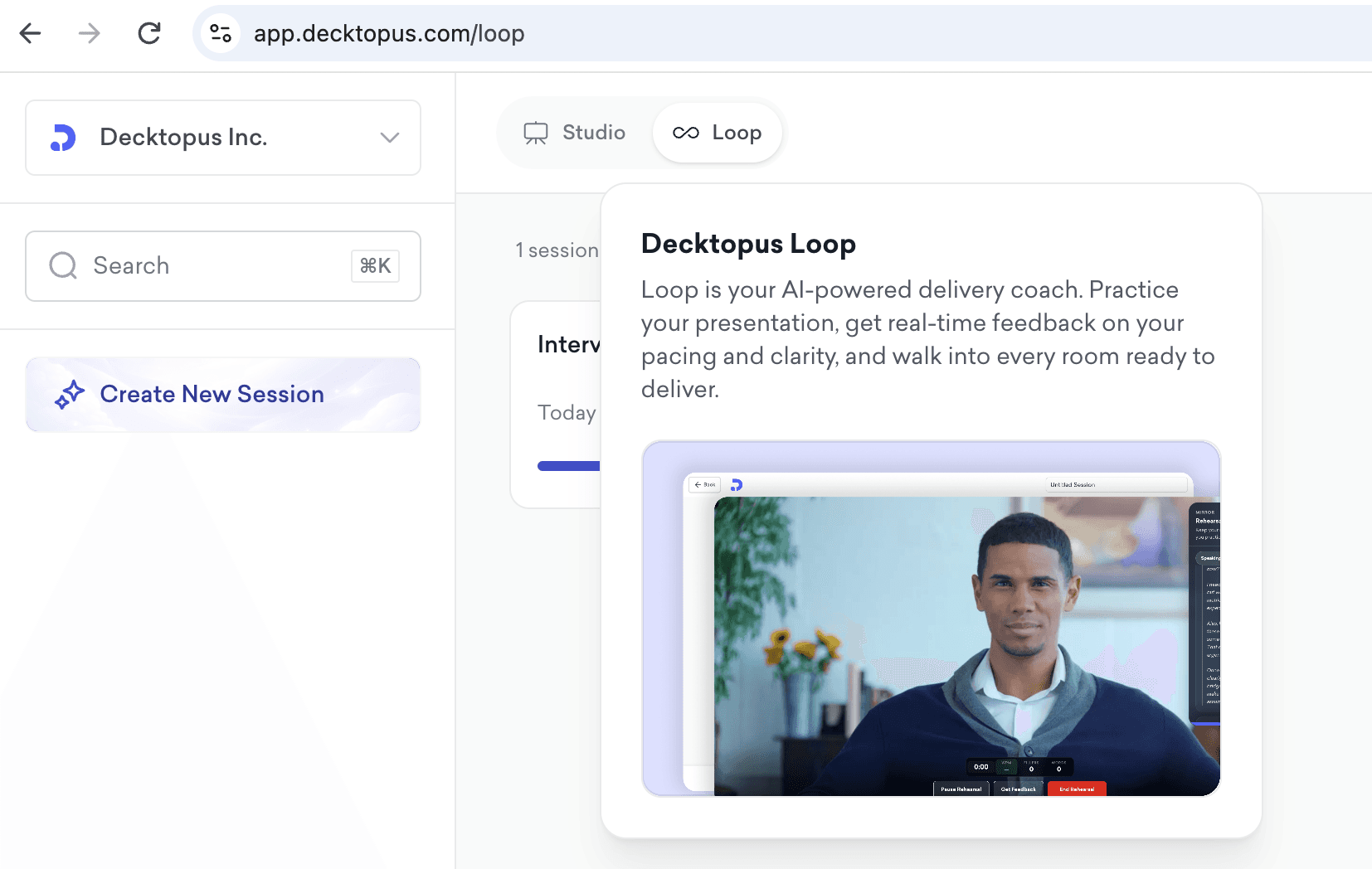
The traditional practice method for a raise conversation is running it by a friend or a family member. That's better than nothing, but two problems: (1) they aren't skeptical enough, (2) they don't ask the hard follow-up questions your manager will. This is the same weakness that makes mirror practice ineffective for public speaking preparation.
Loop AI Delivery Coach is Decktopus AI's built-in rehearsal environment. Four AI agents simulate the manager conversation before you have it live.
The 4 Loop Agents
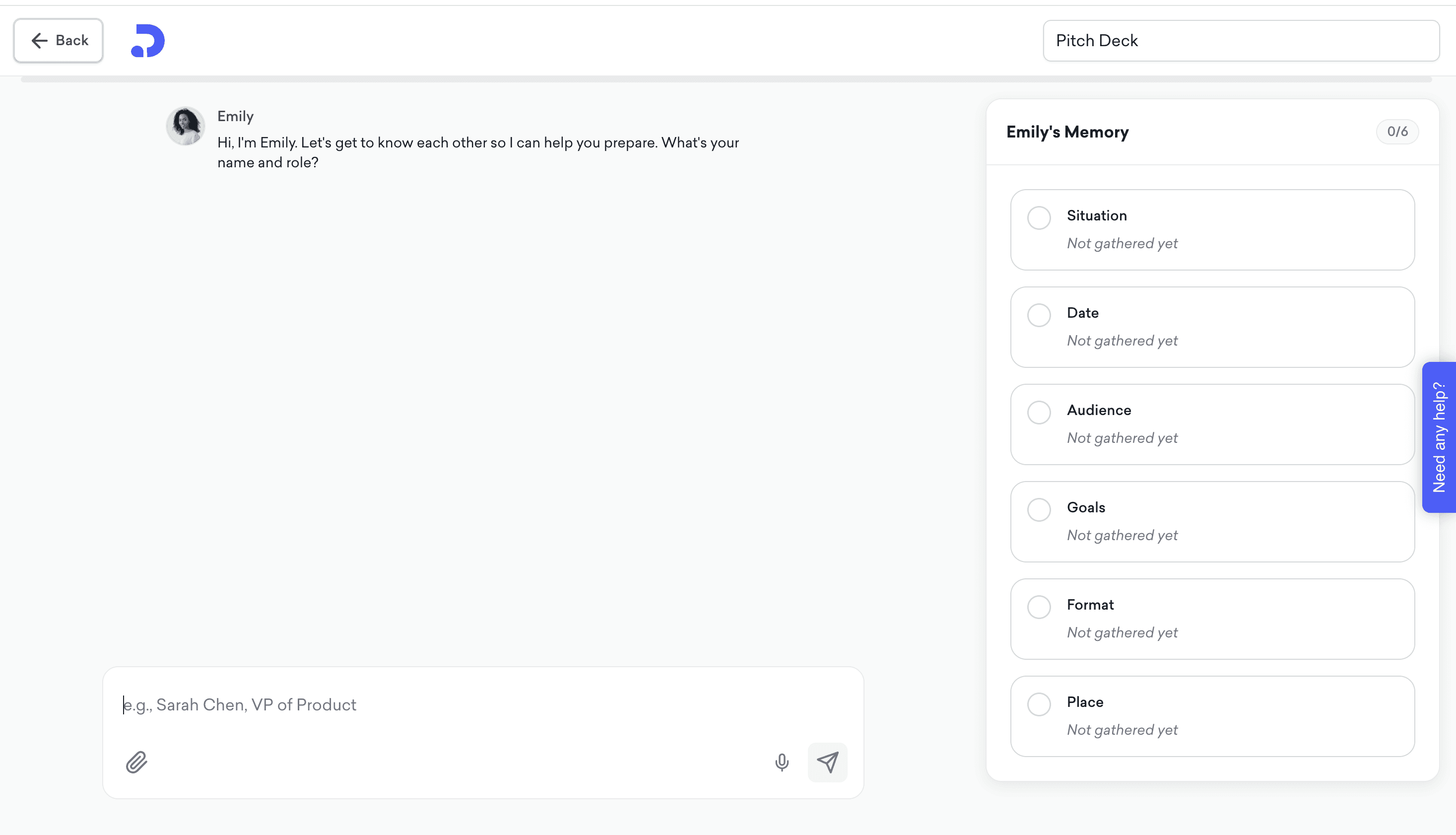
Profiler (Emily) simulates your specific manager. Describe them: analytical, budget-conscious, supportive, defensive. Emily reacts the way that manager would. You rehearse for your exact conversation, not a generic one.
Architect (Marcus) scores your script structure. Flags when you lead with personal need, when your data is buried, when your ask is vague or when your close is too soft.
Red Team fires the pushback you will actually face. "We do not have budget." "Others in your role make less." "Prove the impact." "Let me talk to HR." Facing these in rehearsal turns them into routine responses.
Mirror records your delivery and plays it back with metrics. Raise conversations sound different when you hear yourself. Weak tone, filler words, apologetic phrasing all become visible.

Loop Workflow for Raise Negotiations
Write your script in Decktopus AI or a doc
Open Loop and describe your manager
Run the conversation, Emily reacts
Face Red Team's pushback until answers feel automatic
Review Mirror playback and cut apologetic phrasing
Repeat until your delivery is calm and confident
Most professionals run 3-4 Loop sessions before a raise conversation. The difference in delivery is the difference between getting the target number and settling for a token increase.
Practice your raise negotiation with Loop AI Delivery Coach →
Pre-Conversation Checklist
Market data printed or open in a tab
3 to 5 measurable achievements documented
Specific target number rehearsed
Answers ready for the top 3 objections
Exit plan clear in your own head
Follow-up date already in mind
Frequently Asked Questions
When is the best time to ask for a raise?
Right after a measurable win, during your company's budget planning cycle, or during your performance review. Avoid Mondays, late Fridays, and any time your manager is visibly stressed.
How much should I ask for in a raise?
Ask for the market rate for your role at companies of your size, in your location. Use Levels.fyi, Glassdoor, and Payscale. Most successful raises land 10 to 20% above current base. Bigger jumps require role change or promotion, not just a raise conversation.
Should I threaten to quit if I do not get the raise?
Only if you have another offer in hand and are prepared to leave. Threats without leverage backfire. What you can do: mention that the market rate is X, and current compensation is misaligned. That's a business observation, not a threat.
How do I ask for a raise over email?
Email is fine for requesting the meeting. The actual conversation should happen live. Written raise requests are easier to say no to and easier to slow-walk.
What if my manager says the company has no budget?
Ask when the next budget cycle is. Agree on the target number now, timed to the cycle. Get it in writing.
How long should a raise conversation take?
15 to 30 minutes. Anything shorter is rushed, anything longer means you are over-defending. Come prepared, ask cleanly, then let your manager respond.
Should I tell HR before asking my manager?
No. Talk to your direct manager first. HR gets involved only if your manager needs sign-off, and they usually will not push for you.
What do I do if the answer is no?
Ask for specific feedback: what would need to change for the answer to be yes, and by when. If the answer is "nothing," you have your answer about the company's real trajectory for you.
How often can I ask for a raise?
Once every 12 months is standard, unless you have taken on a materially larger role. Asking every 6 months without a clear scope increase reads as impatient.
Should I bring a competing offer to the conversation?
Only if you are genuinely willing to accept it. Faking a competing offer is a career-ending move if you get called on it.
How do I ask for a raise as a remote worker?
Same framework, delivered over video. Turn the camera on. Sit up. Do not multitask. Your delivery quality matters more remotely because there are fewer body-language signals to fill the gap.
What if my manager gets emotional or defensive?
Stay calm, do not match their tone. Restate the facts. If it gets truly hostile, close the meeting professionally and follow up in writing. Never negotiate under emotional pressure.
Can I negotiate benefits instead of a raise?
Yes. Extra PTO, remote work flexibility, stock, learning budget, or title change can all be part of the negotiation. Bring one or two of these as backup options if base salary is a hard no.
How do I practice a raise conversation alone?
Not in your head. Write the script, run it out loud, or run it through Loop AI Delivery Coach. Real rehearsal requires either a simulated listener or agent-driven feedback. Reading it silently teaches you nothing about how you'll actually sound.
Related posts

How to Improve Communication Skills at Work (2026 Practical Guide)
The 5 workplace communication skills that matter most, the CLEAR framework, and the AI practice method that turns weak communicators into strong ones.
Business & Strategy

Job Interview Sample Questions: How to Practice Your Answers (2026)
The 20 most common interview questions, the STAR framework for answers, and the AI practice method that turns rehearsed responses into confident ones.
Business & Strategy
How to Deliver an Elevator Pitch That Actually Lands
Master elevator pitch delivery with the DELIVER framework, real examples, and the AI practice method that turns a good pitch into one that gets the next meeting.
Business & Strategy