Business & Strategy
Job Interview Sample Questions: How to Practice Your Answers (2026)
The 20 most common interview questions, the STAR framework for answers, and the AI practice method that turns rehearsed responses into confident ones.


İlayda Tunaboylu
Job interview questions are structured prompts hiring managers use to evaluate a candidate's skills, experience, cultural fit, and communication. According to LinkedIn's 2024 Global Talent Trends report, 92% of hiring managers say soft skills (especially communication) weigh as heavily as hard skills in final hiring decisions, and Interview Prep by Indeed found that candidates who practice their answers out loud are 33% more likely to receive an offer.
The problem: most candidates prepare their answers silently or read them off notes. Neither builds the delivery skill that decides whether the answer lands.
This guide gives you the 20 most common interview questions, the STAR framework for answering them, and the AI-based practice method that turns rehearsed answers into confident, natural responses under pressure. If your interview also includes a deck component, see our guide on job interview presentations.
You'll get:
The 20 most common job interview questions
Sample answers using the STAR framework
The 6 answer mistakes that quietly kill interview performance
The AI practice method that beats rehearsing with a friend
Answers to the questions candidates actually ask
The 20 Most Common Job Interview Questions
Behavioral Questions
Tell me about yourself.
Why do you want to work here?
Tell me about a time you overcame a challenge.
Describe a time you failed. What did you learn?
Tell me about a time you handled conflict on a team.
Skills and Experience Questions
What are your greatest strengths?
What is your biggest weakness?
Walk me through a project you led.
How do you prioritize competing deadlines?
What tools or platforms are you most experienced with?
Motivation and Fit Questions
Why are you leaving your current role?
Where do you see yourself in 5 years?
What motivates you at work?
How do you handle feedback?
Describe your ideal work environment.
Situational Questions
How would you handle a difficult manager?
What would you do in your first 90 days?
How do you approach a task with no clear direction?
How do you handle competing stakeholder requests?
What questions do you have for us?
The STAR Framework for Interview Answers
STAR is the most widely used answer framework for behavioral interview questions.
Letter | Component | What to Include |
|---|---|---|
S | Situation | Set the context in one to two sentences |
T | Task | Explain what you were responsible for |
A | Action | Describe what you specifically did |
R | Result | Quantify the outcome |
Weak candidates spend too long on Situation and never get to Result. Strong candidates spend 20% on Situation and Task, 60% on Action, and 20% on quantified Result.
Sample STAR Answer
Question: Tell me about a time you overcame a challenge.
Weak answer: "There was a project that was really hard. We had a tight deadline and I worked with the team and we got it done."
STAR answer:
Situation: "In Q2 last year, our largest client escalated a billing issue that had been open for six weeks. Their contract renewal was at risk."
Task: "I was the account lead. My job was to resolve the issue and preserve the renewal."
Action: "I mapped every dependency, identified the root cause was a data sync bug across two systems, brought in our engineering lead within 24 hours, and set up daily check-ins with the client until it was resolved."
Result: "We closed the issue in 8 days, renewed the account, and expanded the contract by 30%."
The STAR answer takes about the same time to deliver but is 4x more memorable. The same "quantify the result" principle applies when you later ask for a raise, see our guide on how to negotiate a raise.
The 6 Answer Mistakes That Kill Interview Performance
1. Rambling Without Structure
Answers that wander lose the interviewer by the 30-second mark. Every answer should have a beginning, middle, and end.
2. No Quantified Results
"It went well" is not a result. "Revenue grew 40%" is. Numbers land, adjectives don't.
3. Bad-Mouthing a Previous Employer
Speaking negatively about a previous manager or company signals you'll do the same to this one. Reframe every past frustration as a learning.
4. The Fake Weakness
"My biggest weakness is that I'm a perfectionist" is a canned answer every interviewer has heard 100 times. Give a real weakness plus a concrete action you're taking to address it.
5. No Questions at the End
When the interviewer asks "do you have any questions?", saying "no, you covered everything" reads as disinterest. Always have 3 to 5 specific questions ready.
6. Reading From Notes on Video Interviews
Interviewers can tell when your eyes are on notes instead of the camera. Prepare trigger words, not scripts.
How Loop AI Delivery Coach Rehearses Interview Answers
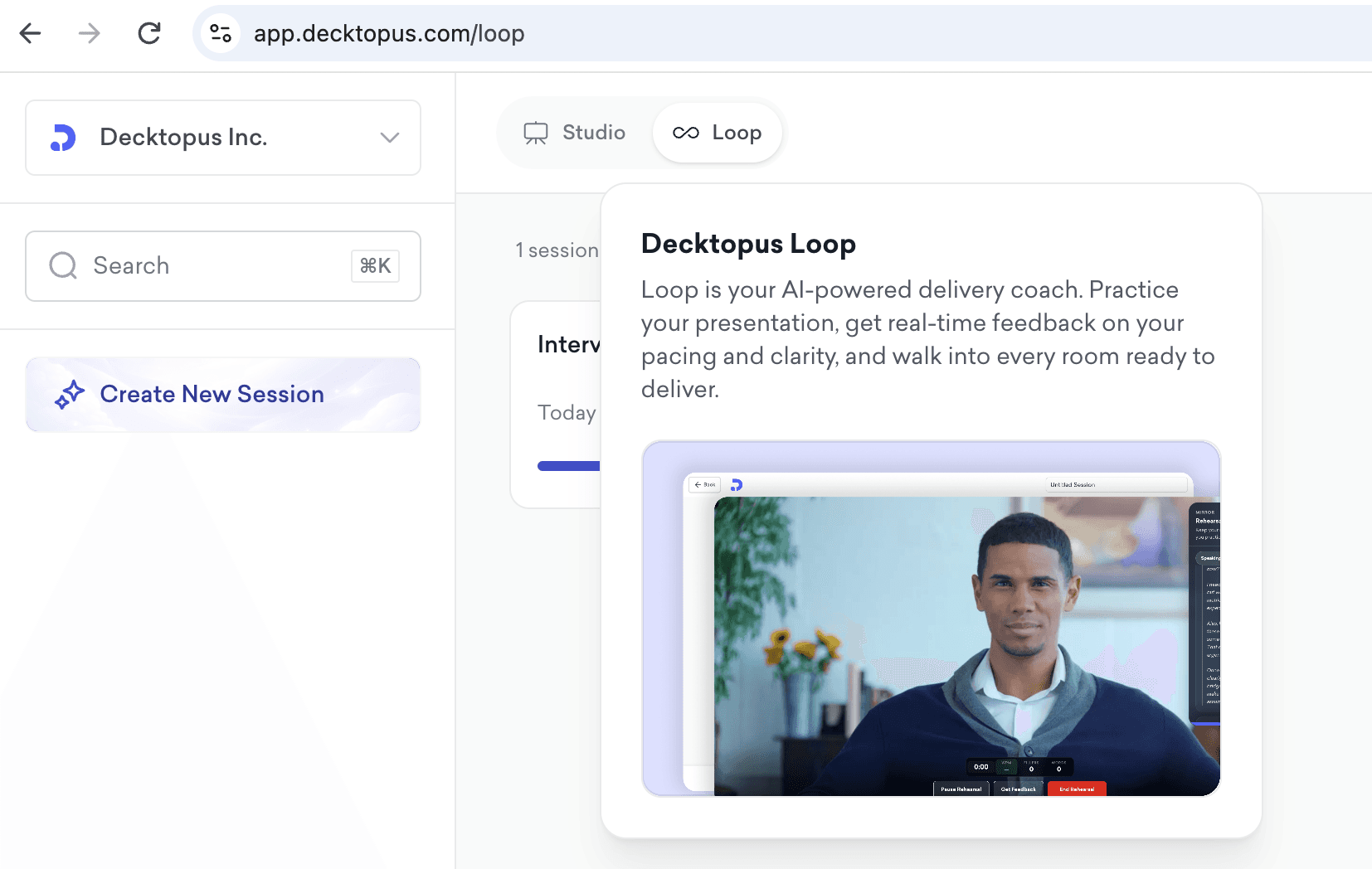
Most candidates rehearse interview answers in one of three ways: reading them silently, muttering them in the shower, or running them by a friend. All three fail to prepare you for the actual interview experience.
The interview happens live, with a listener who reacts, follows up, and pushes back. Loop AI Delivery Coach simulates that experience. This is the same weakness that makes mirror rehearsal fail, covered in our guide on how to practice public speaking alone.
The 4 Loop Agents
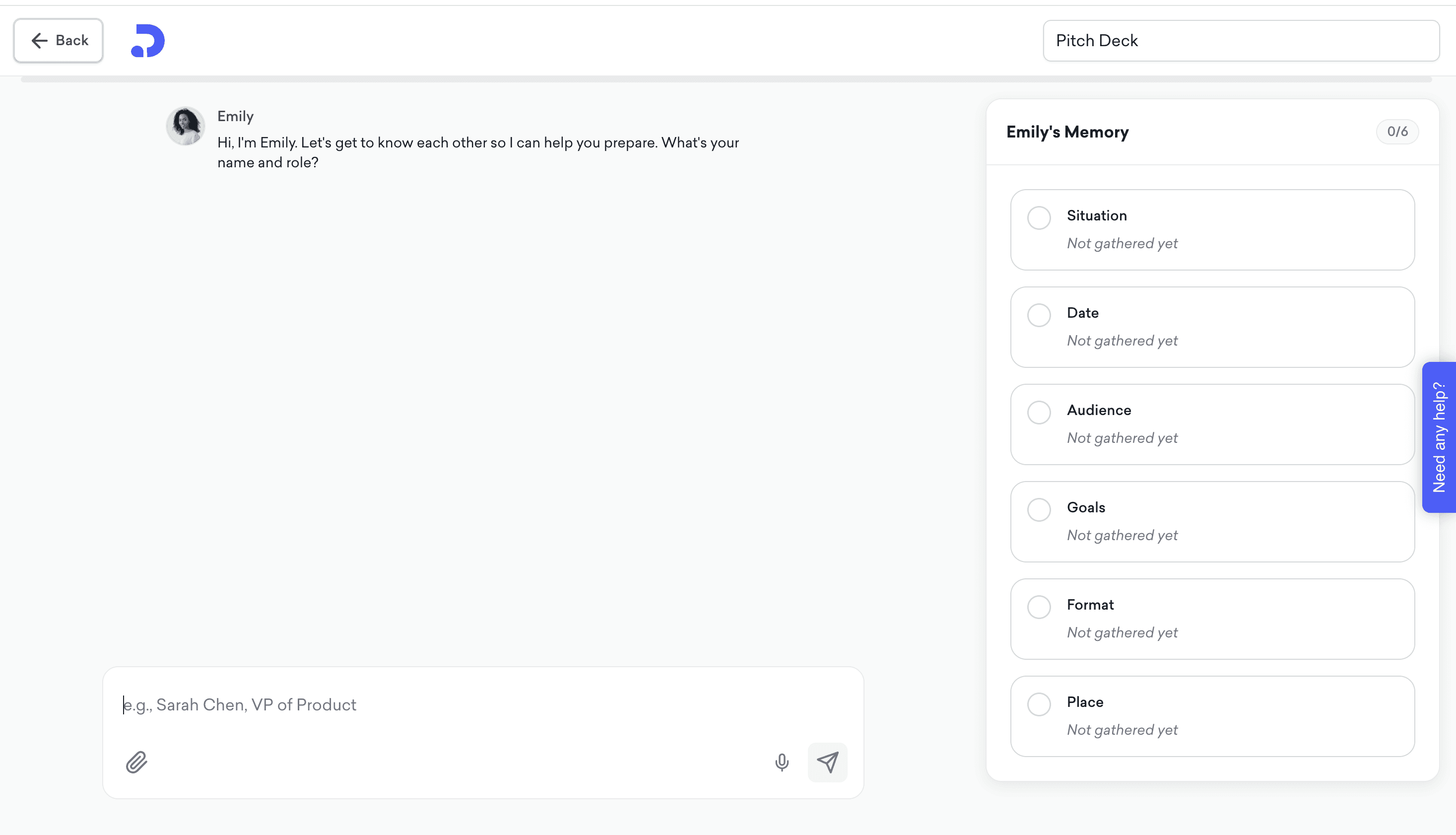
Profiler (Emily) simulates your specific interviewer. Describe the role (technical lead, HR partner, hiring manager, C-suite exec) and Emily reacts the way that person would. You rehearse for the exact interview, not a generic one.
Architect (Marcus) scores your answer structure. Flags when your STAR is out of balance (too much Situation, too little Result), when you buried the key point, or when you rambled.
Red Team fires the follow-up questions interviewers actually ask. "Give me another example." "What would you do differently?" "How did you measure that result?" Facing these in rehearsal turns them into routine answers.
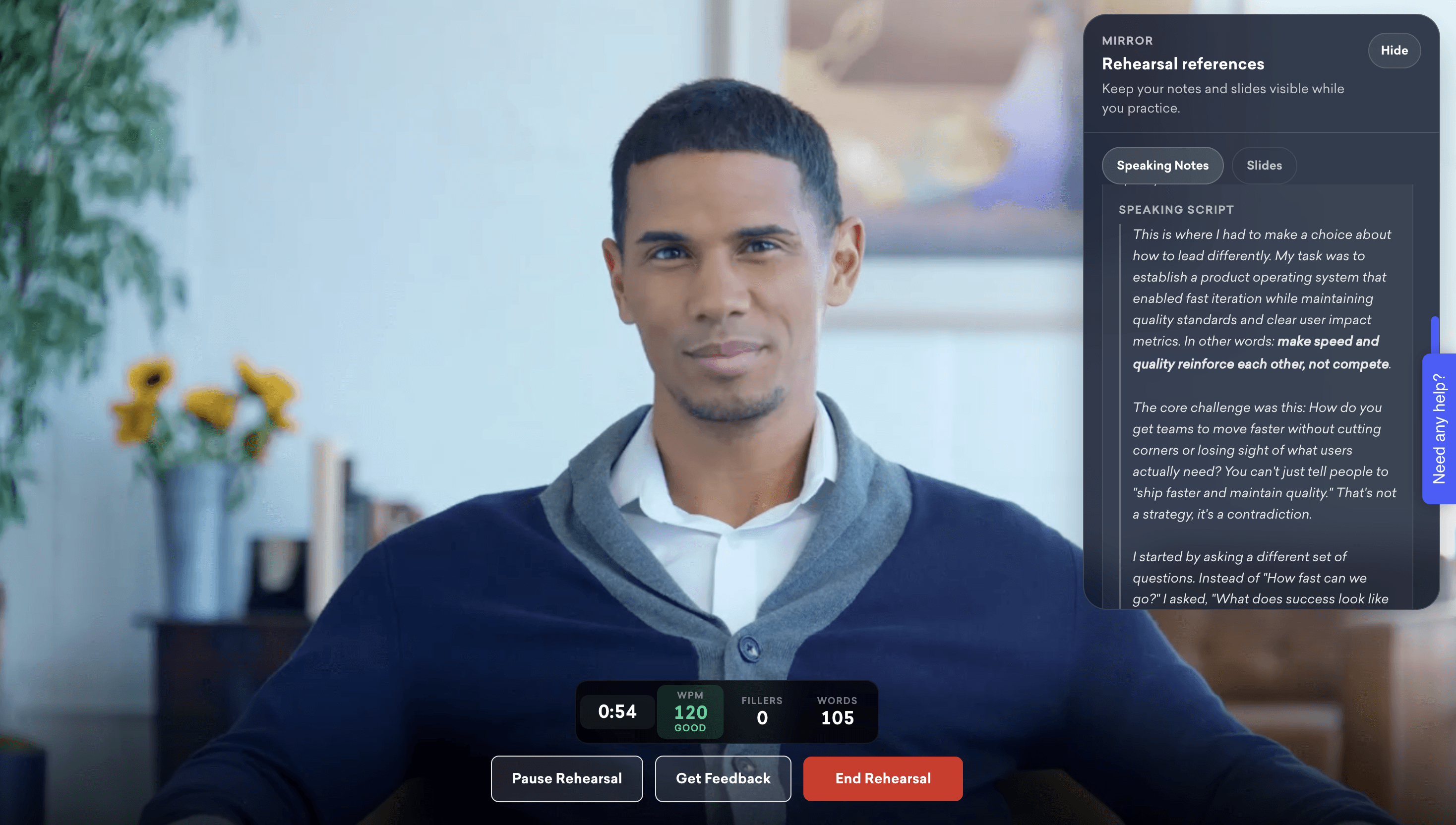
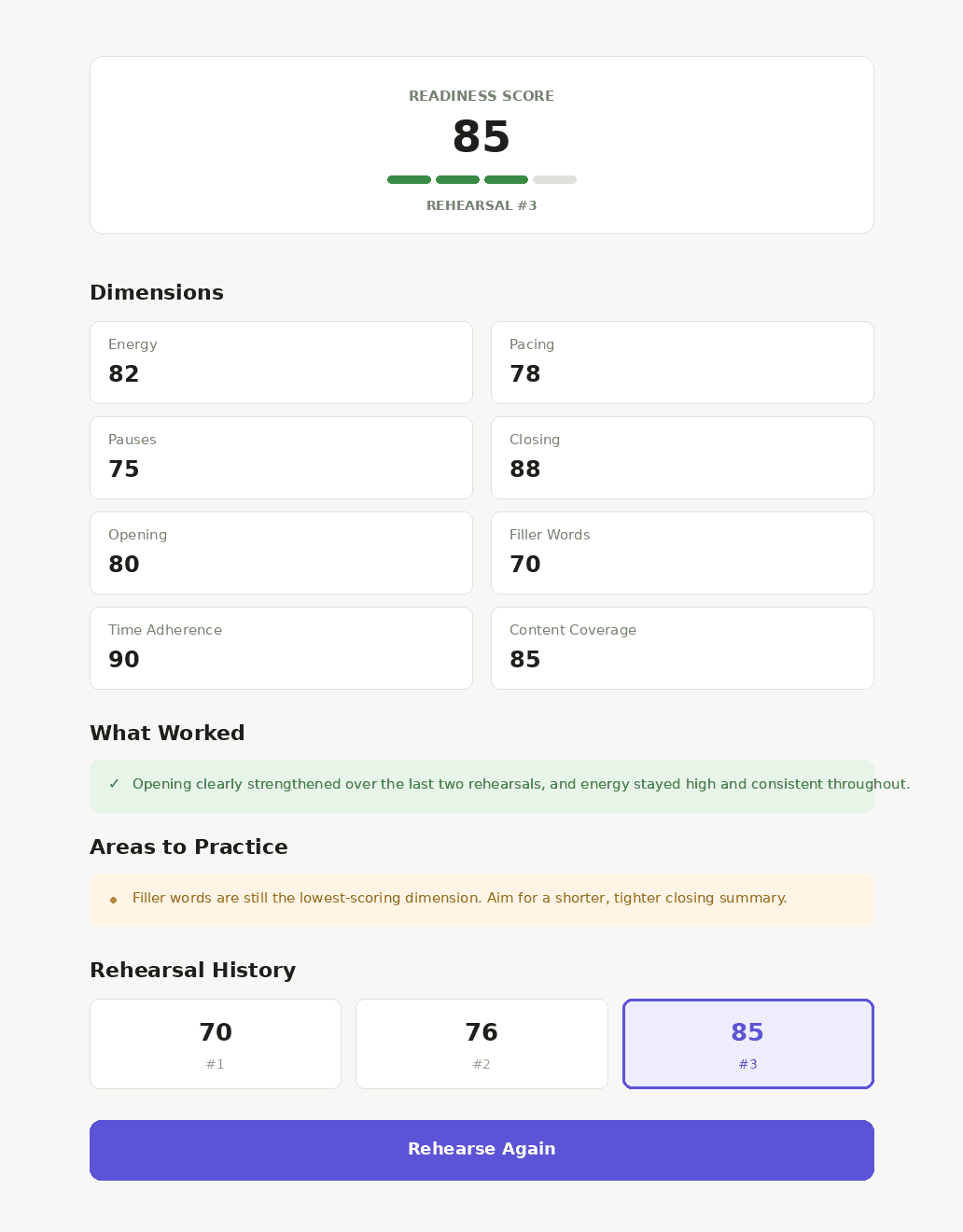
Mirror records your delivery and plays it back with metrics: filler count, pace per minute, pause length, tone. You hear yourself the way the interviewer hears you.
Loop Workflow for Interview Prep
Write out your STAR answers to the top 10 questions for your role
Open Loop and describe the interview panel
Deliver each answer, Emily reacts, Marcus scores
Face Red Team follow-ups until you have answers ready
Review Mirror playback, cut filler and rambling
Repeat 2 to 3 times per week leading up to the interview
Most candidates run 5 to 10 Loop sessions before a high-stakes interview. The difference between "I hope I do well" and "I've handled every question they'll ask" is what closes the gap between a callback and a rejection.
Practice interview answers with Loop AI Delivery Coach →
Pre-Interview Checklist
STAR answers written for the top 10 questions for your role
3 to 5 specific questions ready for the interviewer
Research done on the company, team, and interviewer
Resume printed and reviewed one more time
Outfit chosen the night before
Video call tech tested 30 minutes before if remote
Water within reach
Two deep breaths before the call or the walk in
Frequently Asked Questions
How do I answer "tell me about yourself"?
Use a 60-second structure: current role and one recent win, brief career history, why this role and company. Do not recite your resume, hit the highlights and land on why you're excited about this specific opportunity.
How do I answer "what is your biggest weakness"?
Give a real weakness plus a concrete action you're taking to address it. "I tend to over-commit to projects, so I've started blocking review time on Fridays to reassess load" beats "I'm a perfectionist."
How do I answer "why do you want to work here"?
Reference one specific thing about the company (recent product, mission, team) and connect it to your own goals. Never say "the growth opportunity" without specifying what growth means to you.
How do I handle a question I don't know the answer to?
"Great question. Let me think for a second." Take the second. Give the honest best answer you can. If you truly don't know, say so and explain how you would figure it out. Faking an answer destroys credibility.
Should I memorize interview answers word-for-word?
No. Memorize the STAR structure and the key numbers, then speak the rest naturally. Fully memorized answers sound rehearsed and collapse under follow-up questions.
How long should interview answers be?
60 to 90 seconds for most behavioral answers. Longer than 2 minutes and you'll lose the interviewer. Shorter than 45 seconds and you'll seem underprepared.
What should I do in the first 30 seconds of an interview?
Introduce yourself calmly, thank them for the time, and give one specific compliment on something you know about the company. This earns 30 seconds of warmth before the harder questions start.
How many questions should I have ready to ask the interviewer?
Have 5 prepared, expect to ask 2 to 3. Some will be answered during the conversation. Never say "you covered everything."
How do I handle interview nerves?
Reframe nerves as excitement (same physiology, different label, better performance). Rehearse enough that the material is automatic. Our guide on how to build speaking confidence covers the full playbook.
How do I practice interview questions if I don't have a real interview coming up?
Pick 3 to 5 sample roles you'd potentially apply for. Write STAR answers to the top 10 questions per role. Run them through Loop AI Delivery Coach 2 to 3 times per week. When a real interview comes, you're already prepared.
How do I handle a panel interview?
Look at whoever asked the question when starting your answer, then rotate eye contact across the panel as you continue. Never fixate on one person or ignore anyone.
What if I get an unexpected question?
Pause. Take a breath. Reframe the question in your head. Answer honestly, even if the answer is "I haven't thought about that specifically, but here's how I would approach it."
How do I follow up after an interview?
Send a thank-you email within 24 hours to each person you met with. Reference one specific thing from the conversation. Reiterate your interest in one sentence. Keep it short.
Should I bring notes to an interview?
Yes, one page of notes with the top 5 questions you want to answer well and 3 to 5 questions you want to ask. Do not read from them, use them as anchors.
How do I practice for a technical interview differently?
Technical interviews test knowledge and problem-solving under pressure. Practice explaining your thought process out loud while solving problems. Loop's Red Team can simulate the pressure of unexpected follow-up questions during your explanations.
What if I bombed the interview?
Send a strong follow-up email within 24 hours. Address the specific moment you struggled with a better answer. Sometimes recovery from a bad interview lands the job.
Related posts

How to Improve Communication Skills at Work (2026 Practical Guide)
The 5 workplace communication skills that matter most, the CLEAR framework, and the AI practice method that turns weak communicators into strong ones.
Business & Strategy

How to Negotiate a Raise: The Script, Practice Method & Tips That Actually Work
A step-by-step script for negotiating a raise, common mistakes to avoid, and the AI practice method that turns a nervous ask into a confident one.
Business & Strategy

How to Deliver an Elevator Pitch That Actually Lands
Master elevator pitch delivery with the DELIVER framework, real examples, and the AI practice method that turns a good pitch into one that gets the next meeting.
Business & Strategy