Templates & How-to
How to Give a TED Talk: Delivery Tips from the Best Speakers (2026)
A structured breakdown of what makes TED talks land, the delivery framework used by top speakers, and the AI practice method that closes the gap.


İlayda Tunaboylu
A TED talk is a short-form spoken presentation (typically 6 to 18 minutes) built around one clear idea worth spreading, delivered live and later published to a global audience. Since 2006, over 4,000 TED and TEDx talks have accumulated more than 3 billion views combined, but the top 100 talks account for over 40% of that traffic.
The gap between a talk that gets 10,000 views and one that gets 10 million is almost never the topic. It's the delivery.
This guide breaks down what makes the top TED talks land, gives you the delivery framework used by speakers like Simon Sinek, Brené Brown, and Sir Ken Robinson, and shows you how to rehearse for that level of performance without a professional coach. For broader delivery mechanics, our guide on public speaking tips covers the fundamentals every TED speaker also uses.
You'll get:
The one-idea rule that separates strong TED talks from weak ones
The TEDTALK framework for delivery
5 mistakes that quietly wreck first-time TED and TEDx speakers
Real examples of opening lines that landed
The AI rehearsal method that replaces years of speaking coach access
The One-Idea Rule
Every strong TED talk teaches one idea. Not three. One.
Simon Sinek's "Start With Why" teaches one idea: people don't buy what you do, they buy why you do it. Brené Brown's "The Power of Vulnerability" teaches one: connection requires vulnerability. Sir Ken Robinson's "Do Schools Kill Creativity?" teaches one: the education system suppresses the creative capacity children are born with.
Weak talks try to cover three or four ideas and end up teaching none. If you cannot state your talk in one sentence, you do not have a TED talk yet. You have a topic.
The TEDTALK Framework
Letter | Component | What It Does |
|---|---|---|
T | Target idea | One sentence that captures what you want the audience to walk away believing |
E | Emotional hook | An opening story or claim that earns 30 seconds of attention |
D | Data or example | Concrete evidence, not abstract theory |
T | Turn point | The reframe that makes the audience see the problem differently |
A | Application | What this means for the audience's own life or work |
L | Lived voice | You speak like yourself, not like a lecturer |
K | Killer close | A specific ask, an image, or a line the audience will remember |
Weak TED speakers skip the Turn point. They present information without reframing it. Strong TED speakers use the reframe as the pivot of the whole talk.
Real Examples of Openings That Landed
Sir Ken Robinson: "Good morning. How are you? It's been great, hasn't it? I've been blown away by the whole thing. In fact, I'm leaving." Self-deprecating opener earns immediate warmth and attention. Now the tallied 82 million views. For more opening structures that work across contexts, see how to start a presentation: 10 hooks that instantly grab attention.
Simon Sinek: "How do you explain when things don't go as we assume, or better, how do you explain when others are able to achieve things that seem to defy all of the assumptions?" A specific puzzle that earns curiosity in the first 15 seconds.
Brené Brown: "So I'll start with this: A couple years ago, an event planner called me because I was going to do a speaking event. And she called, and she said, 'I'm really struggling with how to write about you on the little flyer.'" Personal story that lowers the stakes and pulls the audience in.
Pattern: none of these openings start with "Today I'm going to talk about..." That framing is what weak speakers do. Strong TED openings hook first, frame later.
The 5 Mistakes That Wreck TED and TEDx Talks
1. Reading From a Teleprompter Voice
Rehearsed talks that sound rehearsed lose the audience. The best TED speakers have memorized their talk so deeply that it sounds spoken, not recited.
2. Trying to Teach Too Much
TED audiences remember one idea. Trying to teach four ideas means teaching none. Cut everything that does not directly support your one target idea.
3. Running Over Time
TED talks have hard time limits (typically 6, 12, or 18 minutes). Speakers who run over cut into the next talk and read as unprepared. Rehearse with a timer.
4. Weak Body Language
Standing behind a lectern, avoiding the stage, gripping notes with both hands. TED audiences read your body first, your words second. Move with purpose.
5. No Killer Close
Ending with "so, in conclusion" or "thanks for listening" wastes the moment the audience is most primed to be moved. Every TED close should land with a specific line, image, or ask.
How to Rehearse a TED Talk Like a Professional Speaker
Professional TED speakers spend 60 to 200 hours rehearsing a single 18-minute talk. Chris Anderson (head of TED) recommends at least 25 out-loud runs before you take the stage. For the underlying practice methods, see our guide on how to practice public speaking alone.
The rehearsal is not just repetition. It's:
Getting real audience reactions before the real audience is watching
Getting structural feedback on where the talk drags
Hearing your own voice back so you can cut filler and adjust pace
Historically only speakers with access to expensive coaches got all three. That has changed.
How Loop AI Delivery Coach Rehearses You
Loop AI Delivery Coach is Decktopus AI's built-in rehearsal environment. Four AI agents simulate the TED experience before you take the stage.
The 4 Loop Agents
Profiler (Emily) simulates your specific audience. A TEDx audience of academics reacts differently than a corporate keynote crowd. Describe your room, Emily calibrates.
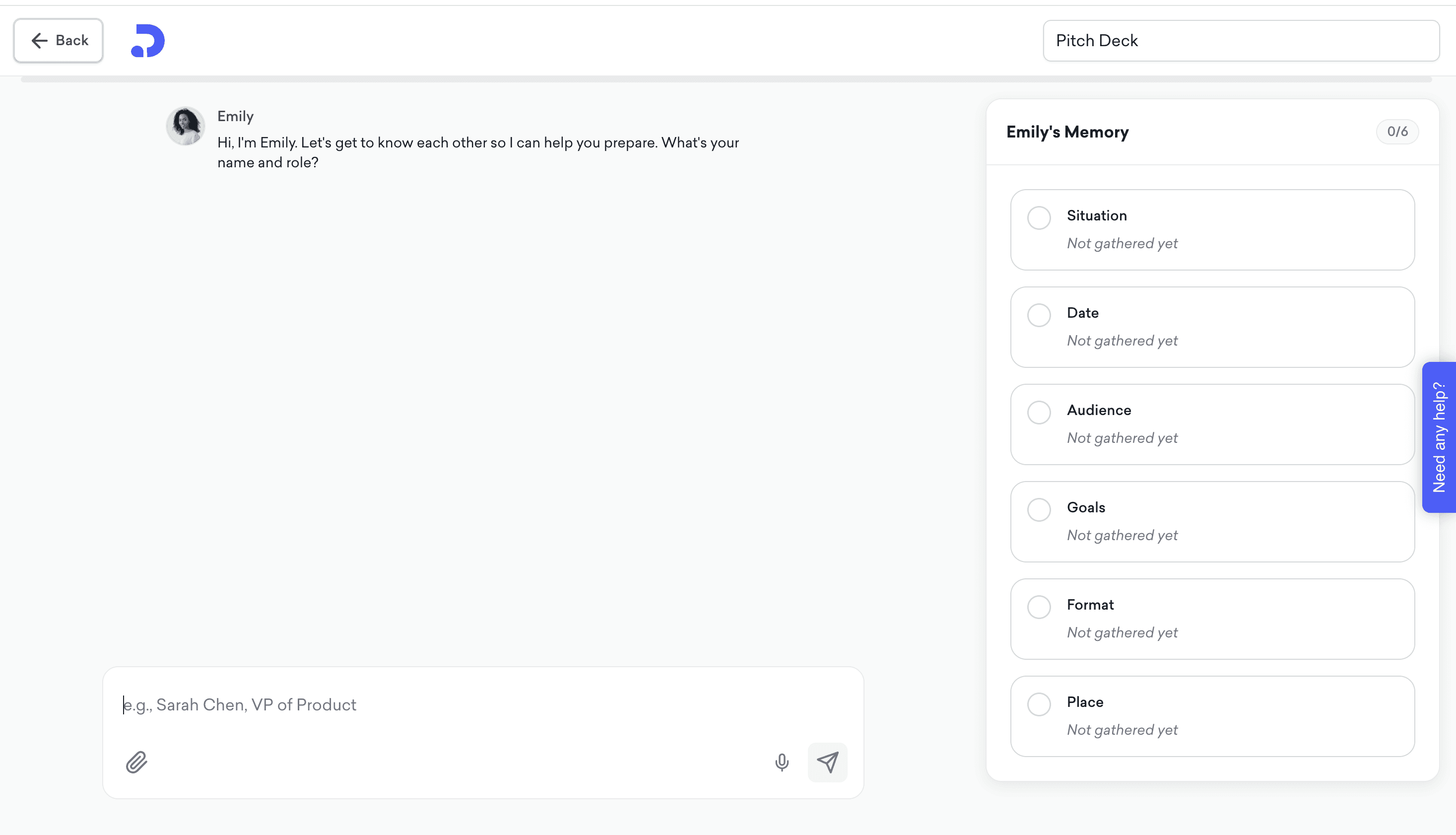
Architect (Marcus) scores the structure of your talk against TED best practices. Flags when your emotional hook takes too long, when your data section drags, when your close does not land, or when you drift from your one idea.
Red Team fires the questions your audience might ask in Q&A or afterward. "What's your evidence?" "How does this apply beyond your example?" "What's the counterargument?" Preparing for these makes the talk hold up under scrutiny.
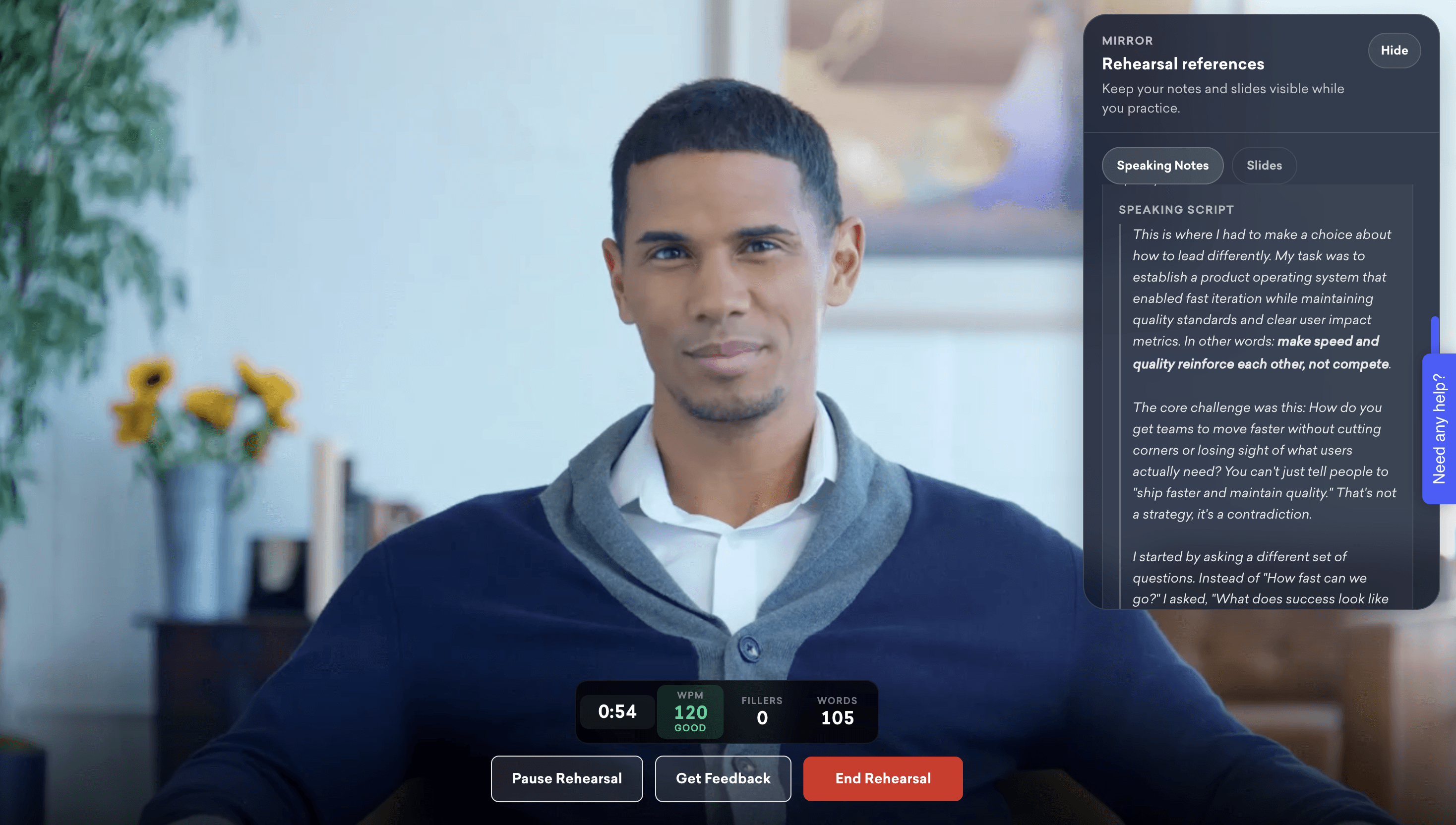
Mirror records your delivery and plays it back with metrics: pace per minute, pause length, filler count, tone variance. You hear the exact places you sped up, dragged, or lost energy.
Loop Workflow for TED Talks
Write the talk, target one idea in one sentence
Build supporting slides in Decktopus AI if you have them
Open Loop, describe your audience and the talk length
Deliver the talk end-to-end, Emily reacts, Marcus scores structure
Face Red Team's questions
Review Mirror playback and cut filler, adjust pace, tighten sections that dragged
Repeat until you can deliver the talk cold in the target time
Most first-time TEDx speakers see meaningful improvement after 5-8 Loop sessions. It's the closest thing to a private speaking coach without paying for one.
Rehearse your next talk with Loop AI Delivery Coach →
Pre-Talk Checklist (30 Minutes Before You Go On)
Opening line memorized cold
Closing line memorized cold
Water within reach on the stage side table
Slides loaded on the venue system, tested with your clicker
Phone silenced and stashed
Two deep breaths before walking onstage
Pick one friendly face to anchor eye contact for the first 30 seconds
Remind yourself: the audience wants you to succeed
Frequently Asked Questions
How long does it take to prepare a TED talk?
Most TED and TEDx speakers spend 60 to 200 hours preparing an 18-minute talk. Chris Anderson recommends at least 25 out-loud runs. This is not something you prepare in a week.
What is the one-idea rule?
Every strong TED talk teaches one idea that fits in one sentence. If you cannot state your talk in one sentence, you have a topic, not a talk. Cut until you can.
How long should a TED or TEDx talk be?
TED main-stage talks are typically 12 or 18 minutes. TEDx talks are commonly 6, 12, or 18 minutes. Salon talks can be as short as 3 to 5 minutes. Match your assigned time exactly, never longer.
Should I memorize my TED talk?
Yes, but memorize it deeply enough that it sounds spoken, not recited. A talk that sounds memorized is worse than one that sounds improvised. The audience should feel you thinking through the ideas in real time.
How do I open a TED talk?
Never with "Today I'm going to talk about..." Open with a story, a specific puzzle, a personal moment, or a surprising claim. The first 30 seconds decide whether the audience stays with you.
How do I close a TED talk?
With a specific line, image, or ask the audience will remember. Not "thanks for listening" and not "any questions." The close is 25% of what the audience carries with them.
Should I use slides in a TED talk?
If they add to the talk, yes. If they duplicate what you're saying, no. The best TED talks use slides as visual anchors for specific moments, not as an outline.
What do TED speakers do differently than average public speakers?
They rehearse more, they cut more, and they teach one idea instead of four. Delivery variety (pace, pauses, volume) is much higher than average speakers, and body language is more intentional.
How do I get invited to give a TED or TEDx talk?
TED main-stage speakers are usually invited based on published work, media presence, or field-defining research. TEDx events run local application processes, check the event website for the specific TEDx you want to speak at.
What if I run over time during my TED talk?
You cannot. TED and TEDx events have strict time limits. If you rehearse with a timer 25 times, you will not run over. Rehearsing without a timer is why speakers run long.
How do I handle nerves before a TED talk?
Reframe nerves as excitement (same physical symptoms, different label, better performance). Rehearse enough that the material is automatic. Do a physical warm-up before you go on. Breathe out longer than you breathe in.
Should I write the talk or the slides first?
The talk first, always. If you build slides first, you build a lecture. Write the talk out, get it tight, then decide which moments need a visual.
How do I know if my talk is ready?
You should be able to deliver it end-to-end, in the target time, without notes, twice in a row, at a pace that feels almost slow. If you can do that, you're ready.
What is the biggest mistake first-time TEDx speakers make?
Trying to teach too much. Second: reading from a teleprompter voice. Third: no killer close. The one-idea rule fixes the first, deep memorization fixes the second, and rehearsal fixes the third.
Related posts

How to Build Confidence When Speaking in Public (2026 Guide)
The science behind speaking confidence, the CONFIDENT framework, and the AI practice method that turns nervous presenters into calm, credible speakers.
Templates & How-to

How to Practice Public Speaking Alone (With and Without AI)
The 4 rehearsal methods that actually build public speaking skill, why mirror practice fails, and how AI simulates a real audience for structured feedback.
Templates & How-to

About Me Powerpoint Template: A Simple, Easy To Use Template
Use this article as a guide while you prepare your about me PowerPoint presentation. Let’s go over the steps of creating an “about me presentation” while understanding common use cases and where should you use this kind of template.
Templates & How-to