Business & Strategy
How to Deliver an Elevator Pitch That Actually Lands
Master elevator pitch delivery with the DELIVER framework, real examples, and the AI practice method that turns a good pitch into one that gets the next meeting.

İlayda Tunaboylu
An elevator pitch is a 30-60 second spoken summary of who you are, what you do, and what you need, structured to earn a specific next step from the listener. According to a 2024 LinkedIn survey of 2,300 founders and job seekers, 68% report their pitch feels solid on paper but falls apart in delivery.
That gap between writing a pitch and delivering one is where most careers stall. Investors, hiring managers, and prospects rarely remember your slides. They remember how you sounded in 30 seconds. For broader delivery mechanics that apply here too, our guide on public speaking tips covers the fundamentals.
This guide covers delivery, not writing. If your pitch text is already tight (or you need pitch text help, see our elevator pitch examples guide), this is the playbook for turning it into words that land.
You'll get:
The DELIVER framework for elevator pitch performance
Real examples of pitches that got the next meeting
The 6 delivery mistakes that kill otherwise-solid pitches
The AI practice method that beats mirror rehearsal
Answers to real questions from founders, job seekers, and salespeople
What Actually Makes an Elevator Pitch Land
Writing a pitch is a content problem. Delivering it is a performance problem. Three things separate a landed pitch from a fumbled one:
Pace that matches confidence. Rushed pitches read as nervous. Overly slow pitches read as underprepared.
Eye contact that signals conviction. Looking at your notes, the floor, or the middle distance kills trust.
A specific ask. "Let me know if you're interested" is not an ask. "Can we do 15 minutes on Thursday?" is.
Miss any one and the listener walks away thinking "solid idea" but does nothing about it.
The DELIVER Framework for Elevator Pitch Performance
Letter | Component | What It Does |
|---|---|---|
D | Direction | You know the one outcome you want (meeting, referral, contact info) |
E | Energy | Voice, pace, and body match the weight of what you're saying |
L | Line one memorized | The opening sentence is locked, delivered without thinking |
I | Intent-driven pause | You pause after the value line, not after every clause |
V | Vocal variety | Volume, pace, and pitch shift with the material |
E | Eye contact | You look at the listener, not down at your phone |
R | Recovery | If you stumble, you don't apologize, you keep going |
Weak pitchers skip Line one memorized and Recovery. When they get thrown off, they collapse. Strong pitchers treat small failures as invisible until they name them. If nervousness is what makes you collapse, our guide on building speaking confidence covers what to do about it.
Real Examples of Elevator Pitches That Got the Next Meeting
Founder Pitch (30 seconds)
"Small law firms lose an average of 8 billable hours a week to chasing unpaid invoices. We built the first automated collections platform designed specifically for firms under 20 attorneys. In 6 months we've recovered $2.4M for our first 40 clients. Can I show you the demo Thursday?"
Why it lands: specific pain, specific solution, specific traction, specific ask. Nothing vague.
Job Seeker Pitch (30 seconds)
"I'm a product manager who's shipped three fintech products from zero to 100K users. My last one grew 40% month-over-month by rebuilding the onboarding flow. I'm looking for a Series B fintech ready to hit that growth stage. Are you hiring PMs, or do you know someone who is?"
Why it lands: quantified results, clear specialty, direct ask that invites a helpful yes/no.
Sales Pitch (45 seconds)
"Most SaaS companies lose 30% of their trial users because their onboarding email sequences are generic. We built an AI that personalizes onboarding emails based on how each user actually behaves in-product. Companies using us convert 22% more trials. I noticed you're on Segment already, so integration would be one click. Worth 15 minutes next week?"
Why it lands: names the pain in the listener's language, quantifies the win, removes friction, requests a specific slot.
The 6 Delivery Mistakes That Kill Elevator Pitches
1. Starting With Your Name
"Hi, I'm Sarah, I'm the founder of..." wastes the first three seconds. Open with the problem or the hook. Introduce yourself when it matters.
2. Talking Too Fast
Nervousness compresses time. What feels like a normal pace is often 40% too fast. Practice at what feels almost slow to you.
3. No Real Ask
"Let me know if you want to learn more" is a request the listener will forget. Give them a concrete next step with a time attached.
4. Filler Words
"Um, so basically, like, we sort of..." Every filler is a confidence leak. Silence beats filler every single time.
5. Reciting, Not Speaking
A memorized pitch that sounds memorized is worse than an improvised one. The audience needs to feel you thinking, not reading.
6. No Recovery Plan
You will get interrupted, questioned, or thrown off. Great pitchers have a plan for that moment. Weak ones freeze.
How Loop AI Delivery Coach Trains Your Pitch
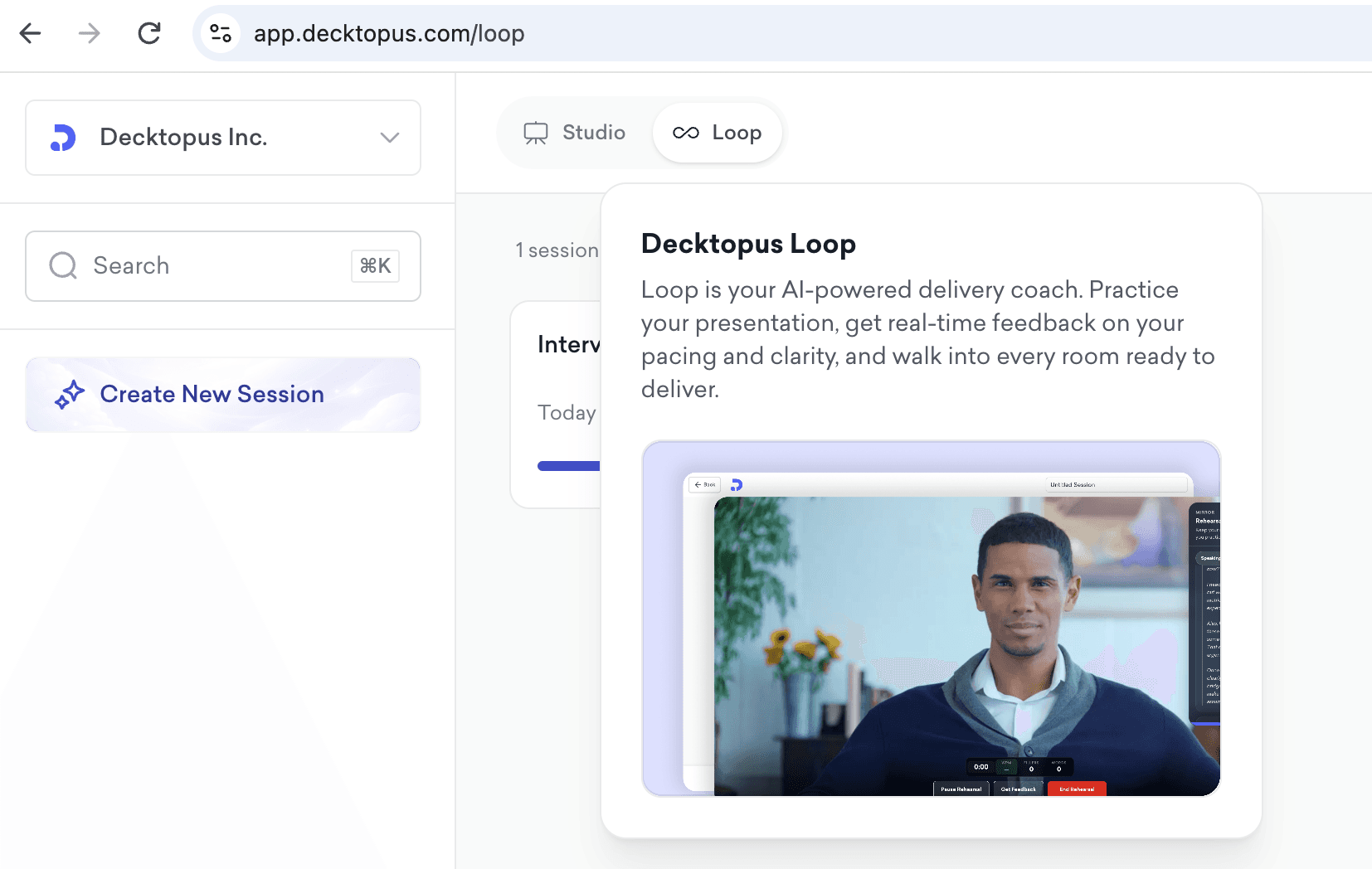
Practicing a pitch in front of a mirror teaches you nothing about how a real listener will react. The mirror doesn't interrupt. Doesn't ask "how are you different from X?" Doesn't check their phone when your energy drops. For a full breakdown of solo practice methods and why mirrors fail, see our guide on how to practice public speaking alone.
Loop AI Delivery Coach is Decktopus AI's built-in rehearsal environment. Four AI agents simulate the real pitch moment before you deliver it live.
The 4 Loop Agents
Profiler (Emily) simulates your exact listener. Pitching a Series B VC? Emily reacts like a skeptical VC. Pitching a hiring manager at a Series A fintech? Her responses mirror that role. You rehearse for the exact room, not a generic one.
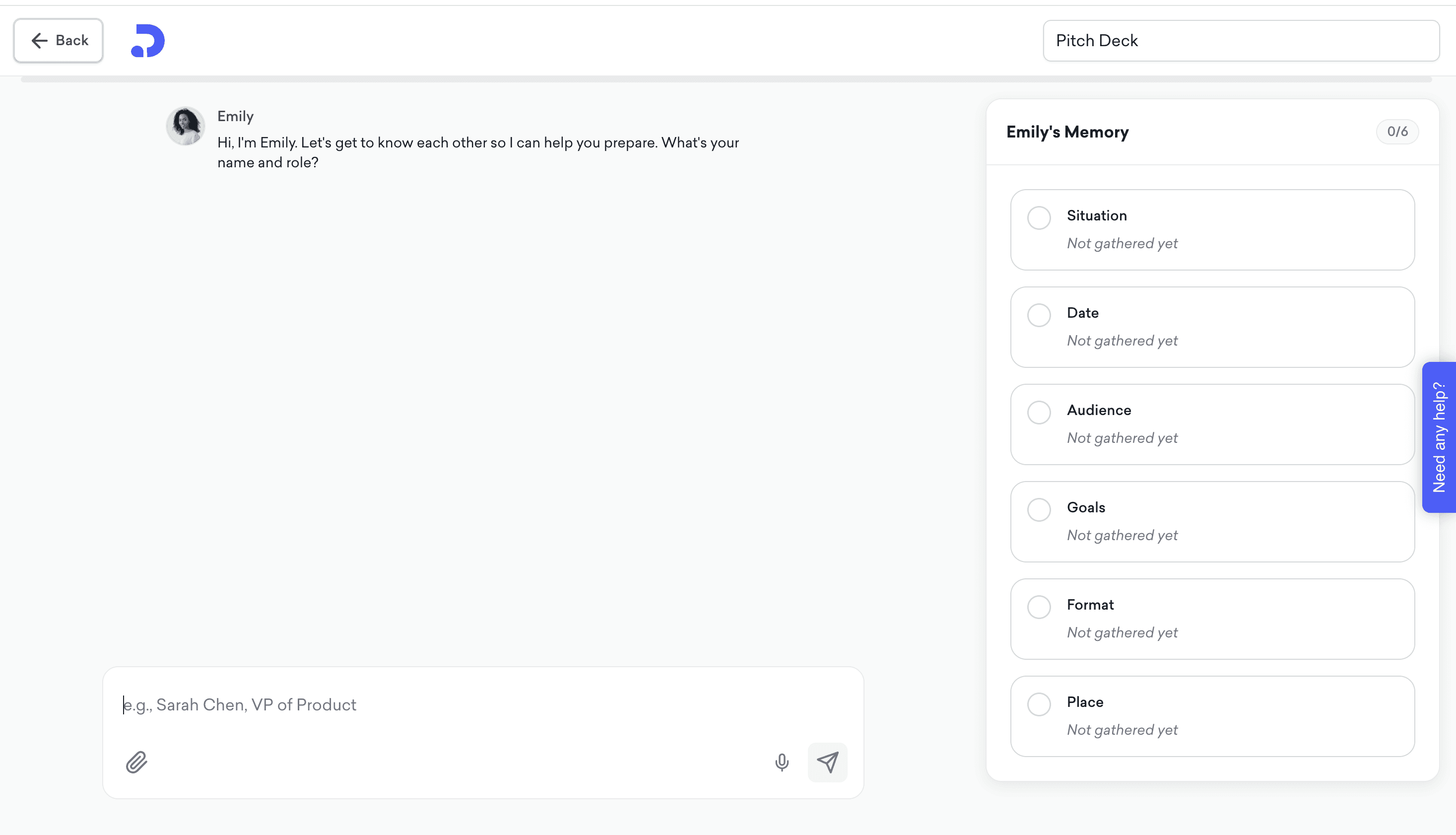
Architect (Marcus) scores your pitch structure in delivery. Flags when your hook takes too long, when your traction line is buried, when your ask is vague.
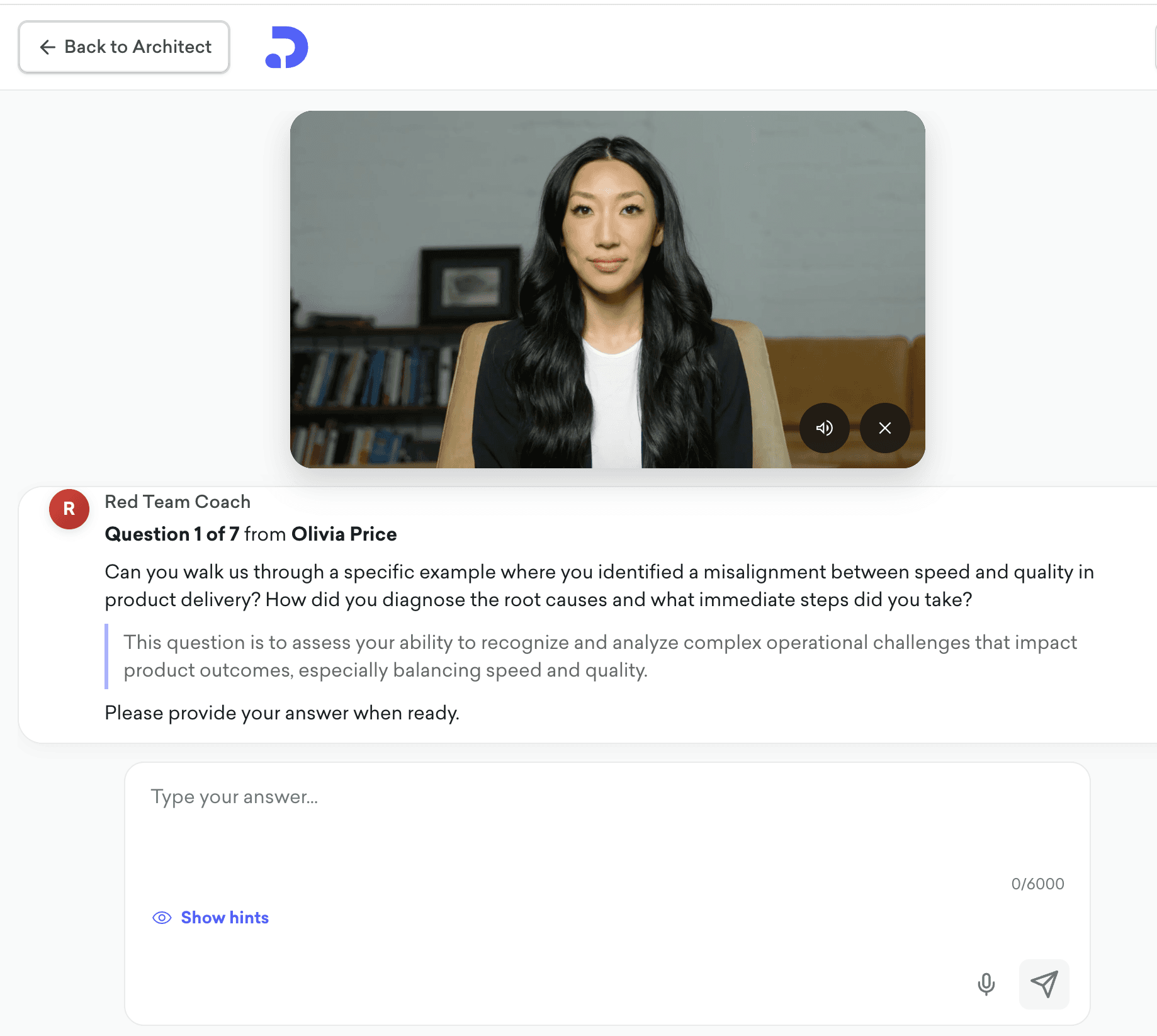
Red Team fires the follow-up questions that sink unprepared pitches. "What's your CAC?" "How is this different from Competitor X?" "Why should I meet with you specifically?" Facing these in rehearsal turns them into routine answers.
Mirror records your delivery and plays it back with metrics: filler count, pace per minute, pause length, tone variance. You hear yourself the way the listener hears you.
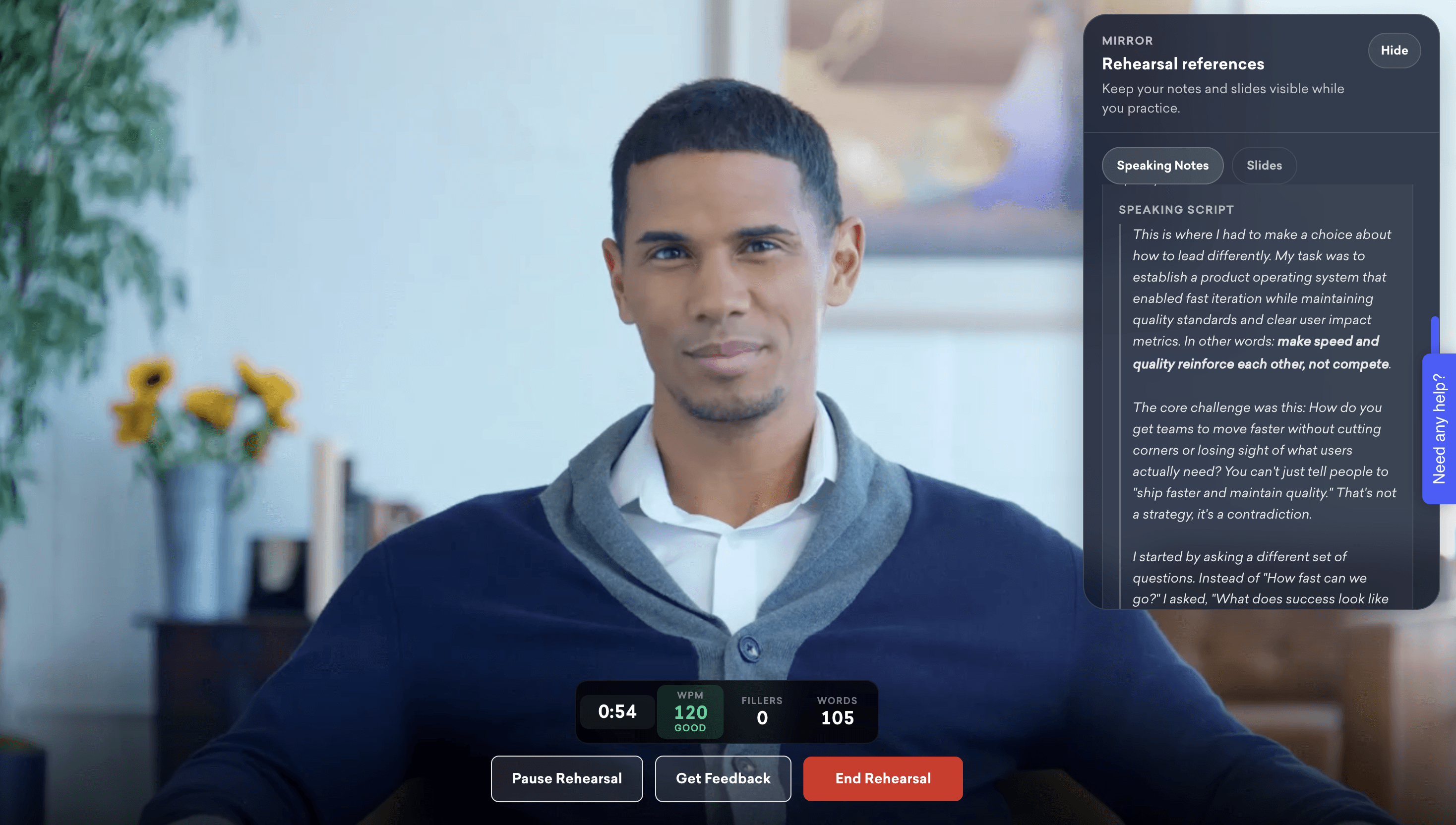
Loop Workflow for Elevator Pitch Practice
Draft your 30-60 second pitch in Decktopus AI
Open Loop and describe your listener (VC, buyer, recruiter)
Deliver the pitch, Emily reacts in real time
Face Red Team's follow-ups until answers feel automatic
Review Mirror playback and cut filler
Repeat until the pitch lands cold under pressure
Most founders and job seekers run 3-5 Loop sessions before a high-stakes pitch. It replaces weeks of unstructured self-rehearsal with structured, agent-driven feedback.
Practice your elevator pitch with Loop AI Delivery Coach →
Pre-Pitch Checklist (5 Minutes Before You Go)
Opening line memorized cold
Specific ask ready with a suggested time
Water within reach if you can
Two deep breaths before the first word
Phone silenced
One friendly face picked in the room, anchor eye contact there for the first 10 seconds
Frequently Asked Questions
How long should an elevator pitch be?
30 to 60 seconds. Shorter is stronger. If you cannot deliver your pitch in 60 seconds, the pitch itself is too complex, not just the delivery.
What is the biggest elevator pitch delivery mistake?
Starting with "Hi, I'm..." Openings should hook the listener with the problem or the value, not with your name. Introduce yourself once you have their attention.
How do I stop being nervous before an elevator pitch?
Reframe nervousness as excitement. Both produce identical physical symptoms. Alison Wood Brooks' 2014 Harvard research shows the reframe measurably improves performance. Also: rehearse out loud, not in your head.
Should I memorize my elevator pitch word for word?
Memorize the opening sentence, the value line, and the ask. Everything else should be spoken naturally. A fully memorized pitch sounds robotic and collapses if you get thrown off.
How many times should I practice an elevator pitch?
Enough that the opening and the ask are automatic. Most founders and job seekers hit this after 10-15 out-loud reps, or 3-5 Loop rehearsal sessions.
How do I handle interruptions during a pitch?
Acknowledge the question briefly, answer if it is short, defer if it will take you off-script, and return to the pitch. Never let an interruption end your pitch prematurely.
What's the strongest way to open an elevator pitch?
A specific problem statement in the listener's language, or a surprising data point that quantifies the pain. "Small law firms lose 8 billable hours a week to chasing invoices" beats "We help law firms get paid faster."
How do I close an elevator pitch?
With a specific ask that names the next step and a suggested time. "Can we do 15 minutes on Thursday?" beats "Let me know if you're interested." The listener should not have to figure out what to do next.
Can I use an elevator pitch in an email?
The written version and the spoken version are different. Written can be tighter and more scannable. Spoken needs pace and pauses. Do not just copy-paste your written pitch into a conversation.
How do I practice an elevator pitch alone?
Not in front of a mirror, that trains the wrong feedback. Record yourself, count filler words, watch your pace. Or use Loop AI Delivery Coach, which simulates a listener and gives structured feedback.
What is the biggest sign of a strong pitcher?
Vocal variety. Weak pitchers deliver in monotone. Strong pitchers slow down on key insights, speed up on transitions, and pause deliberately after the value line.
Should I include a slide with my elevator pitch?
If you have one, keep it to a single strong visual, not a full deck. The pitch is the vocal performance, the slide is a backup singer.
How do I handle a pitch that goes long?
Cut before you deliver, not during. If you are running long in the moment, jump to your ask. Never rush the ending to hit a time limit.
How do I improve my pitch if I do not pitch often?
Rehearse pitches you will never deliver. Pick a topic, write a 30-second version, run it through Loop. The skill compounds with reps, not with waiting for the next real opportunity.
Related posts

How to Improve Communication Skills at Work (2026 Practical Guide)
The 5 workplace communication skills that matter most, the CLEAR framework, and the AI practice method that turns weak communicators into strong ones.
Business & Strategy

Job Interview Sample Questions: How to Practice Your Answers (2026)
The 20 most common interview questions, the STAR framework for answers, and the AI practice method that turns rehearsed responses into confident ones.
Business & Strategy

How to Negotiate a Raise: The Script, Practice Method & Tips That Actually Work
A step-by-step script for negotiating a raise, common mistakes to avoid, and the AI practice method that turns a nervous ask into a confident one.
Business & Strategy