Presentations
Webinar Follow-Up Emails: The Sequence That Runs After the Deck Ends
Learn how to build a webinar follow-up email sequence with behavioral segmentation, timely emails, better deliverability, and personalized outreach.


Decktopus Content Team
You spent two weeks on the deck and about nine minutes on the emails that come after it.
The webinar ends, a thank-you note goes out the next morning with a recording link, and the replies trickle in at a rate that makes you wonder why you bothered. Some of it bounced. Nobody can say whether the copy was weak or the delivery failed, because nobody checked. That is the average webinar follow-up email sequence, and it wastes the most concentrated hour of attention you will get all quarter.
Attendance isn't the measure either. Replies and meetings booked are. Forty attendees and six meetings beat 300 attendees and none, and if you're reporting the first number upward, you're reporting the wrong one.
What follows is the sequence that works instead. Who gets what, when it goes out, and whether any of it lands at all.
Decktopus already made the case that the last slide is a conversion slide rather than a farewell. Same argument, four days later, in the inbox.
Split the list before you write anything
Segmenting into attendees and no-shows is where most teams stop. Go a level deeper, because a webinar produces five groups, and they want five different things.
Who they are | What they did | What the email does |
|---|---|---|
Stayed to the end | Highest intent in the room | Ask for the meeting |
Dropped early | Interested, then lost | Send the part they missed, timestamped |
Registered, no-show | Intent with nothing behind it | Recording, one line on what they missed |
Asked a question in Q&A | Told you exactly what they care about | Answer that question personally |
Dead or junk address | Never received anything | Not a copy problem. See below. |
Contrast's benchmark data, drawn from over a million registrants, found that engagement starts declining around the 22-minute mark. The drop-early group isn't an edge case, then. In a 45-minute session, it's a real slice of everyone who showed up, and most teams send them the same recap they send the people who stayed to the end.
No-shows deserve better treatment than they usually get, too. The same Contrast dataset found that more than four in ten webinar views happen on-demand rather than live. The replay is a primary channel, not a consolation prize for people who let you down.
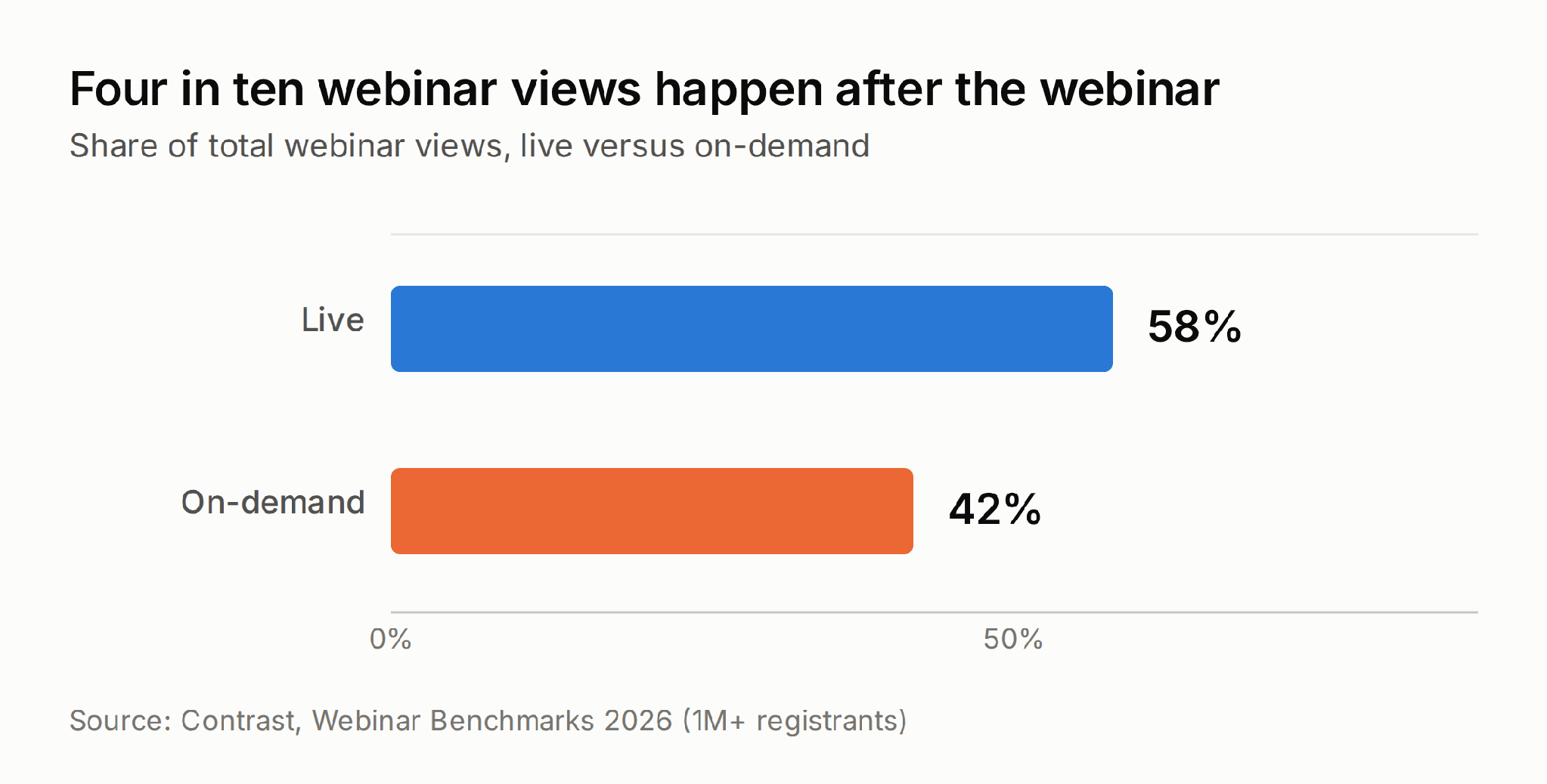
Alt text: Bar chart showing 42% of webinar views happen on-demand versus 58% live
If you only add one email to your current sequence, make it the Q&A one. Somebody typed a question into a box during a live session. That isn't a lead score you inferred from a click; it's a person telling you what they care about in their own words. Answering it individually takes ten minutes and gets the highest reply rate of anything you'll send. Almost nobody does it.
One honest caveat. If your platform export doesn't tell you who dropped early, use two segments instead of three and don't invent the data. A fake segment is worse than a coarse one.
The four-day sequence
Commit to real intervals. "Follow up promptly" is useless advice when you're staring at a Tuesday afternoon with a CSV open.
Send one goes to everyone within two hours. Recording link, almost nothing else. Send two reaches attendees the next morning with one takeaway and one ask tied to what they watched. Send three hits no-shows that same morning, built around what they missed rather than an apology. Send four lands on day three for the Q&A askers, with a real answer, from a human address rather than the marketing domain. Send five goes out on day four or five to anyone who didn't open send two, either as a resend with a new subject line or as a handoff to sales.
Five emails feels like a lot until you look at what one email gets you. In Hunter's analysis of 31 million emails sent in 2025, sequences using three messages instead of one lifted total replies by 106%, from 3.3% to 6.8%. Past three, the returns flatten out, which is worth knowing before somebody proposes eight.
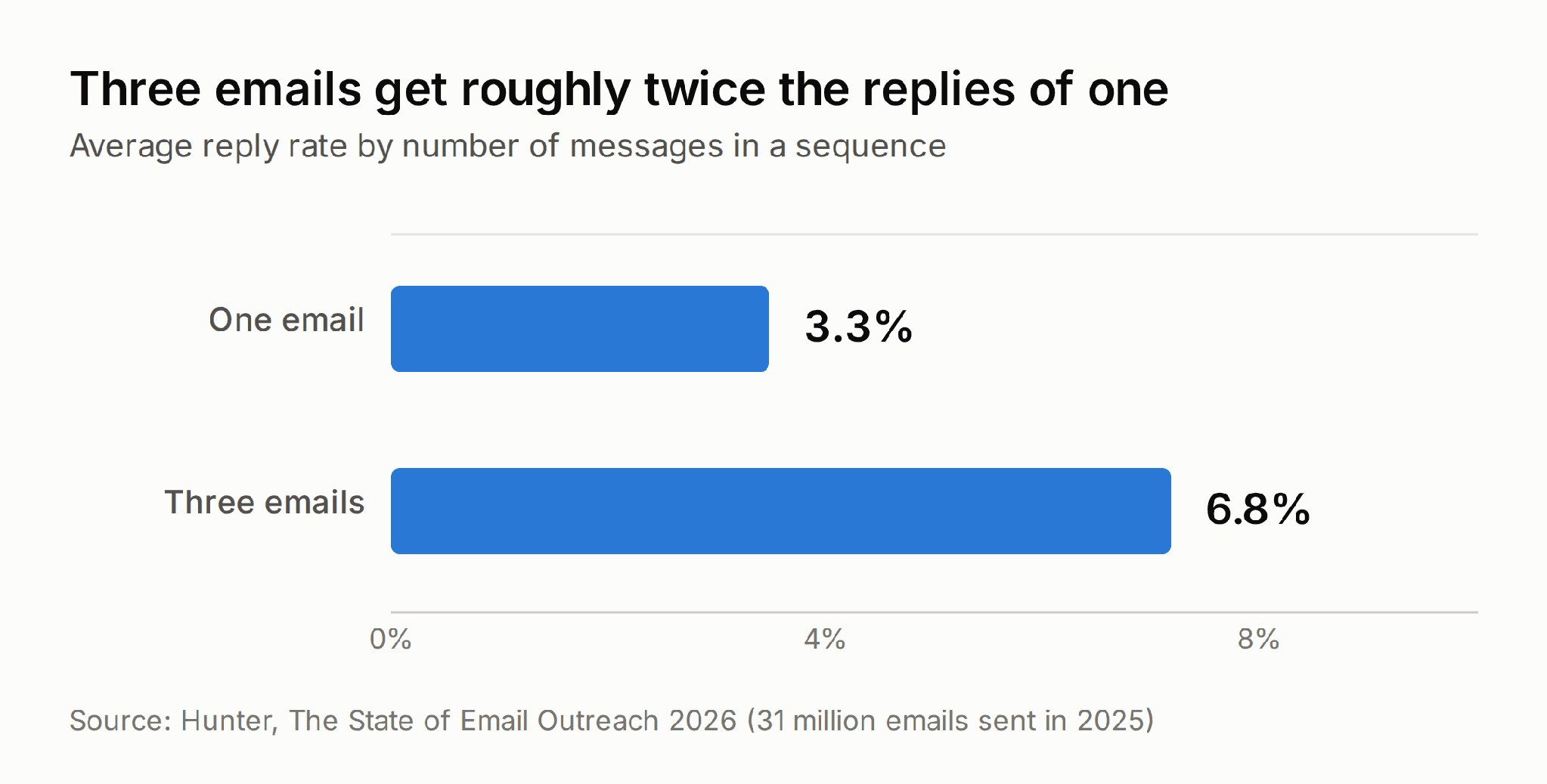
Alt text: Bar chart showing three-email sequences achieve 6.8% reply rate versus 3.3% for a single email
Two rules I'd hold to. Send one goes while the session is still in short-term memory, and a day of delay costs you more than mediocre copy does. And the no-show email is not an apology. They didn't do anything wrong by not turning up, and "sorry we missed you" makes the whole thing sound like a guilt trip for skipping a sales call.
Make sure the sequence actually lands
A webinar list is the worst list your team touches all quarter.
People type it into a registration form themselves, mostly to get the recording. It arrives full of typos, throwaway addresses, and personal Gmail accounts. Then that same list takes a reminder sequence before the event and a follow-up sequence after it. Seven or eight automated sends to unverified addresses inside two weeks, going out from the same domain everything else goes out from.
That's how one webinar quietly wrecks deliverability for the campaigns that follow it. Your sending reputation is the score mailbox providers keep on your domain, built from how recipients react to your mail over time. Google asks bulk senders to keep spam rates below 0.3% in Postmaster Tools. A messy webinar list is one of the faster ways to find out where you sit against that number.
So before the sequence runs:
Export the registrant list and actually look at it. Ninety seconds of scanning catches the obvious junk. The throwaway addresses, the person who typed theirs with a space in the middle.
Verify it. This is the step everyone skips. It takes one upload to verify email addresses in bulk, and anything that doesn't come back valid comes straight out of the list.
Check the sending domain, not just the list. A clean list still bounces when SPF, DKIM, or DMARC are misconfigured, and Google requires all three from bulk senders. You can check email deliverability for your domain in about a minute. Do it before a high-volume send rather than after.
Suppress the bad addresses rather than deleting them. Keep the record, stop the sending. You'll want to know later that the address existed.
Re-verify anything older than 30 days. Replay nurture usually runs weeks after the event, against a list that has aged since you cleaned it.
Steps 2 and 3 get conflated constantly. Verification tells you the address exists. Deliverability tells you whether your domain can reach it. A webinar sequence needs both, because it's high volume, fully automated, and pointed at people who have never had mail from you before.
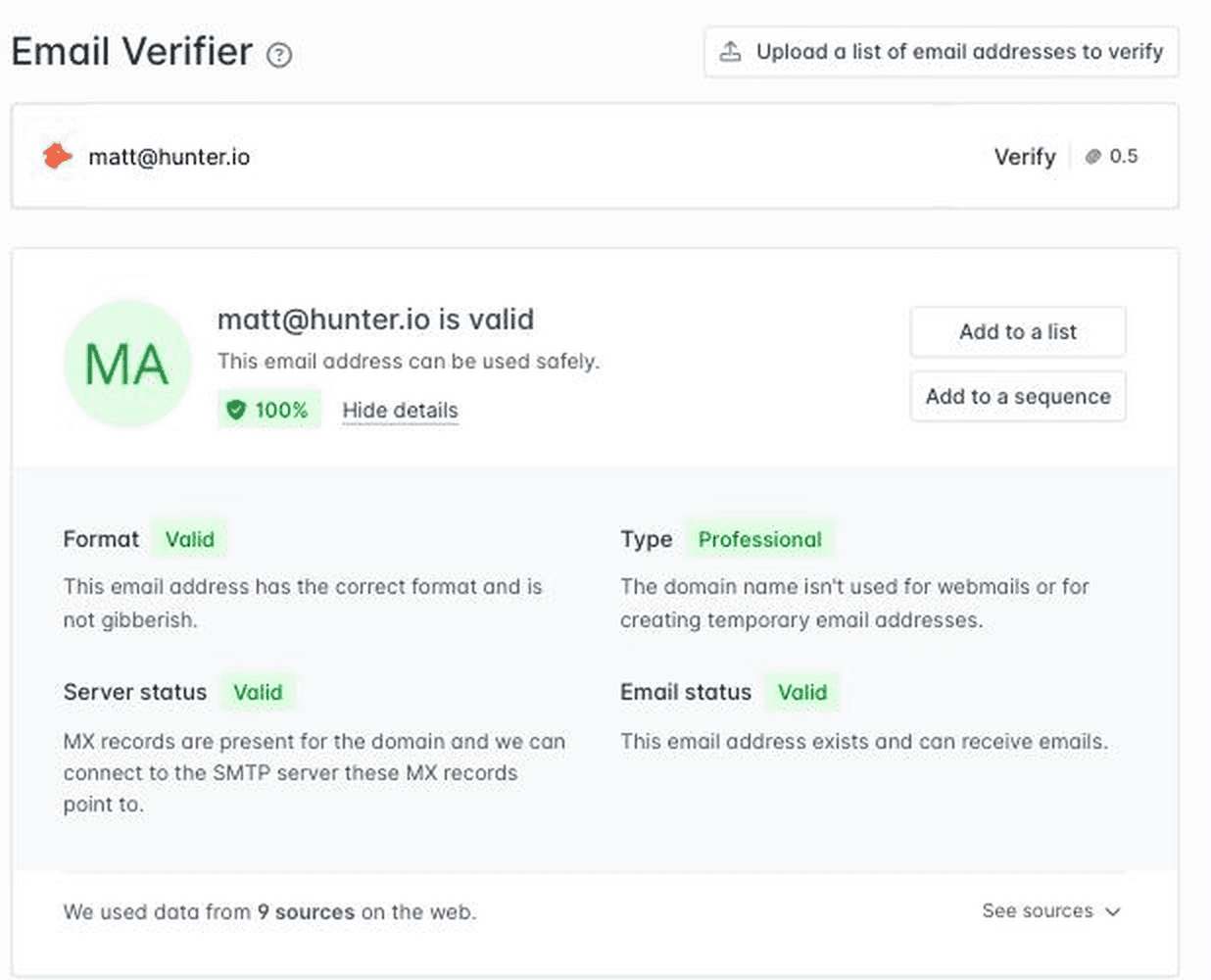
Alt text: Hunter Email Verifier result showing format, type, server status, and email status all returning valid
The attendee is rarely the person who signs
The person with a free hour to sit through a webinar often isn't the person who approves the purchase. Treat the attendee as your lead, and you're pitching an audience of one inside an account that decides as a group.
Gartner's 2025 survey of 632 B2B buyers found buying groups ranging from five to 16 people across as many as four functions. One of those five to 16 came to your webinar. A follow-up that only reaches them is asking one person to internally sell something they watched once to a group the same survey found in unhealthy conflict 74% of the time.
The method I use is boring, and it works.
Pull the account list out of the registrant export by email domain. Three registrations from one company is a signal worth acting on, and it's already sitting in the CSV.
Decide which two roles at that account belong in the conversation before you look anyone up. Do it in the other order, and you'll email whoever was easiest to find, which is usually a junior marketer or a generic inbox.
Then find those people. This is where it stalls, because the registration form handed you exactly one name. Hunter's Domain Search will find company email addresses from the domain already sitting in the registration email, and the useful part isn't the addresses so much as the job titles beside them. Filter by department and you reach the two roles you picked without guessing.
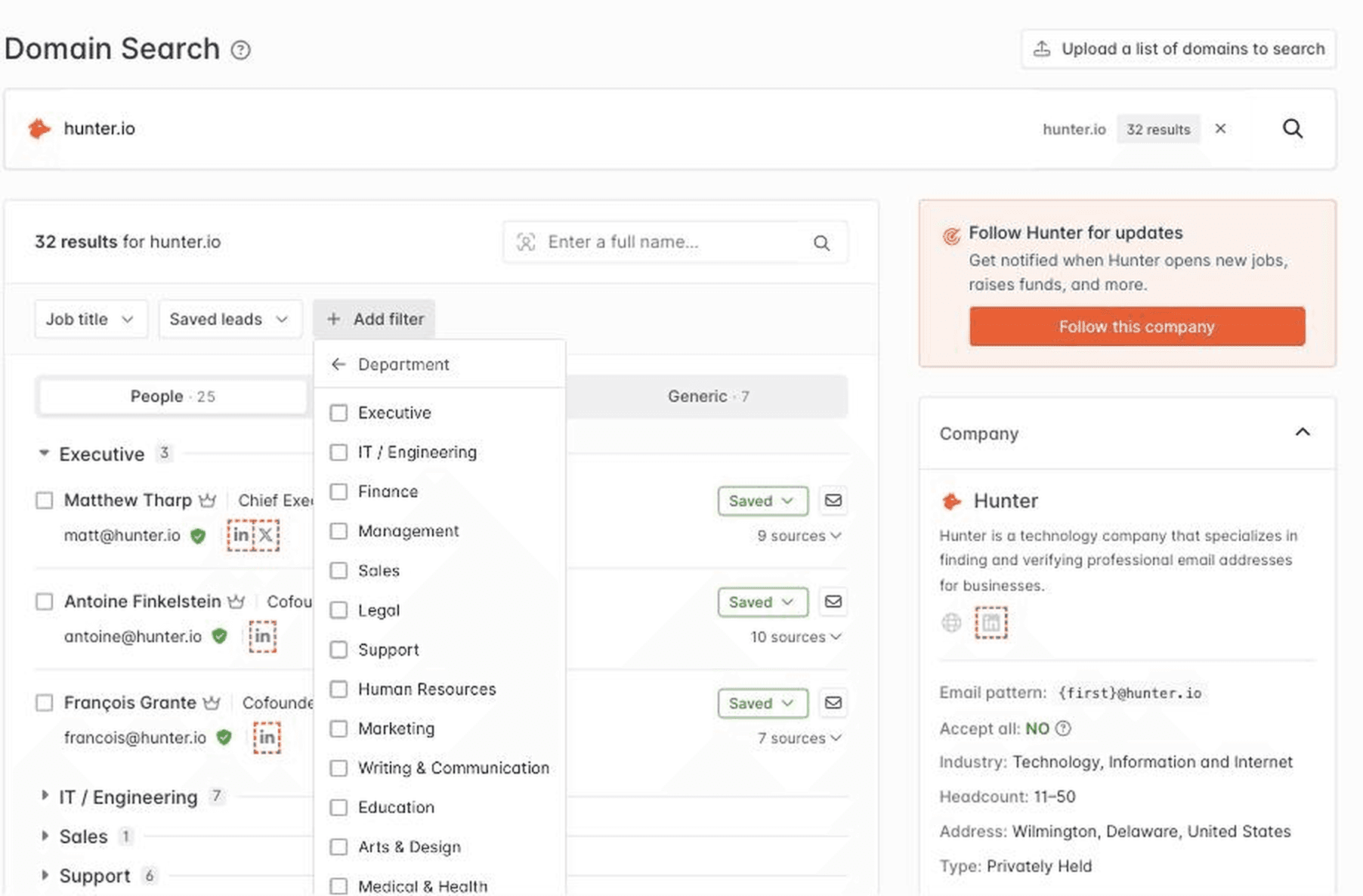
Alt text: Hunter Domain Search results grouped by department with the department filter list open, showing names, job titles, and verified addresses
Send them something different from the attendee follow-up. One line on why a colleague attended, one line on what it covered, one ask. Don't send a stranger the recording of a 45-minute session and expect them to watch it.
And give the attendee something forwardable. A one-page summary does more internal selling than a recording link ever will, because it survives being pasted into Slack. This is where the deck you built for the webinar earns its second life, and pulling one summary slide out of it is about twenty minutes of work.
Three templates worth stealing
You don't need ten templates. You need one per segment that matters, short enough that people actually use them.
Attendee who stayed to the end. Subject: The [specific thing] question from today. Two sentences on the point they stayed for, then the meeting ask with a specific reason to take it. Under 80 words.
No-show. Subject: What you missed on [topic]. The replay link and one concrete thing from the session, not a summary of all of it. Give them a reason to click that isn't guilt.
The third one barely qualifies as a template. For the person who asked a question in Q&A, put their question in the subject line and then answer it, properly, at whatever length the answer needs. No takeaway, no replay link, no ask. It's the only genuinely personal email in the sequence, and it's the one that gets replies, which is exactly why a template can't do much of the work for you.
Keep the first two under 90 words where you can. Long templates don't get used. They get skimmed, then rewritten badly at 5 pm.
Where to start before your next webinar
Export the registrant list on the day, while the session is fresh, and split it by behaviour before you write a single line of copy. That's the whole change. Everything else here follows from having five lists instead of one.
The verification pass takes about ten minutes, and it's the most valuable ten minutes in the process, because every other improvement you make assumes the email arrived.
Meta description: How to build a webinar follow-up email sequence that segments by behaviour, lands in the inbox, and reaches the people who weren't in the room.
Related posts

Best TED Talks to Improve Your Presentation Skills
Watch ten of the best TED talks for presentation skills and use a practical exercise from each to improve structure, voice, visuals, and confidence.
Presentations

Decktopus AI Best Practices: The Complete Guide, Tips and Tricks (2026)
A complete guide to using Decktopus AI effectively, from writing better prompts and reviewing outlines to rehearsing with Loop and building carousels.
Presentations
What Makes Slides Look Professional in 2026
Learn the 10 slide design principles top presenters follow, common presentation design mistakes to avoid, and how to apply every principle to your slides in minutes with AI
Presentations