Marketing
How AI Voice Agents Help Sales Teams Prepare and Deliver Better Presentations
Learn how AI voice agents help sales teams turn call insights into focused slides, stronger delivery, and more confident customer presentations at every stage.


İlayda Tunaboylu
A sales representative can have several useful conversations with a prospect and still struggle when it is time to build the presentation. Notes sit in the CRM, call summaries appear in different documents, and important objections are easy to miss.
The result is often a polished deck that does not match the buyer’s real concerns.
AI voice agents can help close this gap. They capture information during sales conversations, identify patterns, and give teams clearer context before the presentation begins. When these insights are combined with an AI presentation platform such as Decktopus AI, sales teams can move from scattered call data to a focused, customer-specific story.
This process does more than save time. It helps representatives understand what to say, what to show, and how to deliver the message with confidence.
Why Strong Sales Presentations Start Before Slide Creation
Many teams treat presentation preparation as a design task. A representative opens an old deck, changes the prospect’s name, updates a few numbers, and sends the presentation to a manager for review.
The slides may look professional, but the message can still feel generic.
A useful sales presentation starts with customer understanding. The team needs to know what triggered the buyer’s interest, which problems have the highest priority, who influences the decision, and what concerns may delay the next step.
These details usually appear during calls. A prospect may mention that reporting takes too long, adoption is low, leadership wants faster results, and the current process creates extra work. Each comment can shape the presentation.
Without a clear system for capturing this information, the representative may focus on product features instead of the buyer’s situation. AI voice agents give teams a more structured way to collect conversation context and carry it into the presentation process.
How AI Voice Agents Help Sales Teams Prepare Better Presentations
Sales calls often involve the same routine tasks, such as asking basic questions, noting down contact details, and booking the next meeting. An ai voice agent can take care of much of this work. It speaks with callers, listens to their answers, and saves useful details for the sales team. When a conversation needs personal attention, it can pass the caller to a sales representative. This gives the representative more context before the next discussion and reduces the time spent updating CRM records.
This context becomes valuable when a representative starts preparing a presentation.
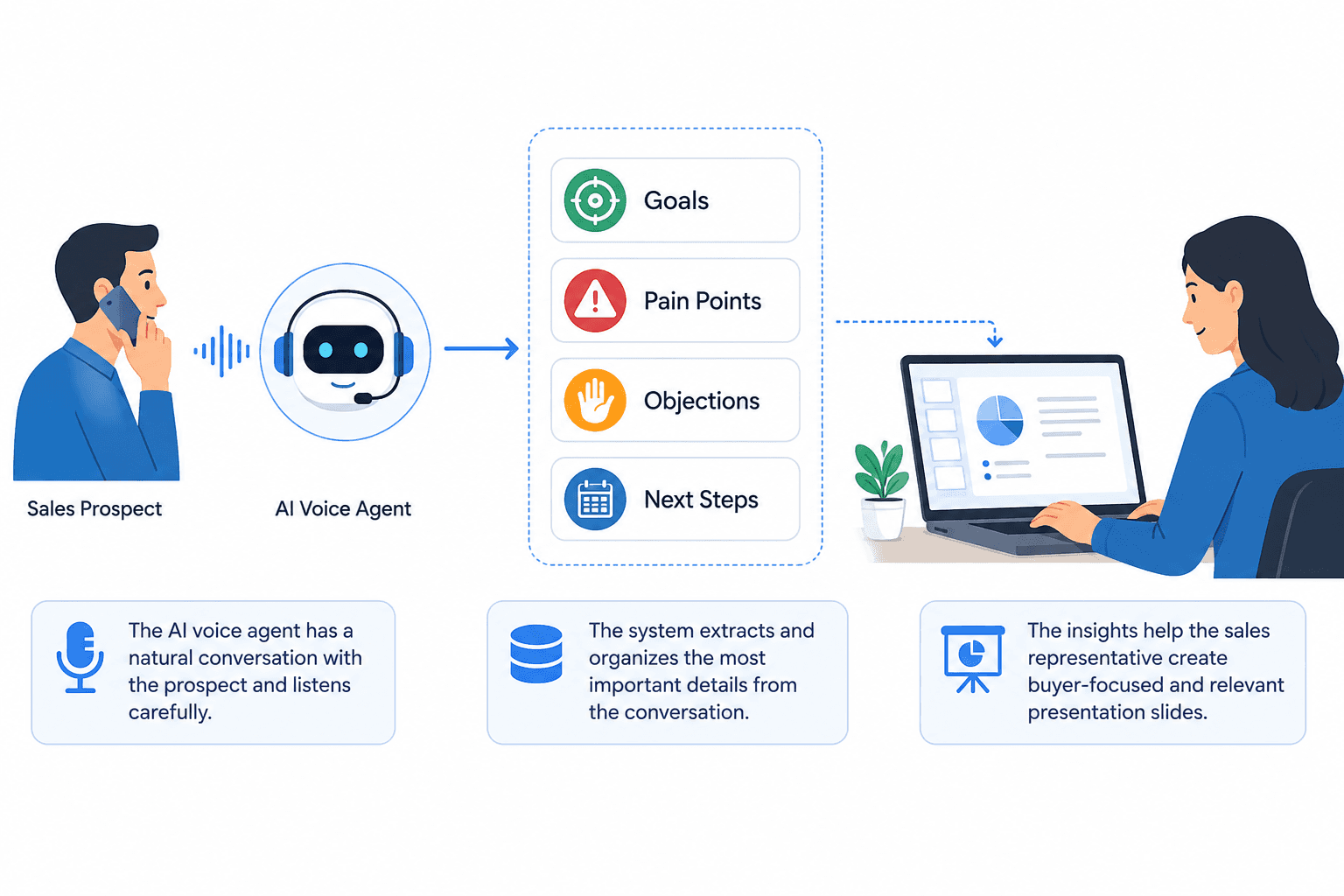
A sales representative does not have to remember every detail from past calls. They can look back at the notes and see which problems came up more than once, what the buyer still wants to know, and which results matter most to them.
AI voice agents can support presentation preparation by helping teams:
Before the rep starts working on the slides, it helps to look back at what the buyer actually said. A deadline may have come up. The buyer may also have concerns about cost, setup, security, and getting the team on board.
An AI voice agent can pull these details into the call notes. It can also show which concerns came up more than once. This saves the rep from searching through every recording.
The buyer’s own words matter too. Using familiar language in the presentation can make the message feel more personal and less like a standard sales pitch.
Update CRM fields and call summaries so representatives can find important information without reviewing every recording.
Route high-value prospects to human representatives with enough context to prepare a useful follow-up presentation.
This does not mean every sentence from a call should appear on a slide. The goal is to separate useful signals from background information.
For example, a prospect may ask ten questions during an early qualification call. Eight questions may concern basic features. Two questions may focus on integration time and management approval. Those final two questions can have the greatest impact on the deal, so they deserve more attention in the presentation.
Turning Voice Insights Into a Clear Presentation Story
Call data becomes useful only when the team turns it into a clear narrative.
Most buyers do not want a long story. They want to know that you understood the problem. Start there. Talk about how the issue affects their team, then show where your product fits. The last slide should make the next step clear.
AI voice insights help sales teams decide which information belongs in each part of that story.
The process can follow five practical steps:
Read through the conversation and mark the points that matter most. Pay attention to the buyer’s goals, problems, questions, and signs of interest.
Decide what the meeting should achieve. Keep one result in mind, such as approval for a trial, a pricing discussion, and agreement on the next step.
Put similar comments together. Notes about time, cost, team workload, customer experience, and setup can each become a separate part of the presentation.
Add proof where it helps. A case study, product example, workflow, and approved result can make the message easier to trust.
End with one clear action. Ask the buyer to book a technical review, begin a pilot, then confirm the plan.
This structure keeps the deck focused. It also prevents the representative from adding slides simply because they appeared in an older company template.
Putting the Presentation Together
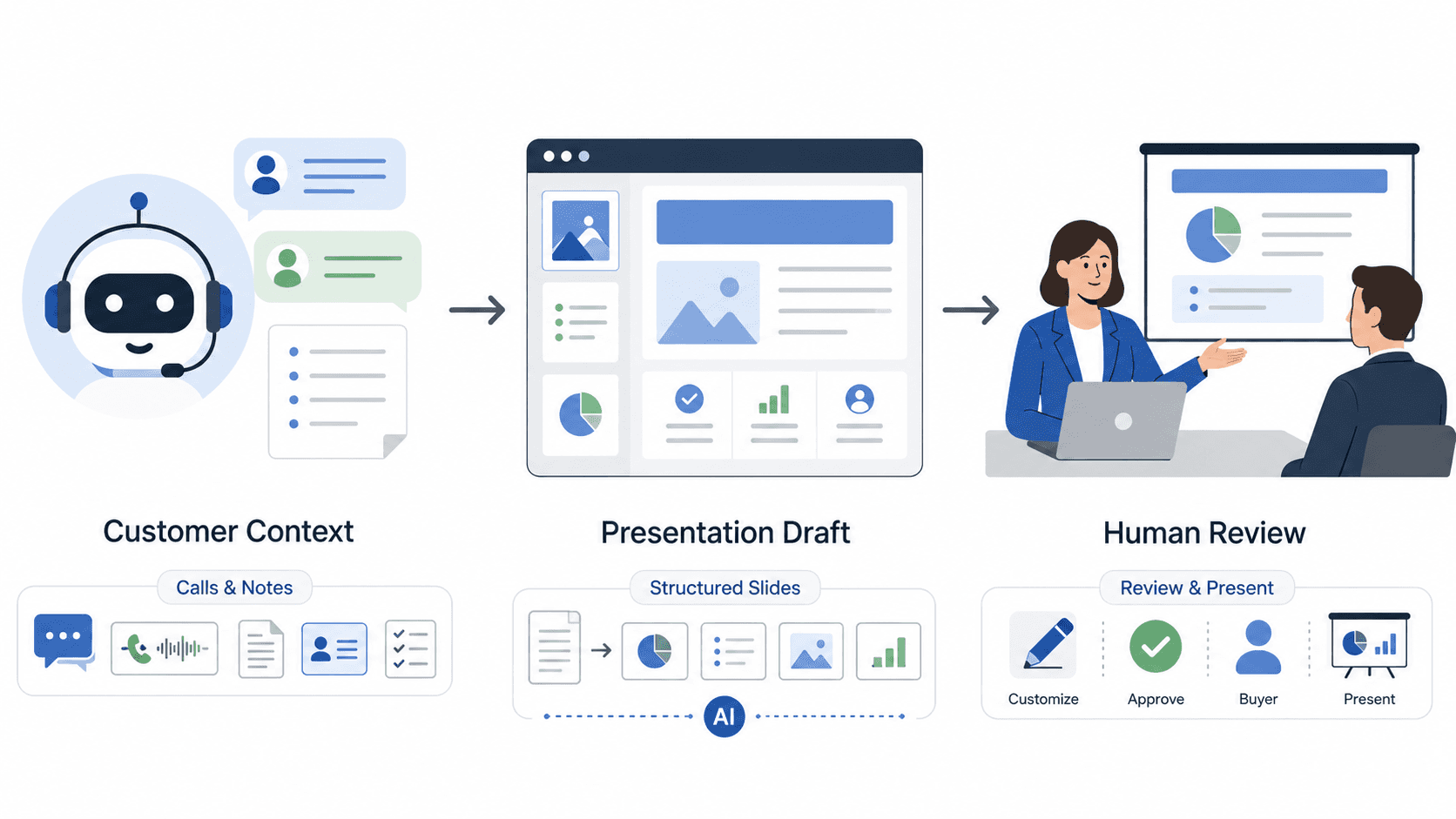
Once the rep knows what the buyer cares about, the slides are easier to plan. Call notes and useful files can be added to a sales presentation tool to create the first version of the deck.
The tool can prepare the slide text, images, and layout. It can also use the company’s logo, colors, and fonts. The rep can then go through each slide, change anything that feels too general, and practice the presentation before meeting the buyer.
The generated deck then becomes a strong starting point. The representative can review the message, remove unnecessary details, add approved proof, and adjust the flow for the people attending the meeting.
This combination creates a useful workflow:
AI voice agents collect and organize customer context. Decktopus AI turns that context into a clear visual story. The sales representative adds judgment, experience, and personal understanding.
Brand consistency also matters. When several representatives create their own decks, fonts, colors, logos, and tone can quickly become inconsistent. Decktopus AI supports brand settings that help teams apply company colors, fonts, logos, and visual styles across presentations.
That gives sales managers more control while allowing representatives to personalize the message.
Using AI Voice Insights to Improve Presentation Delivery
A strong deck cannot compensate for weak delivery. These persuasive presentation tips can help reps explain their ideas clearly and keep the meeting focused on the buyer. AI voice insights also make practice easier because the rep already knows which topics may come up.
Before the meeting, the representative can practice answers to the objections captured during earlier calls. The presentation can include natural transitions into those topics instead of waiting for the buyer to raise them.
A simple rehearsal checklist can include:
Explain the buyer’s main challenge in plain language without reading directly from the slide.
Connect every major feature to a specific outcome mentioned during earlier conversations.
Prepare a clear answer for the three most likely objections.
Remove slides that do not support the meeting’s main goal.
Practice the final request so the next step sounds direct and reasonable.
Making Presentations More Relevant During the Meeting
Customer context should influence delivery even after the presentation begins.
A representative may learn that the finance leader cares about cost control while the operations leader cares about workflow speed. Both people are viewing the same deck, but they need different explanations.
The representative can connect each slide to the person most affected by the topic. A financial impact slide can focus on wasted resources and expected value. An implementation slide can focus on workload, adoption, and responsibility.
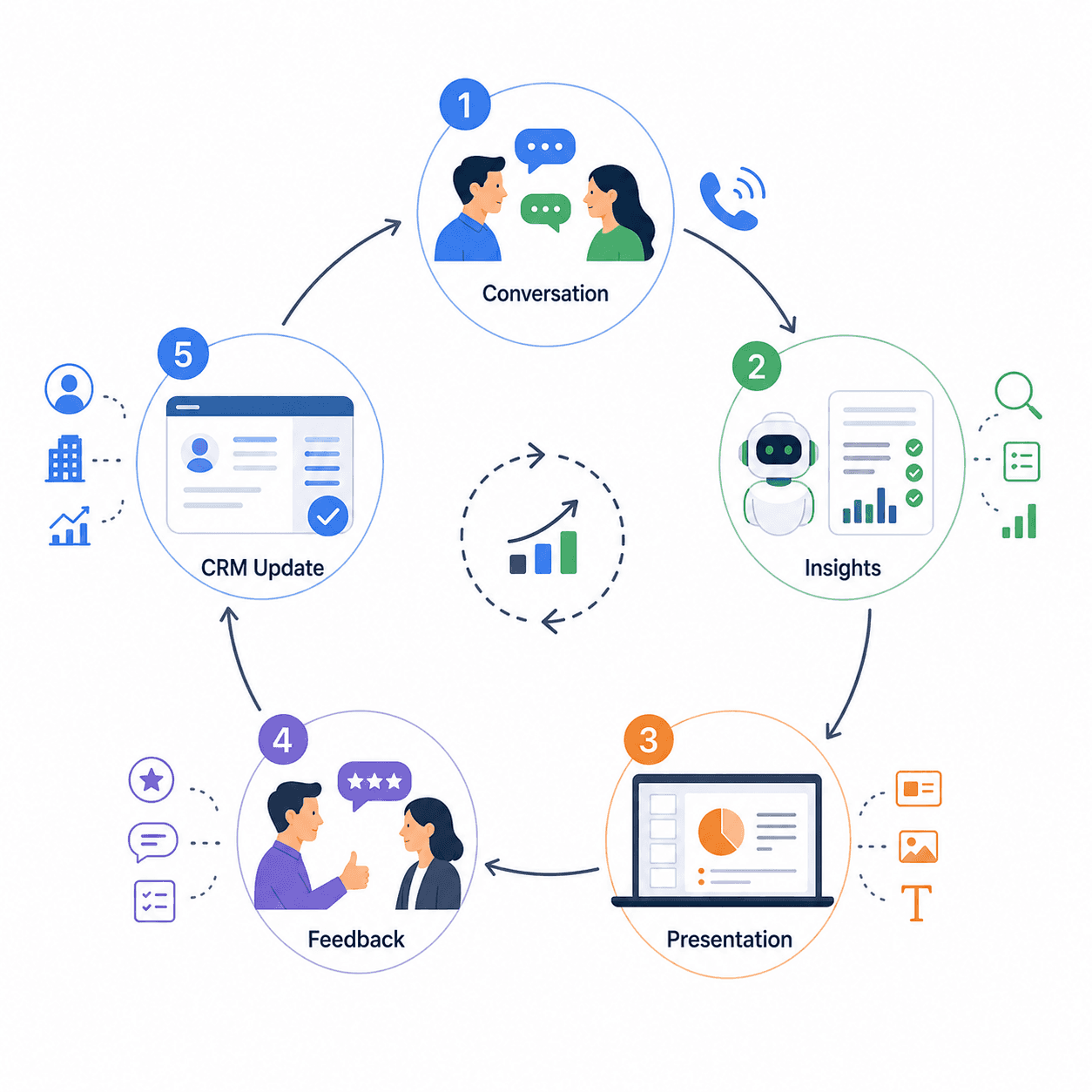
AI voice agents can also support follow-up after the meeting. They can help manage scheduled calls, collect additional information, and keep CRM records updated. The sales representative can then use the new context to refine the next presentation.
This creates a continuous improvement loop. Every conversation produces new insight. Every presentation becomes more focused. Every follow-up starts with better context.
Keeping Human Judgment at the Center
AI tools can organize information and speed up preparation, but they should not make every sales decision.
Call summaries may miss emotional signals. A prospect may describe a problem calmly while still considering it urgent. An automated system may also give too much importance to a repeated topic that has little impact on the final decision.
Sales representatives need to review AI-generated insights, confirm important details, and decide what belongs in the presentation.
Human judgment is especially important when discussing pricing, legal commitments, security requirements, sensitive customer data, and promises about future results.
Teams should also define clear rules for data access, call consent, approved knowledge sources, CRM updates, and human handoffs. These controls help the technology support the sales process without creating unnecessary risk.
The best approach is a partnership. AI handles repetitive information work. Sales professionals handle trust, strategy, negotiation, and complex decisions.
Conclusion
Better sales presentations begin with better customer understanding.
AI voice agents help teams capture buying intent, pain points, objections, and conversation context before a representative starts building slides. Decktopus AI can then turn that context into a structured, branded presentation while supporting rehearsal and delivery improvement.
Together, these tools reduce manual preparation and help representatives focus on the message that matters most to the buyer.
The final presentation still needs a human point of view. When sales professionals combine AI-generated insights with careful review and thoughtful delivery, they can create presentations that feel more relevant, confident, and useful.
Related posts

Instagram Carousel Size & Dimensions Guide (2026)
Instagram carousel size in 2026: exact dimensions for square, portrait, and landscape, plus file limits and safe zones, verified across sources.
Marketing

LinkedIn Carousel Size, Dimensions & Format Guide 2026
LinkedIn carousel size in 2026: exact dimensions, file limits, aspect ratios, and formatting rules so your slides never get cropped.
Marketing

Best AI Carousel Makers in 2026 (Tested & Compared)
The best AI carousel maker for 2026, compared by AI approach, platforms, and pricing. Find the right tool for LinkedIn and Instagram carousels.
Marketing